2007 SUBARU OUTBACK lights
[x] Cancel search: lightsPage 315 of 442

8-28Driving tips
speed. You should also keep the
following tips in mind:
! Before starting out on a trip
. Check that the vehicle and vehicle-to-
hitch mounting are in good condition. If
any problems are apparent, do not tow the
trailer. . Check that the vehicle sits horizontally
with the trailer attached. If the vehicle is
tipped sharply up at the front and down at
the rear, check the total trailer weight,
GVW, GAWs and tongue load again, then
confirm that the load and its distribution
are acceptable. . Check that the tire pressures are
correct.. Check that the vehicle and trailer are
connected properly. Confirm that
–the trailer tongue is connected
properly to the hitch ball. – the trailer lights connector is con-
nected properly and trailer ’s brake
lights illuminate when the vehicle ’s
brake pedal is pressed, and that the trailer ’s turn signal lights flash when
the vehicle ’s turn signal lever is oper-
ated. – the safety chains are connected
properly.– all cargo in the trailer is secured safety in position.–
the side mirrors provide a good
rearward field of view without a sig-
nificant blind spot.
. Sufficient time should be taken to learn
the “feel ”of the vehicle/trailer combination
before starting out on a trip. In an area free
of traffic, practice turning, stopping and
backing up. ! Driving with a trailer
. You should allow for considerably more
stopping distance when towing a trailer.
Avoid sudden braking because it may
result in skidding or jackknifing and loss ofcontrol. . Avoid abrupt starts and sudden accel-
erations. If your vehicle has a manual
transmission, always start out in first gear
and release the clutch at moderate enginerevolution. . Avoid uneven steering, sharp turns and
rapid lane changes. . Slow down before turning. Make a
longer than normal turning radius because
the trailer wheels will be closer than the
vehicle wheels to the inside of the turn. In
a tight turn, the trailer could hit yourvehicle. . Crosswinds will adversely affect the
handling of your vehicle and trailer, caus-
ing sway. Crosswinds can be due to weather conditions or the passing of large
trucks or buses. If swaying occurs, firmly
grip the steering wheel and slow down
immediately but gradually. .
When passing other vehicles, consid-
erable distance is required because of the
added weight and length caused by
attaching the trailer to your vehicle.
1) Left turn
2) Right turn
. Backing up with a trailer is difficult and
takes practice. When backing up with a
trailer, never accelerate or steer rapidly.
When turning back, grip the bottom of the
steering wheel with one hand and turn it to
the left for a left turn, and turn it to the right
for a right turn. . If the ABS warning light illuminates
while the vehicle is in motion, stop towing
Page 316 of 442

the trailer and have repairs performed
immediately by the nearest SUBARU
dealer. !Driving on grades
. Before going down a steep hill, slow
down and shift into lower gear (if neces-
sary, use 1st gear) in order to utilize the
engine braking effect and prevent over-
heating of your vehicle ’s brakes. Do not
make sudden downshifts. . When driving uphill in hot weather, the
air conditioner may turn off automatically
to protect the engine from overheating. . When driving uphill in hot weather, pay
attention to the water temperature gauge
pointer (for all vehicles) and AT OIL TEMP
warning light (for AT vehicles) since the
engine and transmission are relatively
prone to overheating under these condi-
tions. If the water temperature gauge
pointer approaches the OVERHEAT zone
or the AT OIL TEMP warning light illumi-
nates, immediately switch off the air
conditioner and stop the vehicle at the
nearest safe place. Refer to the “Engine
overheating ”section in chapter 9, and
“ Warning and indicator lights ”section in
chapter 3. NOTE
With AT vehicles, the temperature of engine coolant is less likely to rise to
the OVERHEAT zone in the
“D ” posi-
tion than in the manual mode position. . If your vehicle has an automatic trans-
mission, avoid using the accelerator pedal
to stay stationary on an uphill slope
instead of using the parking brake or foot
brake. That may cause the transmission
fluid to overheat. ! Parking on a grade
Always block the wheels under both
vehicle and trailer when parking. Apply
the parking brake firmly. You should not
park on a hill or slope. But if parking on a
hill or slope cannot be avoided, you
should take the following steps:
1. Apply the brakes and hold the pedal down.
2. Have someone place wheel blocks
under both the vehicle and trailer wheels.
3. When the wheel blocks are in place,
release the regular brakes slowly until the
blocks absorb the load.
4. Apply the regular brakes and then
apply the parking brake; slowly release
the regular brakes.
5. Shift into 1st or reverse gear (manual
transmission) or “P ” (automatic transmis-
sion) and shut off the engine. Driving tips
8-29
Page 327 of 442
9-10In case of emergency
Jump starting
WARNING
. Battery fluid is SULFURIC ACID.
Do not let it come in contact with
the eyes, skin, clothing or thevehicle.
If battery fluid gets on you,
thoroughly flush the exposed
area with water immediately. Get
medical help if the fluid has
entered your eyes.
If battery fluid is accidentally
swallowed, immediately drink a
large amount of milk or water,
and obtain immediate medicalhelp.
Keep everyone including chil-
dren away from the battery.
. The gas generated by a battery
explodes if a flame or spark is
brought near it. Do not smoke or
light a match while jump starting.
. Never attempt jump starting if the
discharged battery is frozen. It
could cause the battery to burst
or explode.
. Whenever working on or around
a battery, always wear suitable eye protectors, and remove metal
objects such as rings, bands or
other metal jewelry.
. Be sure the jumper cables and
clamps on them do not have
loose or missing insulation.
. Do not jump start unless cables
in suitable condition are avail-able.
. A running engine can be danger-
ous. Keep your fingers, hands,
clothing, hair and tools away
from the cooling fan, belts and
any other moving engine parts.
Removing rings, watches and
ties is advisable.
. Jump starting is dangerous if it is
done incorrectly. If you are un-
sure about the proper procedure
for jump starting, consult a com-
petent mechanic.
When your vehicle does not start due to a
run down (discharged) battery, the vehicle
may be jump started by connecting your
battery to another battery (called the
booster battery) with jumper cables. &
How to jump start
1. Make sure the booster battery is 12
volts and the negative terminal isgrounded.
2. If the booster battery is in another
vehicle, do not let the two vehicles touch.
3. Turn off all unnecessary lights and accessories.
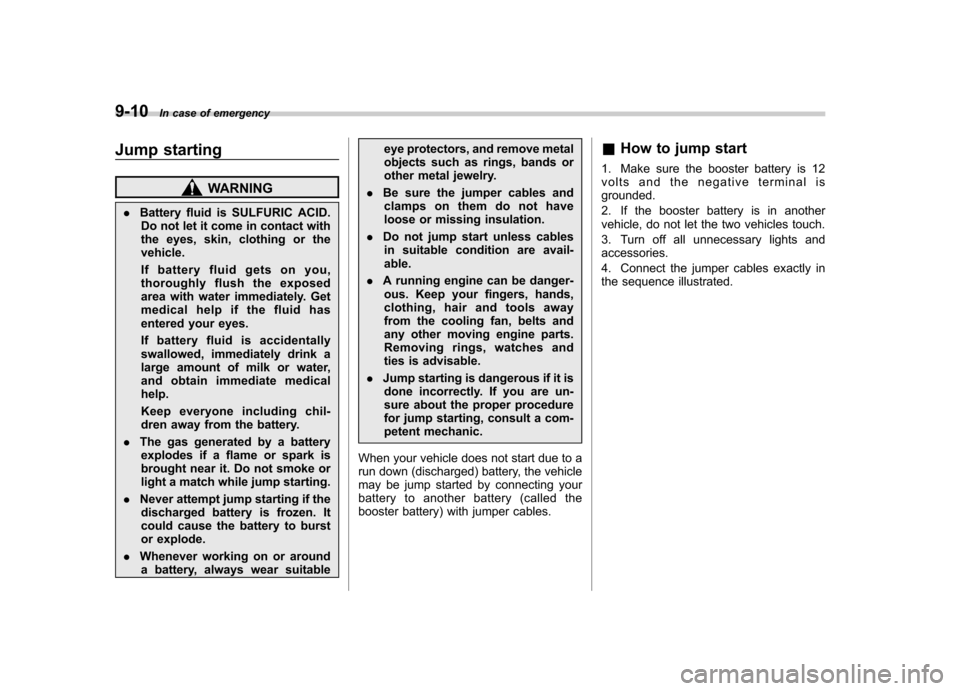
4. Connect the jumper cables exactly in
the sequence illustrated.
Page 345 of 442
Maintenance and serviceParking brake stroke ........................................ 11-33
Tires and wheels .............................................. 11-34
Types of tires ................................................... 11-34
Tire pressure monitoring system (TPMS) (if equipped) ................................................... 11-34
Tire inspection ................................................. 11-36
Tire pressures and wear ................................... 11-36
Wheel balance .................................................. 11-38
Wear indicators ................................................ 11-38
Tire rotation direction mark .............................. 11-39
Tire rotation ..................................................... 11-39
Tire replacement .............................................. 11-40
Wheel replacement ........................................... 11-40
Aluminum wheels ............................................. 11-41
Windshield washer fluid .................................. 11-41
Replacement of wiper blades .......................... 11-42
Windshield wiper blade assembly ..................... 11-43
Windshield wiper blade rubber ......................... 11-43
Rear window wiper blade assembly .................. 11-44
Rear window wiper blade rubber ....................... 11-45Battery
.............................................................. 11-46
Fuses ................................................................ 11-47
Main fuse .......................................................... 11-49
Installation of accessories .............................. 11-49
Replacing bulbs ............................................... 11-50
Headlight ......................................................... 11-51
Parking light .................................................... 11-53
Front turn signal light ...................................... 11-53
Front fog light (if equipped) .............................. 11-53
Rear combination lights ................................... 11-54
Backup light (Station wagon) ........................... 11-55
License plate light ........................................... 11-56
Dome light ....................................................... 11-56
Map light ......................................................... 11-57
Door step light ................................................. 11-57
Cargo area light (Station wagon) ... ................... 11-58
Trunk light (Sedan) .......................................... 11-58
High mount stop light (Sedan) .......................... 11-59
Page 391 of 442
11-48Maintenance and service
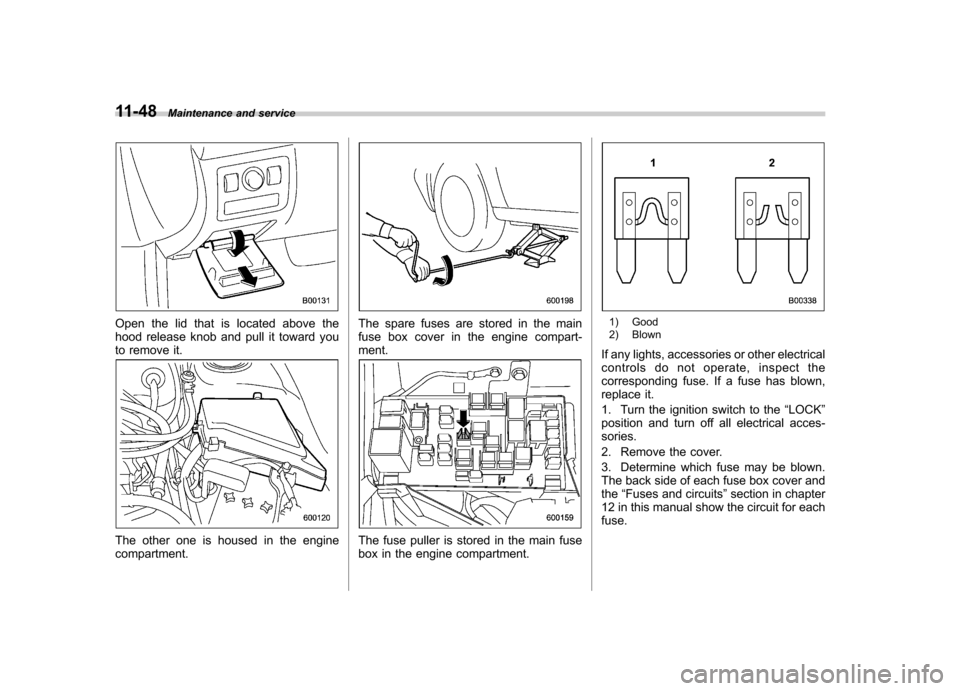
Open the lid that is located above the
hood release knob and pull it toward you
to remove it.
The other one is housed in the engine compartment.
The spare fuses are stored in the main
fuse box cover in the engine compart-ment.
The fuse puller is stored in the main fuse
box in the engine compartment.
1) Good
2) Blown
If any lights, accessories or other electrical
controls do not operate, inspect the
corresponding fuse. If a fuse has blown,
replace it.
1. Turn the ignition switch to the “LOCK ”
position and turn off all electrical acces- sories.
2. Remove the cover.
3. Determine which fuse may be blown.
The back side of each fuse box cover andthe “Fuses and circuits ”section in chapter
12 in this manual show the circuit for eachfuse.
Page 392 of 442
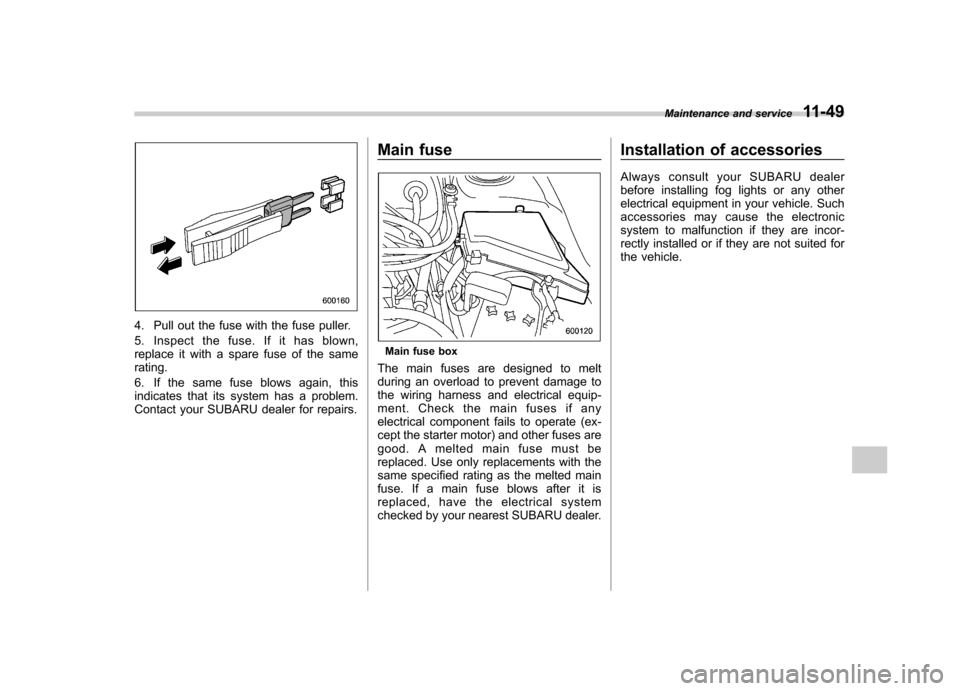
4. Pull out the fuse with the fuse puller.
5. Inspect the fuse. If it has blown,
replace it with a spare fuse of the samerating.
6. If the same fuse blows again, this
indicates that its system has a problem.
Contact your SUBARU dealer for repairs.Main fuse
Main fuse box
The main fuses are designed to melt
during an overload to prevent damage to
the wiring harness and electrical equip-
ment. Check the main fuses if any
electrical component fails to operate (ex-
cept the starter motor) and other fuses are
good. A melted main fuse must be
replaced. Use only replacements with the
same specified rating as the melted main
fuse. If a main fuse blows after it is
replaced, have the electrical system
checked by your nearest SUBARU dealer. Installation of accessories
Always consult your SUBARU dealer
before installing fog lights or any other
electrical equipment in your vehicle. Such
accessories may cause the electronic
system to malfunction if they are incor-
rectly installed or if they are not suited for
the vehicle.
Maintenance and service
11-49
Page 397 of 442

11-54Maintenance and service
& Rear combination lights
! Sedan
1. Push the knobs of the cover to open
the cover.
1) Rear turn signal light
2) Backup light
3) Brake/tail and rear side marker light
2. Remove the bulb holder from the rear
combination light assembly by turning itcounterclockwise.
3. Pull the bulb out of the bulb holder and
replace it with a new one.
4. Set the bulb holder into the rear
combination light assembly and turn it
clockwise until it locks.
5. Securely lock the cover against the
trunk trim by using the screwdriver to turn
the top knob clockwise. !
Station wagon
1. Using a Phillips screwdriver, remove
the upper and lower screws.
2. Wrap tape around a flat-head screw-
driver, then insert the screwdriver into the
gap A between the side cover and rear
Page 434 of 442

HeadlightFlasher ................................................................. 3-40
Indicator light ......................................................... 3-33
Headlights ........................................................ 3-39, 11-51
Heater operation .......................................................... 4-5
High beam indicator light ............................................ 3-33
High mount stop light ................................................. 11-59
High/low beam change (dimmer) .................................. 3-39
Horn ......................................................................... 3-52
Hose and connections ............................................... 11-14
I
Ignition switch .............................................................. 3-3
Light ....................................................................... 3-5
Illuminated entry .......................................................... 2-9
Illumination brightness control ...................................... 3-41
Immobilizer system. ...................................................... 2-3
Indicator light ......................................................... 3-31
Indicator light
Cruise control ........................................................ 3-33
Cruise control set ................................................... 3-33
Front fog ............................................................... 3-33
Headlight .............................................................. 3-33
High beam ............................................................ 3-33
Select lever/Gear position ....................................... 3-33
Selector lever position ............................................ 3-32
Shift-up ................................................................. 3-32
SPORT mode (AT vehicles) .................................... 3-32
S# PREP ................................................................ 3-7
Turn signal ............................................................ 3-33
Vehicle Dynamics Control OFF ................................ 3-31 Vehicle Dynamics Control operation
.......................... 3-30
Indicator lights
Vehicle Dynamics Control ................................ 7-39, 7-40
Information display ...................................................... 3-34
Inside mirror .............................................................. 3-48
Interior light ................................................................. 6-2
Internal trunk lid release handle .................................... 2-23
JJack. ......................................................................... 9-18
Jack handle ............................................................... 9-18
Jump starting ............................................................. 9-10
KKey Keyless entry system ............................................... 2-8
Number .................................................................. 2-2
Reminder chime ...................................................... 3-5
Replacement. .......................................................... 2-4
Keys .......................................................................... 2-2
L
Leather seat materials ................................................. 10-5
Light
Cargo area ............................................................. 6-2
Control switch ........................................................ 3-39
Dome ..................................................................... 6-2
Map ....................................................................... 6-2
Light control switch ..................................................... 3-39
Limited slip differential (LSD). ....................................... 7-33
Loading your vehicle ................................................... 8-13 Index
14-5