2007 SUBARU OUTBACK coolant
[x] Cancel search: coolantPage 357 of 442
11-14Maintenance and service
temperatures are not expected.
Never mix different kinds of cool-ant.
. Do not splash the engine coolant
over painted parts. The alcohol
contained in the engine coolant
may damage the paint surface.
& Hose and connections
Your vehicle employs an electric cooling
fan which is thermostatically controlled to
operate when the engine coolant reaches
a specific temperature.
If the radiator cooling fan does not operate
even when the engine coolant tempera-
ture gauge exceeds the normal operating
range, the cooling fan circuit may be
defective. Check the fuse and replace it
if necessary. If the fuse is not blown, have
the cooling system checked by your
SUBARU dealer.
If frequent addition of coolant is neces-
sary, there may be a leak in the engine
cooling system. It is recommended that
the cooling system and connections be
checked for leaks, damage, or looseness. &
Engine coolant
! Checking the coolant level
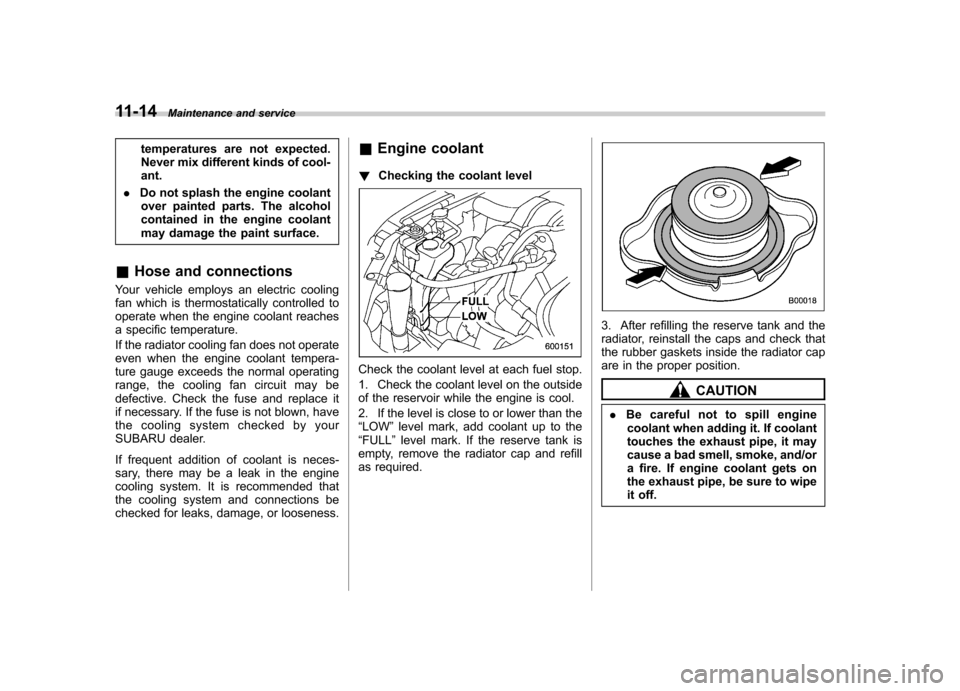
Check the coolant level at each fuel stop.
1. Check the coolant level on the outside
of the reservoir while the engine is cool.
2. If the level is close to or lower than the “LOW ”level mark, add coolant up to the
“ FULL ”level mark. If the reserve tank is
empty, remove the radiator cap and refill
as required.
3. After refilling the reserve tank and the
radiator, reinstall the caps and check that
the rubber gaskets inside the radiator cap
are in the proper position.
CAUTION
. Be careful not to spill engine
coolant when adding it. If coolant
touches the exhaust pipe, it may
cause a bad smell, smoke, and/or
a fire. If engine coolant gets on
the exhaust pipe, be sure to wipe
it off.
Page 358 of 442
.Do not splash the engine coolant
over painted parts. The alcohol
contained in the engine coolant
may damage the paint surface.
! Changing the coolant
Always add genuine Subaru cooling sys-
tem conditioner whenever the coolant isreplaced.
Change the engine coolant and add
genuine Subaru cooling system condi-
tioner using the following procedures
according to the maintenance schedule
in the “Warranty and Maintenance Book-
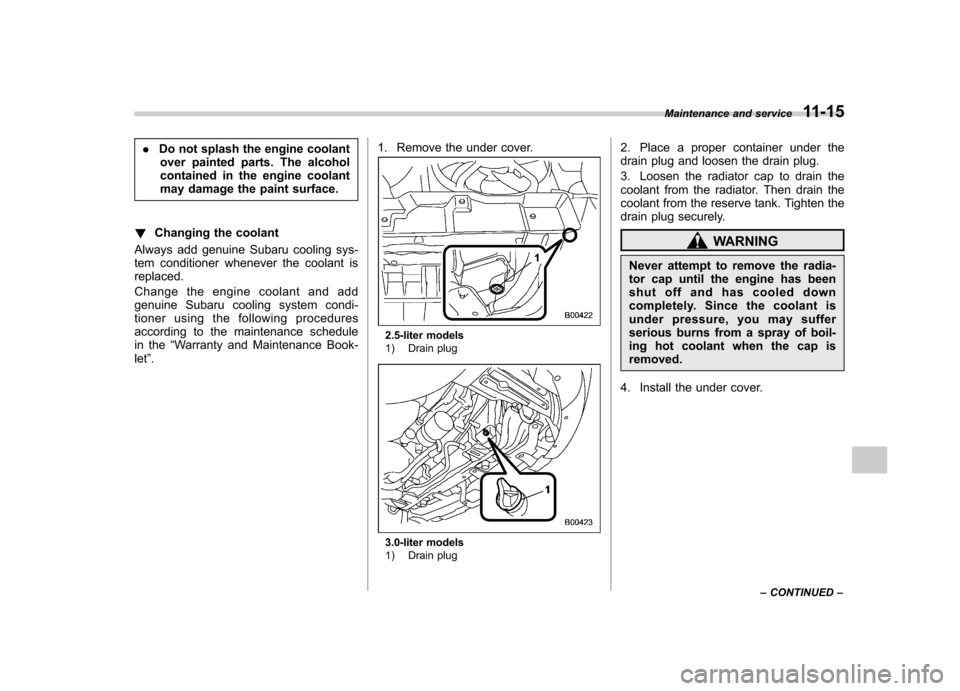
let ”. 1. Remove the under cover.
2.5-liter models
1) Drain plug
3.0-liter models
1) Drain plug 2. Place a proper container under the
drain plug and loosen the drain plug.
3. Loosen the radiator cap to drain the
coolant from the radiator. Then drain the
coolant from the reserve tank. Tighten the
drain plug securely.
WARNING
Never attempt to remove the radia-
tor cap until the engine has been
shut off and has cooled down
completely. Since the coolant is
under pressure, you may suffer
serious burns from a spray of boil-
ing hot coolant when the cap is removed.
4. Install the under cover. Maintenance and service
11-15
– CONTINUED –
Page 359 of 442
11-16Maintenance and service
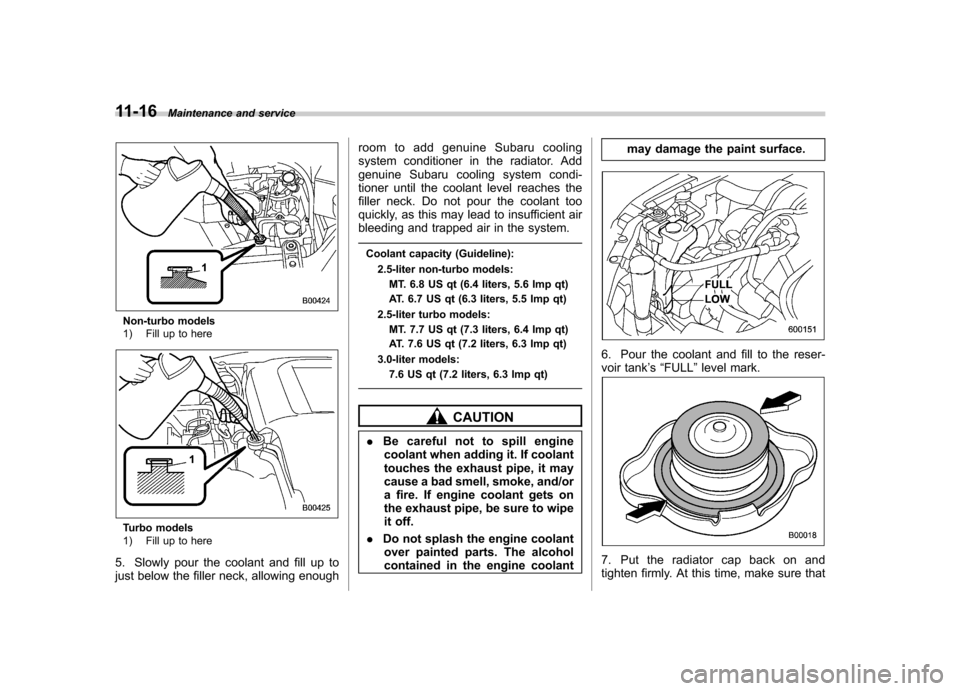
Non-turbo models
1) Fill up to here
Turbo models
1) Fill up to here
5. Slowly pour the coolant and fill up to
just below the filler neck, allowing enough room to add genuine Subaru cooling
system conditioner in the radiator. Add
genuine Subaru cooling system condi-
tioner until the coolant level reaches the
filler neck. Do not pour the coolant too
quickly, as this may lead to insufficient air
bleeding and trapped air in the system.
Coolant capacity (Guideline): 2.5-liter non-turbo models:MT. 6.8 US qt (6.4 liters, 5.6 Imp qt)
AT. 6.7 US qt (6.3 liters, 5.5 Imp qt)
2.5-liter turbo models: MT. 7.7 US qt (7.3 liters, 6.4 Imp qt)
AT. 7.6 US qt (7.2 liters, 6.3 Imp qt)
3.0-liter models: 7.6 US qt (7.2 liters, 6.3 Imp qt)
CAUTION
. Be careful not to spill engine
coolant when adding it. If coolant
touches the exhaust pipe, it may
cause a bad smell, smoke, and/or
a fire. If engine coolant gets on
the exhaust pipe, be sure to wipe
it off.
. Do not splash the engine coolant
over painted parts. The alcohol
contained in the engine coolant may damage the paint surface.
6. Pour the coolant and fill to the reser-
voir tank
’s “FULL ”level mark.
7. Put the radiator cap back on and
tighten firmly. At this time, make sure that
Page 360 of 442
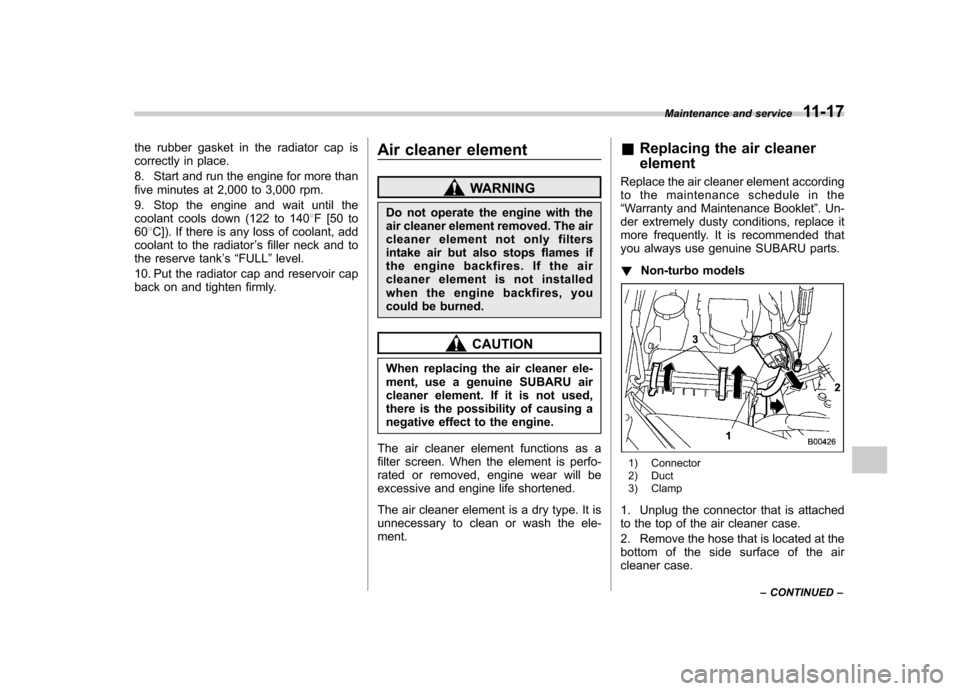
the rubber gasket in the radiator cap is
correctly in place.
8. Start and run the engine for more than
five minutes at 2,000 to 3,000 rpm.
9. Stop the engine and wait until the
coolant cools down (122 to 1408F [50 to
60 8C]). If there is any loss of coolant, add
coolant to the radiator ’s filler neck and to
the reserve tank ’s “FULL ”level.
10. Put the radiator cap and reservoir cap
back on and tighten firmly. Air cleaner element
WARNING
Do not operate the engine with the
air cleaner element removed. The air
cleaner element not only filters
intake air but also stops flames if
the engine backfires. If the air
cleaner element is not installed
when the engine backfires, you
could be burned.
CAUTION
When replacing the air cleaner ele-
ment, use a genuine SUBARU air
cleaner element. If it is not used,
there is the possibility of causing a
negative effect to the engine.
The air cleaner element functions as a
filter screen. When the element is perfo-
rated or removed, engine wear will be
excessive and engine life shortened.
The air cleaner element is a dry type. It is
unnecessary to clean or wash the ele-ment. &
Replacing the air cleaner element
Replace the air cleaner element according
to the maintenance schedule in the“ Warranty and Maintenance Booklet ”. Un-
der extremely dusty conditions, replace it
more frequently. It is recommended that
you always use genuine SUBARU parts. ! Non-turbo models
1) Connector
2) Duct
3) Clamp
1. Unplug the connector that is attached
to the top of the air cleaner case.
2. Remove the hose that is located at the
bottom of the side surface of the air
cleaner case. Maintenance and service
11-17
– CONTINUED –
Page 384 of 442
Aluminum wheels
Aluminum wheels can be scratched and
damaged easily. Handle them carefully to
maintain their appearance, performance,
and safety. .When any of the wheels is removed
and replaced for tire rotation or to change
a flat, always check the tightness of the
wheel nuts after driving approximately 600
miles (1,000 km). If any nut is loose,
tighten it to the specified torque. . Never apply oil to the threaded parts,
wheel nuts, or tapered surface of the wheel. . Never let the wheel rub against sharp
protrusions or curbs.. Be sure to fit tire chains on uniformly
and completely around the tire, otherwise
the chains may scratch the wheel. . When wheel nuts, balance weights, or
the center cap is replaced, be sure to
replace them with genuine SUBARU parts
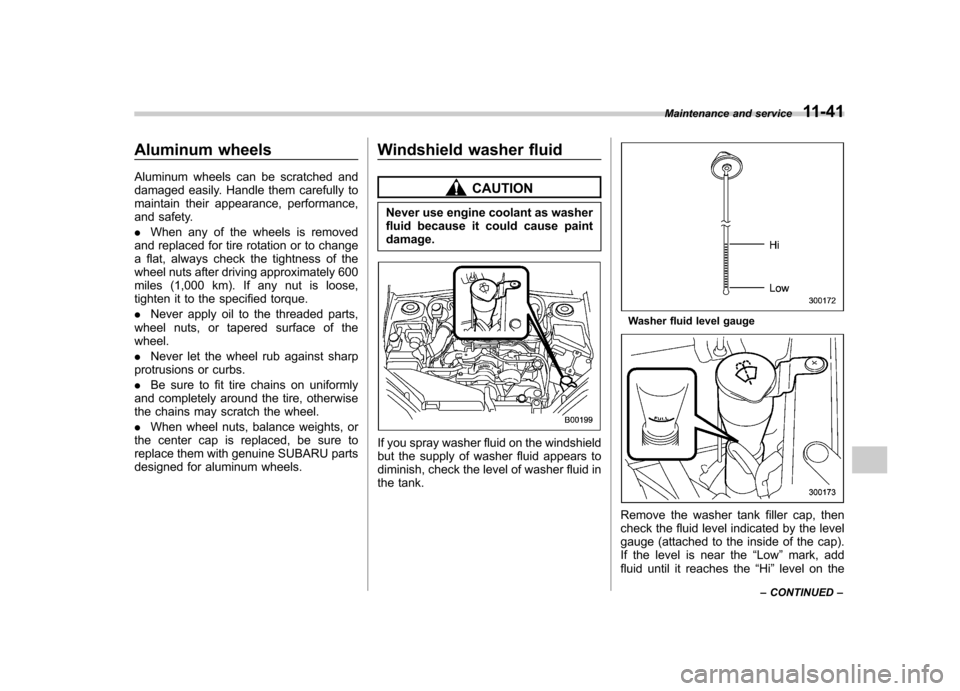
designed for aluminum wheels. Windshield washer fluid
CAUTION
Never use engine coolant as washer
fluid because it could cause paintdamage.
If you spray washer fluid on the windshield
but the supply of washer fluid appears to
diminish, check the level of washer fluid in
the tank.
Washer fluid level gauge
Remove the washer tank filler cap, then
check the fluid level indicated by the level
gauge (attached to the inside of the cap).
If the level is near the “Low ”mark, add
fluid until it reaches the “Hi ”level on the
Maintenance and service
11-41
– CONTINUED –
Page 407 of 442

12-4Specifications
&Capacities
Fuel tank 16.9 US gal (64 liters, 14.1 Imp gal)
Engine oil 2.5-liter models 4.2 US qt (4.0 liters, 3.5 Imp qt)
3.0-liter models 5.8 US qt (5.5 liters, 4.8 Imp qt)
Transmission oil (MT) 5-speeds 3.7 US qt (3.5 liters, 3.1 Imp qt)
6-speeds 4.3 US qt (4.1 liters, 3.6 Imp qt)
Transmission fluid (AT) 2.5-liter non-turbo models 9.8 US qt (9.3 liters, 8.2 Imp qt)
2.5-liter turbo and 3.0-liter models 10.4 US qt (9.8 liters, 8.6 Imp qt)
AT differential gear oil 2.5-liter non-turbo models 1.3 US qt (1.2 liters, 1.1 Imp qt)
2.5-liter turbo and 3.0-liter models 1.5 US qt (1.4 liters, 1.2 Imp qt)
Rear differential gear oil Turbo 6-speeds MT models 1.0 US qt (1.1 liter, 0.9 Imp qt)
Other models 0.8 US qt (0.8 liter, 0.7 Imp qt)
Power steering fluid 0.7 US qt (0.7 liter, 0.6 Imp qt)
Engine coolant 2.5-liter non-turbo models MT6.8 US qt (6.4 liters, 5.6 Imp qt)
AT 6.7 US qt (6.3 liters, 5.5 Imp qt)
2.5-liter turbo models MT 7.7 US qt (7.3 liters, 6.4 Imp qt)
AT 7.6 US qt (7.2 liters, 6.3 Imp qt)
3.0-liter models 7.6 US qt (7.2 liters, 6.3 Imp qt)
Page 422 of 442

an asymmetrical tire that has a
particular side that must always
face outward when mounting on a
vehicle.
. Accessory weight
The combined weight (in excess of
those standard items which may be
replaced) of floor mats, leather seats
and cross bars to the extent that these
items are available as factory-in-
stalled equipment (whether installed
or not). . Curb weight
The weight of a motor vehicle with
standard equipment including the
maximum capacity of fuel, oil, and
coolant and air conditioning. . Maximum loaded vehicle weight
The sum of curb weight, accessory
weight, vehicle capacity weight and
production options weight. . Normal occupant weight
150 lbs (68 kg) times the number of
occupants (3 occupants). . Occupant distribution
Distribution of occupants in a vehicle,
2 in front, 1 in rear seat. . Production options weight The combined weight of those in-
stalled regular production options
weighing over 5.1 lbs (2.3 kg) in
excess of those standards items
which they replace, not previously
considered in curb weight or acces-
sory weight. .
Vehicle capacity weight
The total weight of cargo, luggage
and occupants that can be added to
the vehicle. . Vehicle maximum load on a tire
Load on an individual tire that is
determined by distributing to each
axle its share of the maximum loaded
vehicle weight and dividing by two. . Vehicle normal load on a tire
Load on an individual tire that is
determined by distributing to each
axle its share of the curb weight,
accessory weight, and normal occu-
pant weight and dividing by two. & Tire care –maintenance and
safety practices
. Check on a daily basis that the tires
are free from serious damage, nails,
and stones. At the same time, check
the tires for abnormal wear. .
Inspect the tire tread regularly and
replace the tires before their tread
wear indicators become visible. When
a tire ’s tread wear indicator becomes
visible, the tire is worn beyond the
acceptable limit and must be replaced
immediately. With a tire in this condi-
tion, driving at even low speeds in wet
weather can cause the vehicle to
hydroplane. Possible resulting loss
of vehicle control can lead to an
accident. . To maximize the life of each tire
and ensure that the tires wear uni-
formly, it is best to rotate the tires
every 7,500 miles (12,500 km). Rotat-
ing the tires involves switching the
front and rear tires on the right-hand
side of the vehicle and similarly
switching the front and rear tires on
the left-hand side of the vehicle.
(Each tire must be kept on its original
side of the vehicle.) Replace any
damaged or unevenly worn tire at
the time of rotation. After tire rotation,
adjust the tire pressures and make
sure the wheel nuts are correctly
tightened. A tightening torque specifi-
cation and a tightening sequence
Consumer information and Reporting safety defects
13-7
– CONTINUED –
Page 433 of 442

14-4Index
Driving All-Wheel Drive vehicle ........................................... 3-30
Car phone/cell phone .................................................. 7
Drinking ..................................................................... 6
Drugs ........................................................................ 6
Foreign countries ..................................................... 8-4
Pets .......................................................................... 7
Snowy and icy roads ................................................ 8-9
Tips....................................... 7-16, 7-18, 7-23, 7-29, 8-5
Tired or sleepy. ........................................................... 7
E
ECO gauge ................................................................. 3-8
Electrical system ........................................................ 12-3
Electronic Brake Force Distribution (EBD) system ........................................................... 3-29, 7-36
Emergency Locking Retractor (ELR) ............................. 1-14
Engine Compartment overview ........................................... 11-6
Coolant ................................................................ 11-14
Exhaust gas (Carbon monoxide) ............................ 6, 8-2
Hood .................................................................... 11-4
Oil........................................................................ 11-9Overheating .......................................................... 9-12
Starting ................................................................... 7-9
Stopping ............................................................... 7-11
Exterior care .............................................................. 10-2
F
Flat tires ..................................................................... 9-4
Floor mat .................................................................. 6-12 Fluid level
Automatic transmission ......................................... 11-22
Brake .................................................................. 11-29
Clutch ................................................................. 11-30
Power steering ..................................................... 11-28
Fog light switch .......................................................... 3-42
Front
Differential gear oil ................................................ 11-24
Fog light .............................................................. 11-53
Seatbelt pretensioners ............................................ 1-24
Seats ..................................................................... 1-2
Turn signal light .................................................... 11-53
Fuel ........................................................................... 7-3
Economy hints ........................................................ 8-2
Filler lid and cap ...................................................... 7-5
Gauge ............................................................ 3-6, 3-20
Requirements ......................................................... 7-3
Fuses ..................................................................... 11-47
Fuses and circuits ...................................................... 12-6
G
GAWR (Gross Axle Weight Rating) ............................... 8-15
Gear position indicator ................................................ 3-32
Glove box ................................................................... 6-5
GVWR (Gross Vehicle Weight Rating) ... ........................ 8-15
H
Hazard warning flasher .......................................... 3-5, 9-2
Head restraint adjustment Front ...................................................................... 1-7
Rear ..................................................................... 1-10