Page 363 of 442
11-20Maintenance and service
Spark plugs
CAUTION
. When disconnecting the spark
plug cables, always grasp the
spark plug cap, not the cables.
. Make sure the cables are re-
placed in the correct order.
It may be difficult to replace the spark
plugs. It is recommended that you have
the spark plugs replaced by your
SUBARU dealer.
The spark plugs should be replaced
according to the maintenance schedule
in the “Warranty and Maintenance Book-
let ”. &
Recommended spark plugs
2.5-liter non-turbo models: FR5AP-11 (NGK)
2.5-liter turbo models:
SILFR6A (NGK)
3.0-liter models: ILFR6B (NGK) Drive belts
The alternator, power steering pump, and
air conditioner compressor depend on
drive belts. Satisfactory performance re-
quires that belt tension be correct. &
2.5-liter models
1) Power steering pump pulley
2) Air conditioner compressor pulley
3) Crank pulley
Page 421 of 442
13-6Consumer information and Reporting safety defects
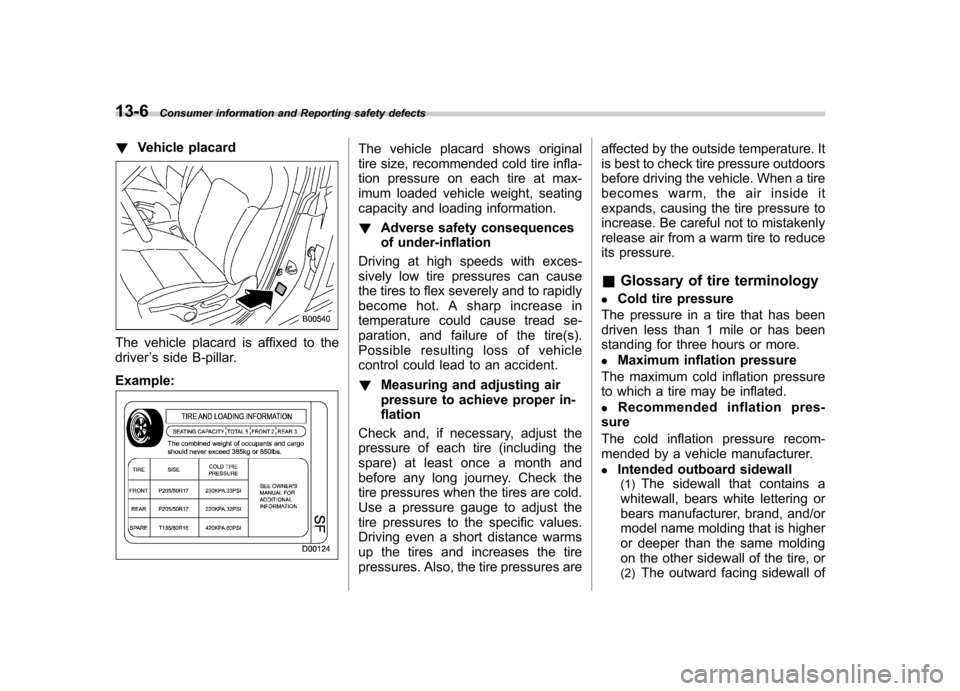
! Vehicle placard
The vehicle placard is affixed to the driver ’s side B-pillar.
Example:
The vehicle placard shows original
tire size, recommended cold tire infla-
tion pressure on each tire at max-
imum loaded vehicle weight, seating
capacity and loading information. ! Adverse safety consequences
of under-inflation
Driving at high speeds with exces-
sively low tire pressures can cause
the tires to flex severely and to rapidly
become hot. A sharp increase in
temperature could cause tread se-
paration, and failure of the tire(s).
Possible resulting loss of vehicle
control could lead to an accident. ! Measuring and adjusting air
pressure to achieve proper in-
flation
Check and, if necessary, adjust the
pressure of each tire (including the
spare) at least once a month and
before any long journey. Check the
tire pressures when the tires are cold.
Use a pressure gauge to adjust the
tire pressures to the specific values.
Driving even a short distance warms
up the tires and increases the tire
pressures. Also, the tire pressures are affected by the outside temperature. It
is best to check tire pressure outdoors
before driving the vehicle. When a tire
becomes warm, the air inside it
expands, causing the tire pressure to
increase. Be careful not to mistakenly
release air from a warm tire to reduce
its pressure. &
Glossary of tire terminology
. Cold tire pressure
The pressure in a tire that has been
driven less than 1 mile or has been
standing for three hours or more. . Maximum inflation pressure
The maximum cold inflation pressure
to which a tire may be inflated. . Recommended inflation pres-
sure
The cold inflation pressure recom-
mended by a vehicle manufacturer. . Intended outboard sidewall
(1) The sidewall that contains a
whitewall, bears white lettering or
bears manufacturer, brand, and/or
model name molding that is higher
or deeper than the same molding
on the other sidewall of the tire, or (2) The outward facing sidewall of
Page 441 of 442

GAS STATION REFERENCE
& Fuel:
! 2.5-liter non-turbo models
Use only unleaded gasoline with an octane rating of 87 AKI or
higher. ! 2.5-liter turbo models
Use premium unleaded gasoline with an octane rating of 91 AKI
or higher. For temporary purposes if premium unleaded
gasoline is not available, you may use regular unleaded
gasoline with an octane rating of 87 AKI or higher. For optimum
engine performance and driveability, it is required that you use
premium grade unleaded gasoline. ! 3.0-liter models
Use unleaded gasoline with an octane rating of 91 AKI or
higher. Regular unleaded gasoline with an octane rating of 87
AKI or higher may be used. However for optimum engine
performance and driveability, it is recommended that you use
91 AKI or higher grade unleaded gasoline. You may experience
reduced output, poor accelerator response, and reduced fuel
economy when using gasoline with an octane rating lower than
91 AKI, depending on your driving habits and conditions. If you
experience any of these conditions while using a lower octane
rated fuel, you may want to return to using 91 AKI octane rated
fuel as soon as possible. Additionally, if your vehicle knocks
heavily or persistently, or if you are driving with heavy loads
such as when towing a trailer, the use of 91 AKI or higher grade
unleaded gasoline is required. &
Fuel octane rating
This octane rating is the average of the Research Octane and
Motor Octane numbers and is commonly referred to as the Anti
Knock Index (AKI). Refer to “Fuel ”section in this manual.
& Fuel capacity:
16.9 US gal (64 liters, 14.1 Imp gal) & Engine oil:
Use only API classification SM with the words “ENERGY
CONSERVING ”and the ILSAC certification mark (starburst
mark) displayed on the container.& Engine oil capacity:
2.5-liter models: 4.2 US qt (4.0 liters, 3.5 Imp qt)
3.0-liter models: 5.8 US qt (5.5 liters, 4.8 Imp qt)
