Page 424 of 442

Black plate (429,1)
北米Model "A2420BE-B" EDITED: 2006/ 7/ 26
Example 1BFor example, if a person weighing 176
lbs (80 kg) now enters the same
vehicle (bringing the number of occu-
pants to two), the calculations are as
follows:
1. Calculate the total weight.
2. Calculate the available load capa-
city.3. The total weight now exceeds the
capacity weight by 81 lbs (37 kg), so
the cargo weight must be reduced by
81 lbs (37 kg) or more.
Example 2AVehicle capacity weight of the vehicle
is 800 lbs (363 kg), which is indicated
on the vehicle placard with the state- ment
“The combined weight of occu-
pants and cargo should never exceed
363 kg or 800 lbs ”.
For example, the vehicle has one
occupant weighing 165 lbs (75 kg)
plus cargo weighing 265 lbs (120 kg).
In addition, the vehicle is fitted with a
trailer hitch weighing 22 lbs (10 kg), to
which is attached a trailer weighing
1,764 lbs (800 kg). 10% of the trailer
weight is applied to the trailer tongue
(i.e. Tongue load = 176 lbs (80 kg)).
1. Calculate the total weight.
Consumer information and Reporting safety defects
13-9
– CONTINUED –
13
ProCarManuals.com
Page 425 of 442
Black plate (430,1)
北米Model "A2420BE-B" EDITED: 2006/ 7/ 26
13-10
Consumer information and Reporting safety defects
2. Calculate the available load capa-
city.3. The result of step 2 shows that a
further 172 lbs (78 kg) of cargo can be
carried.
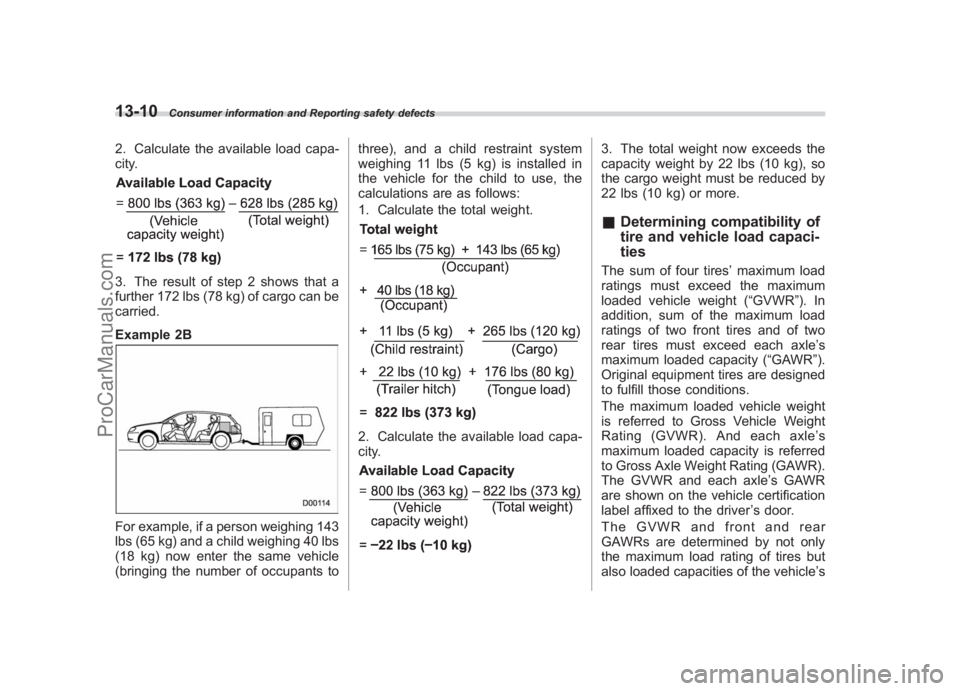
Example 2BFor example, if a person weighing 143
lbs (65 kg) and a child weighing 40 lbs
(18 kg) now enter the same vehicle
(bringing the number of occupants to three), and a child restraint system
weighing 11 lbs (5 kg) is installed in
the vehicle for the child to use, the
calculations are as follows:
1. Calculate the total weight.
2. Calculate the available load capa-
city.
3. The total weight now exceeds the
capacity weight by 22 lbs (10 kg), so
the cargo weight must be reduced by
22 lbs (10 kg) or more.&
Determining compatibility of
tire and vehicle load capaci-
tiesThe sum of four tires ’maximum load
ratings must exceed the maximum
loaded vehicle weight ( “GVWR ”). In
addition, sum of the maximum load
ratings of two front tires and of two
rear tires must exceed each axle ’s
maximum loaded capacity ( “GAWR ”).
Original equipment tires are designed
to fulfill those conditions.
The maximum loaded vehicle weight
is referred to Gross Vehicle Weight
Rating (GVWR). And each axle ’s
maximum loaded capacity is referred
to Gross Axle Weight Rating (GAWR).
The GVWR and each axle ’sGAWR
are shown on the vehicle certification
label affixed to the driver ’s door.
The GVWR and front and rear
GAWRs are determined by not only
the maximum load rating of tires but
also loaded capacities of the vehicle ’s
ProCarManuals.com
Page 426 of 442

Black plate (431,1)
北米Model "A2420BE-B" EDITED: 2006/ 7/ 26
suspension, axles and other parts of
the body.
Therefore, this means that the vehicle
cannot necessarily be loaded up to
the tire ’s maximum load rating on the
tire sidewall.& Adverse safety conse-
quences of overloading on
handling and stopping and
on tiresOverloading could affect vehicle
handling, stopping distance, vehicle
and tire as shown in the following.
This could lead to an accident and
possibly result in severe personal
injury..
Vehicle stability will deteriorate.
.
Heavy and/or high-mounted loads
could increase the risk of rollover.
.
Stopping distance will increase.
.
Brakes could overheat and fail.
.
Suspension, bearings, axles and
other parts of the body could break or
experience accelerated wear that will
shorten vehicle life.
.
Tires could fail.
.
Tread separation could occur.
.
Tire could separate from its rim.
& Steps for Determining Cor-
rect Load Limit1. Locate the statement “The com-
bined weight of occupants and cargo
should never exceed XXX pounds ”on
your vehicle ’s placard.
2. Determine the combined weight of
the driver and passengers that will be
riding in your vehicle.
3. Subtract the combined weight of
the driver and passengers from XXX
kilograms or XXX pounds.
4. The resulting figure equals the
available amount of cargo and lug-
gage load capacity. For example, if
the “XXX ”amount equals 1,400 lbs
(635kg). and there will be five- 150 lbs
(68 kg) passengers in your vehicle,
the amount of available cargo and
luggage load capacity is 650 lbs.
(1,400 750 (5 6150) = 650 lbs.)
5. Determine the combined weight of
luggage and cargo being loaded on
the vehicle. That weight may not
safely exceed the available cargo
and luggage load capacity calculated
in Step 4.
6. If your vehicle will be towing a trailer, load from your trailer will be
transferred to your vehicle. Consult
this manual to determine how this
reduces the available cargo and
luggage load capacity of your vehicle.
Consumer information and Reporting safety defects
13-11
13
ProCarManuals.com
Page 441 of 442

Black plate (2,1)
北米Model "A2420BE-B" EDITED: 2006/ 7/ 28
GAS STATION REFERENCE
&
Fuel:
! 2.5-liter non-turbo models
Use only unleaded gasoline with an octane rating of 87 AKI or
higher.
! 2.5-liter turbo models
Use premium unleaded gasoline with an octane rating of 91 AKI
or higher. For temporary purposes if premium unleaded
gasoline is not available, you may use regular unleaded
gasoline with an octane rating of 87 AKI or higher. For optimum
engine performance and driveability, it is required that you use
premium grade unleaded gasoline.
! 3.0-liter models
Use unleaded gasoline with an octane rating of 91 AKI or
higher. Regular unleaded gasoline with an octane rating of 87
AKI or higher may be used. However for optimum engine
performance and driveability, it is recommended that you use
91 AKI or higher grade unleaded gasoline. You may experience
reduced output, poor accelerator response, and reduced fuel
economy when using gasoline with an octane rating lower than
91 AKI, depending on your driving habits and conditions. If you
experience any of these conditions while using a lower octane
rated fuel, you may want to return to using 91 AKI octane rated
fuel as soon as possible. Additionally, if your vehicle knocks
heavily or persistently, or if you are driving with heavy loads
such as when towing a trailer, the use of 91 AKI or higher grade
unleaded gasoline is required.
&
Fuel octane rating
This octane rating is the average of the Research Octane and
Motor Octane numbers and is commonly referred to as the Anti
Knock Index (AKI). Refer to “Fuel”section in this manual.&
Fuel capacity:
16.9 US gal (64 liters, 14.1 Imp gal)&
Engine oil:
Use only API classification SM with the words “ENERGY
CONSERVING ”and the ILSAC certification mark (starburst
mark) displayed on the container.&
Engine oil capacity:
2.5-liter models: 4.2 US qt (4.0 liters, 3.5 Imp qt)
3.0-liter models: 5.8 US qt (5.5 liters, 4.8 Imp qt)
ProCarManuals.com