2007 SUBARU IMPREZA child lock
[x] Cancel search: child lockPage 104 of 364
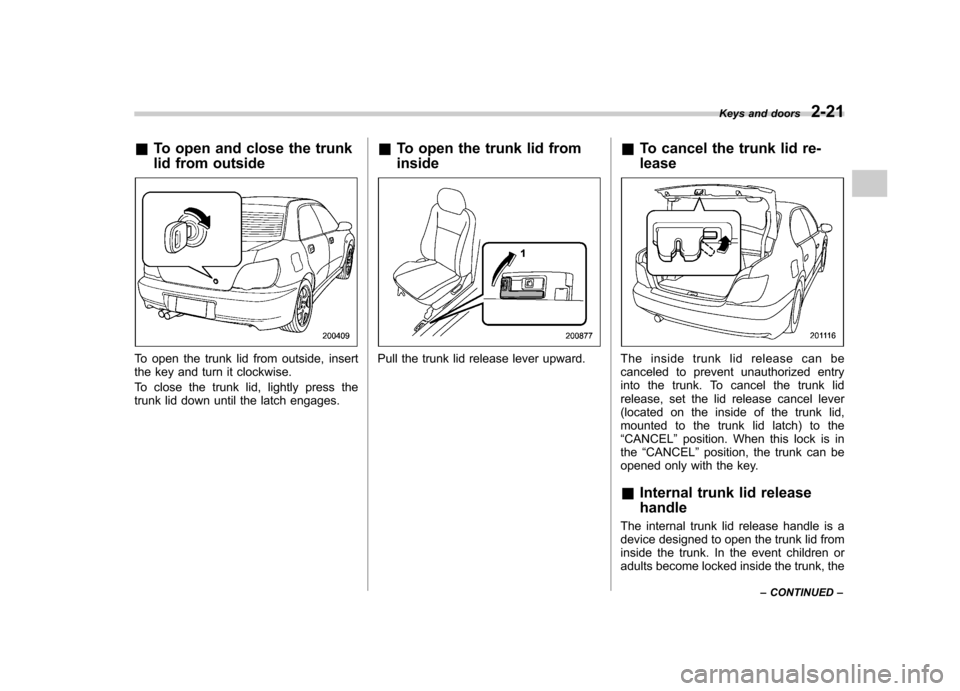
&To open and close the trunk
lid from outside
To open the trunk lid from outside, insert
the key and turn it clockwise.
To close the trunk lid, lightly press the
trunk lid down until the latch engages. &
To open the trunk lid from insidePull the trunk lid release lever upward. &
To cancel the trunk lid re- leaseTheinsidetrunklidreleasecanbe
canceled to prevent unauthorized entry
into the trunk. To cancel the trunk lid
release, set the lid release cancel lever
(located on the inside of the trunk lid,
mounted to the trunk lid latch) to the“CANCEL ”position. When this lock is in
the “CANCEL ”position, the trunk can be
opened only with the key. & Internal trunk lid release handle
The internal trunk lid release handle is a
device designed to open the trunk lid from
inside the trunk. In the event children or
adults become locked inside the trunk, the Keys and doors
2-21
– CONTINUED –
Page 105 of 364
2-22Keys and doors
handle allows them to open the lid. The
handle is located on the inside of the trunklid.
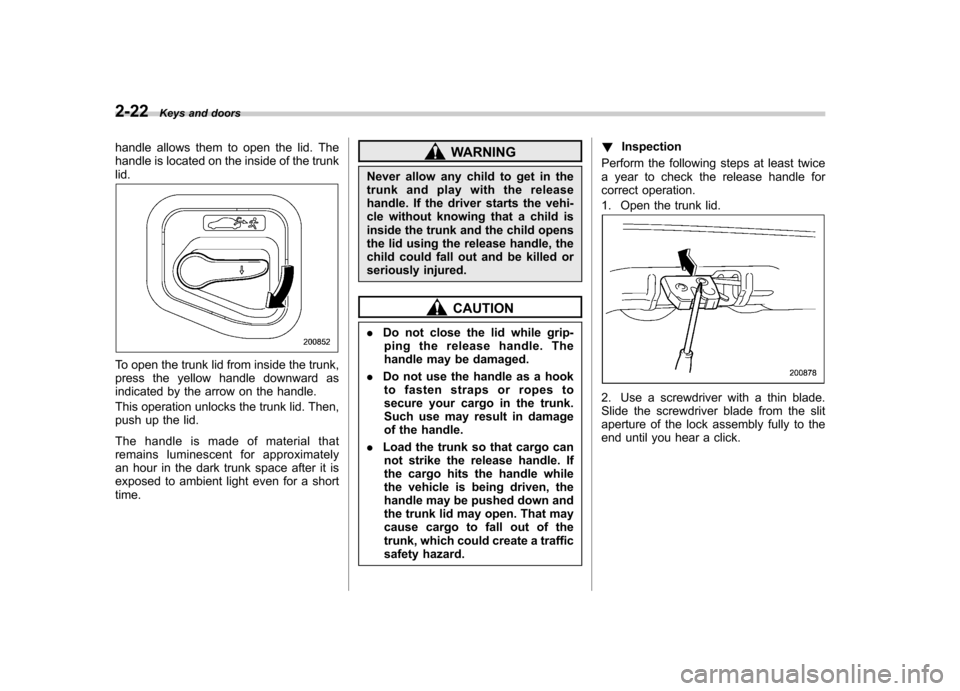
To open the trunk lid from inside the trunk,
press the yellow handle downward as
indicated by the arrow on the handle.
This operation unlocks the trunk lid. Then,
push up the lid.
The handle is made of material that
remains luminescent for approximately
an hour in the dark trunk space after it is
exposed to ambient light even for a shorttime.
WARNING
Never allow any child to get in the
trunk and play with the release
handle. If the driver starts the vehi-
cle without knowing that a child is
inside the trunk and the child opens
the lid using the release handle, the
child could fall out and be killed or
seriously injured.
CAUTION
. Do not close the lid while grip-
ping the release handle. The
handle may be damaged.
. Do not use the handle as a hook
to fasten straps or ropes to
secure your cargo in the trunk.
Such use may result in damage
of the handle.
. Load the trunk so that cargo can
not strike the release handle. If
the cargo hits the handle while
the vehicle is being driven, the
handle may be pushed down and
the trunk lid may open. That may
cause cargo to fall out of the
trunk, which could create a traffic
safety hazard. !
Inspection
Perform the following steps at least twice
a year to check the release handle for
correct operation.
1. Open the trunk lid.
2. Use a screwdriver with a thin blade.
Slide the screwdriver blade from the slit
aperture of the lock assembly fully to the
end until you hear a click.
Page 112 of 364
Ignition switch
WARNING
. Never turn the ignition switch to
“ LOCK ”while the vehicle is
being driven or towed because
that will lock the steering wheel,
preventing steering control. And
when the engine is turned off, it
takes a much greater effort than
usual to steer.
. Before leaving the vehicle, al-
ways remove the key from the
ignition switch for safety and
never allow an unattended child
to remain in the vehicle. Failure
to follow this procedure could
result in injury to a child or
others. Children could operate
the power windows, the moon-
roof or other controls or even
make the vehicle move.
CAUTION
Do not attach a large key holder or
key case to either key. If it banged
against your knees or hands while
you are driving, it could turn the
ignition switch from the “ON ”posi- tion to the
“Acc ”or “LOCK ”posi-
tion, thereby stopping the engine.
Also, if the key is attached to a
keyholder or to a large bunch of
other keys, centrifugal force may act
on it as the vehicle moves, resulting
in unwanted turning of the ignitionswitch.
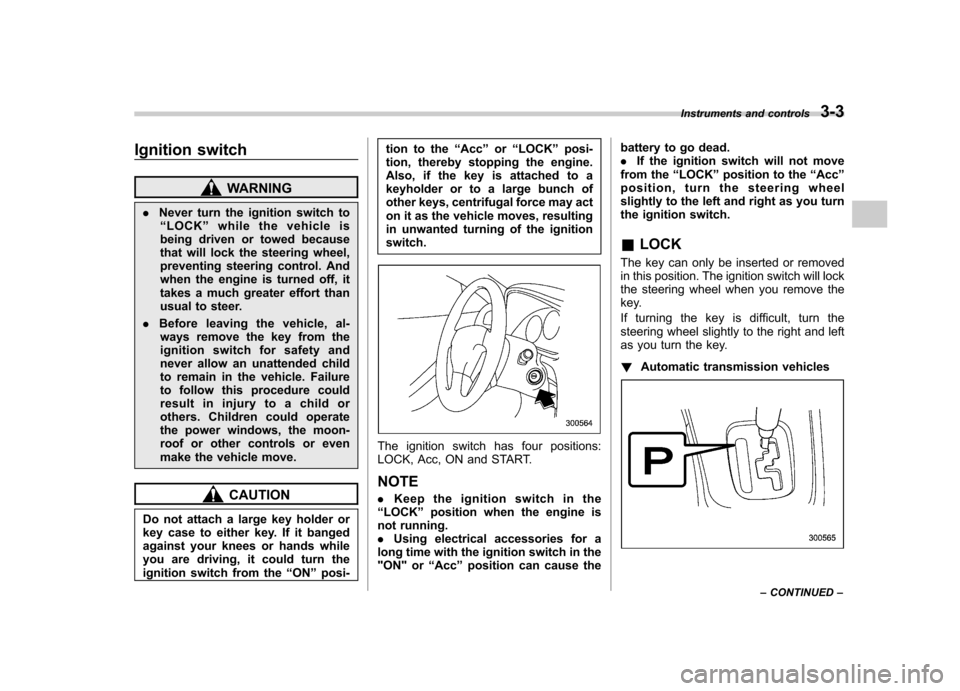
The ignition switch has four positions:
LOCK, Acc, ON and START. NOTE . Keep the ignition switch in the
“ LOCK ”position when the engine is
not running. . Using electrical accessories for a
long time with the ignition switch in the
"ON" or “Acc ”position can cause the battery to go dead..
If the ignition switch will not move
from the “LOCK ”position to the “Acc ”
position, turn the steering wheel
slightly to the left and right as you turn
the ignition switch. & LOCK
The key can only be inserted or removed
in this position. The ignition switch will lock
the steering wheel when you remove the
key.
If turning the key is difficult, turn the
steering wheel slightly to the right and left
as you turn the key. ! Automatic transmission vehicles
Instruments and controls 3-3
– CONTINUED –
Page 222 of 364
CAUTION
Never drive while the parking brake
is set because this will cause un-
necessary wear on the brake lin-
ings. Before starting to drive, always
make sure that the parking brake
has been fully released.
& Parking tips
When parking your vehicle, always set the
parking brake firmly and put the shift lever
in the “1 ” (1st) for an upgrade or “R ”
(Reverse) for a downgrade for manual
transmission vehicles, or in the “P ”(Park)
position for automatic transmission vehi-
cles. Always set the parking brake firmly
when parking your vehicle. Never rely on
the transmission alone to hold the vehicle.
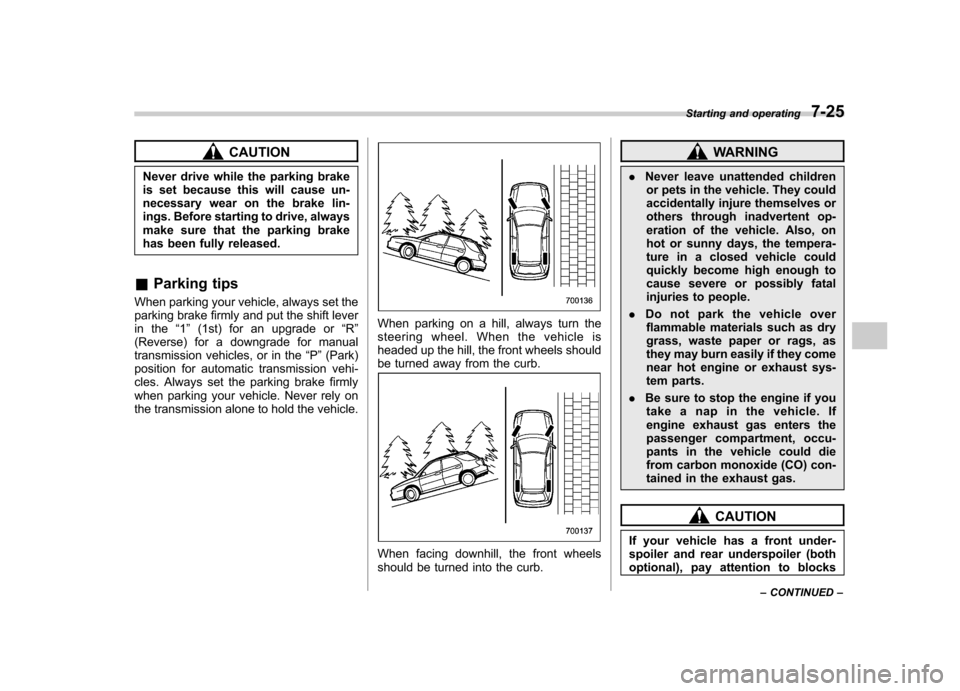
When parking on a hill, always turn the
steering wheel. When the vehicle is
headed up the hill, the front wheels should
be turned away from the curb.
When facing downhill, the front wheels
should be turned into the curb.
WARNING
. Never leave unattended children
or pets in the vehicle. They could
accidentally injure themselves or
others through inadvertent op-
eration of the vehicle. Also, on
hot or sunny days, the tempera-
ture in a closed vehicle could
quickly become high enough to
cause severe or possibly fatal
injuries to people.
. Do not park the vehicle over
flammable materials such as dry
grass, waste paper or rags, as
they may burn easily if they come
near hot engine or exhaust sys-
tem parts.
. Be sure to stop the engine if you
take a nap in the vehicle. If
engine exhaust gas enters the
passenger compartment, occu-
pants in the vehicle could die
from carbon monoxide (CO) con-
tained in the exhaust gas.
CAUTION
If your vehicle has a front under-
spoiler and rear underspoiler (both
optional), pay attention to blocks Starting and operating
7-25
– CONTINUED –
Page 317 of 364
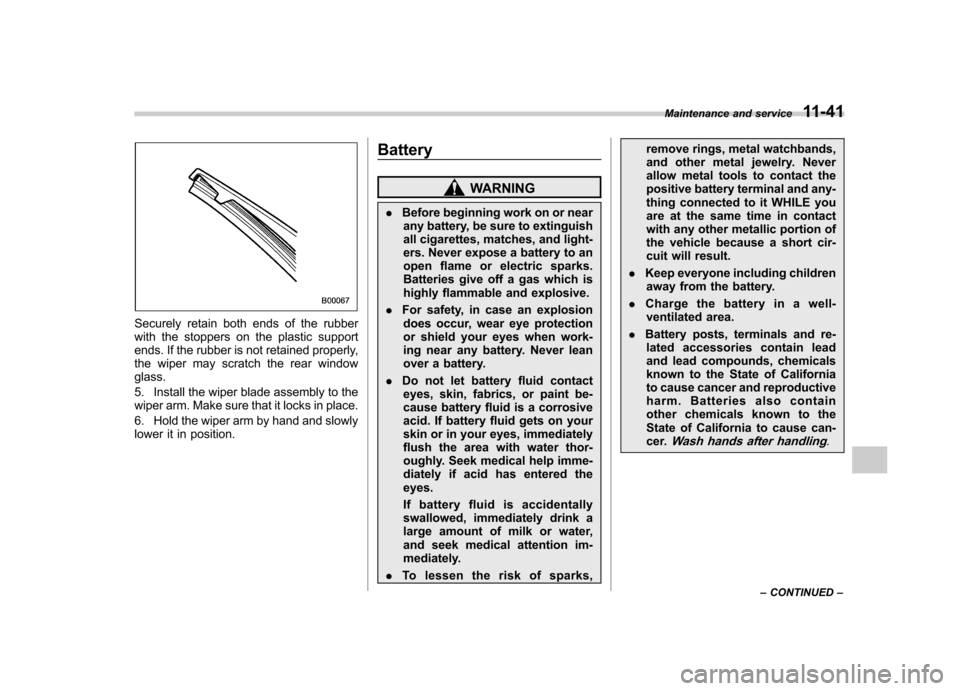
Securely retain both ends of the rubber
with the stoppers on the plastic support
ends. If the rubber is not retained properly,
the wiper may scratch the rear windowglass.
5. Install the wiper blade assembly to the
wiper arm. Make sure that it locks in place.
6. Hold the wiper arm by hand and slowly
lower it in position.Battery
WARNING
. Before beginning work on or near
any battery, be sure to extinguish
all cigarettes, matches, and light-
ers. Never expose a battery to an
open flame or electric sparks.
Batteries give off a gas which is
highly flammable and explosive.
. For safety, in case an explosion
does occur, wear eye protection
or shield your eyes when work-
ing near any battery. Never lean
over a battery.
. Do not let battery fluid contact
eyes, skin, fabrics, or paint be-
cause battery fluid is a corrosive
acid. If battery fluid gets on your
skin or in your eyes, immediately
flush the area with water thor-
oughly. Seek medical help imme-
diately if acid has entered theeyes.
If battery fluid is accidentally
swallowed, immediately drink a
large amount of milk or water,
and seek medical attention im-
mediately.
. To lessen the risk of sparks, remove rings, metal watchbands,
and other metal jewelry. Never
allow metal tools to contact the
positive battery terminal and any-
thing connected to it WHILE you
are at the same time in contact
with any other metallic portion of
the vehicle because a short cir-
cuit will result.
. Keep everyone including children
away from the battery.
. Charge the battery in a well-
ventilated area.
. Battery posts, terminals and re-
lated accessories contain lead
and lead compounds, chemicals
known to the State of California
to cause cancer and reproductive
harm. Batteries also contain
other chemicals known to the
State of California to cause can-
cer.
Wash hands after handling.
Maintenance and service
11-41
– CONTINUED –
Page 356 of 364

CenterConsole .................................................................. 6-4
Ventilators ............................................................... 4-3
Center and side ventilators ............................................ 4-3
Changing Flat tire ................................................................... 9-4
Oil and oil filter ...................................................... 11-9
Charge warning light .................................................. 3-16
CHECK ENGINE warning light/Malfunction indicator lamp ...................................................................... 3-16
Checking Brake pedal free play ............................................ 11-27
Brake pedal reserve distance ................................. 11-28
Clutch function ...................................................... 11-28
Clutch pedal free play ............................................ 11-28
Engine oil level ...................................................... 11-8
Fluid level ............................... 11-20, 11-24, 11-25, 11-26
Gear oil level ........................................................ 11-22
Child restraint systems ............................................... 1-22
Installation with A/ELR seatbelt ................................ 1-25
Lower and tether anchorages .................................. 1-29
Child safety .................................................................... 5
Locks ................................................................... 2-18
Chime Key ........................................................................ 3-5 Seatbelt ........................................................ 1-11, 3-14
Cleaning
Aluminum wheels ................................................... 10-3
Interior .................................................................. 10-5
Ventilation grille ..................................................... 4-11 Climate control system
Automatic ............................................................... 4-8
Manual ................................................................... 4-3
Clock ........................................................................ 3-22
Clutch Fluid ................................................................... 11-26
Pedal .................................................................. 11-28
Coat hook. .................................................................. 6-9
Coin tray .................................................................... 6-4
Cooling system ........................................................ 11-12
Corrosion protection ............................................ 8-10, 10-4
Cruise control ............................................................ 7-26
Set indicator light .................................................... 3-20
Cruise control indicator light ......................................... 3-20
Cup holder ................................................................. 6-5
Front passenger ’s.................................................... 6-5
Rear passenger ’s .................................................... 6-6
D
Daytime running light system ....................................... 3-23
Differential gear oil
Front ................................................................... 11-21
Rear ................................................................... 11-22
Dimensions ................................................................ 12-2
Disarming the system ................................................. 2-15
Disc brake pad wear warning indicators ........................ 7-21
Dome light .................................................................. 6-2
Door
Locks ..................................................................... 2-4
Open warning light. ................................................. 3-19
Drive belts ............................................................... 11-18 Index
14-3