2007 SUBARU IMPREZA weight
[x] Cancel search: weightPage 66 of 364

WARNING
Do not attach accessories to the
windshield, or fit an extra-wide mir-
ror over the rear view mirror. If the
SRS airbag deploys, those objects
could become projectiles that could
seriously injure vehicle occupants.
! Driver ’s SRS frontal airbag
The driver ’s SRS frontal airbag uses a
dual stage inflator. The inflator operates in
different ways depending on the severity
of impact, backward-forward adjustment
of the driver ’s seat position and whether or
not he/she is wearing the seatbelt.
The backward-forward adjustment of the driver ’s seat position is monitored by the driver
’s seat position sensor under the
driver ’s seat.
Whether or not the driver is wearing the
seatbelt is monitored by the seatbelt
buckle switch.
Observe the following precautions. Failure
to do so may cause the seatbelt buckle
switch and/or the seat position sensor to
malfunction, preventing the Subaru ad-
vanced frontal airbag system from func-
tioning correctly or causing the system tofail. . Do not place articles/metal objects or
install any accessory other than a genuine
SUBARU accessory under the driver ’s
seat. Do not allow the rear seat occupant
to kick the driver ’s seat or push up its
bottom surface with his/her feet. . Do not place a magnet near the
seatbelt buckle or under the driver ’s seat.
If the seatbelt buckle switch and/or the driver ’s seat position sensor have failed,
the SRS airbag system warning light will
illuminate. Although the driver ’sSRS
frontal airbag can deploy regardless of
the backward-forward adjustment of the
driver ’s seat position even when the
warning light is on, have the system
inspected by your SUBARU dealer im-
mediately if the SRS airbag system warn-
ing light comes on. NOTE
The driver
’s SRS side airbag and
seatbelt pretensioner are not controlled
by the Subaru advanced frontal airbagsystem. ! Front passenger ’s SRS frontal air-
bag
The front passenger ’s SRS frontal airbag
uses a dual stage inflator. The inflator
operates in different ways depending on
the severity of impact.
The total load on the seat is monitored by
the occupant detection system ’s weight
sensor located under the seat.
The system has another sensor that
monitors the tension of the front passen-
ger seatbelt. Using the total seat load and
seatbelt tension data from the sensors,
the occupant detection system determines
whether the front passenger ’s SRS frontal
airbag should or should not be inflated.
The occupant detection system may not
inflate the front passenger ’s SRS frontal
airbag even when the driver ’s SRS frontal
airbag deploys. This is normal.
Observe the following precautions. Failure
to do so may prevent the Subaru ad-
vanced frontal airbag system from func-
tioning correctly or cause the system to fail. Seat, seatbelt and SRS airbags
1-41
– CONTINUED –
Page 72 of 364

The SRS airbag can function only when
the ignition switch is in the“ON ”position.
The Subaru advanced frontal airbag sys-
tem is designed to determine the activa-
tion or deactivation condition of the frontpassenger ’s SRS frontal airbag depend-
ing on the total load on the front passen-ger ’s seat monitored by the front passen-
ger ’s occupant detection system weight
sensor. For this reason, only the driver ’s
SRS frontal airbag may deploy in the
event of a collision, but this does not mean
failure of the system.
If the front sub sensors inside both front
fenders and the impact sensors in the
airbag control module detect a predeter-
mined amount of force during a frontal
collision, the control module sends signals
to the airbag module(s) (only driver ’s
module or both driver ’s and front passen-
ger ’s modules) instructing the module(s)
to inflate the SRS frontal airbag(s). Thedriver ’s and front passenger ’s SRS frontal
airbags use dual stage inflators.
The two inflators of each airbag are
triggered either sequentially or simulta-
neously, depending on the severity of
impact, backward-forward adjustment of
the driver ’s seat position and fastening/
unfastening of the seatbelt in the case of
the driver ’s SRS frontal airbag and de-
pending on the severity of impact and the total load on the seat in the case of the
front passenger
’s SRS frontal airbag. After
deployment, the SRS airbag immediately
starts to deflate so that the driver ’s vision
is not obstructed. The time required from
detecting impact to the deflation of the
SRS airbag after deployment is shorter
than the blink of an eye.
Both when only the driver ’s SRS frontal
airbag deploys and the driver ’s and front
passenger ’s SRS frontal airbags deploy,
the driver ’s and front passenger ’s seatbelt
pretensioners operate at the same time.
Although it is highly unlikely that the SRS
airbag would activate in a non-accident
situation, should it occur, the SRS airbag
will deflate quickly, not obscuring vision
and will not interfere with the driver ’s
ability to maintain control of the vehicle.
When the SRS airbag deploys, a sudden,
fairly loud inflation noise will be heard and
some smoke will be released. These
occurrences are a normal result of the
deployment. This smoke does not indicate
a fire in the vehicle.
CAUTION
Do not touch the SRS airbag system
components around the steering
wheel and dashboard with bare hands right after deployment. Doing
so can cause burns because the
components can be very hot as a
result of deployment.
The driver ’s SRS frontal airbag and front
passenger ’s SRS frontal airbag are de-
signed to deploy in the event of an
accident involving a moderate to severe
frontal collision. It is basically not designed
to deploy in lesser frontal impacts be-
cause the necessary protection can be
achieved by the seatbelt alone. Also, they
are basically not designed to deploy in
side or rear impacts or in roll-over acci-
dents because deployment of only thedriver ’s SRS frontal airbag or both driver ’s
and front passenger ’s SRS frontal airbags
would not help the occupant in those
situations. The driver ’s and front passen-
ger ’s SRS frontal airbags are designed to
function on a one-time-only basis.
SRS airbag deployment depends on the
level of force experienced in the passen-
ger compartment during a collision. That
level differs from one type of collision to
another, and it may have no bearing on
the visible damage done to the vehicleitself. Seat, seatbelt and SRS airbags
1-47
– CONTINUED –
Page 81 of 364
1-56Seat, seatbelt and SRS airbags
ger’s side)
. Side airbag sensor (Center pillar right-
hand side) . Side airbag sensor (Center pillar left-
hand side). Side airbag module (Driver ’s side)
. Side airbag module (Front passenger ’s
side). Seatbelt pretensioner (Driver ’s side)
. Seatbelt pretensioner (Front passen-
ger ’s side)
. Seatbelt buckle switch (Driver ’s side)
. Seatbelt buckle switch (Front passen-
ger ’s side)
. Driver ’s seat position sensor
. Front passenger ’s seatbelt tension
sensor. Front passenger ’s occupant detection
system weight sensor. Front passenger ’s occupant detection
control module. Front passenger ’s frontal airbag ON
and OFF indicator. All related wiring
WARNING
If the warning light exhibits any of
the following conditions, there may
be a malfunction in the seatbelt
pretensioners and/or SRS airbag system. Immediately take your vehi-
cle to your nearest SUBARU dealer
to have the system checked. Unless
checked and properly repaired, the
seatbelt pretensioners and/or SRS
airbag will not operate properly in
the event of a collision, which may
increase the risk of injury. .
Flashing or flickering of the warn-
ing light
. No illumination of the warning
light when the ignition switch is
first turned to the “ON ”position
. Continuous illumination of the
warning light
. Illumination of the warning light
while driving
& SRS airbag system servicing
WARNING
. When discarding an airbag mod-
ule or scrapping the entire vehi-
cle damaged by a collision, con-
sult your SUBARU dealer.
. The SRS airbag has no user-
serviceable parts. Do not use
electrical test equipment on any
circuit related to the SRS airbag system. For required servicing of
the SRS airbag, see your nearest
SUBARU dealer. Tampering with
or disconnecting the system
’s
wiring could result in accidental
inflation of the SRS airbag or
could make the system inopera-
tive, which may result in serious
injury. The wiring harnesses of
the SRS airbag system are cov-
ered with yellow insulation and
system connectors are yellow for
easy identification.
CAUTION
If you need service or repair in areas
listed in the following, have an
authorized SUBARU dealer perform
the work. The SRS airbag control
module, impact sensors and airbag
modules are stored in these areas. . Under the center console
. Inside each front fender
. Steering wheel and column and
nearby areas
. Top of the dashboard on front
passenger ’s side and nearby
areas
. Each front seat and nearby area
Page 194 of 364
6-10Interior equipment
Cargo area cover (Wagon –if
equipped)
The cargo area cover is provided for
covering the cargo area and to protect its
contents from direct sunlight. This cover is
detachable to make room for additionalcargo. & Using the cover
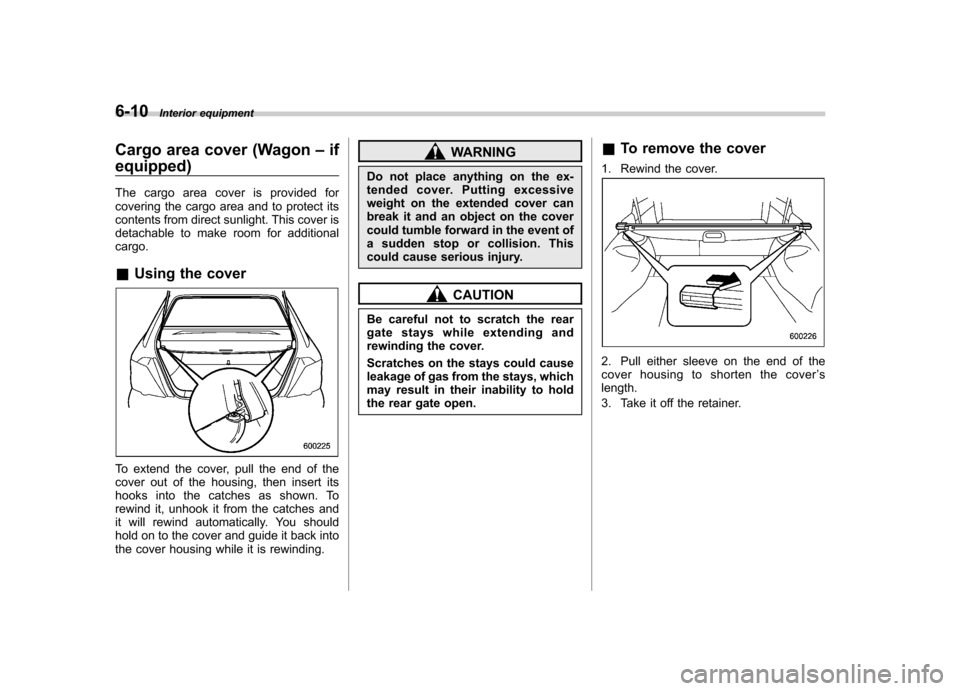
To extend the cover, pull the end of the
cover out of the housing, then insert its
hooks into the catches as shown. To
rewind it, unhook it from the catches and
it will rewind automatically. You should
hold on to the cover and guide it back into
the cover housing while it is rewinding.
WARNING
Do not place anything on the ex-
tended cover. Putting excessive
weight on the extended cover can
break it and an object on the cover
could tumble forward in the event of
a sudden stop or collision. This
could cause serious injury.
CAUTION
Be careful not to scratch the rear
gate stays while extending and
rewinding the cover.
Scratches on the stays could cause
leakage of gas from the stays, which
may result in their inability to hold
the rear gate open. &
To remove the cover
1. Rewind the cover.
2. Pull either sleeve on the end of the
cover housing to shorten the cover ’s
length.
3. Take it off the retainer.
Page 196 of 364

6-12Interior equipment
CAUTION
The cargo tie-down hooks are de-
signed only for securing light cargo.
Never try to secure cargo that
exceeds the capacity of the hooks.
The maximum load capacity is 44
lbs (20 kg) per hook. Cargo area bars (Wagon)
1) Cargo area bar
In the cargo area, there are two bars (one
on each side) to which a net can beattached.
CAUTION
Do not place objects with a total
weight exceeding 6.6 lbs (3 kg) on a
net attached to the cargo area bars. Under-floor storage compart-
ment (Wagon
–if equipped)
The storage compartment is located under
the floor of the cargo area and can be
used to store small items. To open the lid,
pull the tab up. NOTE
When storing a flat tire, put the storage
tray in the cargo area.
CAUTION
. Always keep the lids closed while
drivingtoreducetheriskof
injury in the event of a sudden
stop or an accident.
. Do not store spray cans, contain-
Page 227 of 364

New vehicle break-in driving–the first
1,000 miles (1,600 km) ..................................... 8-2
Fuel economy hints ............................................ 8-2
Engine exhaust gas (Carbon monoxide) ........... 8-2
Catalytic converter .............................................. 8-3
Periodic inspections ........................................... 8-4
Driving in foreign countries ............................... 8-4
Driving tips for AWD vehicles ............................ 8-5
Off road driving ................................................... 8-6
All AWD models except OUTBACK SPORT .......... 8-6
OUTBACK SPORT ............................................... 8-6
Winter driving ...................................................... 8-8
Operation during cold weather ............................. 8-8
Driving on snowy and icy roads .......................... 8-9
Corrosion protection .......................................... 8-10
Snow tires ......................................................... 8-10
Tire chains ......................................................... 8-11 Rocking the vehicle
........................................... 8-12
Loading your vehicle ......................................... 8-12
Vehicle capacity weight ...................................... 8-13
GVWR and GAWR (Gross Vehicle Weight Rating and Gross Axle Weight Rating) ........................ 8-14
Roof rail and crossbar (if equipped) ................... 8-14
Trailer hitch (if equipped) .................................. 8-17
Connecting a trailer ........................................... 8-18
When you do not tow a trailer .. .......................... 8-19
Trailer towing ..................................................... 8-20
Warranties and maintenance .............................. 8-20
Maximum load limits .......................................... 8-20
Trailer hitches .................................................... 8-23
Connecting a trailer ........................................... 8-24
Trailer towing tips .............................................. 8-25
STI front lip spoiler (if equipped) ...................... 8-28Driving tips
8
Page 239 of 364
WARNING
. When you carry something inside
the vehicle, secure it whenever
you can to prevent it from being
thrown around inside the vehicle
during sudden stops, sharp turns
or in an accident.
. Do not pile heavy loads on the
roof. These loads raise the vehi-cle ’s center of gravity and make it
more prone to tip over.
. Secure lengthy items properly to
prevent them from shooting for-
ward and causing serious injury
during a sudden stop.
. Never exceed the maximum load
limit. If you do, some parts on
your vehicle can break, or it can
change the way your vehicle
handles. This could result in loss
of control and cause personal
injury. Also, overloading can
shorten the life of your vehicle.
. Do not place anything on the rear
shelf behind the rear seatback
(for Sedan) or the extended cargo
area cover (for Wagon). Such
items could tumble forward in
the event of a sudden stop or a
collision. This could cause ser- ious injury.
CAUTION
Do not carry spray cans, containers
with flammable or corrosive liquids
or any other dangerous items inside
the vehicle.
NOTE
For better fuel economy, do not carry
unneeded cargo. & Vehicle capacity weight
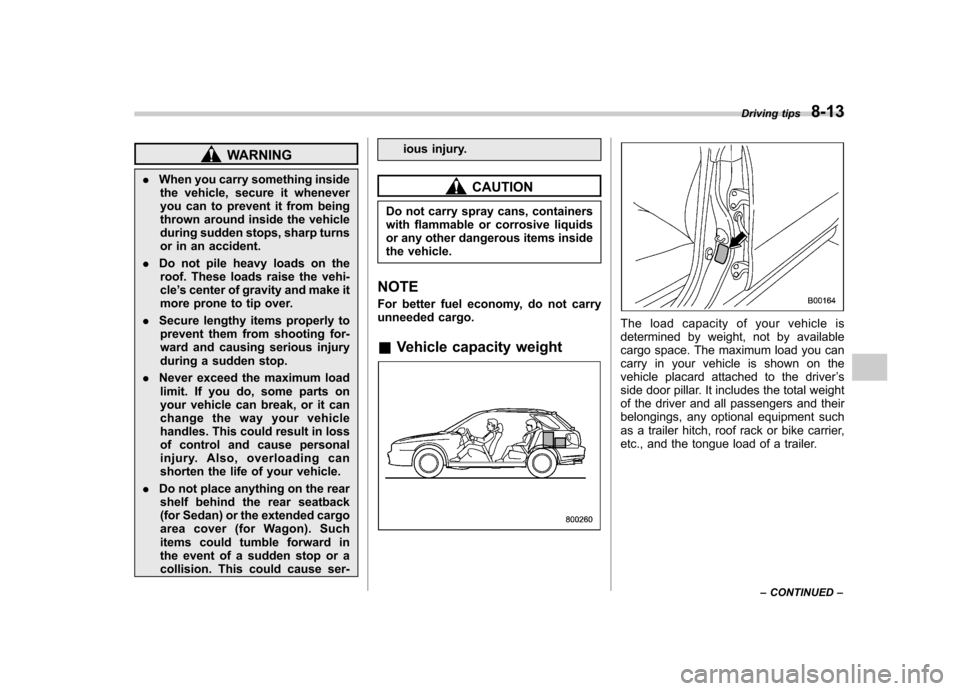
The load capacity of your vehicle is
determined by weight, not by available
cargo space. The maximum load you can
carry in your vehicle is shown on the
vehicle placard attached to the driver ’s
side door pillar. It includes the total weight
of the driver and all passengers and their
belongings, any optional equipment such
as a trailer hitch, roof rack or bike carrier,
etc., and the tongue load of a trailer. Driving tips
8-13
– CONTINUED –
Page 240 of 364
8-14Driving tips
& GVWR and GAWR (Gross
Vehicle Weight Rating and
Gross Axle Weight Rating)
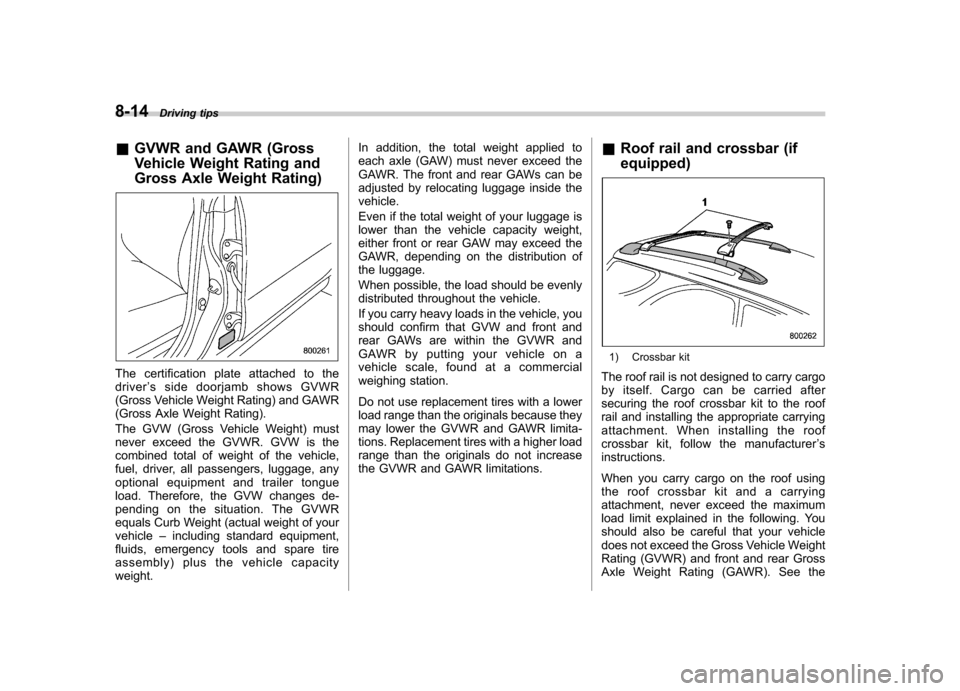
The certification plate attached to the driver ’s side doorjamb shows GVWR
(Gross Vehicle Weight Rating) and GAWR
(Gross Axle Weight Rating).
The GVW (Gross Vehicle Weight) must
never exceed the GVWR. GVW is the
combined total of weight of the vehicle,
fuel, driver, all passengers, luggage, any
optional equipment and trailer tongue
load. Therefore, the GVW changes de-
pending on the situation. The GVWR
equals Curb Weight (actual weight of yourvehicle –including standard equipment,
fluids, emergency tools and spare tire
assembly) plus the vehicle capacityweight. In addition, the total weight applied to
each axle (GAW) must never exceed the
GAWR. The front and rear GAWs can be
adjusted by relocating luggage inside thevehicle.
Even if the total weight of your luggage is
lower than the vehicle capacity weight,
either front or rear GAW may exceed the
GAWR, depending on the distribution of
the luggage.
When possible, the load should be evenly
distributed throughout the vehicle.
If you carry heavy loads in the vehicle, you
should confirm that GVW and front and
rear GAWs are within the GVWR and
GAWR by putting your vehicle on a
vehicle scale, found at a commercial
weighing station.
Do not use replacement tires with a lower
load range than the originals because they
may lower the GVWR and GAWR limita-
tions. Replacement tires with a higher load
range than the originals do not increase
the GVWR and GAWR limitations.
&
Roof rail and crossbar (if equipped)
1) Crossbar kit
The roof rail is not designed to carry cargo
by itself. Cargo can be carried after
securing the roof crossbar kit to the roof
rail and installing the appropriate carrying
attachment. When installing the roof
crossbar kit, follow the manufacturer ’s
instructions.
When you carry cargo on the roof using
the roof crossbar kit and a carrying
attachment, never exceed the maximum
load limit explained in the following. You
should also be careful that your vehicle
does not exceed the Gross Vehicle Weight
Rating (GVWR) and front and rear Gross
Axle Weight Rating (GAWR). See the