2007 SUBARU FORESTER ECO mode
[x] Cancel search: ECO modePage 208 of 356
7-10 Starting and operating
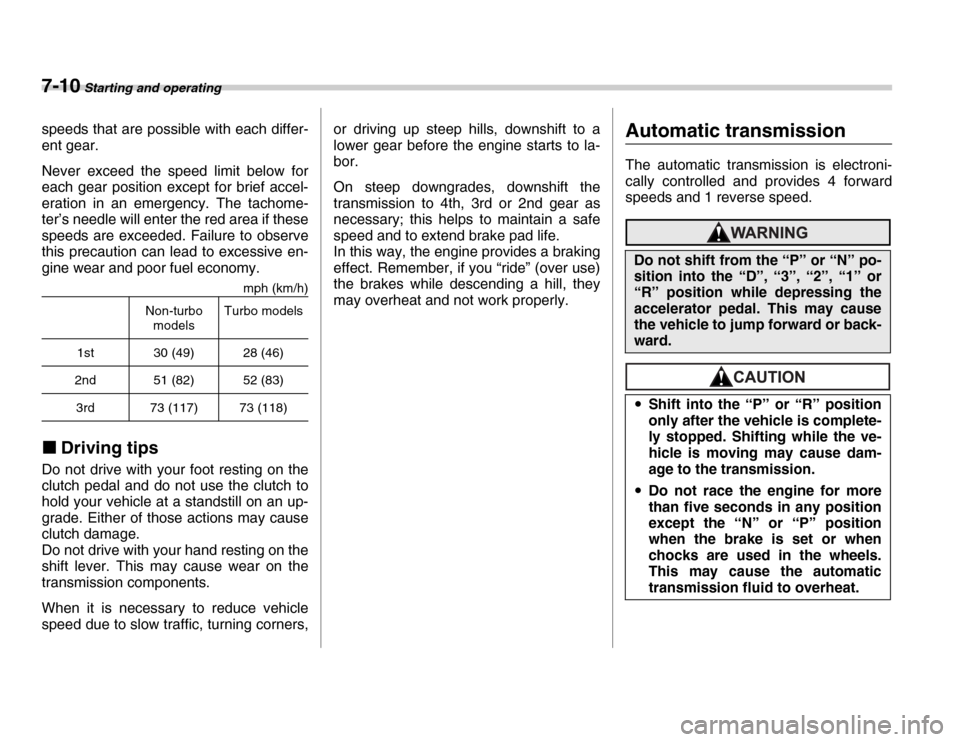
speeds that are possible with each differ-
ent gear.
Never exceed the speed limit below for
each gear position except for brief accel-
eration in an emergency. The tachome-
ter’s needle will enter the red area if these
speeds are exceeded. Failure to observe
this precaution can lead to excessive en-
gine wear and poor fuel economy.mph (km/h)
„ Driving tips
Do not drive with your foot resting on the
clutch pedal and do not use the clutch to
hold your vehicle at a standstill on an up-
grade. Either of those actions may cause
clutch damage.
Do not drive with your hand resting on the
shift lever. This may cause wear on the
transmission components.
When it is necessary to reduce vehicle
speed due to slow traffic, turning corners, or driving up steep hills, downshift to a
lower gear before the engine starts to la- bor.
On steep downgrades, downshift the
transmission to 4th, 3rd or 2nd gear as
necessary; this helps to maintain a safe
speed and to extend brake pad life.
In this way, the engine provides a braking
effect. Remember, if you “ride” (over use)
the brakes while descending a hill, they
may overheat and not work properly.Automatic transmission
The automatic transmission is electroni-
cally controlled and provides 4 forward
speeds and 1 reverse speed.
Non-turbo
models Turbo models
1st 30 (49) 28 (46)
2nd 51 (82) 52 (83)
3rd 73 (117) 73 (118)
Do not shift from the “P” or “N” po-
sition into the “D”, “3”, “2”, “1” or
“R” position while depressing the
accelerator pedal. This may cause
the vehicle to jump forward or back-
ward. y Shift into the “P” or “R” position
only after the vehicle is complete-
ly stopped. Shifting while the ve-
hicle is moving may cause dam-
age to the transmission.
y Do not race the engine for more
than five seconds in any position
except the “N” or “P” position
when the brake is set or when
chocks are used in the wheels.
This may cause the automatic
transmission fluid to overheat.
Page 211 of 356
Starting and operating 7-13
– CONTINUED –
shortly after the vehicle has been
parked for an extended period of time.
When the ATF temperature has risen to
a certain level, automatic downshift
normally takes place. In the meantime,
downshift manually for engine braking
as required.
Also, downshifting when braking
downhill will not occur at speeds
above approximately 48 mph (78 km/h). T
3 (Third)
This position is for using engine braking
when going down a hill or for climbing a
grade.
The transmission automatically shifts into
a suitable gear from 1st to 3rd according
to the vehicle speed and the acceleration
you require.
When more acceleration is required in this
position, press the accelerator pedal fully
to the floor and hold that position. The
transmission will automatically downshift
to 2nd or 1st gear. When you release the
pedal, the transmission will return to the
original gear position. T 2 (Second)
This position is for using engine braking
when going down a hill or for climbing a
steep grade.
In this position, the transmission holds in the 2nd gear.
Use this position when starting off from a
standstill on slippery road surfaces such
as mud or snow. It will ensure greater trac-
tion. T
1 (First)
This position is for driving up or down very
steep grades, or driving through mud or
sand, or on slippery surfaces. In this posi-
tion, the transmission holds in the 1st
gear. T Maximum speeds
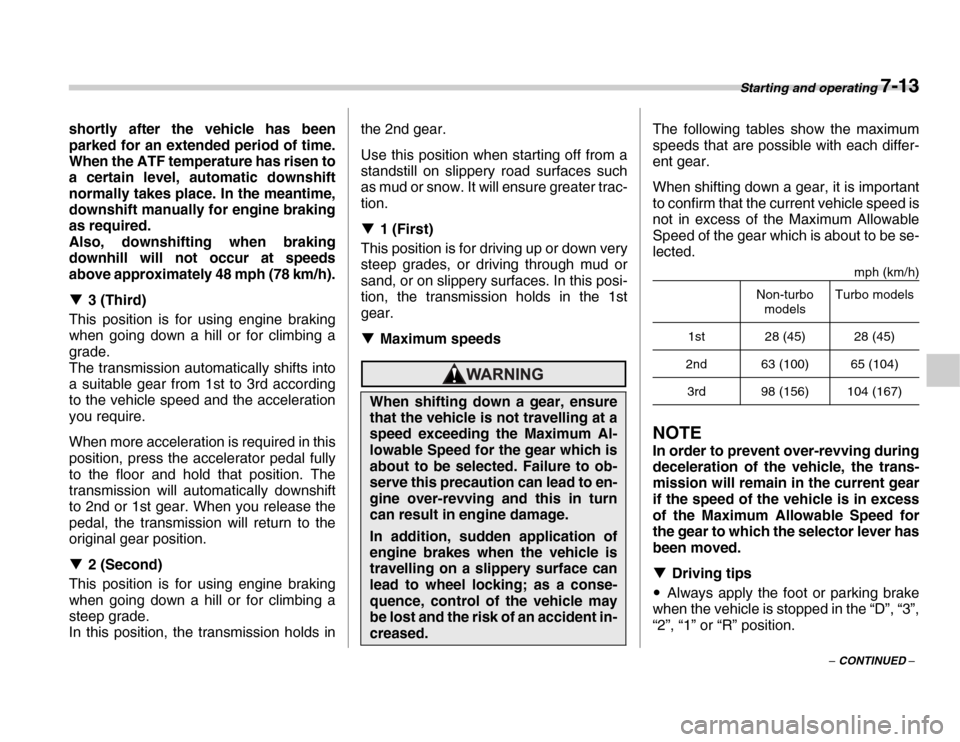
The following tables show the maximum
speeds that are possible with each differ-
ent gear.
When shifting down a gear, it is important
to confirm that the current vehicle speed is
not in excess of the Maximum Allowable
Speed of the gear which is about to be se-
lected.
mph (km/h)
NOTE
In order to prevent over-revving during
deceleration of the vehicle, the trans-
mission will remain in the current gear
if the speed of the vehicle is in excess
of the Maximum Allowable Speed for
the gear to which the selector lever has
been moved. T Driving tips
y Always apply the foot or parking brake
when the vehicle is stopped in the “D”, “3”,
“2”, “1” or “R” position.
When shifting down a gear, ensure
that the vehicle is not travelling at a
speed exceeding the Maximum Al-
lowable Speed for the gear which is
about to be selected. Failure to ob-
serve this precaution can lead to en-
gine over-revving and this in turn
can result in engine damage.
In addition, sudden application of
engine brakes when the vehicle is
travelling on a slippery surface can
lead to wheel locking; as a conse-
quence, control of the vehicle may
be lost and the risk of an accident in-
creased.
Non-turbo models Turbo models
1st 28 (45) 28 (45)
2nd 63 (100) 65 (104) 3rd 98 (156) 104 (167)
Page 215 of 356
Starting and operating 7-17
– CONTINUED –
The ABS system prevents the lock-up of
wheels which may occur during sudden
braking or braking on slippery road surfac-
es. This helps prevent the loss of steering
control and directional stability caused by
wheel lock-up.
When the ABS system is operating, you
may hear a chattering noise or feel a slight
vibration in the brake pedal. This is normal
when the ABS operates.
The ABS system will not operate when the
vehicle speed is below approximately 6
mph (10 km/h). „
ABS system self-check
You may feel a slight shock in the brake
pedal and hear the operating sound of
ABS from the engine compartment just af-
ter the vehicle is started. This is caused by
an automatic functional test of the ABS
system being carried out and does not in-
dicate any abnormal condition. „
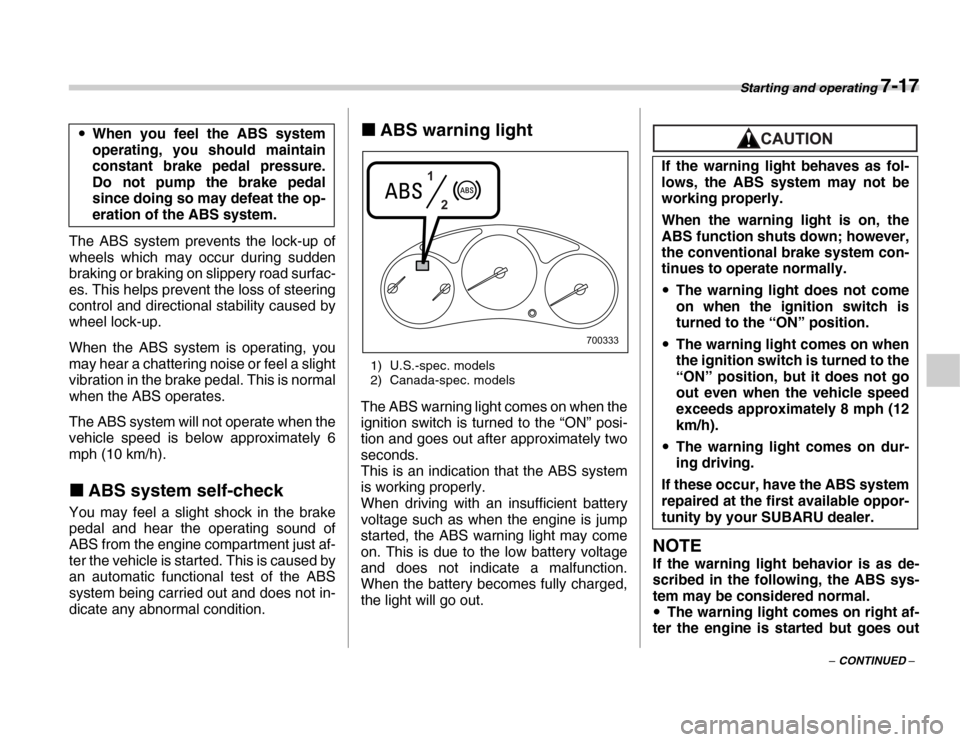
ABS warning light
1) U.S.-spec. models
2) Canada-spec. models
The ABS warning light comes on when the
ignition switch is turned to the “ON” posi-
tion and goes out after approximately two
seconds.
This is an indication that the ABS system
is working properly.
When driving with an insufficient battery
voltage such as when the engine is jump
started, the ABS warning light may come
on. This is due to the low battery voltage
and does not indicate a malfunction.
When the battery becomes fully charged,
the light will go out.
NOTE
If the warning light behavior is as de-
scribed in the following, the ABS sys-
tem may be considered normal. y The warning light comes on right af-
ter the engine is started but goes out
y
When you feel the ABS system
operating, you should maintain
constant brake pedal pressure.
Do not pump the brake pedal
since doing so may defeat the op-
eration of the ABS system.
1
2
700333 If the warning light behaves as fol-
lows, the ABS system may not be
working properly.
When the warning light is on, the
ABS function shuts down; however,
the conventional brake system con-
tinues to operate normally. y
The warning light does not come
on when the ignition switch is
turned to the “ON” position.
y The warning light comes on when
the ignition switch is turned to the
“ON” position, but it does not go
out even when the vehicle speed
exceeds approximately 8 mph (12
km/h).
y The warning light comes on dur-
ing driving.
If these occur, have the ABS system
repaired at the first available oppor-
tunity by your SUBARU dealer.
Page 273 of 356

11
Maintenance and service
Maintenance schedule ....................................... 11-3
Maintenance precautions .................................. 11-3Before checking or servicing in the engine compartment ........................................................ 11-4
When you do checking or servicing in the
engine compartment while the engine is
running .................................................................. 11-4
Engine hood ....................................................... 11-4
Engine compartment overview ......................... 11-6 Non-turbo models ................................................... 11-6
Turbo models .......................................................... 11-7
Engine oil ............................................................ 11-8 Checking the oil level ............................................. 11-8
Changing the oil and oil filter ................................ 11-8
Recommended grade and viscosity ..................... 11-10
Recommended grade and viscosity under severe driving conditions .................................... 11-11
Synthetic oil ............................................................ 11-11
Cooling system .................................................. 11-11 Cooling fan, hose and connections ...................... 11-12
Engine coolant ........................................................ 11-12
Air cleaner element ............................................ 11-15 Replacing the air cleaner element ......................... 11-15
Spark plugs ......................................................... 11-17 Recommended spark plugs ................................... 11-17
Drive belts ........................................................... 11-18
Manual transmission oil .................................... 11-18 Checking the oil level ............................................. 11-18 Recommended grade and viscosity ..................... 11-19
Automatic transmission fluid ............................ 11-20 Checking the fluid level .......................................... 11-20
Recommended fluid ............................................... 11-21
Front differential gear oil (AT vehicles) ............ 11-21 Checking the oil level ............................................. 11-21
Recommended grade and viscosity ..................... 11-22
Rear differential gear oil .................................... 11-22 Checking the gear oil level .................................... 11-22
Recommended grade and viscosity ..................... 11-23
Power steering fluid ........................................... 11-23 Checking the fluid level .......................................... 11-23
Recommended fluid ............................................... 11-24
Brake fluid ........................................................... 11-25 Checking the fluid level .......................................... 11-25
Recommended brake fluid ..................................... 11-25
Clutch fluid (MT vehicles) .................................. 11-26 Checking the fluid level .......................................... 11-26
Recommended clutch fluid .................................... 11-26
Brake booster ..................................................... 11-27
Brake pedal ......................................................... 11-27 Checking the brake pedal free play ...................... 11-27
Checking the brake pedal reserve distance ......... 11-27
Clutch pedal (MT vehicles) ................................ 11-28 Checking the clutch function ................................ 11-28
Checking the clutch pedal free play ..................... 11-28
Hill holder (MT vehicles – if equipped) ............. 11-28
Page 287 of 356
Maintenance and service 11 - 15
– CONTINUED –
Air cleaner element
The air cleaner element functions as a fil-
ter screen. When the element is perforat-
ed or removed, engine wear will be exces-
sive and engine life shortened.
The air cleaner element has a viscous
type and a dry type.
Be sure to use the appropriate type of air
cleaner element, which depends on the
vehicle type.
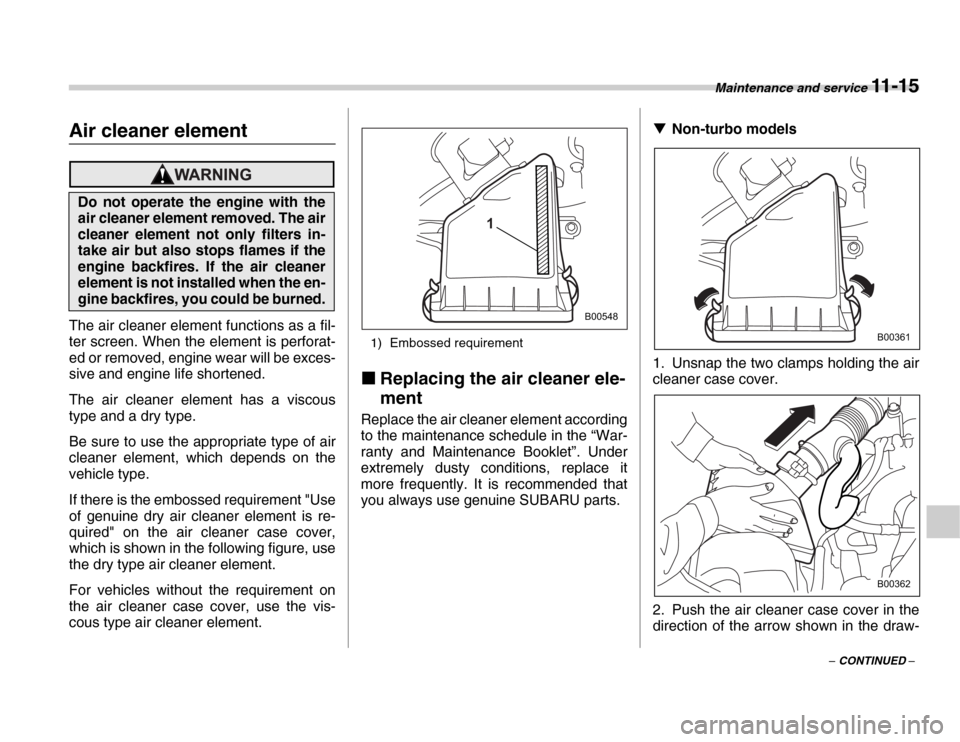
If there is the embossed requirement "Use
of genuine dry air cleaner element is re-
quired" on the air cleaner case cover,
which is shown in the following figure, use
the dry type air cleaner element.
For vehicles without the requirement on
the air cleaner case cover, use the vis-
cous type air cleaner element.1) Embossed requirement
„ Replacing the air cleaner ele- ment
Replace the air cleaner element according
to the maintenance schedule in the “War-
ranty and Maintenance Booklet”. Under
extremely dusty conditions, replace it
more frequently. It is recommended that
you always use genuine SUBARU parts. T
Non-turbo models
1. Unsnap the two clamps holding the air
cleaner case cover.
2. Push the air cleaner case cover in the
direction of the arrow shown in the draw-
Do not operate the engine with the
air cleaner element removed. The air
cleaner element not only filters in-
take air but also stops flames if the
engine backfires. If the air cleaner
element is not installed when the en-
gine backfires, you could be burned.
B00548
1
B00361
B00362
Page 289 of 356

Maintenance and service 11 - 17
3. Clean the inside of the air cleaner cov-
er and case with a damp cloth and install
a new air cleaner element.
4. To install the air cleaner case cover, in-
sert the two projections on the air cleaner
case cover into the slits on the air cleaner
case and then snap the two clamps on the
air cleaner case cover.Spark plugs
It may be difficult to replace the spark
plugs. It is recommended that you have
the spark plugs replaced by your
SUBARU dealer.
The spark plugs should be replaced ac-
cording to the maintenance schedule in
the “Warranty and Maintenance Booklet”.„
Recommended spark plugs
Non-turbo models:
FR5AP-11 (NGK)
Turbo models:
ILFR6B (NGK)
B00026
y When disconnecting the spark
plug cables, always grasp the
spark plug cap, not the cables.
y Make sure the cables are replaced
in the correct order.
B00027
Page 291 of 356

Maintenance and service 11 - 19
Turbo models
Check the oil level monthly.
1. Park the vehicle on a level surface and
stop the engine.
2. Pull out the dipstick, wipe it clean, and
insert it again. 1) Upper level
2) Lower level
3. Pull out the dipstick again and check
the oil level on it. If it is below the lower
level, add oil through the dipstick hole to
bring the level up to the upper level.
„ Recommended grade and
viscosity
Each oil manufacturer has its own base
oils and additives. Never use different
brands together.
Oil grade:
API classification GL-5
SAE viscosity No. and applicable tem-
perature
B00367 Be careful not to spill manual trans-
mission oil when adding it. If oil
touches the exhaust pipe, it may
cause a bad smell, smoke, and/or a
fire. If oil gets on the exhaust pipe,
be sure to wipe it off.
LF
F
L1
2 1
2
B00368
-30 -20 -10 0 10 20 30 40-20 0 60 20
80W 75W/90 80 100
40
85W 90
B00032
Page 330 of 356

12-8 Specifications
„Fuse panel located in the engine compartment
A) FWD socket
B) Main fuse
A 12 4
3 B
5
6 789
10 11 12 13
C00105
14
Fuse panelFuse ratingCircuit
130Ay
Radiator cooling fan (Main)
230AyRadiator cooling fan (Sub)
330AyABS motor
430AyEngine sensor (Non-turbo models only)
520AyRear window defogger
615AyHazard warning flasher
y Horn
715AyTurn signal lights
810AyAutomatic transmission control unit
910AyAlternator
1015AyHeadlight (right side)
1115AyHeadlight (left side)
1220AyLighting switch
1315AyClock
y Interior light
1410AySecondary air combination valve
(Turbo models only)