2007 SUBARU FORESTER odometer
[x] Cancel search: odometerPage 111 of 356

3
Instruments and controls
Ignition switch .................................................... 3-3LOCK ....................................................................... 3-3
ACC .......................................................................... 3-4
ON ............................................................................ 3-4
START ...................................................................... 3-4
Key reminder chime ............................................... 3-5
Ignition switch light (if equipped) ......................... 3-5
Key interlock release (AT vehicles only) .............. 3-5
Hazard warning flasher ...................................... 3-6
Meters and gauges ............................................. 3-6 Speedometer ........................................................... 3-6
Odometer/Trip meter .............................................. 3-6
Tachometer ............................................................. 3-7
Fuel gauge ............................................................... 3-7
Temperature gauge ................................................ 3-8
Outside temperature indicator .............................. 3-8
Warning and indicator lights ............................. 3-9 Seatbelt warning light and chime .......................... 3-9
SRS airbag system warning light .......................... 3-10
Front passenger’s frontal airbag ON and OFF indicators .............................................................. 3-11
CHECK ENGINE warning light/Malfunction indicator lamp ....................................................... 3-11
Charge warning light .............................................. 3-12
Oil pressure warning light ..................................... 3-12
AT OIL TEMPerature warning light (AT vehicles) ......................................................... 3-12
ABS warning light ................................................... 3-13
Brake system warning light ................................... 3-13
Door open warning lights ...................................... 3-14 Low fuel warning light ............................................ 3-14
All-Wheel Drive warning light (AT vehicles) ......... 3-15
Shift position indicator (AT vehicles) ................... 3-15
Turn signal indicator lights .................................... 3-15
High beam indicator light ....................................... 3-15
Cruise control indicator light ................................. 3-15
Cruise control set indicator light .......................... 3-16
Clock .................................................................... 3-16
Light control switch ........................................... 3-17 Headlights ............................................................... 3-17
High/low beam change (dimmer) .......................... 3-17
Headlight flasher ..................................................... 3-18
Daytime running light system ............................... 3-18
Turn signal lever ................................................. 3-19
Illumination brightness control ......................... 3-19
Headlight beam leveler (Canada-spec. 2.5XT) ............................................................... 3-20
Parking light switch ........................................... 3-20
Front fog light button ......................................... 3-20
Wiper and washer ............................................... 3-21 Windshield wiper and washer switches ............... 3-22
Rear window wiper and washer switch ................ 3-23
Windshield wiper deicer (if equipped) .............. 3-24
Rear window defogger button ........................... 3-24
Mirrors ................................................................. 3-25 Inside mirror ............................................................ 3-25
Outside mirrors ....................................................... 3-27
Page 116 of 356
3-6 Instruments and controls
Hazard warning flasher
The hazard warning flasher is used to
warn other drivers when you have to park
your vehicle under emergency conditions.
The hazard warning flasher works with the
ignition switch in any position.
To turn on the hazard warning flasher,
push the hazard warning button on the in-
strument panel. To turn off the flasher,
push the button again.
NOTE
When the hazard warning flasher is on,
the turn signals do not work.
Meters and gauges „ Speedometer
The speedometer shows the vehicle
speed. „ Odometer/Trip meter
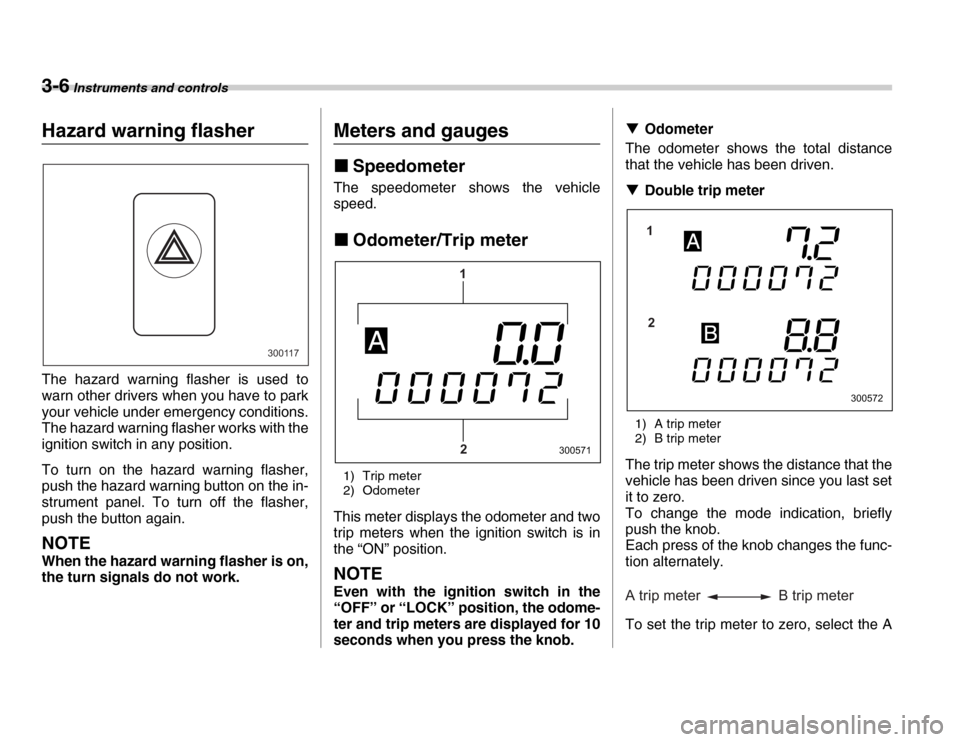
1) Trip meter
2) Odometer
This meter displays the odometer and two
trip meters when the ignition switch is in
the “ON” position.
NOTE
Even with the ignition switch in the
“OFF” or “LOCK” position, the odome-
ter and trip meters are displayed for 10
seconds when you press the knob. T
Odometer
The odometer shows the total distance
that the vehicle has been driven. T Double trip meter
1) A trip meter
2) B trip meter
The trip meter shows the distance that the
vehicle has been driven since you last set
it to zero.
To change the mode indication, briefly
push the knob.
Each press of the knob changes the func-
tion alternately.
To set the trip meter to zero, select the A
300117
1
2
300571
1 2
300572
A trip meter B trip meter
Page 119 of 356

Instruments and controls 3-9
– CONTINUED –
AT vehicles
1) U.S.-spec. models
2) Canada-spec. models
The outside temperature indicator is locat-
ed below the odometer/trip meter. The in-
dicator can indicate an outside tempera-
ture ranging from –22 to 122 qF (–30 to
50 qC).
The indicator can give a false reading un-
der any of the following conditions: y When there is too much sun.
y During idling; while running at low
speeds in a traffic jam; when the engine is
restarted immediately following a shut-
down. y When the actual outside temperature
falls outside the specified indicator range.
Warning and indicator lights
Several of the warning and indicator lights
come on momentarily and then go out
when the ignition switch is initially turned
to the “ON” position. This permits check-
ing the operation of the bulbs.
Apply the parking brake and turn the igni-
tion switch to the “ON” position. The fol-
lowing lights come on:
: Seatbelt warning light
: SRS airbag system warning light
/ : Front passenger’s frontal air-
bag ON indicator light
/ : Front passenger’s frontal
airbag OFF indicator light
: CHECK ENGINE warning light/
Malfunction indicator lamp
: Charge warning light : Oil pressure warning light
: AT OIL temperature warning light
(AT vehicles) / : ABS warning light
/ : Brake system warning light : All-Wheel Drive warning light (AT
vehicles)
: Cruise control indicator light
: Cruise control set indicator light
If any lights fail to come on, it indicates a
burned-out bulb or a malfunction of the
corresponding system.
Consult your authorized SUBARU dealer
for repair.
„ Seatbelt warning light and chime
Your vehicle is equipped with a seatbelt
warning device at the driver’s seat, as re-
quired by current safety standards. There
is a seatbelt warning light in the combina-
tion meter.
If the driver has not yet fastened the seat-
belt when the ignition switch is turned to
the “ON” position, the seatbelt warning
light will flash for 6 seconds, to warn that
the seatbelt is unfastened. If the driver’s
seatbelt is not fastened, a chime will also
sound simultaneously.
If the driver’s seatbelt is still not fastened
12
300576
Page 229 of 356

Driving tips 8-5
Driving tips for AWD vehicles
All-Wheel Drive distributes the engine
power to all four wheels. AWD vehiclesprovide better traction when driving on
slippery, wet or snow-covered roads and
when moving out of mud, dirt and sand. By
shifting power between the front and rear
wheels, SUBARU AWD can also provide
added traction during acceleration and
added engine braking force during decel-
eration.
Therefore, your SUBARU AWD vehicle
may handle differently than an ordinary
two wheel drive vehicle and it contains
some features unique to AWD. For safety
purposes as well as to avoid damaging
the AWD system, you should keep the fol-
lowing tips in mind: y
An AWD vehicle is better able to climb
steeper roads under snowy or slippery
conditions than a two wheel drive vehicle.
There is little difference in handling, how-
ever, during extremely sharp turns or sud-
den braking. Therefore, when driving
down a slope or turning corners, be sure
to reduce your speed and maintain an am-
ple distance from other vehicles. y When replacing a tire, make sure you
use only the same size, construction,
brand, and load range as the original tires
listed on the tire placard. Using other sizes
or construction may result in severe me-
chanical damage to the drive train of your
vehicle and may affect ride, handling, braking, speedometer/odometer calibra-
tion, and clearance between the body and
tires. It also may be dangerous and lead to
loss of vehicle control. y
Always check the cold tire pressure be-
fore starting to drive. The recommended
tire pressure is provided on the tire plac-
ard, which is located under the door latch
on the driver’s side. y Tire chains should always be placed on
the front wheels only. y There are some precautions that you
must observe when towing your vehicle.
For detail information, see the “Towing”
section in chapter 9.
y Always maintain a safe driving
speed according to the road and
weather conditions in order to
avoid having an accident on a
sharp turn, during sudden braking
or under other similar conditions.
yAlways use the utmost care in
driving – overconfidence because
you are driving an All-Wheel Drive
vehicle could easily lead to a seri-
ous accident.
800004
Page 234 of 356

8-10 Driving tips
zero temperatures. Blades of this type
give superior wiping performance in
snowy conditions. Be sure to use blades
that are suitable for your vehicle.
NOTE
When the season requiring non-freez-
ing type wiper blades is over, replace
them with standard wiper blades. „Corrosion protection
Refer to the “Corrosion protection” section
(chapter 10). „
Snow tires
Your vehicle is equipped with “all season
tires” as original equipment, which are de-
signed to provide an adequate measure of
traction, handling and braking perfor-
mance in year-round driving. In winter, it
may be possible to enhance performance
through use of tires designed specifically
for winter driving conditions.
When you choose to install winter tires on
your vehicle, be sure to use the correct tire
size and type. You must install four winter
tires that are of the same size, construc-
tion, brand and load range and you should
never mix radial, belted bias or bias tires
since this may result in dangerous han-
dling characteristics. When you choose a
tire, make sure that there is enough clear-
ance between the tire and vehicle body.
Remember to drive with care at all times
regardless of the type of tires on your ve-
hicle. „Tire chains
Driving on snowy grades or icy roads may
require the use of tire chains, in which
case put the chains on the front wheels
only. Use only SAE class S type chains
that are of the correct size for your tires so
as not to damage the vehicle body or sus-
pension.
When driving with tire chains, drive at
During high-speed driving, non-
freezing type wiper blades may not
perform as well as standard wiper
blades. If this happens, reduce the
vehicle speed.
y
When replacing original tires with
winter (snow) tires, make sure you
use only the same size, construc-
tion and load range as the original
tires listed on the tire placard. Us-
ing other sizes and construction
may affect speedometer/odome-
ter calibration and clearance be-
tween the body and tires. It also
may be dangerous and lead to
loss of vehicle control.
yYou must install four winter tires
that are of the same size, con-
struction, brand, and load range.
Mixing other sizes or construc-
tions may result in severe me-
chanical damage to the drive train
of your vehicle and may affect
ride, handling, braking and speed-
ometer/odometer calibration. It
also may be dangerous and lead
to loss of vehicle control.
yDo not use a combination of radi-
al, belted bias or bias tires since it
may cause dangerous handling
characteristics and lead to an ac-
cident.
Page 306 of 356

11 - 3 4 Maintenance and service
„Tire rotation
Vehicles equipped with unidirectional tires
1) Front
Vehicles equipped with 4 non-unidirec-
tional tires
1) Front Tire wear varies from wheel to wheel. To
maximize the life of each tire and ensure
that the tires wear uniformly, it is best to
rotate the tires every 7,500 miles (12,500
km). Move the tires to the positions shown
in the illustration each time they are rotat-ed.
Replace any damaged or unevenly worn
tire at the time of rotation. After tire rota-
tion, adjust the tire pressures and make
sure the wheel nuts are correctly tight-
ened.
After driving approximately 600 miles
(1,000 km), check the wheel nuts again
and retighten any nut that has become
loose. „
Tire replacement
The wheels and tires are important and in-
tegral parts of your vehicle’s design; they
cannot be changed arbitrarily. The tires fit-
ted as standard equipment are optimally
matched to the characteristics of the vehi-
cle and were selected to give the best pos-
sible combination of running performance,
ride comfort, and service life. It is essential
for every tire to have a size and construc-
tion matching those shown on the tire
placard and to have a speed symbol and
load index matching those shown on the
tire placard. Using tires of a non-specified size detracts
from controllability, ride comfort, braking
performance, speedometer accuracy and
odometer accuracy. It also creates incor-
rect body-to-tire clearances and inappro-
priately changes the vehicle’s ground
clearance.
All four tires must be the same in terms of
manufacturer, brand (tread pattern), con-
struction, and size. You are advised to re-
place the tires with new ones that are
identical to those fitted as standard equip-
ment.
For safe vehicle operation, SUBARU rec-
ommends replacing all four tires at the
same time.
1
B00545
1
B00546
y
All four tires must be the same in
terms of manufacturer, brand
(tread pattern), construction, de-
gree of wear, speed symbol, load
index and size. Mixing tires of dif-
ferent types, sizes or degrees of
wear can result in damage to vehi-
cle’s power train. Use of different
types or sizes of tires can also
dangerously reduce controllabili-
ty and braking performance and
can lead to an accident.
Page 351 of 356

Index 14-5
M
Main fuse ........................................................................ 11-42
MaintenancePrecautions .................................................................. 11-3
Schedule ...................................................................... 11-3
Seatbelt ....................................................................... 1-19
Tools ............................................................................ 9-14
Malfunction indicator lamp ................................................ 3-11
Manual
Climate control system .................................................. 4-3
Seat ............................................................................... 1-3
Transmission ................................................................. 7-9
Transmission oil ......................................................... 11-18
Map lights ........................................................................... 6-3
Maximum load limits ......................................................... 8-18
Meters and gauges ............................................................. 3-6
Mirrors .............................................................................. 3-25
Moonroof ................................................................. 2-21, 9-13 N
New vehicle break-in driving ............................................... 8-2 O
Odometer/Trip meter .......................................................... 3-6
Off road driving ................................................................... 8-6
Oil filter ............................................................................. 11-8
Oil level
Engine ......................................................................... 11-8
Manual transmission .................................................. 11-18
Rear differential ......................................................... 11-22
Oil pressure warning light ................................................. 3-12 Outside mirrors ................................................................. 3-27
Outside temperature indicator ............................................ 3-8
Overhead console ............................................................... 6-6 P
Parking brake ......................................................... 7-20, 11-30
Stroke ......................................................................... 11-30
Parking light switch ........................................................... 3-20
Parking your vehicle ......................................................... 7-19
Periodic inspections ............................................................ 8-4
Pocket ................................................................................. 6-7 Power
Door locking switches .................................................... 2-6
Seat ................................................................................ 1-4
Steering ........................................................................ 7-15
Steering fluid level ...................................................... 11-23
Windows ...................................................................... 2-18
R
Rear Combination lights ..................................................... 11-47
Differential gear oil level ............................................. 11-22
Gate .................................................................... 2-20, 9-13
Seats .............................................................................. 1-7
Viscous limited slip differential (LSD) ........................... 7-15
Rear window
Defogger button ........................................................... 3-24
Wiper and washer switch ............................................. 3-23
Wiper blade ................................................................ 11-38
Remote keyless entry system ............................................. 2-6