2007 SUBARU FORESTER engine oil
[x] Cancel search: engine oilPage 204 of 356
7-6 Starting and operating
not damage an AWD SUBARU vehicle.
Under no circumstances should the rear
wheels be jacked off the ground, nor
should the driveshaft be disconnected for
state emission testing.
The EPA has issued regulations for in-
specting the On-Board Diagnostic (OBD)
system as part of the state emissions in-
spection. The OBD system is designed to
detect engine and transmission problems
that might cause vehicle emissions to ex-
ceed allowable limits. These inspections
apply to all 1996 model year and newer
passenger cars and light trucks. Over 30
states plus the District of Columbia have
implemented the OBD system inspection. yThe inspection of the OBD system con-
sists of a visual operational check of the
“CHECK ENGINE” warning light/mal-
function indicator lamp (MIL) and an ex-
amination of the OBD system with an
electronic scan tool while the engine is
running y A vehicle passes
the OBD system in-
spection if proper the “CHECK ENGINE”
warning light/MIL illumination is observed,
there is no stored diagnostic trouble
codes, and the OBD system readiness
monitors are complete. y A vehicle fails
the OBD inspection if the “CHECK ENGINE”
warning light/MIL is
not properly operating or there is one or
more diagnostic trouble codes stored in
vehicle’s computer with the “CHECK EN-
GINE” warning light/MIL illuminated.
y A state emission inspection may reject
(not pass or fail) a vehicle if the number of
OBD system readiness monitors “Not
Ready” is greater than one. Under this
condition, the vehicle operator should be
instructed to drive his/her vehicle for a few
days to set the monitors and return for an
emission re-inspection. y Owners of rejected or failing vehicles
should contact their SUBARU Dealer for
service.
Preparing to drive
You should perform the following checks
and adjustments every day before you
start driving.
1. Check that all windows, mirrors, and
lights are clean and unobstructed.
2. Check the appearance and condition of
the tires. Also check tires for proper infla-
tion.
3. Look under the vehicle for any sign of
leaks.
4. Check that the hood and rear gate are
fully closed.
5. Check the adjustment of the seat.
6. Check the adjustment of the inside and
outside mirrors.
7. Fasten your seatbelt. Check that your
passengers have fastened their seatbelts.
8. Check the operation of the warning and
indicator lights when the ignition switch is
turned to the “ON” position.
9. Check the gauges, indicator and warn-
ing lights after starting the engine.
NOTE
Engine oil, engine coolant, brake fluid,
washer fluid and other fluid levels
should be checked daily, weekly or at
fuel stops.
Page 231 of 356
Driving tips 8-7
– CONTINUED –
thrown around in the vehicle and cause in-
jury. Do not pile heavy loads on the roof.
Those loads raise the vehicle’s center of
gravity and make it more prone to tip over. y
If you must rock the vehicle to free it
from sand or mud, depress the accelera-
tor pedal slightly and move the selector le-
ver back and forth between “D” and “R” re-
peatedly. Do not race the engine. For the
best possible traction, avoid spinning the
wheels when trying to free the vehicle.
When the road surface is extremely slip-
pery, you can obtain better traction by
starting the vehicle with the transmission
in 2nd than 1st (both for MT and AT). y Never equip your vehicle with tires larg-
er than those specified in this manual.y Frequent driving of an AWD vehicle un-
der hard-driving conditions such as rough
roads or off roads will necessitate more
frequent replacement of engine oil, brake
fluid and transmission oil than that speci-
fied in the maintenance schedule de-
scribed in the “Warranty and Maintenance
Booklet”.
Remember that damage done to your
SUBARU while operating it off-road and
not using common sense precautions
such as those listed above is not eligible
for warranty coverage.y Wash the vehicle’s underbody after off-
road driving. Suspension components are particularly prone to dirt buildup, so they
need to be washed thoroughly.
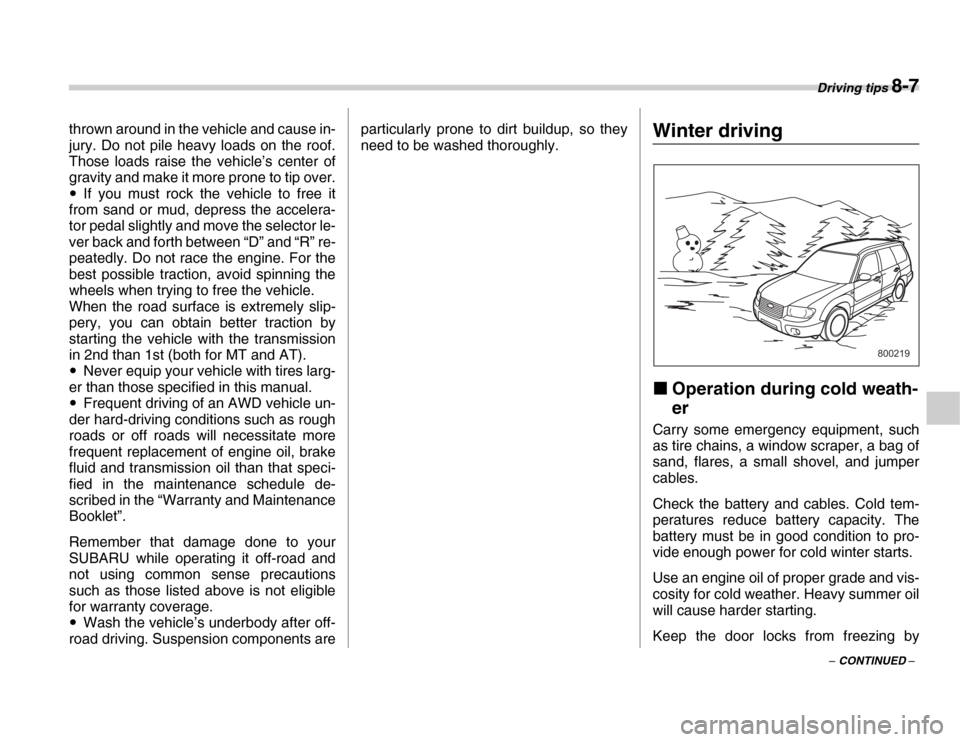
Winter driving „
Operation during cold weath- er
Carry some emergency equipment, such
as tire chains, a window scraper, a bag of
sand, flares, a small shovel, and jumper
cables.
Check the battery and cables. Cold tem-
peratures reduce battery capacity. The
battery must be in good condition to pro-
vide enough power for cold winter starts.
Use an engine oil of proper grade and vis-
cosity for cold weather. Heavy summer oil
will cause harder starting.
Keep the door locks from freezing by
800219
Page 248 of 356

8-24 Driving tips
olution. yAvoid uneven steering, sharp turns and
rapid lane changes. y Slow down before turning. Make a long-
er than normal turning radius because the
trailer wheels will be closer than the vehi-
cle wheels to the inside of the turn. In a
tight turn, the trailer could hit your vehicle. y Crosswinds will adversely affect the
handling of your vehicle and trailer, caus-
ing sway. Crosswinds can be due to
weather conditions or the passing of large
trucks or buses. If swaying occurs, firmly
grip the steering wheel and slow down im-
mediately but gradually. y When passing other vehicles, consider-
able distance is required because of the
added weight and length caused by at-
taching the trailer to your vehicle. 1) Left turn
2) Right turn
y Backing up with a trailer is difficult and
takes practice. When backing up with a
trailer, never accelerate or steer rapidly.
When turning back, grip the bottom of the
steering wheel with one hand and turn it to
the left for a left turn, and turn it to the right
for a right turn.y If the ABS warning light illuminates
while the vehicle is in motion, stop towing
the trailer and have repairs performed im-
mediately by the nearest SUBARU dealer. T Driving on grades
y Before going down a steep hill, slow
down and shift into lower gear (if neces-
sary, use 1st gear) in order to utilize the
engine braking effect and prevent over- heating of your vehicle’s brakes. Do not
make sudden downshifts. y
When driving uphill in hot weather, the
air conditioner may turn off automatically
to protect the engine from overheating. y When driving uphill in hot weather, pay
attention to the water temperature gauge
pointer (for all vehicles) and AT OIL TEMP
warning light (for AT vehicles) since the
engine and transmission are relatively
prone to overheating under these condi-
tions. If the water temperature gauge
pointer approaches the OVERHEAT zone
or the AT OIL TEMP warning light illumi-
nates, immediately switch off the air con-
ditioner and stop the vehicle at the nearest
safe place. Refer to the “Engine overheat-
ing” section in chapter 9, and “Warning
and indicator lights” section in chapter 3. y If your vehicle has an automatic trans-
mission, avoid using the accelerator pedal
to stay stationary on an uphill slope in-
stead of using the parking brake or foot
brake. That may cause the transmission
fluid to overheat. y If your vehicle has an automatic trans-
mission, place the selector lever as fol-
lows:
Uphill slopes: “D” position
Downhill slopes: A low-speed gear posi-
tion to use engine braking
1 2
800231
Page 260 of 356

9-10 In case of emergency
Engine overheating
If the engine overheats, safely pull off the
road and stop the vehicle in a safe place. „If steam is coming from the
engine compartment
Turn off the engine and get everyone
away from the vehicle until it cools down. „ If no steam is coming from
the engine compartment
1. Keep the engine running at idling
speed.
2. Open the hood to ventilate the engine
compartment.
Confirm that the cooling fan is turning. If
the fan is not turning, immediately turn off the engine and contact your authorized
dealer for repair.
3. After the engine coolant temperature
has dropped, turn off the engine.
If the temperature gauge stays at the
overheated zone, turn off the engine.
4. After the engine has fully cooled down,
check the coolant level in the reserve
tank.
If the coolant level is below the “LOW”
mark, add coolant up to the “FULL” mark.
5. If there is no coolant in the reserve
tank, add coolant to the reserve tank.
Then remove the radiator cap and fill the
radiator with coolant.
If you remove the radiator cap from a hot
radiator, first wrap a thick cloth around the
radiator cap, then turn the cap counter-
clockwise slowly without pressing down
until it stops. Release the pressure from
the radiator. After the pressure has been
fully released, remove the cap by pressing
down and turning it.
Towing
If towing is necessary, it is best done by
your SUBARU dealer or a commercial
towing service. Observe the following pro-
cedures for safety.
Never attempt to remove the radia-
tor cap until the engine has been
shut off and has fully cooled down.
When the engine is hot, the coolant
is under pressure. Removing the
cap while the engine is still hot
could release a spray of boiling hot
coolant, which could burn you very
seriously.Never tow AWD vehicles (both AT
and MT) with the front wheels raised
off the ground while the rear wheels
are on the ground, or with the rear
wheels raised off the ground while
the front wheels are on the ground.
This will cause the vehicle to spin
away due to the operation or deteri-
oration of the center differential.
900014
Page 262 of 356

9-12 In case of emergency
„Using a flat-bed truck
This is the best way to transport your vehi-
cle. Use the following procedures to en-
sure safe transportation.
1. Shift the selector lever into the “P” po-
sition for automatic transmission vehicles
or “1st” for manual transmission vehicles.
2. Pull up the parking brake lever firmly.
3. Secure the vehicle onto the carrier
properly with safety chains. Each safety
chain should be equally tightened and
care must be taken not to pull the chains
so tightly that the suspension bottoms out. „
Towing with all wheels on the ground
1. Check the transmission and differential
oil levels and add oil to bring it to the upper
level if necessary.
2. Release the parking brake and put the
transmission in neutral.
3. The ignition switch should be in the
“ACC” position while the vehicle is being
towed.
4. Take up slack in the towline slowly to
prevent damage to the vehicle.
900018
yNever turn the ignition switch to
the “LOCK” position while the ve-
hicle is being towed because the
steering wheel and the direction
of the wheels will be locked.
yRemember that the brake booster
and power steering do not func-
tion when the engine is not run-
ning. Because the engine is
turned off, it will take greater ef-
fort to operate the brake pedal and
steering wheel.
900019
yIf transmission failure occurs,
transport your vehicle on a flat-
bed truck.
y Do not run the engine while being
towed using this method. Trans-
mission damage could result if
the vehicle is towed with the en-
gine running.
y For vehicles with automatic trans-
mission, the traveling speed must
be limited to less than 20 mph (30
km/h) and the traveling distance
to less than 31 miles (50 km). For
greater speeds and distances,
transport your vehicle on a flat-
bed truck.
Page 273 of 356

11
Maintenance and service
Maintenance schedule ....................................... 11-3
Maintenance precautions .................................. 11-3Before checking or servicing in the engine compartment ........................................................ 11-4
When you do checking or servicing in the
engine compartment while the engine is
running .................................................................. 11-4
Engine hood ....................................................... 11-4
Engine compartment overview ......................... 11-6 Non-turbo models ................................................... 11-6
Turbo models .......................................................... 11-7
Engine oil ............................................................ 11-8 Checking the oil level ............................................. 11-8
Changing the oil and oil filter ................................ 11-8
Recommended grade and viscosity ..................... 11-10
Recommended grade and viscosity under severe driving conditions .................................... 11-11
Synthetic oil ............................................................ 11-11
Cooling system .................................................. 11-11 Cooling fan, hose and connections ...................... 11-12
Engine coolant ........................................................ 11-12
Air cleaner element ............................................ 11-15 Replacing the air cleaner element ......................... 11-15
Spark plugs ......................................................... 11-17 Recommended spark plugs ................................... 11-17
Drive belts ........................................................... 11-18
Manual transmission oil .................................... 11-18 Checking the oil level ............................................. 11-18 Recommended grade and viscosity ..................... 11-19
Automatic transmission fluid ............................ 11-20 Checking the fluid level .......................................... 11-20
Recommended fluid ............................................... 11-21
Front differential gear oil (AT vehicles) ............ 11-21 Checking the oil level ............................................. 11-21
Recommended grade and viscosity ..................... 11-22
Rear differential gear oil .................................... 11-22 Checking the gear oil level .................................... 11-22
Recommended grade and viscosity ..................... 11-23
Power steering fluid ........................................... 11-23 Checking the fluid level .......................................... 11-23
Recommended fluid ............................................... 11-24
Brake fluid ........................................................... 11-25 Checking the fluid level .......................................... 11-25
Recommended brake fluid ..................................... 11-25
Clutch fluid (MT vehicles) .................................. 11-26 Checking the fluid level .......................................... 11-26
Recommended clutch fluid .................................... 11-26
Brake booster ..................................................... 11-27
Brake pedal ......................................................... 11-27 Checking the brake pedal free play ...................... 11-27
Checking the brake pedal reserve distance ......... 11-27
Clutch pedal (MT vehicles) ................................ 11-28 Checking the clutch function ................................ 11-28
Checking the clutch pedal free play ..................... 11-28
Hill holder (MT vehicles – if equipped) ............. 11-28
Page 276 of 356

11 - 4 Maintenance and service
„Before checking or servicing
in the engine compartment
„When you do checking or ser-
vicing in the engine compart-
ment while the engine is run-ning
Engine hood
0
To open the hood:
1. If the wiper blades are lifted off the
windshield, return them to their original
positions.
2. Pull the hood release knob under the
instrument panel.
yWear adequate eye protection to
guard against getting oil or fluids
in your eyes. If something does
get in your eyes, thoroughly wash
them out with clean water.
yDo not tamper with the wiring of
the SRS airbag system or seatbelt
pretensioner system, or attempt
to take its connectors apart, as
that may activate the system or it
can render it inoperative. The wir-
ing and connectors of these sys-
tems are yellow for easy identifi-
cation. NEVER use a circuit tester
for these wiring.
If your SRS airbag or seatbelt pre-
tensioner needs service, consult
your nearest SUBARU dealer.
yAlways stop the engine and set
the parking brake firmly to pre-
vent the vehicle from moving.
yAlways let the engine cool down.
Engine parts become very hot
when the engine is running and
remain hot for some time after the
engine is stopped.
yDo not spill engine oil, engine
coolant, brake fluid or any other
fluid on hot engine components.
This may cause a fire.
yAlways remove the key from the
ignition switch. When the ignition
switch is in the “ON” position, the
cooling fan may operate suddenly
even when the engine is stopped.
A running engine can be dangerous.
Keep your fingers, hands, clothing,
hair and tools away from the cooling
fan, belts and any other moving en-
gine parts. Removing rings, watch-
es and ties is advisable.
B00002
Page 278 of 356

11 - 6 Maintenance and service
Engine compartment overview „Non-turbo models
12 3 456
7
8
9
10
11
13 12
B00357 1) Air cleaner element (page 11-15)
2) Manual transmission oil level gauge
(MT) (page 11-18) or Differential gear
oil level gauge (AT) (page 11-21)
3) Clutch fluid reservoir (page 11-26)
4) Automatic transmission fluid level gauge (page 11-20)
5) Brake fluid reservoir (page 11-25)
6) Fuse box (page 11-41)
7) Battery (page 11-40)
8) Windshield washer tank (page 11-35)
9) Engine coolant reservoir (page 11- 11)
10) Engine oil level gauge (page 11-8)
11) Engine oil filler cap (page 11-8)
12) Radiator cap (page 11-11)
13) Power steering fluid reservoir (page 11-23)