2007 SKODA OCTAVIA lock
[x] Cancel search: lockPage 68 of 288

Seats and Stowage67
Using the systemSafetyDriving TipsGeneral MaintenanceBreakdown assistanceTechnical Data
Seats and Stowage
Front seats
Basic information
The front seats have a wide range of differ ent settings and can thus be matched to
the physical characteristics of the driver and front passenger. Correct adjustment of
the seats is particularly important for
•safely and quickly reaching the controls,
•a relaxed, fatigue-free body position,
•achieving the maximum protection offere d by the seat belts and the airbag
system.
WARNING
•Never transport more occupants than the maximum seating in the
vehicle.
•Each occupant must correctly fasten the seat belt belonging to the seat.
Children must be fastened ⇒page 173, “Transporting children safely” with
a suitable restraint system.
•The front seats and the head restraints must always be adjusted to match
the body size of the seat occupant as well as the seat belts must always be
correctly fastened in order to provide an optimal protection for you and your
occupants.
•Always keep your feet in the footwell when the car is being driven - never
place your feet on the instrument panel, out of the window or on the
surfaces of the seats. This is particularly important for the front seat
passenger. You will be exposed to increa sed risk of injury if it becomes
necessary to apply the brake or in the ev ent of an accident. If an airbag is
deployed, you may suffer fatal injuries when adopting an incorrect seated
position!
•It is important for the driver and front passenger to maintain a distance
of at least 25 cm from the steering wheel or dash panel. Not maintaining this minimum distance will mean that the airb
ag system will not be able to prop-
erly protect you - hazard! The front seats and the head restraints must
always also be correctly adjusted to match the body size of the occupant.
•Ensure that there are no objects in the footwell as any objects may get
behind the pedals during a driving or braking manoeuvre. You would then
no longer be able to operate the clutch, to brake or accelerate.
Adjusting the front seats
Adjusting a seat in a forward/back direction
–Pull the lever ⇒fig. 59 up and push the seat into the desired posi-
tion.
– Release the lever and push the seat further until the lock is heard to engage.
Adjusting height of seat*
– Lift the seat if required by pulling or pumping lever upwards.
WARNING (continued)
Fig. 59 Controls at seat
A1
A1
A2
NKO A5 20 MR08.book Page 67 Wednesday, April 11, 2007 2:54 PM
Page 71 of 288

Seats and Stowage
70
•Each time you store the seat and exterior mirror settings for driving forward you
also have to re-store the individual settin g of the exterior mirror on the passenger
side for reversing.
Assigning remote control to the memory buttons
After storing the settings of the seat and exterior mirrors, you have 10
seconds in order to assign the remote control to the appropriate memory
button.
– Withdraw the ignition key.
– Press the button for unlocking the vehicle ⇒page 42. The setting is
stored with the memory button which you have selected.
If you wish to be able to retrieve the settings which are stored in the memory by also
using the remote control, you have to assign the remote control to a memory
button in each case.
If you wish, you can obtain an additional key with radio remote control from a
Škoda dealer and then assign the radio remote control to another memory button.
Note
•If the remote control had previously been assigned to another memory button,
this setting is then erased by the new assignment.
•If you assign the remote control to a memory button which has already been
assigned to a remote control, the old assi gnment is also replaced by a new assign-
ment in this case.
•T h e a s s i g n m e n t o f t h e re m o te c o n tro l t o a m e m o r y b u tt o n i s re t a i n e d , h o w e v e r,
after reassigning the seats and exterior mirrors.
Retrieving settings of the seat and mirrors
You can retrieve the stored settings either with the memory buttons
or with the remote control*.
Retrieving settings with memory buttons
– In order to retrieve the stored setting, you have two possibilities:
– One-touch automatic memory: Briefly press the desired memory
button ⇒page 69, fig. 61 . The seat and exterior mirror are moved
automatically into the stored positions (this applies only if the ignition
is switched on and the speed is less than 5 km/h).
– Memory keying : Press and hold the desired memory button
pressed long enough until the seat and the exterior mirror are moved
into the stored positions.
Retrieving settings with remote control
– If the driver door is closed and the ignition is switched off, briefly press the unlock button of the remote control ⇒page 42 and then open the
driver door.
– The seat and exterior mirrors now move automatically into the stored
positions.
Retrieving setting of exterior mirror for reversing*
– Turn the rotary knob for the exterior mirror setting into the position
⇒ page 65 before engaging the reverse gear.
The mirror returns back into its initial position, after the rotary knob is moved out
of the position and put into another position or if the speed is more than 15 km/h.
Emergency Off
You can interrupt the setting operation at any time, if you operate any button of the
driver seat.
AB
AB
NKO A5 20 MR08.book Page 70 Wednesday, April 11, 2007 2:54 PM
Page 72 of 288
Seats and Stowage71
Using the systemSafetyDriving TipsGeneral MaintenanceBreakdown assistanceTechnical Data
Head restraints
Best protection is achieved if the top edge of the head restraint is at the
same level as the upper part of your head.
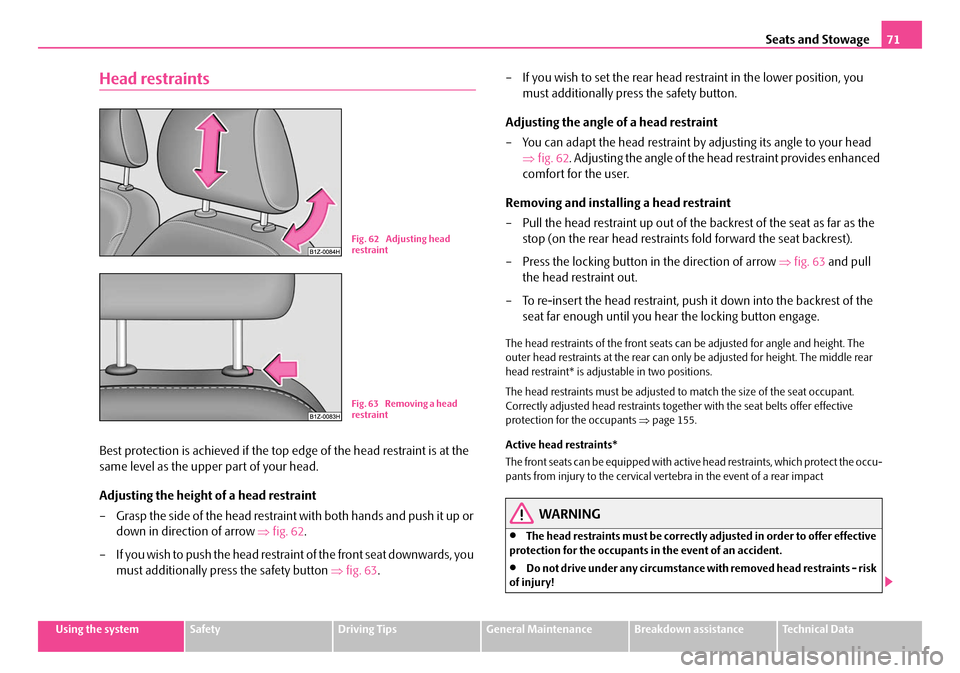
Adjusting the height of a head restraint
– Grasp the side of the head restraint with both hands and push it up or
down in direction of arrow ⇒fig. 62 .
– If you wish to push the head restra int of the front seat downwards, you
must additionally press the safety button ⇒fig. 63 . – If you wish to set the rear head restraint in the lower position, you
must additionally press the safety button.
Adjusting the angle of a head restraint
– You can adapt the head restraint by adjusting its angle to your head
⇒ fig. 62 . Adjusting the angle of the head restraint provides enhanced
comfort for the user.
Removing and installing a head restraint
– Pull the head restraint up out of the backrest of the seat as far as the
stop (on the rear head restraints fold forward the seat backrest).
– Press the locking button in the direction of arrow ⇒fig. 63 and pull
the head restraint out.
– To re-insert the head restraint, push it down into the backrest of the
seat far enough until you hear the locking button engage.
The head restraints of the front seats can be adjusted for angle and height. The
outer head restraints at the rear can only be adjusted for height. The middle rear
head restraint* is adjustable in two positions.
The head restraints must be adjusted to match the size of the seat occupant.
Correctly adjusted head restraints together with the seat belts offer effective
protection for the occupants ⇒page 155.
Active head restraints*
The front seats can be equipped with active head restraints, which protect the occu-
pants from injury to the cervical vertebra in the event of a rear impact
WARNING
•The head restraints must be correctly adjusted in order to offer effective
protection for the occupants in the event of an accident.
•Do not drive under any circumstance with removed head restraints - risk
of injury!
Fig. 62 Adjusting head
restraint
Fig. 63 Removing a head
restraint
NKO A5 20 MR08.book Page 71 Wednesday, April 11, 2007 2:54 PM
Page 73 of 288

Seats and Stowage
72
•If the rear seats are occupied, the rear head restraint must not be in the
lower position.
Middle rear head restraint*
IIn certain countries national legal pr ovisions also require the equipment
of the rear seat with fixing eyes for child seat using the “Top Tether” system
⇒ page 180. For vehicles, which are equipped with such fixing eyes, a
deviating sequence for removing the middle head restraint must be
observed.
Removing and installing the rear middle head restraint
– Pull the head restraint out of the backrest of the seat as far as the stop.
– Press the locking button in the di rection of arrow , press simultane-
ously the locking button into the opening using a flat screwdriver
with a width of maximum 5 mm an d pull out the head restraint.
– To re-insert the head restraint, push it down into the backrest of the seat far enough until you hear the locking button engage.
WARNING
•The head restraints must be correctly adjusted in order to offer effective
protection for the occupants in the event of an accident.
•Do not drive under any circumstance with removed head restraints - risk
of injury!
•If the rear seats are occupied, the rear head restraint must not be in the
lower position.
WARNING (continued)
Fig. 64 Rear seats:
middle head restraint
AA
AB
NKO A5 20 MR08.book Page 72 Wednesday, April 11, 2007 2:54 PM
Page 74 of 288

Seats and Stowage73
Using the systemSafetyDriving TipsGeneral MaintenanceBreakdown assistanceTechnical Data
Rear seats
Folding the rear seats forwards
To enlarge the luggage compartment , the rear seats can be folded
forwards, if necessary remove the rear seats. The rear seats can be folded
forward individually on vehicl es with divided rear seats*.
Folding the rear seats forwards
– Before folding the rear seats forwar d adjust the front seats in such a
way that they are not damaged when folding forward the rear seats. – Pull up the rear seats in the direction of arrow and fold forwards in
direction of arrow ⇒ fig. 65.
– Press the unlocking knob and fold the rear seat backrest forwards ⇒fig. 66 .
If the front seats are too far back, we recommend that you have the rear head
restraints removed before the seat backrests are folded forward. Store the removed
head restraints in such a way that they cannot be damaged or soiled. Please refer to
the guidelines ⇒page 76, “luggage compartment”.
Folding the rear seats back into position
Folding the rear seats back into position
– Install the head restraint in the slightly lifted rear seat backrest.
– Place the rear lateral seat belt behind the edge of the side trim
panel ⇒fig. 67 .
– Then push the seat backrest back into the upright position until the
securing knob clicks into place - check by pulling on the rear seat
backrest.
– Make sure that the red pin is covered ⇒fig. 66 .
Fig. 65 Folding the rear
seat forwards
Fig. 66 Unlock the seat
backrest
A1
A2
AA
Fig. 67 Lock the seat
backrest
AC
AB
NKO A5 20 MR08.book Page 73 Wednesday, April 11, 2007 2:54 PM
Page 75 of 288

Seats and Stowage
74
– Fold the rear seat back into its original position.
WARNING
•The belts and the belt locks must be in their original position after folding
back the rear seats and seat backre sts - they must be ready to use.
•The seat backrests must be securely interlocked in position so that no
objects in the luggage compartment ca n slide into the passenger compart-
ment if there is sudden braking - risk of injury!
•Pay attention that the rear seat backresst are correctly interlocked. It is
only then that the three-point seat belt for the middle seat can reliably fulfil
its function.
•Before folding the seat backrest back into the secure position, place the
rear lateral seat belt behind the edge of the side trim panel. Take suitable
measures to prevent that the seat belt is jammed between the seat backrest
and the side trim panel is thus damaged.
Remove the rear seat
You can enlarge the luggage compartment on vehicles with divided rear
seats* by removing the rear seat. Removing
– Fold the rear seat forwards.
– Press the wire clamps in the direction of the arrow
⇒fig. 68 and
remove the rear seat from its holder.
Installing
– Press the wire clamp in the direct ion of the arrow and place the seat
upholstery in its holder.
– Fold the rear seat back into its original position.
Caution
For vehicles with heated rear seats* it is necessary to disconnect the plug connec-
tion for the power supply before removing th e rear seat bench. For re-installation it
is necessary to re-connect the plug connection.
Rear seat armrest*
– You can fold down the armrest at the loop to enhance occupant comfort ⇒fig. 69 .
Fig. 68 Remove the rear
seatsFig. 69 Rear seats:
Armrest
NKO A5 20 MR08.book Page 74 Wednesday, April 11, 2007 2:54 PM
Page 84 of 288

Seats and Stowage83
Using the systemSafetyDriving TipsGeneral MaintenanceBreakdown assistanceTechnical Data
– In the same way, fix the cross rod to the other side of the vehicle,
mount .
– Fold the stowage compartment cover downwards.
Rolling up
– Fold down the stowage compartment cover behind the rear seats ⇒fig. 86 .
– Pull the cross rod back slightly, first on the one side then on the other side and take the cross rod out of the mount ⇒fig. 87 .
– Hold the cross rod in such a way that the net partition can roll up
slowily and without damage into housing .
– Fold the stowage compartment cover downwards.
If you wish to use the entire luggage compartment, you can remove the luggage
compartment cover ⇒page 81, fig. 84 .
WARNING
•First check for yourself that the cross road is inserted into the mounts
in the front position!
•Pay attention that the rear seat backrest is correctly interlocked. It is only
then that the three-point seat belt for the middle seat can reliably fulfil its
function.
Use behind the front seats
Unrolling
– Fold the rear seats forwards ⇒page 73
– Pull the net partiton net at the plate out of the housing ⇒fig. 88 .
– Insert the cross rod into the mount first on the one side and push the cross rod forward.
– In the same way, fix the cross rod to the other side of the vehicle, mount .
Rolling up
– Pull the cross rod back slightly, first on the one side then on the other side and take the cross rod out of the mount ⇒fig. 88 .
– Hold the cross rod in such a way that the net partition can roll up
slowily and without damage into housing .
– Fold the rear seats back into its original position.
AC
AC
AB
AC
Fig. 88 Unrolling net
partition
AAAB
AC
AC
AC
AB
NKO A5 20 MR08.book Page 83 Wednesday, April 11, 2007 2:54 PM
Page 85 of 288

Seats and Stowage
84
WARNING
•The belt locks and the belts must be in their original position after folding
back the rear seats and seat backre sts - they must be ready to use.
•The seat backrests must be securely interlocked in position so that no
objects in the luggage compartment ca n slide into the passenger compart-
ment if there is sudden braking - risk of injury!
•Pay attention that the rear seat backrest is correctly interlocked. It is only
then that the three-point seat belt for the middle seat can reliably fulfil its
function.
•First check for yourself that the cros s road is inserted into the mounts
in the front position!
Removing and installing net partition housing
Removing
– Fold the rear seats forwards ⇒page 73
– Open the right rear door.
– Push the net partition housing ⇒fig. 89 in the direction of arrow
and take it out of the mounts of the rear seat backrests in the direc-
tion of the arrow . Installing
– Position the net partition housing in
to the mounts of the seat backrest.
– Push the net partition housing in the opposite direction of arrow
as far as the stop.
– Fold the rear seats back into its original position.
The roof rack*
Description
Pay attention to the following points if you wish to transport luggage or other items
on the roof of your vehicle:
•A special roof luggage rack system was developed for the vehicle, that is why
you should only use a roof luggage rack which has been released for use by Škoda
Auto a.s.
•The base carrier is the basis for a comple te roof luggage rack system. Separate
additional holders are required for safety reasons for transporting luggage, bikes,
surfboards, skis and boats.
•The basic version of the roof luggage rack system and further components are
obtainable as accessories from Škoda Service Partners.
Caution
•If you use other roof rack systems or if th e roof bars are not properly fitted, then
any damage which may result to your ca r is not covered by the warranty agree-
ments. It is therefore essential to pay atte ntion to the fitting instructions supplied
with the roof luggage rack system.
•On models fitted with a power sliding/tilting roof, ensure that the opened
sliding/tilting roof does not strike any items of luggage transported on the roof.
•Ensure that the opened boot lid do es not collide with the roof load.
AC
Fig. 89 Rear seats: Net
partition housing
AA
A1
A2
A1
NKO A5 20 MR08.book Page 84 Wednesday, April 11, 2007 2:54 PM