2007 SKODA OCTAVIA ecu
[x] Cancel search: ecuPage 85 of 288

Seats and Stowage
84
WARNING
•The belt locks and the belts must be in their original position after folding
back the rear seats and seat backre sts - they must be ready to use.
•The seat backrests must be securely interlocked in position so that no
objects in the luggage compartment ca n slide into the passenger compart-
ment if there is sudden braking - risk of injury!
•Pay attention that the rear seat backrest is correctly interlocked. It is only
then that the three-point seat belt for the middle seat can reliably fulfil its
function.
•First check for yourself that the cros s road is inserted into the mounts
in the front position!
Removing and installing net partition housing
Removing
– Fold the rear seats forwards ⇒page 73
– Open the right rear door.
– Push the net partition housing ⇒fig. 89 in the direction of arrow
and take it out of the mounts of the rear seat backrests in the direc-
tion of the arrow . Installing
– Position the net partition housing in
to the mounts of the seat backrest.
– Push the net partition housing in the opposite direction of arrow
as far as the stop.
– Fold the rear seats back into its original position.
The roof rack*
Description
Pay attention to the following points if you wish to transport luggage or other items
on the roof of your vehicle:
•A special roof luggage rack system was developed for the vehicle, that is why
you should only use a roof luggage rack which has been released for use by Škoda
Auto a.s.
•The base carrier is the basis for a comple te roof luggage rack system. Separate
additional holders are required for safety reasons for transporting luggage, bikes,
surfboards, skis and boats.
•The basic version of the roof luggage rack system and further components are
obtainable as accessories from Škoda Service Partners.
Caution
•If you use other roof rack systems or if th e roof bars are not properly fitted, then
any damage which may result to your ca r is not covered by the warranty agree-
ments. It is therefore essential to pay atte ntion to the fitting instructions supplied
with the roof luggage rack system.
•On models fitted with a power sliding/tilting roof, ensure that the opened
sliding/tilting roof does not strike any items of luggage transported on the roof.
•Ensure that the opened boot lid do es not collide with the roof load.
AC
Fig. 89 Rear seats: Net
partition housing
AA
A1
A2
A1
NKO A5 20 MR08.book Page 84 Wednesday, April 11, 2007 2:54 PM
Page 98 of 288

Seats and Stowage97
Using the systemSafetyDriving TipsGeneral MaintenanceBreakdown assistanceTechnical Data
Through-loading bag*
Loading
– Open the boot lid/luggage compartment door.
– Push the unlock button downwards ⇒fig. 114 and fold the lid
(with armrest) to the front.
– Place the empty through-loading bag in such a way that the end of the bag with the zip lies in the boot.
– Push the objects into the thro ugh-loading bag from the boot ⇒. Securing
– Insert the securing belt of the through-loading bag into the middle
seat belt buckle ⇒fig. 115 .
– Place the securing belt on ski sport articles in the middle between the bindings ⇒.
– Pull the securing belt tight at the free end of the belt .
Stowing
– Fold the lid and the armrest up to the stop in upward direction - the lid must click into place audibly. You can recognize this on the fact that
the red field above the unlocking button of the luggage compart-
ment is not visible ⇒fig. 114 .
– Carefully fold the empty (dry) through-loading bag together, place it in the luggage compartment and secure it to prevent it slipping.
WARNING
•After placing items into the through- loading bag, you must secure the
bag with the securing belt .
•The securing belt must hold the items tight.
•Ensure that the securing belt on ski sport articles lies in the middle
between the bindings (see imprin t on the through-loading bag).
Note
•Place the skis with the tips facing the fr ont, snowboards and ski sticks with the
tips facing the rear into the through-loading bag.
•If there are several pairs of skis in the through-loading bag, ensure that the bind-
ings are positioned at the same height.
•The through-loading bag must never be folded together or stowed when
moist.
Fig. 114 Luggage
compartment: Unlock
button
Fig. 115 Attaching
through-loading bag to
middle seat belt buckle
of rear seats
AA
AA
AC
AB
AA
AA
NKO A5 20 MR08.book Page 97 Wednesday, April 11, 2007 2:54 PM
Page 142 of 288

Communication141
Using the systemSafetyDriving TipsGeneral MaintenanceBreakdown assistanceTechnical Data
WARNING
Pay attention primarily to the traffic situation! As the driver you are fully
responsible for the traffic safety. Use the telephone system only to such an
extent, so that you are in full control of your vehicle at any time.
Caution
Taking the mobile phone out of the adapter during the call can lead to interruption
of the connection. When taking out the mobile phone, the connection to the
factory-fitted antenna is interrupted, this reduces the quality of the transmitting
and receiving signal. This might result additionally in harmful radiation from the
mobile phone in the interior of the ve hicle and the charging of the telephone
battery is interrupted.
Note
•Please also refer to the additional instructions ⇒page 149, “Mobile phones
and two-way radio systems”.
•Please contact your Škoda Service Partner if there are any points which are not
clear.
•The voice control of the telephone is only possible for adapters with PTT button.
Suitable adapters are available at a Škoda Service Partner.
Inserting the mobile phone and adapter
Only one telephone mount is factory-fitted. An adapter for the mobile
phone can be purchased from Škoda original accessories.
Inserting the mobile phone and adapter
– First of all push the adapter in the direction of arrow ⇒fig. 152 up
to the stop into the mount. Press the adapter slightly downwards, until
it locks securely into position.
– Insert the mobile phone into the adapter (as specified in manufac- turer's instructions).
Removing the mobile phone and adapter
– Press simultaneouly the side locks of the mount and remove the mobile phone and adapter ⇒fig. 152 .
This enables you to make full use of the advantages of a normal carphone (“hands-
free system” using a microphone integrated in the vehicle, optimal transmission of
signals using an external aerial etc.). The battery of the mobile phone is also
constantly charged.
Fig. 152 Universal prep-
aration for the mobile
phone
AA
AA
NKO A5 20 MR08.book Page 141 Wednesday, April 11, 2007 2:54 PM
Page 145 of 288

Communication
144
Enter PIN code
A PIN code must be entered before operating the system.
– Press the PTT button.
– Give the command ENTER PIN/PIN CODE after the signal tone.
After this command the PIN code can be entered.
The entry of the PIN code is only possible if:
•the ignition and
•the mobile phone is in the mount;
•the mobile phone are switched on.
The digits zero to nine are permitted. The system detects no continuous digit
combinations such as twenty-three, but only individually spoken digits (two, three).
After each order of digits (separation thro ugh brief voice pause) the detected digits
are repeated.
Notes for entering the PIN code
•When entering a PIN code with more than 8 digits, the system indicates “The
PIN is too long ”.
•When entering an incorrect PIN code, the system indicates “ The PIN is incor-
rect ”.
•If the incorrect PIN code has been entered three times consecutively, the card
is blocked. With the aid of the personal unblocking code PUK (Personal Unblock
Key), the SIM card can be unblocked. The unblocking code can only be entered
via the phone keypad and not through the voice control.
Example for entering the PIN code
You can interrupt the dialogue at any time by pressing the PTT button or with the
voice command CANCEL .
Select number
– Press the PTT button.
– Give the command DIAL NUMBER after the signal tone.
After giving this command, the system requests the entry of a telephone number.
The telephone number can be entered as an interconnected spoken row of digits
(complete number), in the form of order of digits (separation through a brief voice
pause) or through individually spoken digits. After each order of digits (separation
through brief voice pause) the detected digits are repeated.
The digits zero to nine are permitted. The system detects no continuous digit
combinations such as twenty-three, but only individually spoken digits (two, three).
BACK
The entered name or the last entered order of digits
is erased. Previously entered groups of digits are
repeated. Then the system requests with voice
response “ please proceed ” the entry of further
digits or commands.
DELETE
All entered digits are erased. Then the system
requests with voice response “ The number is
deleted. The number please ” the entry of further
digits or commands.
CANCELThe dialogue is ended.
Voice commandActivity
Voice commandAnnouncement
ENTER PIN/PIN CODE“ The PIN please ”
e.g. ZERO ONE TWO THREE“Zero One Two Three ”
If no entry is put in, the following a nnouncement is made after about 5 sec-
onds.
“ Possible commands are: store, repeat,
back, delete or more digits ”
STORE“The PIN is saved ”
(end of dialogue)
NKO A5 20 MR08.book Page 144 Wednesday, April 11, 2007 2:54 PM
Page 151 of 288
Communication
150
Input AUX-IN*
The input for external audio sources AUX-IN is located below the armrest of the
front seat and is marked with This input serves for connecting external audio
sources (e.g. portable mp3 player) to th e your radio system. The equipment AUX-
IN* can only be used in combination with a radio or navigation system installed in
the factory. The description on how to operate AUX-IN* can be found in the rele-
vant operating instructions of the radio or the navigation system Nexus.
Note
If an external audio source is connected via AUX-IN, which has a separate power
supply, this can lead to an interference of the audio signals. It depends on the prop-
erties of the adapter.
CD changer*
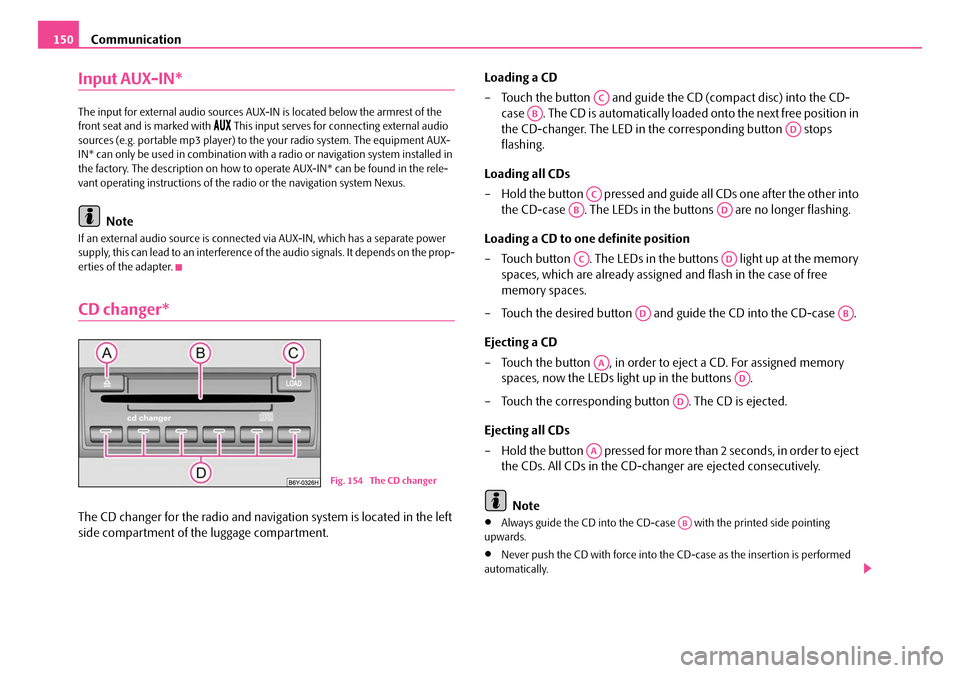
The CD changer for the radio and navigation system is located in the left
side compartment of the luggage compartment. Loading a CD
– Touch the button and guide the
CD (compact disc) into the CD-
case . The CD is automatically loaded onto the next free position in
the CD-changer. The LED in the corresponding button stops
flashing.
Loading all CDs
– Hold the button pressed and guide all CDs one after the other into the CD-case . The LEDs in the buttons are no longer flashing.
Loading a CD to one definite position
– Touch button . The LEDs in the buttons light up at the memory spaces, which are already assigned and flash in the case of free
memory spaces.
– Touch the desired button and guide the CD into the CD-case .
Ejecting a CD
– Touch the button , in order to eject a CD. For assigned memory spaces, now the LEDs light up in the buttons .
– Touch the corresponding button . The CD is ejected.
Ejecting all CDs
– Hold the button pressed for more th an 2 seconds, in order to eject
the CDs. All CDs in the CD-changer are ejected consecutively.
Note•Always guide the CD into the CD-cas e with the printed side pointing
upwards.
•Never push the CD with force into the CD-case as the insertion is performed
automatically.
Fig. 154 The CD changer
AC
AB
AD
AC
ABAD
ACAD
ADAB
AA
AD
AD
AA
AB
NKO A5 20 MR08.book Page 150 Wednesday, April 11, 2007 2:54 PM
Page 174 of 288

Transporting children safely173
Using the systemSafetyDriving TipsGeneral MaintenanceBreakdown assistanceTechnical Data
Transporting children safely
What you should know about transporting children!
An introduction to the subject
Accident statistics have revealed that children are generally more
safely transported on the rear seat s than on the front passenger seat.
Children younger than 12 years of age should normally travel on the rear seat of the
vehicle (take note of any na tional legal provisions which differ from this). They
should be secured there by means of a child restraint system or by using the existing
seat belts depending on their age, body si ze and weight. The child seat should be
mounted behind the front passen ger seat for safety reasons.
The physical principle of an accident do es, of course, also apply to children
⇒ page 159, “The physical principle of a fronta l collision”. They differ from adults in
that their muscles and bone structure of ch ildren are not yet fully developed. Thus
children are exposed to increased risk of injury.
Children should be transported by using special child safety seats in order to
reduce this risk of injury.
Use only child safety seats which are offici ally approved and are suitable for chil-
dren and which comply with the ECE-R 44 Standard, which classifies child safety
seats into 5 groups ⇒page 176, “Classification of child seats into groups”. Child
restraint systems which have been tested for conformity with ECE-R 44 have a non-
detachable test seal (a large E within a circle and below this the test number)
attached to the seat.
We recommend that you use ch ild safety seats from the Škoda genuine accessories.
These child seats were developed and also tested for use in Škoda vehicles. They
fulfil the standard ECE-R 44.
WARNING
Always comply with legal provisions and instructions from the relevant child
safety seat manufacturer when in stalling and using the child seat ⇒ in
“Important safety information regarding the use of child safety seats”.
Note
Any varying national legal regulations take priority over the information provided in
these instructions for use, or stated in this chapter.
Important safety information regarding the use of child safety
seats
Correct use of child safety seats considerably reduces the risk of
injury!
WARNING
•All the occupants of the car - in particular children - must wear a seat belt
when the car is moving.
•Chi ld re n le s s tha n 1. 5 0 m i n h e ig ht or younger than 12 years must not use
a normal seat belt withou t a child restraint system otherwise this may result
in injuries to the stomach and neck areas. Comply with the national legal
requirements.
•One should never carry children, and also not babies! - on one's lap.
•You can transport a child safely in a suitable child safety seat ⇒page 176,
“Child seat”!
•Only one child may be fastened with a seat belt into a child safety seat.
•Never leave the child sitting unattended in the seat.
•Certain outside climatic conditions can cause life-threatening tempera-
tures in the vehicle.
•Never allow your child to be transported in a vehicle without the use of a
suitable restraint system.
•Children should also never stand up in a vehicle or kneel on the seats
when the vehicle is moving. In the event of an accident the child will be
thrown through the vehicle and may as a result suffer fatal injuries, and also
injure other occupants.
NKO A5 20 MR08.book Page 173 Wednesday, April 11, 2007 2:54 PM
Page 197 of 288
Towing a trailer
196
Towing a trailer
To w i n g a t r a i l e r
Technical requirements
The towing device must satisfy certain technical requirements.
Your vehicle is designed primarily for tr ansporting persons and luggage. It can,
however, also be used for towing a traile r - provided certain technical equipment is
fitted.
If your vehicle has already been supplied with a factory-fitted towing device then
everything that is necessary for towing a trailer in technical terms, and in terms of
the law, has already been taken into account.
Your vehicle is fitted with a 13-pin power socket for the electrical connection
between the vehicle and trailer. If th e trailer which you wish to tow has a 7-pin
connector, you can use a suitable adapter
10) from Škoda original accessories.
This work must be carried out in accordan ce with the manufacturer's specifications
if a towing device is retrofitted.
Škoda Service Partners are familiar with de tails relating to retrofitting a towing
device and for any necessary modi fications to the cooling system.
WARNING
We recommend that you have the towing device from Škoda original acces-
sories installed by a Škoda Service Partner. He is familiar with all the relevant
details relating to retrofitting such equi pment. There is a risk of an accident
if the towing device is not properly fitted!
General Maintenance
There are a number of points to pay attention to when towing a
trailer.
Trailer load
The permissible trailer load must on no account be exceeded.
You can negotiate appropriately steeper inclines and descents if you do not make
full use of the perm issible trailer load.
The trailer loads specified only apply for altitudes up to 1 000 metres above mean
sea level. The fact that the engine power ou tput drops with increasing height due to
a lowering of air pressure and thus the abil ity to climb, means that the towed weight
must be reduced by 10% for every further increase of 1 000 metres in height above
sea level. The towed weight is the weight of the (laden) vehicle and the (laden)
trailer together. One should take this into account before driving up to higher alti-
tudes.
The trailer and drawbar load information on the type plate of the towing
device are merely test data for the tow ing device The data relating to your
vehicle, which is often less than this test data, can be found in your vehicle
registration documents.
Distribution of the load
Distribute the load in the trailer in such a way that any heavy items are located as
close as possible to the axle. Secure the items to prevent them slipping.
Tyre inflation pressure
Select the tyre inflation pressure on your vehicle for that of “fully laden”,
⇒ page 223. The inflation pressure of the tyres fitted to the trailer adjust in accord-
ance with the manufacturer's recommendation.
Exterior mirrors
You have to have additional exterior mirrors fitted if you are not able to see the
traffic behind the trailer with the standard rear-view mirrors. Both exterior mirrors
10)In some countries the adapter is supplied with the towing device.
NKO A5 20 MR08.book Page 196 Wednesday, April 11, 2007 2:54 PM
Page 208 of 288

Fuel207
Using the systemSafetyDriving TipsGeneral MaintenanceBreakdown assistanceTechnical Data
•Your vehicle is not adapted for use of biofuel (RME), therefore this fuel must not
be refuelled and driven. Using this fuel (RME) can lead to damage to the engine or
the fuel system.
Operation in winter
Winter-grade diesel fuel
A different grade of diesel fuel is available at filling stations in winter than during the
summer. Using “summer-grade diesel fuel” at temperatures below 0°C can result in
operational problems because the diesel be comes viscous as a result of paraffin
separation.
It is therefore the case that DIN EN 590 prescribes diesel fuel class for certain
periods of the year which can also be pu rchased at the corresponding time during
the year. “Winter-grade diesel fuel” will still operate properly even at a temperature
of -20°C.
It is often the case in countries with diff erent climatic conditions that diesel fuels
available have a different temperature characteristic. Škoda Service Partners and
filling stations in the count ry concerned will be able to provide you with informa-
tion regarding the diesel fuels available.
Prewarming fuel
The vehicle is fitted with a fuel filter prewarming system. This secures operation of
a vehicle using diesel fuel down to an environmental temperature of -25°C.
Caution
It is not permitted to add the various fuel additives on the market, including petrol,
to diesel fuel in order to improve its flow properties.
Refuelling
The filler flap is automatically unl ocked or locked* with the central
locking.
Opening the fuel filler cap
– Press onto the left side of the fuel filler flap ⇒fig. 192 .
– The fuel filler cap on the fuel filler tube must be unlocked to the left using the vehicle key (only valid for vehicles which do not have auto-
matic unlocking of the fuel filler flap).
Fig. 192 Right rear side
of the vehicle: Fuel filler
flap
Fig. 193 Filler flap with
cap unscrewed
NKO A5 20 MR08.book Page 207 Wednesday, April 11, 2007 2:54 PM