2007 Seat Ibiza 5D ESP
[x] Cancel search: ESPPage 208 of 272

If and when
206
WARNING
Put the hazard warning lights on and pl ace the warning triangle in position.
This is for your own safety and also warns other road users.
Caution
If you have to change the tyre on a gradient, block the wheel opposite the
wheel being changed by placing a stone or similar object under it to prevent
the vehicle from rolling away.
Note
Please observe legal requirements when doing so.Changing a wheelChange the wheel as described below
– Pull off the hub cap see also ⇒page 207.
–Slacken the wheel bolts.
– Raise the car with the jack in the corresponding zone.
– Ta k e o f f the wheel and then put on the spare wheel.
– Lower the vehicle.
– Tighten the wheel bolts firmly i n d ia go na l s e q u e n ce wi t h t h e b ox
spanner.
–Replace the hub cap.
After changing a wheel
After changing the wheel there are still tasks to complete.– Put the tools and jack back in the luggage compartment.
– Place the wheel with the defective tyre in the luggage compart- ment and secure it.
– Check the tyre pressure of the newly fitted tyre as soon as possible.
– Have the tightening torque of the wheel bolts checked as soon as possible with a torque wrench. The prescribed torque is 120 Nm.
Note•
If you notice that the wheel bolts are corroded and difficult to turn when
changing a wheel, they must be replaced before having the wheel bolt torque
checked.
•
In the interest of safety, drive at moderate speeds until the wheel bolt
torque has been checked.
IBI_ANG_0707 Seite 206 Montag, 6. August 2007 3:59 15
Page 209 of 272
If and when207
Safety First
Operating instructions
Tips and Maintenance
Te c h n i c a l D a t a
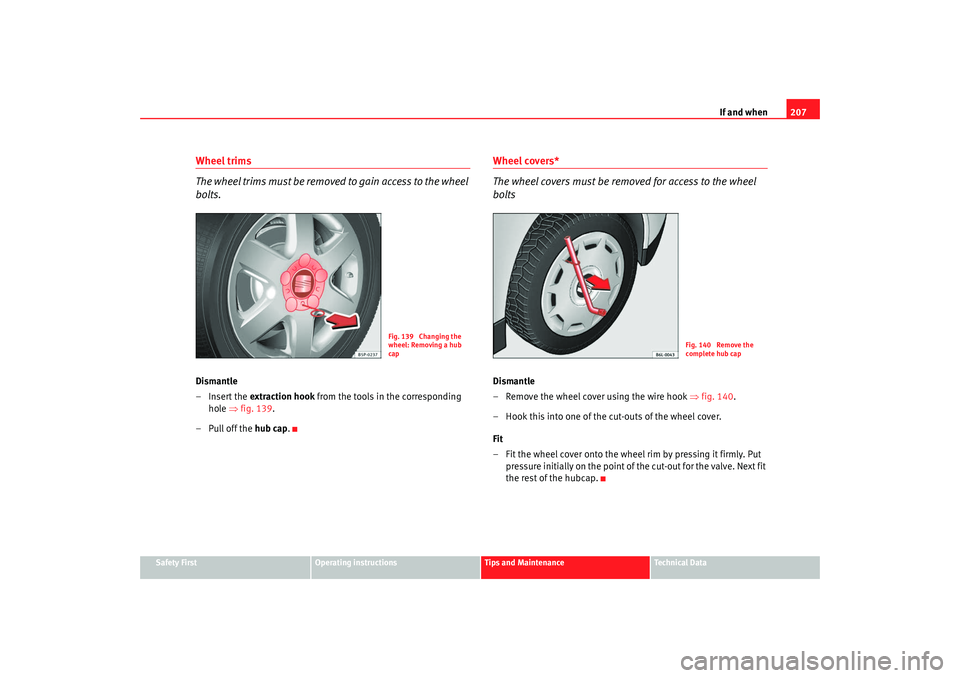
Wheel trims
The wheel trims must be removed to gain access to the wheel
bolts.Dismantle
– Insert the extraction hook from the tools in the corresponding
hole ⇒fig. 139.
– Pull off the hub cap.
Wheel covers*
The wheel covers must be removed for access to the wheel
boltsDismantle
– Remove the wheel cover using the wire hook ⇒fig. 140.
– Hook this into one of the cut-outs of the wheel cover.
Fit
– Fit the wheel cover onto the wheel rim by pressing it firmly. Put pressure initially on the point of the cut-out for the valve. Next fit
the rest of the hubcap.
Fig. 139 Changing the
wheel: Removing a hub
cap
Fig. 140 Remove the
complete hub cap
IBI_ANG_0707 Seite 207 Montag, 6. August 2007 3:59 15
Page 218 of 272

If and when
216
22 Main beam headlight, left 10
23 Number plate light/si de light indicator 5
24 Rear windscreen wiper 10
25 Injectors(fuel) 10
26 Brake light switch /ESP (Turn sensor) 10
27 Instrument panel/Diagnosis 5
28 Switchboard: glovebox light, boot light, interior light 10
29 Climatronic 5
30 Power supply central locking unit 5
31 Left front window control 25
32 Vacant
33 Self powered alarm horn 15
34 Engine control unit 15
35 Sunroof 20
36 Engine ventilator heating /blower 25
37 Headlight washer pump 20
38 Front and rear fog lights 15
39 Engine control unit (petrol) 15
40 Engine control unit diesel + SDI Fuel pump 30
41 Fuel gauge 15
42 Ignition transformer+ Engine control unit T70 15
43 Dipped headlight (right side) 15
44 Left rear window control 25
45 Front right window control 25
Number
Consumer Amperes
IBI_ANG_0707 Seite 216 Montag, 6. August 2007 3:59 15
Page 222 of 272

If and when
220Xenon headlights
9)
Dipped beam 12V/35W (D1S)
10)
roadway 12V/55W (H7)
turn signals 12V/PY21W
position lights 12V/W5W
Fog lights*
Fog lights 12V/55W (H3)
Registration plate light
Registration plate light - C5W
Caution
•
The halogen lamps (H3, H7...) are pressurised and might explode on
changing them.
•
Therefore protective gloves and glas ses should be worn when changing a
halogen lamp.Note
•
Due to the difficulty in accessing the lamps, any replacement work should
be done by a SEAT dealer. However, we shall explain how to change these
lamps, except for the xenon lights*.
Main headlight lamps
Dipped headlights
Main beam headlights
9)On this type of headlight, the bulb changes must be made by the SEAT dealer, given
that complex elements must be removed from the vehicle and a reset must be made
on the automatic control system incorporated.10)The Xenon bulbs discharge 2.5 times the light flux and have an average lifespan of 5
times more than that of halo gen bulbs, this means that, except due to unusual circum-
stances, there is no need to change the bulbs for the whole life of the vehicle.
Fig. 148 Main headlight
lampsFig. 149 Main headlight
lamps
AAAB
IBI_ANG_0707 Seite 220 Montag, 6. August 2007 3:59 15
Page 235 of 272

If and when233
Safety First
Operating instructions
Tips and Maintenance
Te c h n i c a l D a t a
Towing and tow-startingTo w - s t a r t i n g *
The use of jump leads is preferable to tow-starting.We recommend that you do not tow-start your vehicle. Jump-starting
is preferable ⇒page 230.
However, if your vehicle has to be tow-started:
–Engage the 2
nd or the 3
rd gear.
– Keep the clutch pressed down.
– Switch on the ignition.
– Once both vehicles are mo ving, release the clutch.
– As soon as the engine starts, press the clutch and move the gear lever into neutral. This helps to prevent driving into the towing
vehicle.
WARNING
The risk of accidents is high when tow-starting. The vehicle being towed
can easily collide with the towing vehicle.
Caution
When tow-starting, fuel could enter the catalytic converter and damage it.
Towing eyesPlease observe the following points if you use a tow-rope:
Notes for the driver of the towing vehicle
– Drive slowly at first until the tow-rope is taut. Then accelerate gradually.
– Begin and change gears cautiously. If you are driving an auto- matic vehicle, accelerate gently.
– Remember that the brake servo and power steering are not working in the vehicle you are towing. Brake earlier than you
would normally, but with a more gentle pressure on the brake.
Notes for the driver of the towed vehicle
– Ensure that the tow-rope remains taut at all times when towing.
Fig. 171 Towing eye at
the front of the vehicle
IBI_ANG_0707 Seite 233 Montag, 6. August 2007 3:59 15
Page 236 of 272

If and when
234
Fitting the front towing eye
– First remove the right hand cover from the lower part of the bumper.
– Remove the bolt ⇒page 233, fig. 171 .
– Take the towing ring from the onboard tools.
– Rotate the towing ring to the left until it is completely tightened into position.
– To remove the ring, rotate it to the right.Tow-rope or tow-bar
It is easier and safer to tow a vehicle with a tow-bar. You should only use a
tow-rope if you do not have a tow-bar.
A tow-rope should be slightly elastic to reduce the loading on both vehicles.
It is advisable to use a tow-rope made of synthetic fibre or similarly elastic
material.
Attach the tow-rope or the tow-bar only to the towing eyes provided or a
towing bracket.
Driving style
Towing requires some experience, especially when using a tow-rope. Both
drivers should be familiar with the te chnique required for towing. Inexperi-
enced drivers should not attempt to tow-start or tow away another vehicle.
Do not pull too hard with the towing vehicle and take care to avoid jerking the
tow-rope. When towing on an unpaved ro ad, there is always a risk of over-
loading and damaging the anchorage points.
The ignition of the vehicle being towed must be switched on to prevent the
steering wheel from locking and also to allow the use of the turn signals,
horn, windscreen wipers and washers. As the brake servo does not work if the
engine is not running, you must apply
considerably more pressure to the brake pedal than you normally would.
As the power assisted steering does not work if the engine is not running, you
will need more strength to steer than you normally would.
Towing vehicles with an automatic gearbox
•
Put the selector lever into position “N”.
•
Do not drive faster than 50 km/h when towing a vehicle.
•
Do not tow further than 50 km.
•
If a breakdown vehicle is used, the vehicle must be towed with the front
wheels raised.Note
•
Observe legal requirements when towing or tow-starting.
•
Switch on the hazard warning lights of both vehicles. However, observe
any regulations to the contrary.
•
For technical reasons, vehicles with an automatic gearbox must not be
tow-started.
•
If damage to your vehicle means that there is no lubricant in the gearbox,
you must raise the drive wheels while the vehicle is being towed.
•
If the vehicle has to be towed more than 50 km, the front wheels must be
raised during towing, and towing should be carried out by a qualified person.
•
The steering wheel is locked when the vehicle has no electrical power. The
vehicle must then be towed with the front wheels raised. Towing should be
carried out by a qualified person.
•
The towing eye should always be kept in the vehicle. Please refer to the
notes on ⇒page 233.
AA
IBI_ANG_0707 Seite 234 Montag, 6. August 2007 3:59 15
Page 242 of 272

General notes on the technical data
240WeightsKerb weight refers to the basic model with a fuel tank filled to 90% capacity
and without optional extras. The figure quoted includes 75 kg to allow for the
weight of the driver.
For special versions and optional equipment fittings or for the addition of
accessories, the weight of the vehicle will increase ⇒.
WARNING
•
Please note that the centre of gravity may shift when transporting
heavy objects; this may affect the vehi cle's handling and lead to an acci-
dent. Always adjust your speed and dr iving style to suit road conditions
and requirements.
•
Never exceed the gross axle weight rating or the gross vehicle weight
rating. If the allowed axle load or the allowed total weight is exceeded, the
driving characteristics of the vehicle may change, leading to accidents,
injuries and damage to the vehicle.
To w i n g a t r a i l e rTrailer weightsTrailer weights
The trailer weights and drawbar loads approved are selected in intensive
trials according to precisely defined criteria. The approved trailer weights are
valid for vehicles in the EU for maximum speeds of 80 km/h (in certain
circumstances up to 100 km/h). The figu res may be different in other coun-
tries. All data in the official vehicl e documents take precedence over these
data ⇒ . Drawbar load
The
maximum permitted weight exerted by the trailer drawbar on the ball joint
of the towing bracket must not exceed 75 kg.
In the interest of road safety, we recommend that you always tow
approaching the maximum drawbar load. The response of the trailer on the
road will be poor if th e drawbar load is too small.
If the maximum permissible drawbar load cannot be met (e.g. with small,
empty and light-weight single axle trailers or tandem axle trailers with an axle
base of less than 1 metre), at least 4% of the actual trailer weight is a legal
stipulation for a drawbar load.
WARNING
•
For safety reasons, you should not drive at speeds above 80 km/h when
towing a trailer. This also applies to countries where higher speeds are
permitted.
•
Never exceed the maximum trailer weights or the draw bar loading. If
the permissible axle load or the perm issible total weight is exceeded, the
driving characteristics of the vehicle may change, leading to accidents,
injuries and damage to the vehicle.
WheelsTyre pressure, snow chains, wheel boltsTyre pressures
The sticker with the tyre pressure values can be found on the inside of the
tank flap. The tyre pressure values given there are for cold tyres. The slightly
raised pressures of warm tyres must not be reduced ⇒.
IBI_ANG_0707 Seite 240 Montag, 6. August 2007 3:59 15
Page 265 of 272

Index263
Coolant . . . . . . . . . . . . . . . . . . . . . . . . . . . 187, 188
Coolant Level . . . . . . . . . . . . . . . . . . . . . . . . . . . 188
Coolant level
warning light . . . . . . . . . . . . . . . . . . . . . . . . . 63
Coolant Loss . . . . . . . . . . . . . . . . . . . . . . . . . . . 188
Coolant temperature Display . . . . . . . . . . . . . . . . . . . . . . . . . . . . . . 53
Safety instructions . . . . . . . . . . . . . . . . . . . . . 64
Correct adjustment of front head restraints . . . . 12
Cruise control system . . . . . . . . . . . . . . . . . . . . 142
Curtain airbags . . . . . . . . . . . . . . . . . . . . . . . . . . 37 Description . . . . . . . . . . . . . . . . . . . . . . . . . . . 37
Function . . . . . . . . . . . . . . . . . . . . . . . . . . . . . 38
Safety notes . . . . . . . . . . . . . . . . . . . . . . . . . . 38DDanger of fitting a child seat on the front passenger seat . . . . . . . . . . . . . . . . . . . . . . . . . . . . . . . 27
Deep Water in Cupra version . . . . . . . . . . . . . . 151
Diesel . . . . . . . . . . . . . . . . . . . . . . . . . . . . . . . . . 179
Diesel engine Winter driving . . . . . . . . . . . . . . . . . . . . . . . . 180
Diesel engine particulate filter* . . . . . . . . . . . . 153
Differential lock . . . . . . . . . . . . . . . . . . . . . . . . . 150
Differential lock fault (EDL) warning lamp . . . . . . . . . . . . . . . . . . . . . . . . . 67
Digital clock . . . . . . . . . . . . . . . . . . . . . . . . . . . . . 54
Dipped headlights . . . . . . . . . . . . . . . . . . . . . . . . 90
Disabling front passenger airbag Safety notes . . . . . . . . . . . . . . . . . . . . . . . . . . 41 Disabling the airbag
Disabling front passenger airbag . . . . . . . . . 40
Displays in the Mult i-function display
Memory displays . . . . . . . . . . . . . . . . . . . . . . 56
Door lock cylinders . . . . . . . . . . . . . . . . . . . . . . 167
Door release lever . . . . . . . . . . . . . . . . . . . . . . . . 51
Doors Childproof locks . . . . . . . . . . . . . . . . . . . . . . . 74
Unlocking and locking . . . . . . . . . . . . . . . . . 70
Drive wheels traction control system . . . . . . . . 148
Driving Driving abroad . . . . . . . . . . . . . . . . . . . . . . . 153
Economically / With Respect for the Environment . . . . . . . . . . . . . . . . . . . . . . . 160
With a trailer . . . . . . . . . . . . . . . . . . . . . . . . . 159
with a trailer . . . . . . . . . . . . . . . . . . . . . . . . . 158
Driving abroad . . . . . . . . . . . . . . . . . . . . . . . . . . 153 Headlights . . . . . . . . . . . . . . . . . . . . . . . . . . 154
Driving economically . . . . . . . . . . . . . . . . . . . . . 160
Driving safety . . . . . . . . . . . . . . . . . . . . . . . . . . . . . 8
Driving with respect for the environment . . . . . 160
Duplicate keys . . . . . . . . . . . . . . . . . . . . . . . . . . . 77
Dust filter . . . . . . . . . . . . . . . . . . . . . . . . . . . . . . 128
Dynamic headlight range control . . . . . . . . . . . . 91
EEDL . . . . . . . . . . . . . . . . . . . . . . . . . . . . . . . . . . . 150
EDS Warning lamp . . . . . . . . . . . . . . . . . . . . . . . . . 64
Electrical sockets . . . . . . . . . . . . . . . . . . . . . . . . 114 Electrohydraulic steering
warning lamp . . . . . . . . . . . . . . . . . . . . . . . . . 62
Electronic differential lock . . . . . . . . . . . . . . . . 150 Warning lamp . . . . . . . . . . . . . . . . . . . . . . . . 64
Electronic immobiliser . . . . . . . . . . . . . . . . 67, 133
Electronic stabilisation program . . . . . . . . . . . 149
Electronic stabilisation programme . . . . . . . . . . 66 Description . . . . . . . . . . . . . . . . . . . . . . . . . . 131
Warning lamp . . . . . . . . . . . . . . . . . . . . . . . 132
Electronic stabilisation programme (ESP) warning lamp . . . . . . . . . . . . . . . . . . . . . . . . . 66
Emission control system warning lamp . . . . . . . . . . . . . . . . . . . . . . . . . 65
Engine Running in . . . . . . . . . . . . . . . . . . . . . . . . . . 151
Engine compartment Working in the engine compartment . . . . . 180
Engine coolant . . . . . . . . . . . . . . . . . . . . . . . . . . 187
Engine fault warning lamp . . . . . . . . . . . . . . . . . . . . . . . . . 63
Engine management Warning lamp . . . . . . . . . . . . . . . . . . . . . . . . 63
Engine oil . . . . . . . . . . . . . . . . . . . . . . . . . . . . . . 183 Changing . . . . . . . . . . . . . . . . . . . . . . . . . . . 186
Checking level . . . . . . . . . . . . . . . . . . . . . . . 185
Oil properties . . . . . . . . . . . . . . . . . . . . . . . . 184
Specifications . . . . . . . . . . . . . . . . . . . . . . . 183
Topping up . . . . . . . . . . . . . . . . . . . . . . . . . . 186
Engine oil dipstick . . . . . . . . . . . . . . . . . . . . . . . 185
Engine oil pressure Warning lamp . . . . . . . . . . . . . . . . . . . . . . . . 67
IBI_ANG_0707 Seite 263 Montag, 6. August 2007 3:59 15