2007 Seat Altea bolt torque
[x] Cancel search: bolt torquePage 150 of 302

Seats and stowage
148tion manual. Not following these instructions may lead to paintwork damage
or marks on the bodywork.•
Pay special attention to the tightening torque of the attachment bolts and
check them following a short journey. If necessary, retighten the bolts and
check them at regular intervals.
•
Distribute the load evenly. A maximum load of 40 kg only is permitted for
each roof carrier system support bar, the load must be distributed evenly over
the entire length. However, the maximu m load permitted for the entire roof
(including the support system) of 75 kg must not be exceeded nor should the
total weight of the vehicle be exceeded. See the chapter on “Technical Data”.
•
When transporting heavy or large objects on the roof, any change in the
normal vehicle behaviour due to a change in the centre of gravity or an
increased wind resistance must be taken into account. For this reason, a suit-
able speed and driving style must be used.
•
For those vehicles fitted with a sunroof*, ensure that it does not interfere
with the load on the roof carrier system when opened.
altea_ingles_0706.book Seite 148 Mittwoch, 30. August 2006 3:48 15
Page 206 of 302

Accessories, parts replacement and modifications
204If a towing bracket is to be fitted after the vehicle is purchased, this must be
completed according to the instructions of the towing bracket manufacturer.
The attachment points for the towing bracket are underneath the vehicle.
The distance between the centre of the ball coupling and the ground should
never be lower than the measurement indicated when the vehicle is fully
loaded including the maximum resting weight.
Measurement for securing the towing bracket:
65 mm (minimum)
350 mm to 420 mm (fully laden vehicle)
357 mm
569 mm
875 mm
1040 mm
Fitting a towing bracket•
Driving with a trailer implies additional work for the vehicle. Therefore,
before fitting a towing bracket, please contact an Authorised Service Centre
to check whether your cooling system needs modification.
•
Observe the legal requirements in your country (e.g. the fitting of a sepa-
rate warning lamp).
•
Certain vehicle components, e.g. the rear bumper must be removed and
reinstalled. The towing bracket securin g bolts must be tightened using a
torque wrench, and an electrical sock et must be used to connect to the
vehicle's electrical system. This requ ires specialist knowledge and tools.
•
The figures in the illustration show the dimensions and attachment points
that must be observed if you are retrofitting a towing bracket.
WARNING
Towing brackets should be fitted by specialists.
•
If the towing bracket is incorrectly installed, there is serious danger of
an accident.
•
For your own safety, please observe the instructions provided by the
manufacturer of the towing bracket.Caution
•
If the electrical socket is incorrectly installed, this could cause damage to
the vehicle's electrical system.Note
For the sports model (FR), fitting of a trailer bracket is not recommended due
to the design of the bumpers.
AA
ABACADAEAFAG
WARNING (continued)
altea_ingles_0706.book Seite 204 Mittwoch, 30. August 2006 3:48 15
Page 232 of 302

Checking and refilling levels
230Wheel bolts
Wheel bolts must be tightened to the correct torque.The design of wheel bolts is matched to the rims. If different wheel rims are
fitted, the correct wheel bolts with the right length and correctly shaped bolt
heads must be used. This ensures that wheels are fitted securely and that the
brake system functions correctly.
In certain circumstances, you may not use wheel bolts from a different car -
even if it is the same model ⇒page 201.
WARNING
If the wheel bolts are not tightened correctly, the wheel could become
loose while driving. Risk of accident.•
The wheel bolts must be clean and turn easily. Never apply grease or oil
to them.
•
Use only wheel bolts which belong to the wheel.
•
If the prescribed torque of the wheel bolts is too low, they could loosen
whilst the vehicle is in motion. Risk of accident! If the tightening torque is
too high, the wheel bolts and threads could be damaged.Caution
The prescribed torque for wheel bolts for steel and alloy wheels is 120 Nm.
Winter tyres
Winter tyres will improve the vehicles handling on snow and
ice.In winter conditions winter tyres will considerably improve the vehicles
handling. The design of summer tyres (width, rubber compound, tread
pattern) gives less grip on ice and snow.
Winter tyres must be inflated to a pressure 0.2 bar higher than the pressures
specified for summer tyres (see sticker on tank flap).
Winter tyres must be fitted on all four wheels.
Information on permitted winter tyre sizes can be found in the vehicle's regis-
tration documents. Use only radial winter tyres. All tyre sizes listed in the
vehicle documentation also apply to winter tyres.
Winter tyres lose their effectiveness when the tread is worn down to a depth
of 4 mm.
The speed rating code ⇒page 228, “New tyres and wheels” determines the
following speed limits ⇒ :
Q max. 160 km/h
S max. 180 km/h
T max. 190 km/h
H max. 210 km/h
In some countries, vehicles which can exceed the speed rating of the fitted
tyre must have an appropriate sticker in the driver's field of view. These
stickers are available from your Authorised Service Centre. The legal require-
ments of each country must be followed.
Do not have winter tyres fitted for unnecessarily long periods. Vehicles with
summer tyres handle better when the roads are free of snow and ice.
If you have a flat tyre, please refer to the notes on the spare wheel
⇒ page 228, “New tyres and wheels”.
altea_ingles_0706.book Seite 230 Mittwoch, 30. August 2006 3:48 15
Page 234 of 302

If and when
232If and whenTools, tyre repair kit and spare wheelVehicle To ols
The vehicle onboard tools are located under the floor panel in
the luggage compartment.– Lift the cover of the luggage compartment, by pulling it up with a
finger in the fitting.
– Take the onboard tools out of the vehicle.The tool kit includes:•
Jack*
•
Hook for removing wheel covers* or hub caps*
•
Box spanner for wheel bolts*
•
Reversible screwdriver with handle (including hexagonal interior) for the
wheel bolts. The screwdriver is a combination tool.
•
To wi ng e ye
•
Adapter for the anti-theft wheel bolts*
Some of the items listed are only prov ided on certain models / model years,
or are optional extras.
WARNING
•
Do not use the hexagonal socket in the screwdriver handle to tighten
the wheel bolts. It is impossible to tighten the bolts with the torque
required, risk of accident.
•
The jack supplied by the factory is only designed for changing wheels
on this model. On no account attempt to use it for lifting heavier vehicles
or other loads, risk of injury.
•
Use the jack only on firm, level ground.
•
Never start the engine when the vehicle is on the jack, risk of accident.
•
I f wo r k is t o b e ca r r i e d o u t un d e r n ea th the vehicle, this must be secured
by suitable stands. Otherwise, there is a risk of injury.WARNING (continued)
altea_ingles_0706.book Seite 232 Mittwoch, 30. August 2006 3:48 15
Page 237 of 302

If and when235
Safety First
Operating instructions
Tips and Maintenance
Te c h n i c a l D a t a
After changing a wheel
After changing the wheel there are still tasks to complete.– Put the tools and jack back in the luggage compartment.
– Place the wheel with the defective tyre in the luggage compart-
ment and secure it.
– Check the tyre pressure of the newly fitted tyre as soon as
possible.
– Have the tightening torque of the wheel bolts checked as soon as possible with a torque wrench. The prescribed torque is 120 Nm.
Note•
If you notice that the wheel bolts are corroded and difficult to turn when
changing a wheel, they must be replaced before having the wheel bolt torque
checked.
•
In the interest of safety, drive at moderate speeds until the wheel bolt
torque has been checked.
Wheel trims
The wheel trims must be removed to gain access to the wheel
bolts.Removing
–Insert the extraction hook from the tools into the designated ring, located in one of the bolt hole covers of the wheel cover
⇒fig. 172.
–Pull off the hub cap .
Fig. 172 Changing a
wheel: Removing the
wheel trim
altea_ingles_0706.book Seite 235 Mittwoch, 30. August 2006 3:48 15
Page 273 of 302

General notes on the technical data 271
Safety First
Operating instructions
Tips and Maintenance
Te c h n i c a l D a t a
Snow chains
Snow chains may be fitted only to the
front wheels.
Consult the chapter “wheels” of this manual.
Wheel bolts
After the wheels have been changed, the tightening torque of the wheel bolts
should be checked as soon as possible with a torque wrench ⇒. The tight-
ening torque for steel and alloy wheels is 120 Nm.
WARNING
•
Check the tyre pressure at least once per month. Correct tyre pressure
is very important. If the tyre pressure is too high or too low, there is an
increased danger of accidents, particularly at high speeds.
•
If the torque of the wheel bolts is too low, they could loosen whilst the
vehicle is in motion. Risk of accident! If the tightening torque is too high,
the wheel bolts and threads could be damaged.Note
We recommend that you ask your Authorised Service Centre for information
about appropriate wheel, tyre and snow chain size.
altea_ingles_0706.book Seite 271 Mittwoch, 30. August 2006 3:48 15
Page 300 of 302
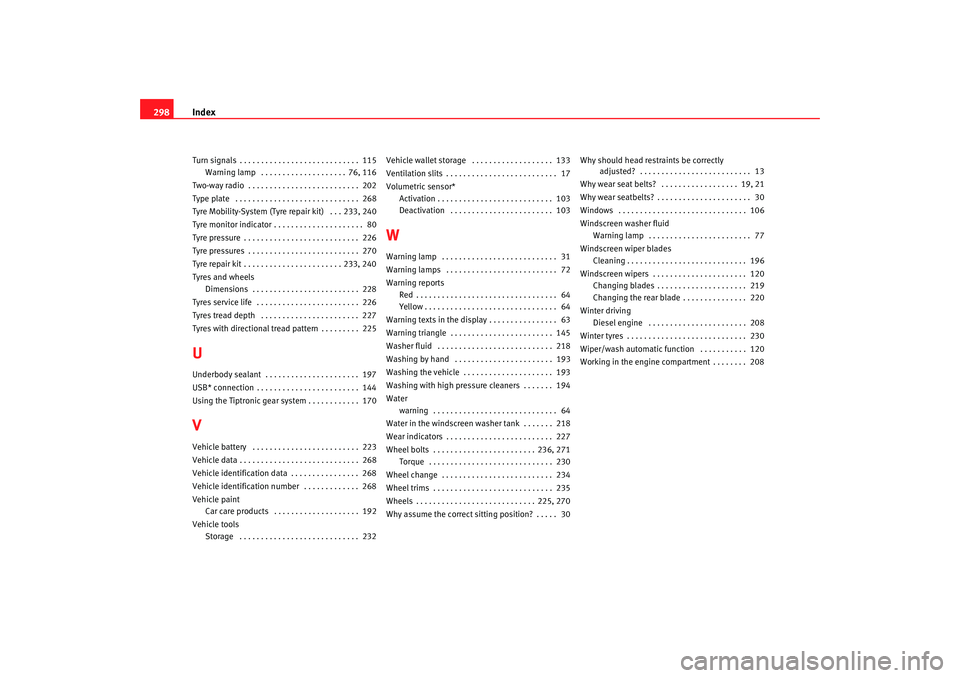
Index
298Turn signals . . . . . . . . . . . . . . . . . . . . . . . . . . . . 115
Warning lamp . . . . . . . . . . . . . . . . . . . . 76, 116
Two-way radio . . . . . . . . . . . . . . . . . . . . . . . . . . 202
Type plate . . . . . . . . . . . . . . . . . . . . . . . . . . . . . 268
Tyre Mobility-System (Tyre repair kit) . . . 233, 240
Tyre monitor indicator . . . . . . . . . . . . . . . . . . . . . 80
Tyre pressure . . . . . . . . . . . . . . . . . . . . . . . . . . . 226
Tyre pressures . . . . . . . . . . . . . . . . . . . . . . . . . . 270
Tyre repair kit . . . . . . . . . . . . . . . . . . . . . . . 233, 240
Tyres and wheels Dimensions . . . . . . . . . . . . . . . . . . . . . . . . . 228
Tyres service life . . . . . . . . . . . . . . . . . . . . . . . . 226
Tyres tread depth . . . . . . . . . . . . . . . . . . . . . . . 227
Tyres with directional tread pattern . . . . . . . . . 225UUnderbody sealant . . . . . . . . . . . . . . . . . . . . . . 197
USB* connection . . . . . . . . . . . . . . . . . . . . . . . . 144
Using the Tiptronic gear system . . . . . . . . . . . . 170VVehicle battery . . . . . . . . . . . . . . . . . . . . . . . . . 223
Vehicle data . . . . . . . . . . . . . . . . . . . . . . . . . . . . 268
Vehicle identification data . . . . . . . . . . . . . . . . 268
Vehicle identification number . . . . . . . . . . . . . 268
Vehicle paint Car care products . . . . . . . . . . . . . . . . . . . . 192
Vehicle tools Storage . . . . . . . . . . . . . . . . . . . . . . . . . . . . 232 Vehicle wallet storage . . . . . . . . . . . . . . . . . . . 133
Ventilation slits . . . . . . . . . . . . . . . . . . . . . . . . . . 17
Volumetric sensor*
Activation . . . . . . . . . . . . . . . . . . . . . . . . . . . 103
Deactivation . . . . . . . . . . . . . . . . . . . . . . . . 103
WWarning lamp . . . . . . . . . . . . . . . . . . . . . . . . . . . 31
Warning lamps . . . . . . . . . . . . . . . . . . . . . . . . . . 72
Warning reportsRed . . . . . . . . . . . . . . . . . . . . . . . . . . . . . . . . . 64
Yellow . . . . . . . . . . . . . . . . . . . . . . . . . . . . . . . 64
Warning texts in the display . . . . . . . . . . . . . . . . 63
Warning triangle . . . . . . . . . . . . . . . . . . . . . . . . 145
Washer fluid . . . . . . . . . . . . . . . . . . . . . . . . . . . 218
Washing by hand . . . . . . . . . . . . . . . . . . . . . . . 193
Washing the vehicle . . . . . . . . . . . . . . . . . . . . . 193
Washing with high pressure cleaners . . . . . . . 194
Water warning . . . . . . . . . . . . . . . . . . . . . . . . . . . . . 64
Water in the windscreen washer tank . . . . . . . 218
Wear indicators . . . . . . . . . . . . . . . . . . . . . . . . . 227
Wheel bolts . . . . . . . . . . . . . . . . . . . . . . . . 236, 271 Torque . . . . . . . . . . . . . . . . . . . . . . . . . . . . . 230
Wheel change . . . . . . . . . . . . . . . . . . . . . . . . . . 234
Wheel trims . . . . . . . . . . . . . . . . . . . . . . . . . . . . 235
Wheels . . . . . . . . . . . . . . . . . . . . . . . . . . . . 225, 270
Why assume the correct sitting position? . . . . . 30 Why should head restraints be correctly
adjusted? . . . . . . . . . . . . . . . . . . . . . . . . . . 13
Why wear seat belts? . . . . . . . . . . . . . . . . . . 19, 21
Why wear seatbelts? . . . . . . . . . . . . . . . . . . . . . . 30
Windows . . . . . . . . . . . . . . . . . . . . . . . . . . . . . . 106
Windscreen washer fluid Warning lamp . . . . . . . . . . . . . . . . . . . . . . . . 77
Windscreen wiper blades Cleaning . . . . . . . . . . . . . . . . . . . . . . . . . . . . 196
Windscreen wipers . . . . . . . . . . . . . . . . . . . . . . 120 Changing blades . . . . . . . . . . . . . . . . . . . . . 219
Changing the rear blade . . . . . . . . . . . . . . . 220
Winter driving Diesel engine . . . . . . . . . . . . . . . . . . . . . . . 208
Winter tyres . . . . . . . . . . . . . . . . . . . . . . . . . . . . 230
Wiper/wash automatic function . . . . . . . . . . . 120
Working in the engine compartment . . . . . . . . 208
altea_ingles_0706.book Seite 298 Mittwoch, 30. August 2006 3:48 15