2007 Seat Altea ESP
[x] Cancel search: ESPPage 226 of 302

Checking and refilling levels
224•
If the vehicle is left standing in cold conditions for a long period, protect
the battery from frost. If it “freezes” it will be damaged.
Checking the electrolyte level
The electrolyte level should be checked regularly in high-
mileage vehicles, in hot countries and in older batteries.– Open the bonnet and open the battery cover at the front ⇒ in
“Safety instructions on working in the engine compartment” on
page 208 ⇒ in “Warnings on handling the battery” on
page 223.
– Check the colour display in the "magic eye" on the top of the battery.
– If there are air bubbles in the window, tap the window gently until they disperse.The position of the battery is shown in the corresponding engine compart-
ment diagram ⇒page 272.
The round window (“magic eye”) on the top of the battery changes colour,
depending on the charge level and electrolyte level of the battery.
If the colour in the window is colourless or bright yellow, the electrolyte level
of the battery is too low. Have the battery checked by a qualified workshop.
The colours green and black are used by the workshops for diagnostic
purposes.
Charging and changing the vehicle battery
The battery is maintenance-free and is checked during the
inspection service. All work on the vehicle battery requires
specialist knowledge.If you often drive short distances or if the vehicle is not driven for long
periods, the battery should be checked by a qualified workshop between the
scheduled services.
If the battery has discharged and you have problems starting the vehicle, the
battery might be damaged. If this happens, we recommend you have the
vehicle battery checked by an Authorised Service Centre where it will be re-
charged or replaced.
Charging the battery
The vehicle battery should be charged by a qualified workshop only, as
batteries using special technology have been installed and they must be
charged in a controlled environment.
Replacing a vehicle battery
The battery has been developed to suit the conditions of its location and has
special safety features.
Genuine SEAT batteries fulfil the maintenance, performance and safety spec-
ifications of your vehicle.
WARNING
•
We recommend you use only maintenance-free or cycle free leak-proof
batteries that comply with the standards T 825 06 and VW 7 50 73. This
standard applies as of 2001.
•
Before starting any work on the batteries, you must read and observe
the warnings ⇒ in “Warnings on handling the battery” on page 223.
altea_ingles_0706.book Seite 224 Mittwoch, 30. August 2006 3:48 15
Page 228 of 302

Checking and refilling levels
226Checking tyre pressure
The correct tyre pressure can be seen on the sticker on the
inside of the tank flap.1. Read the required tyre inflation pressure from the sticker. The
values refer to Summer tyres. For Winter tyres, you must add 0.2
bar to the values given on the sticker.
2. The tyre pressures should only be checked when the tyres are cold. The slightly raised pressures of warm tyres must not be
reduced.
3. Adjust the tyre pressure to the load you are carrying.Tyre pressure
The correct tyre pressure is especially important at high speeds. The pressure
should therefore be checked at least once a month and before starting a
journey.
WARNING
A tyre can easily burst if the pressure is too low, causing an accident!•
At continuously high speeds, a tyre with insufficient pressure flexes
more. In this way it becomes too hot, and this can cause tread separation
and tyre blow-out. Always observ e the recommended tyre pressures.
•
If the tyre pressure is too low or too high, the tyres will wear prema-
turely and the vehicle will not h andle well. Risk of accident!For the sake of the environment
Under-inflated tyres will increase fuel consumption.
Tyre service life
The service life of tyres is dependent on tyre pressure, driving
style and fitting.
Fig. 169 Tyre tread wear
indicatorsFig. 170 Changing
wheels
altea_ingles_0706.book Seite 226 Mittwoch, 30. August 2006 3:48 15
Page 230 of 302

Checking and refilling levels
228
Driving on puncture-proof tyres (emergency use)
– Ensure that the ESP/TCS is operating (electronic stabilization program) ⇒page 181.
– Drive carefully and at moderate speed (80 km/h maximum).
– Avoid sharp turns and rapid manouevres.
– Avoid driving over obstacles (for example, kerbs) or potholes.
– If the ESP/TCS is frequently activated, check whether there is smoke coming from the tyres or a smell of rubber, or if the vehicle
vibrates or rattles. If this is the case, stop the vehicle.Puncture-proof tyres are marked on the tyre wall as follows: “DSST”,
“Eufonia”, “RFT”, “ROF”, “RSC”, “SSR” or “ZP”.
The tyre walls of this type of tyre are reinforced. When the tyres lose air, the
tyre walls keep the tyre up (emergency use).
Loss of air pressure in the tyre is shown on the instrument panel. The vehicle
may still be driven for at least 80 km and, under ideal conditions (for example,
no load) further.
The faulty tyre should be replaced as soon as possible. The tyre rim should be
checked for damage at a specialised workshop and replaced as necessary.
We recommend you contact your Authorised Service Centre. If more than one
tyre is being used under emergency co nditions, this reduces the distance
which can be travelled.
Starting driving in emergency conditions
When the loss in tyre pressure is displayed on the instrument panel, this
implies that at least one tyre is being driven in emergency conditions ⇒.
End of emergency operation
Do not drive on if:
•
smoke is coming from one of the tyres,
•
there is a smell of rubber,
•
the vehicle vibrates,
•
there is a rattling noise.
WARNING
When driving in emergency conditions, the driving quality of the vehicle is
considerably impaired.•
Drive carefully and at moderate speed (80km/h maximum).
•
Avoid sharp turns and rapid manoeuvres, and brake earlier than usual.
•
Avoid driving over obstacles (for example, kerbs) or potholes.
•
If one or more tyres is being driven in emergency conditions, the driving
quality of the vehicle is impaired and there is a risk of accident.Note
•
Puncture-proof tyres do not “deflate” on losing pressure as they are
supported by the tyre walls. Therefore defects in the tyre can not be deteced
with a visual inspection.
•
Snow chains must not be used on front tyres used in emergency
conditions.
New tyres and wheels
New tyres and wheels have to be run-in.The tyres and wheel rims are an essenti al part of the vehicle's design. The
tyres and rims approved by SEAT are specially matched to the characteristics
of the vehicle and make a major contribution to good road holding and safe
handling ⇒.
altea_ingles_0706.book Seite 228 Mittwoch, 30. August 2006 3:48 15
Page 236 of 302

If and when
234
Note•
Seek professional assistance if the repair of a tyre puncture is not
possible with the sealing compound.
Wheel changePreparation work
What you must do before changing a wheel.– If you have a flat tyre or puncture, park the vehicle as far away from the flow of traffic as possible. Choose a location that is as
level as possible.
– All passengers should leave the ve hicle. They should wait in a
safe area (for instance behind the roadside crash barrier).
– Switch off the engine. Switch on the hazard warning lights.
–Apply the handbrake firmly.
– Engage the first gear, or put the selector lever to position P for
those vehicles with an automatic gearbox.
– If you are towing a trailer, unhitch it from your vehicle.
– Take the vehicle tools and the spare wheel out of the luggage
compartment.
WARNING
Put the hazard warning lights on and place the warning triangle in position.
This is for your own safety and also warns other road users.
Caution
If you have to change the tyre on a gradient, block the wheel opposite the
wheel being changed by placing a stone or similar object under it to prevent
the vehicle from rolling away.
Note
Please observe legal requirements when doing so.Changing a wheelChange the wheel as described below
–Pull off the hub cap. Also refer to ⇒page 235, fig. 172 .
– Slacken the wheel bolts .
– Raise the car with the jack in the corresponding zone.
– Ta k e o f f the wheel and then put on the spare wheel.
– Lower the vehicle.
– Tighten the wheel bolts firmly in diagonal sequence with the box
spanner.
–Replace the hub cap.
altea_ingles_0706.book Seite 234 Mittwoch, 30. August 2006 3:48 15
Page 246 of 302

If and when
244Fuses on left side of dash panelFuses
Number Electrical equipment Amperes
1V aca n t
2V aca n t
3V aca n t
4V aca n t
5V aca n t
6V aca n t
7V aca n t
8V aca n t
9 Airbag 5
10 Vacant
11 Vacant
11 After-sales kit 5
12 Left hand side xenon headlight 10
13 Heating controls/ESP, ASR switch/Reverse gear/Telephone pre-installation 5
14 ABS/ESP control unit/ Engine/ Headlights/ Trailer control unit/ light switch/ Instrument panel 10
15 Headlight control unit/ Heated windscreens/ Instrument lighting/ Diagnosis control unit 10
16 Right hand side xenon headlight 10
17 D2L Engine (2.0 litre 147 kW 4 speed TFSI) 10
18 Vacant
19 Vacant
20 Park Pilot (Parking aid) / Gear selector lever/ ESP control unit 10
altea_ingles_0706.book Seite 244 Mittwoch, 30. August 2006 3:48 15
Page 252 of 302

If and when
250Xenon headlights
20)/directional*
Dipped and full beam - D1S
21)
Light burst and additional full beam - H1
Position W5W
Turn signals PY21W
Fog lights
Fog lights - H3
Upper rear light
Stop/Position - P21W
22)
Turn signals - R10W
Lower rear light
Fog light - P21W
Reverse light - P21W
Indicator
Indicator - W5W
Registration plate light
Registration plate light - C5W
Note
•
Due to the difficulty in accessing the lamps, any replacement work should
be done by a SEAT dealer. However, the following is a description of how to
change the lamps except for the fog lights* and interior lamps.
Main headlight lamps
Turn signals
Dipped headlights
Main beam headlights
Side lights
20)On this type of headlight, the bulb changes must be made by the SEAT dealer, given
that complex elements must be removed from the vehicle and a reset must be made
on the automatic control system incorporated.21)The Xenon bulbs discharge 2.5 times the light flux and have an average lifespan of 5
times more than that of halo gen bulbs, this means that, except due to unusual circum-
stances, there is no need to change the bulbs for the whole life of the vehicle.22)Electronically controlled single filament bulb for Stop/side bulbs. If the bulb blows it
will not work in either position or Stop position
Fig. 180 Main headlight
lamps
AAABACAD
altea_ingles_0706.book Seite 250 Mittwoch, 30. August 2006 3:48 15
Page 256 of 302
If and when
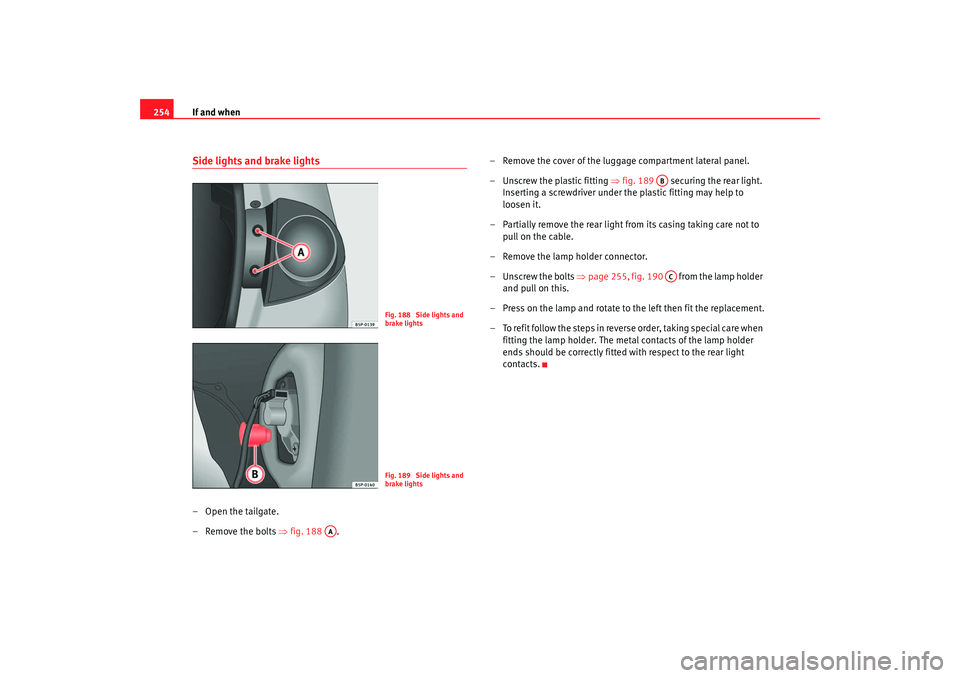
254Side lights and brake lights– Open the tailgate.
– Remove the bolts ⇒fig. 188 . – Remove the cover of the luggage compartment lateral panel.
– Unscrew the plastic fitting
⇒fig. 189 securing the rear light.
Inserting a screwdriver under the plastic fitting may help to
loosen it.
– Partially remove the rear light from its casing taking care not to pull on the cable.
– Remove the lamp holder connector.
– Unscrew the bolts ⇒page 255, fig. 190 from the lamp holder
and pull on this.
– Press on the lamp and rotate to the left then fit the replacement.
– To refit follow the steps in reverse order, taking special care when fitting the lamp holder. The metal contacts of the lamp holder
ends should be correctly fitted with respect to the rear light
contacts.
Fig. 188 Side lights and
brake lightsFig. 189 Side lights and
brake lights
AA
ABAC
altea_ingles_0706.book Seite 254 Mittwoch, 30. August 2006 3:48 15
Page 263 of 302

If and when261
Safety First
Operating instructions
Tips and Maintenance
Te c h n i c a l D a t a
Towing and tow-startingTo w - s t a r t i n g
The use of jump leads is preferable to tow-starting.We recommend that you do not tow-start your vehicle. Jump-starting
is preferable ⇒page 258.
However, if your vehicle has to be tow-started:
–Engage the 2
nd or the 3
rd gear.
– Keep the clutch pressed down.
– Switch on the ignition.
– Once both vehicles are mo ving, release the clutch.
– As soon as the engine starts, press the clutch and move the gear lever into neutral. This helps to prevent driving into the towing
vehicle.
WARNING
The risk of accidents is high when tow-starting. The vehicle being towed
can easily collide with the towing vehicle.
Caution
When tow-starting, fuel could enter the catalytic converter and damage it.
Towing eyesPlease observe the following points if you use a tow-rope:
Fig. 201 The front right
section of the vehicle:
Fitting the front towing
eyeFig. 202 Fitting the
towing eye to the rear of
the vehicle
altea_ingles_0706.book Seite 261 Mittwoch, 30. August 2006 3:48 15