Page 243 of 302
If and when241
Safety First
Operating instructions
Tips and Maintenance
Te c h n i c a l D a t a
Note
Seek professional assistance if the repair of a tyre puncture is not possible
with the sealing compound.Preparation work
What you must do before changing a wheel.– If you have a flat tyre or puncture, park the vehicle as far away
from the flow of traffic as possible.
–Apply the handbrake firmly.
–Engage the first gear, or put the selector lever to position P for
those vehicles with an automatic gearbox.
– All passengers must leave the vehicle. They should wait in a safe
area (for instance behind the roadside crash barrier).
– Check whether the puncture can be mended using the Tyre Mobility System “General observations and safety advice”.
– Unscrew cap from the valve of the affected wheel.
–Take the tyre repair kit from the luggage compartment.
WARNING
Put the hazard warning lights on and place the warning triangle in position.
This is for your own safety and also warns other road users.
Caution
Take the utmost caution when repairing a flat tyre on a gradient.
Note
Please observe legal requirements when doing so.Repairing the puncture
To repair the puncture, once the preliminary tasks are done,
follow these steps.Apply the sealant
– The instructions for using the sealant correctly are on the pack-
aging.
Inflate the tyres.
– Remove the compressor and hose.
– Tighten the fastening nut onto the tyre valve.
– Connect the compressor power supply to the 12 Volt socket.
– Connect the compressor and chec k the tyre pressure with the
pressure gauge.
Finish the repair
– Remove the compressor hose from the valve.
– Check the cap on the tyre valve.
– Disconnect the compressor from the vehicle mains.
altea_ingles_0706.book Seite 241 Mittwoch, 30. August 2006 3:48 15
Page 247 of 302
If and when245
Safety First
Operating instructions
Tips and Maintenance
Te c h n i c a l D a t a
21
Cable control unit 7,5
22 Volumetric alarm sensor/alarm siren 5
23 Diagnosis/Rain sensor/Light switch 10
24 Vacant
25 Automatic gearbox control unit connection 20
26 Vacuum pump 20
27 Vacant
28 Windscreen wiper motor/Cable control unit 20
29 Vacant
30 Cigarette lighter / socket 20
31 Vacant
32 Vacant
33 Heater 40
34 Vacant
35 Vacant
36 2.0 litre 147 kW engine 10
37 2.0 litre 147 kW engine 10
38 2.0 litre 147 kW engine 10
39 Trailer control unit (coupling) 15
40 Trailer control unit (indicators, brakes and left side) 20
41 Trailer control unit (fog light, reversing light and right side) 20
42 Towing kit 15
43 Vacant
44 Rear window heater 25
Number
Electrical equipment Amperes
altea_ingles_0706.book Seite 245 Mittwoch, 30. August 2006 3:48 15
Page 250 of 302
If and when
248
19 Clean 30
20 Vacant
21 Lambda probe 15
22 Brake pedal, speed sensor 5
23 Engine 1.6, main relay (relay n° 100)
5
T 71 diesel EGR 10
2.0 D2L High-pressure fuel pump 15
24 ARF, change valve 10
25 Right lighting 40
26 Left lighting 40
1.6 SLP engine 40
1.9 TDI Glow plug relay 50
28 KL15 40
29 Electric windows (front and back)
50
Electric windows (front) 30
30 X - relief relay 40
Number
Electrical equipment Amperes
altea_ingles_0706.book Seite 248 Mittwoch, 30. August 2006 3:48 15
Page 255 of 302
If and when253
Safety First
Operating instructions
Tips and Maintenance
Te c h n i c a l D a t a
Side lights–Raise the bonnet.
– Remove the cover ⇒fig. 186 by pulling on this. – Extract the lamp holder
⇒fig. 187 outwards.
– Replace the bulb by pulling this out and inserting the replace- ment.
– Installation is done in the reverse order.
Rear lights•
Side lights
•
Brake lights
•
Turn signals
•
Reversing lights
•
Rear fog light
Fig. 186 Side lightsFig. 187 Side lights
AD
A1
altea_ingles_0706.book Seite 253 Mittwoch, 30. August 2006 3:48 15
Page 256 of 302
If and when
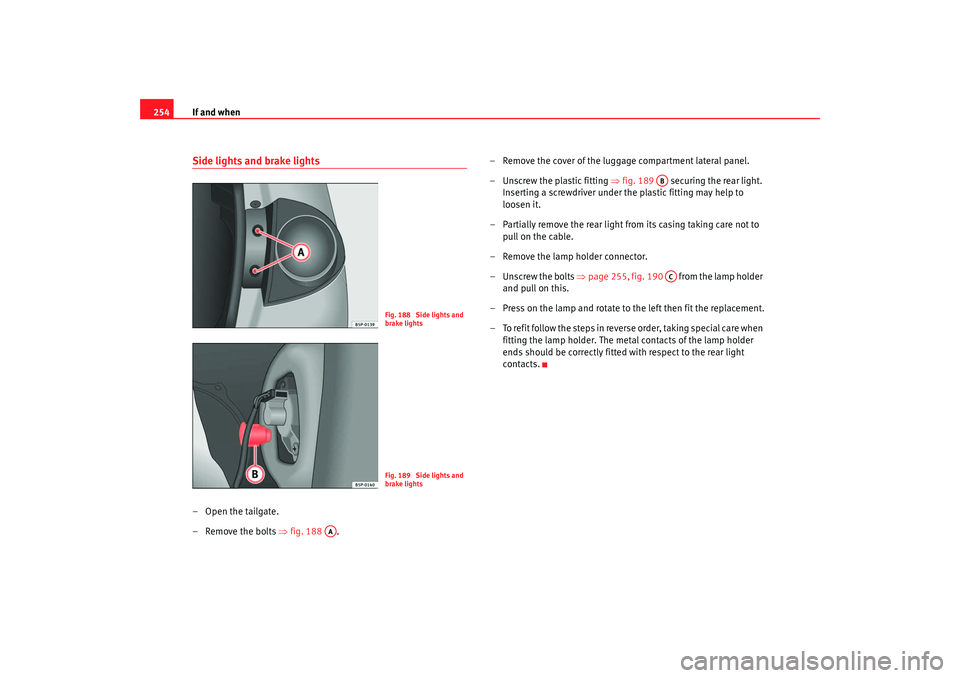
254Side lights and brake lights– Open the tailgate.
– Remove the bolts ⇒fig. 188 . – Remove the cover of the luggage compartment lateral panel.
– Unscrew the plastic fitting
⇒fig. 189 securing the rear light.
Inserting a screwdriver under the plastic fitting may help to
loosen it.
– Partially remove the rear light from its casing taking care not to pull on the cable.
– Remove the lamp holder connector.
– Unscrew the bolts ⇒page 255, fig. 190 from the lamp holder
and pull on this.
– Press on the lamp and rotate to the left then fit the replacement.
– To refit follow the steps in reverse order, taking special care when fitting the lamp holder. The metal contacts of the lamp holder
ends should be correctly fitted with respect to the rear light
contacts.
Fig. 188 Side lights and
brake lightsFig. 189 Side lights and
brake lights
AA
ABAC
altea_ingles_0706.book Seite 254 Mittwoch, 30. August 2006 3:48 15
Page 262 of 302

If and when
260
WARNING
•
Please note the safety warnings referring to working in the engine
compartment ⇒page 208, “Working in the engine compartment”.
•
The battery providing assistance must have the same voltage as the flat
battery (12V) and approximately the same capacity (see imprint on
battery). Failure to comply could result in an explosion.
•
Never use jump leads when one of the batteries is frozen. Danger of
explosion! Even after the battery has thawed, battery acid could leak and
cause chemical burns. If a battery freezes, it should be replaced.
•
Keep sparks, flames and lighted cigarettes away from batteries, danger
of explosion. Failure to comply could result in an explosion.
•
Observe the instructions provided by the manufacturer of the jump
leads.
•
Do not connect the negative cable from the other vehicle directly to the
negative terminal of the flat battery. The gas emitted from the battery could
be ignited by sparks. Danger of explosion.
•
Do not attach the negative cable from the other vehicle to parts of the
fuel system or to the brake line.
•
The non-insulated parts of the battery clamps must not be allowed to
touch. The jump lead atta ched to the positive battery terminal must not
touch metal parts of the vehicle, this can cause a short circuit.
•
Position the leads in such a way that they cannot come into contact
with any moving parts in the engine compartment.
•
Do not bend over the batteries. This could result in chemical burns.Note
The vehicles must not touch each other, otherwise electricity could flow as
soon as the positive terminals are connected.
altea_ingles_0706.book Seite 260 Mittwoch, 30. August 2006 3:48 15
Page 264 of 302

If and when
262
Notes for the driver of the towing vehicle
– Drive slowly at first until the to w-rope is taut. Then accelerate
gradually.
– Begin and change gears cautiously. If you are driving an auto- matic vehicle, accelerate gently.
– Remember that the brake servo and power steering are not working in the vehicle you are towing. Brake earlier than you
would normally, but with a more gentle pressure on the brake.
Notes for the driver of the towed vehicle
– Ensure that the tow-rope remains taut at all times when towing.
Fitting the towing eye
– Take the towing ring from the onboard tools.
– Pull the lower front cover down and leave the cover hanging on the vehicle.
– Remove the cover of the screw hole, insert a screwdriver into the lower slot and lever gently.
– Screw the towing eye as shown by arrow anti-clockwise to the
limit position in the front ⇒page 261, fig. 201 or rear
⇒ page 261, fig. 202 threaded hole.Tow-rope or tow-bar
It is easier and safer to tow a vehicle with a tow-bar. You should only use a
tow-rope if you do not have a tow-bar.
A tow-rope should be slightly elastic to reduce the loading on both vehicles.
It is advisable to use a tow-rope made of synthetic fibre or similarly elastic
material. Attach the tow-rope or the tow-bar only to the towing eyes provided or a
towing bracket.
Driving style
Towing requires some experience, espec
ially when using a tow-rope. Both
drivers should be familiar with the te chnique required for towing. Inexperi-
enced drivers should not attempt to tow-start or tow away another vehicle.
Do not pull too hard with the towing vehicle and take care to avoid jerking the
tow-rope. When towing on an unpaved road, there is always a risk of over-
loading and damaging the anchorage points.
The ignition of the vehicle being towed must be switched on to prevent the
steering wheel from locking and also to allow the use of the turn signals,
horn, windscreen wipers and washers.
As the brake servo does not work if the engine is not running, you must apply
considerably more pressure to the brake pedal than you normally would.
As the power assisted steering does not work if the engine is not running, you
will need more strength to steer than you normally would.
Towing vehicles with an automatic gearbox
•
Put the selector lever into position “N”.
•
Do not drive faster than 50 km/h when towing a vehicle.
•
Do not tow further than 50 km.
•
If a breakdown vehicle is used, the vehicle must be towed with the front
wheels raised.Note
•
Observe legal requirements when towing or tow-starting.
•
Switch on the hazard warning lights of both vehicles. However, observe
any regulations to the contrary.
•
For technical reasons, vehicles with an automatic gearbox must not be
tow-started.
altea_ingles_0706.book Seite 262 Mittwoch, 30. August 2006 3:48 15
Page 277 of 302
Technical Data275
Safety First
Operating instructions
Tips and Maintenance
Te c h n i c a l D a t a
Trailer weights
Engine oil capacity
Petrol engine 2.0 litre 110 kW (150 hp). ManualGeneral engine data
Performance figures
With no brakes, gradients up to 12%
690
With brakes, gradients up to 12% 1200
Approximate engine oil capacity with oil filter change 4,8 litres
Power output in kW (bhp) rpm 110 (150)/ 6000
Maximum torque in Nm at rpm 200/ 3500
No. of cylinders, capacity in cm
3
4/ 1984
Compression 11,5 - 0,5
Fuel 98 RON
a)/ 95 RON
b)
a)Research- Octane- Number = Measure of the predetonation power of the petrol.b)Slight power lossMaximum speed in km/h 206
Acceleration from 0-80 km/h in sec. 6,5
Acceleration from 0-100 km/h in sec. 9,6
altea_ingles_0706.book Seite 275 Mittwoch, 30. August 2006 3:48 15