2007 Seat Altea ACC
[x] Cancel search: ACCPage 238 of 302
If and when
236Wheel covers*
The wheel covers must be removed for access to the wheel
boltsRemoving
– Remove the wheel cover using the wire hook.
– Hook this into one of the cut-outs of the wheel cover.
Fitting
– Fit the wheel cover onto the wheel rim by pressing it firmly. Put
pressure initially on the point of the cut out for the valve. Then
press the wheel cover onto the steel rim so that it engages all
round.
Loosening the wheel bolts
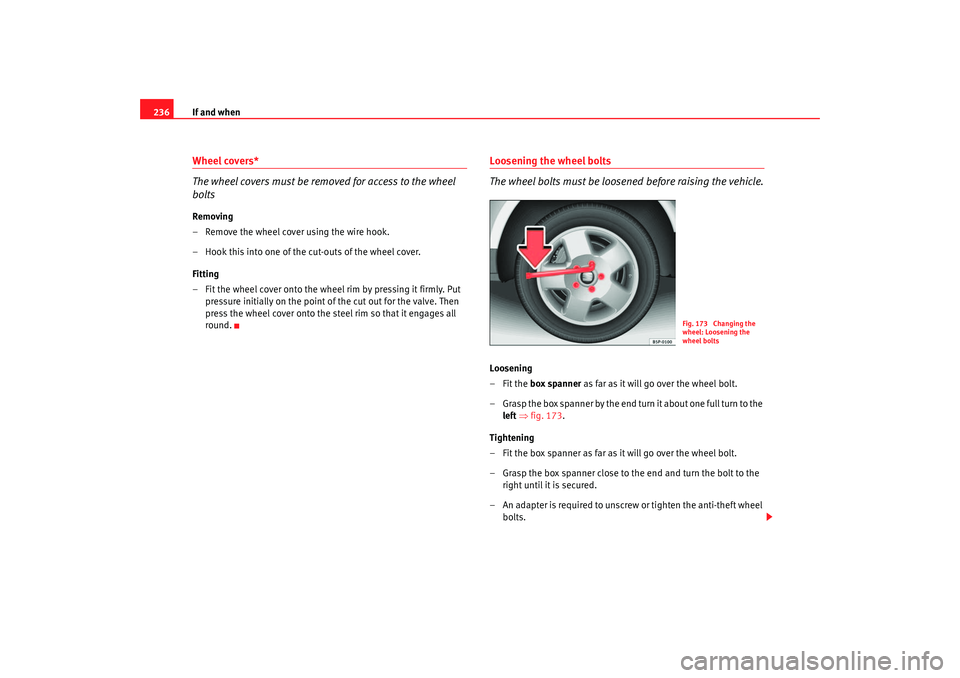
The wheel bolts must be loosened before raising the vehicle.Loosening
–Fit the box spanner as far as it will go over the wheel bolt.
– Grasp the box spanner by the end turn it about one full turn to the left ⇒ fig. 173.
Tightening
– Fit the box spanner as far as it will go over the wheel bolt.
– Grasp the box spanner close to the end and turn the bolt to the right until it is secured.
– An adapter is required to unscrew or tighten the anti-theft wheel bolts.
Fig. 173 Changing the
wheel: Loosening the
wheel bolts
altea_ingles_0706.book Seite 236 Mittwoch, 30. August 2006 3:48 15
Page 239 of 302

If and when237
Safety First
Operating instructions
Tips and Maintenance
Te c h n i c a l D a t a
WARNING
Loosen the wheel bolts only about one tu rn before raising the vehicle with
the jack, loosening the wheel bolts more than one turn can result in an acci-
dent.
Note
•
Do not use the hexagonal socket in th e screwdriver handle to loosen or
tighten the wheel bolts.
•
If the wheel bolt is very tight, you may be able to loosen it by pushing
down the end of the spanner carefully with your foot. Hold on to the vehicle
for support and take care not to slip.
altea_ingles_0706.book Seite 237 Mittwoch, 30. August 2006 3:48 15
Page 240 of 302

If and when
238Raising the vehicle
The vehicle must be raised with a jack to remove the wheel.
– Locate the jacking point under the door sill closest to the wheel
being changed ⇒fig. 174.
– Wind up the jack under the jacking point until the arm of the jack is directly below the vertical rib under the door sill.
– Align the jack so that the arm of the jack fits around the rib under the door sill and the movable base plate of the jack is flat on the
ground ⇒fig. 175.
– Raise the vehicle until the defective wheel is just clear of the ground.Recesses at the front and rear of the door sills mark the jacking points
⇒fig. 174. A position has been made for each wheel. Do not fit the jack
anywhere else.
An unstable surface under the jack may cause the vehicle to slip off the jack.
Therefore, the jack must be fitted on solid ground offering good support. Use
a large and stable base, if necessary. On a hard, slippery surface (such as
tiles) use a rubber mat or similar to prevent the jack from slipping.
WARNING
•
Take all precautions so that the base of the jack does not slip. Failure to
do so could result in an accident.
•
The vehicle can be damaged if the ja ck is not applied at the correct
jacking points. There is also a risk of injury since the jack can slip off
suddenly if it is not properly engaged.
Fig. 174 The jacking
pointsFig. 175 Fitting the jack
altea_ingles_0706.book Seite 238 Mittwoch, 30. August 2006 3:48 15
Page 242 of 302

If and when
240
– Insert the adapter onto the wheel bolt and push it on as far as it will go ⇒page 239, fig. 177 .
– Fit the box spanner as far as it will go over the adapter.
– Loosen or tighten the wheel bolt as appropriate.Code number
The code number of the anti-theft wheel bolt is stamped on the front of the
adapter.
The code number should be noted and kept in a safe place, as it is only by
using the code number that a duplicate adapter can be obtained from an
Authorised Service Centre.Tyres with directional tread pattern
Tyres with directional tread pattern must be fitted so that they
rotate in the correct direction.A directional tread pattern can be identified by arrows on the sidewall that
point in the direction of rotation. Always note the direction of rotation indi-
cated when fitting the wheel. This is important so that these tyres can give
maximum grip and avoid excessive noise, tread wear and aquaplaning.
If, in an emergency, you have to fit the spare wheel so it rotates in the wrong
direction, you must drive extremely ca refully. The tyre will not give optimum
performance. This is particularly important when driving on wet roads.
To benefit from the advantages of tyres with this type of tread pattern, the
defective tyre should be replaced as soon as possible so that all tyres again
rotate in the correct direction.
Tyre repair kit* (Tyre Mobility System)General Observations and safety adviceYour vehicle is equipped with the tyre repair kit called the Tyre mobility
system.
Beneath the floor of the stowage compartment there is a sealant and a
compressor which should be used in case of puncture.
The Tyre Mobility System will allow you to safely repair damage to a tyre by
penetration of a foreign object to 4mm diameter.
The foreign object can be left inside the tyre.
The sealant comes with instructions for use.
There is also a guide to using the compressor.
WARNING
•
The sealant should not be used if th e tyre has been damaged as a result
of going flat.
•
Follow the instructions for your safety and use on the compressor and
the sealant packaging.
•
Do not drive at more than 80 km/h, avo id accelerating or braking hard
or taking curves at high speed.
•
A tyre that has been repaired with sealant should only be used provi-
sionally, and for a short time Therefore, your car should be taken carefully
to the nearest spec ialised workshop.For the sake of the environment
If you want to dispose of the sealant bottle, go to a company that treats waste
products.
altea_ingles_0706.book Seite 240 Mittwoch, 30. August 2006 3:48 15
Page 252 of 302

If and when
250Xenon headlights
20)/directional*
Dipped and full beam - D1S
21)
Light burst and additional full beam - H1
Position W5W
Turn signals PY21W
Fog lights
Fog lights - H3
Upper rear light
Stop/Position - P21W
22)
Turn signals - R10W
Lower rear light
Fog light - P21W
Reverse light - P21W
Indicator
Indicator - W5W
Registration plate light
Registration plate light - C5W
Note
•
Due to the difficulty in accessing the lamps, any replacement work should
be done by a SEAT dealer. However, the following is a description of how to
change the lamps except for the fog lights* and interior lamps.
Main headlight lamps
Turn signals
Dipped headlights
Main beam headlights
Side lights
20)On this type of headlight, the bulb changes must be made by the SEAT dealer, given
that complex elements must be removed from the vehicle and a reset must be made
on the automatic control system incorporated.21)The Xenon bulbs discharge 2.5 times the light flux and have an average lifespan of 5
times more than that of halo gen bulbs, this means that, except due to unusual circum-
stances, there is no need to change the bulbs for the whole life of the vehicle.22)Electronically controlled single filament bulb for Stop/side bulbs. If the bulb blows it
will not work in either position or Stop position
Fig. 180 Main headlight
lamps
AAABACAD
altea_ingles_0706.book Seite 250 Mittwoch, 30. August 2006 3:48 15
Page 263 of 302

If and when261
Safety First
Operating instructions
Tips and Maintenance
Te c h n i c a l D a t a
Towing and tow-startingTo w - s t a r t i n g
The use of jump leads is preferable to tow-starting.We recommend that you do not tow-start your vehicle. Jump-starting
is preferable ⇒page 258.
However, if your vehicle has to be tow-started:
–Engage the 2
nd or the 3
rd gear.
– Keep the clutch pressed down.
– Switch on the ignition.
– Once both vehicles are mo ving, release the clutch.
– As soon as the engine starts, press the clutch and move the gear lever into neutral. This helps to prevent driving into the towing
vehicle.
WARNING
The risk of accidents is high when tow-starting. The vehicle being towed
can easily collide with the towing vehicle.
Caution
When tow-starting, fuel could enter the catalytic converter and damage it.
Towing eyesPlease observe the following points if you use a tow-rope:
Fig. 201 The front right
section of the vehicle:
Fitting the front towing
eyeFig. 202 Fitting the
towing eye to the rear of
the vehicle
altea_ingles_0706.book Seite 261 Mittwoch, 30. August 2006 3:48 15
Page 264 of 302

If and when
262
Notes for the driver of the towing vehicle
– Drive slowly at first until the to w-rope is taut. Then accelerate
gradually.
– Begin and change gears cautiously. If you are driving an auto- matic vehicle, accelerate gently.
– Remember that the brake servo and power steering are not working in the vehicle you are towing. Brake earlier than you
would normally, but with a more gentle pressure on the brake.
Notes for the driver of the towed vehicle
– Ensure that the tow-rope remains taut at all times when towing.
Fitting the towing eye
– Take the towing ring from the onboard tools.
– Pull the lower front cover down and leave the cover hanging on the vehicle.
– Remove the cover of the screw hole, insert a screwdriver into the lower slot and lever gently.
– Screw the towing eye as shown by arrow anti-clockwise to the
limit position in the front ⇒page 261, fig. 201 or rear
⇒ page 261, fig. 202 threaded hole.Tow-rope or tow-bar
It is easier and safer to tow a vehicle with a tow-bar. You should only use a
tow-rope if you do not have a tow-bar.
A tow-rope should be slightly elastic to reduce the loading on both vehicles.
It is advisable to use a tow-rope made of synthetic fibre or similarly elastic
material. Attach the tow-rope or the tow-bar only to the towing eyes provided or a
towing bracket.
Driving style
Towing requires some experience, espec
ially when using a tow-rope. Both
drivers should be familiar with the te chnique required for towing. Inexperi-
enced drivers should not attempt to tow-start or tow away another vehicle.
Do not pull too hard with the towing vehicle and take care to avoid jerking the
tow-rope. When towing on an unpaved road, there is always a risk of over-
loading and damaging the anchorage points.
The ignition of the vehicle being towed must be switched on to prevent the
steering wheel from locking and also to allow the use of the turn signals,
horn, windscreen wipers and washers.
As the brake servo does not work if the engine is not running, you must apply
considerably more pressure to the brake pedal than you normally would.
As the power assisted steering does not work if the engine is not running, you
will need more strength to steer than you normally would.
Towing vehicles with an automatic gearbox
•
Put the selector lever into position “N”.
•
Do not drive faster than 50 km/h when towing a vehicle.
•
Do not tow further than 50 km.
•
If a breakdown vehicle is used, the vehicle must be towed with the front
wheels raised.Note
•
Observe legal requirements when towing or tow-starting.
•
Switch on the hazard warning lights of both vehicles. However, observe
any regulations to the contrary.
•
For technical reasons, vehicles with an automatic gearbox must not be
tow-started.
altea_ingles_0706.book Seite 262 Mittwoch, 30. August 2006 3:48 15
Page 265 of 302

If and when263
Safety First
Operating instructions
Tips and Maintenance
Te c h n i c a l D a t a
•
If damage to your vehicle means that there is no lubricant in the gearbox,
you must raise the drive wheels while the vehicle is being towed.
•
If the vehicle has to be towed more than 50 km, the front wheels must be
raised during towing, and towing should be carried out by a qualified person.
•
The steering wheel is locked when the vehicle has no electrical power. The
vehicle must then be towed with the front wheels raised. Towing should be
carried out by a qualified person.
•
The towing eye should always be kept in the vehicle. Please refer to the
notes on ⇒page 261, “Tow-starting”.
Front towing eye (FR version)
Fitting the front towing eye
– Take the towing ring from the onboard tools.
– Remove screw ⇒fig. 203 .
– Remove the cover in the direction indicated (arrow).
– Screw the eye as far as possible to the left, as shown by the arrow
⇒ fig. 204.
– Tighten the towing eye.
Note•
Observe legal requirements when towing or tow-starting.
•
Switch on the hazard warning lights of both vehicles. However, observe
any regulations to the contrary.
•
For technical reasons, vehicles with an automatic gearbox must not be
tow-started.
Fig. 203 Accessing the
towing eye recess
Fig. 204 Assembly of
towing eye
AA
altea_ingles_0706.book Seite 263 Mittwoch, 30. August 2006 3:48 15