Page 255 of 302
If and when253
Safety First
Operating instructions
Tips and Maintenance
Te c h n i c a l D a t a
Side lights–Raise the bonnet.
– Remove the cover ⇒fig. 186 by pulling on this. – Extract the lamp holder
⇒fig. 187 outwards.
– Replace the bulb by pulling this out and inserting the replace- ment.
– Installation is done in the reverse order.
Rear lights•
Side lights
•
Brake lights
•
Turn signals
•
Reversing lights
•
Rear fog light
Fig. 186 Side lightsFig. 187 Side lights
AD
A1
altea_ingles_0706.book Seite 253 Mittwoch, 30. August 2006 3:48 15
Page 257 of 302
If and when255
Safety First
Operating instructions
Tips and Maintenance
Te c h n i c a l D a t a
Turn indi cato rs– Remove the diode from its housing ⇒page 254. – Unscrew the bolts
⇒fig. 190 from the lamp holder and pull
on this.
– Pull out the lamp holder from the turn signal using a screw driver in the direction of the arrow (see ⇒fig. 191 ).
– Fit the replacement lamp by pressing it down and rotating to the left.
– Installation is done in the reverse order.
Reverse light / rear fog light– Rotate the lamp holder to the left, and remove it in the direction of the arrow ⇒fig. 192.
– Replace the bulb by pressing on it and rotating at the same time
to the left.
Fig. 190 Indicator lightsFig. 191 Indicator lights.
AC
Fig. 192 Lamp on interior
side of bumper
altea_ingles_0706.book Seite 255 Mittwoch, 30. August 2006 3:48 15
Page 259 of 302
If and when257
Safety First
Operating instructions
Tips and Maintenance
Te c h n i c a l D a t a
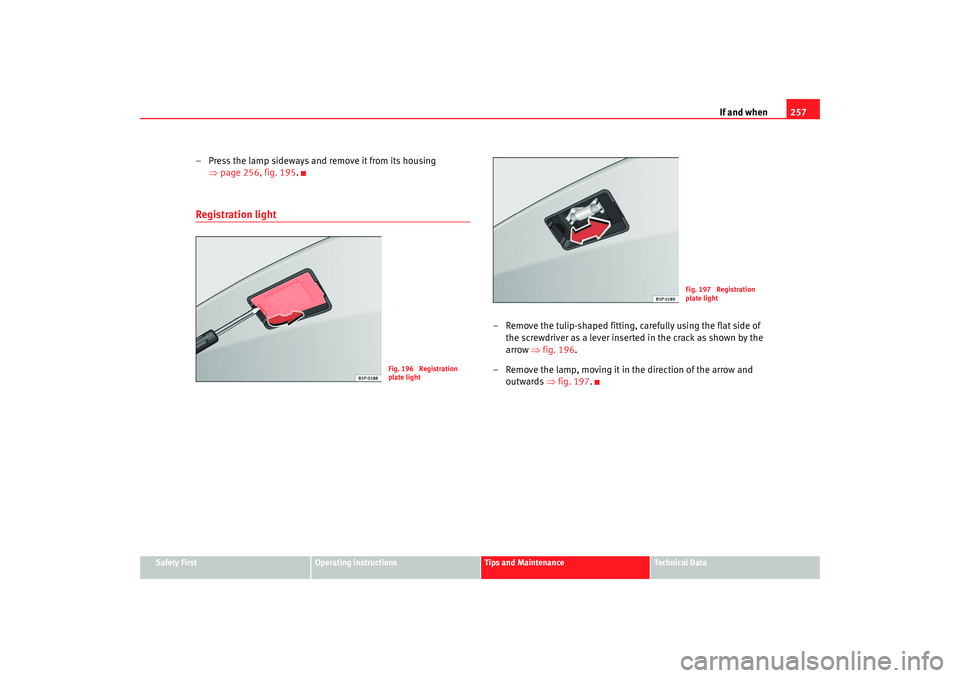
– Press the lamp sideways and remove it from its housing
⇒page 256, fig. 195 .Registration light
– Remove the tulip-shaped fitting, carefully using the flat side of
the screwdriver as a lever inserted in the crack as shown by the
arrow ⇒fig. 196.
– Remove the lamp, moving it in the direction of the arrow and outwards ⇒fig. 197.
Fig. 196 Registration
plate light
Fig. 197 Registration
plate light
altea_ingles_0706.book Seite 257 Mittwoch, 30. August 2006 3:48 15
Page 261 of 302

If and when259
Safety First
Operating instructions
Tips and Maintenance
Te c h n i c a l D a t a
How to jump startIn ⇒ fig. 200, the flat battery is and the charged battery .
Jump lead terminal connections
– Switch off the ignition on both vehicles ⇒.
1. Connect one end of the red jump lead to the positive ⇒fig. 200
terminal of the vehicle with the flat battery ⇒.
2. Connect the other end of the red jump lead to the positive terminal in the vehicle providing assistance.
3. Connect one end of the black jump lead to the negative terminal on the battery of the vehicle providing assistance. 4. Connect the other end of the black jump lead to a solid metal
component which is bolted on to the engine block, or onto the
engine block itself of the vehicle with the flat battery. Do not
connect it to a point near the battery ⇒.
5. Position the leads in such a way that they cannot come into contact with any moving parts in the engine compartment.
Starting
6. Start the engine of the vehicle with the boosting battery and let
it run at idling speed.
7. Start the engine of the car with the flat battery and wait one or two minutes until the engine is “running”.
Removing the jump leads
8. Before you remove the jump leads, switch off the headlights (if they are switched on).
9. Turn on the heater blower and rear window heater in the vehicle with the flat battery. This helps minimise voltage peaks that are
generated when the leads are disconnected.
10. When the engine is running, disconnect the leads in reverse order to the details given above.
Connect the battery clamps so they ha ve good metal-to-metal contact with
the battery terminals.
If the engine fails to start, switch off the starter after about 10 seconds and
try again after about half a minute.
Fig. 200 How to connect
the jump leads
AA
AB
A+
A+
A-
AX
altea_ingles_0706.book Seite 259 Mittwoch, 30. August 2006 3:48 15
Page 263 of 302

If and when261
Safety First
Operating instructions
Tips and Maintenance
Te c h n i c a l D a t a
Towing and tow-startingTo w - s t a r t i n g
The use of jump leads is preferable to tow-starting.We recommend that you do not tow-start your vehicle. Jump-starting
is preferable ⇒page 258.
However, if your vehicle has to be tow-started:
–Engage the 2
nd or the 3
rd gear.
– Keep the clutch pressed down.
– Switch on the ignition.
– Once both vehicles are mo ving, release the clutch.
– As soon as the engine starts, press the clutch and move the gear lever into neutral. This helps to prevent driving into the towing
vehicle.
WARNING
The risk of accidents is high when tow-starting. The vehicle being towed
can easily collide with the towing vehicle.
Caution
When tow-starting, fuel could enter the catalytic converter and damage it.
Towing eyesPlease observe the following points if you use a tow-rope:
Fig. 201 The front right
section of the vehicle:
Fitting the front towing
eyeFig. 202 Fitting the
towing eye to the rear of
the vehicle
altea_ingles_0706.book Seite 261 Mittwoch, 30. August 2006 3:48 15
Page 265 of 302

If and when263
Safety First
Operating instructions
Tips and Maintenance
Te c h n i c a l D a t a
•
If damage to your vehicle means that there is no lubricant in the gearbox,
you must raise the drive wheels while the vehicle is being towed.
•
If the vehicle has to be towed more than 50 km, the front wheels must be
raised during towing, and towing should be carried out by a qualified person.
•
The steering wheel is locked when the vehicle has no electrical power. The
vehicle must then be towed with the front wheels raised. Towing should be
carried out by a qualified person.
•
The towing eye should always be kept in the vehicle. Please refer to the
notes on ⇒page 261, “Tow-starting”.
Front towing eye (FR version)
Fitting the front towing eye
– Take the towing ring from the onboard tools.
– Remove screw ⇒fig. 203 .
– Remove the cover in the direction indicated (arrow).
– Screw the eye as far as possible to the left, as shown by the arrow
⇒ fig. 204.
– Tighten the towing eye.
Note•
Observe legal requirements when towing or tow-starting.
•
Switch on the hazard warning lights of both vehicles. However, observe
any regulations to the contrary.
•
For technical reasons, vehicles with an automatic gearbox must not be
tow-started.
Fig. 203 Accessing the
towing eye recess
Fig. 204 Assembly of
towing eye
AA
altea_ingles_0706.book Seite 263 Mittwoch, 30. August 2006 3:48 15
Page 267 of 302
If and when265
Safety First
Operating instructions
Tips and Maintenance
Te c h n i c a l D a t a
•
If damage to your vehicle means that there is no lubricant in the gearbox,
you must raise the drive wheels while the vehicle is being towed.
•
If the vehicle has to be towed more than 50 km, the front wheels must be
raised during towing, and towing should be carried out by a qualified person.
•
The steering wheel is locked when the vehicle has no electrical power. The
vehicle must then be towed with the front wheels raised. Towing should be
carried out by a qualified person.
•
The towing eye should always be kept in the vehicle. Please refer to the
notes on ⇒page 261, “Tow-starting”.
altea_ingles_0706.book Seite 265 Mittwoch, 30. August 2006 3:48 15
Page 269 of 302

General notes on the technical data 267
Safety First
Operating instructions
Tips and Maintenance
Te c h n i c a l D a t a
Te c h n i c a l D a t aGeneral notes on the technical dataWhat you should be aware ofGeneral notes
All data in the official vehicle documents take precedence over this data.All data in these documents are valid for the basic model as offered in Spain.
The vehicle data card included in the inspection and maintenance schedule
in the vehicles registration documents show which engine is installed in the
vehicle. The figures may be different if addition
al equipment is fitted, for different
models, for special vehicles and for other countries.
Abbreviations used in this paragraph of the Technical Data Abbreviation MeaningkW Kilowatt, engine power measurement.
bhp Brake horse power, formerly used to denote engine power
at rpm Revolutions per minute - engine speed. Nm Newton metres, unit of engine torque.
l/100 km Fuel consumption in litres per 100 kilometres g/km Carbon dioxide emission s in grams per kilometre.
CO
2
Carbon dioxide
CN Cetane number, indication of the ignition quality of the diesel.
RON Research octane number, indication of the knock resistance of petrol.
altea_ingles_0706.book Seite 267 Mittwoch, 30. August 2006 3:48 15