2007 Seat Altea warning
[x] Cancel search: warningPage 130 of 302

Seats and stowage
128Head restraintsCorrect adjustment of head restraints
Properly adjusted head restraints are an important part of
occupant protection and can redu ce the risk of injuries in
most accident situations.
– Adjust the head restraint so that its upper edge is at the same
level as the top of your head, or as close as possible to the same
level as the top of your head and, as a very minimum at eye level
⇒fig. 90 and ⇒fig. 91 .Adjusting the head restraints ⇒page 129.
WARNING
•
Travelling with the head restraints removed or improperly adjusted
increases the risk of severe injuries.
•
Improperly adjusted head restraints could lead to death in the event of
a collision or accident.
•
Incorrectly adjusted head restraints also increase the risk of injury
during sudden or unexpected driving or braking manoeuvres.
•
The head restraints must always be adjusted according to the occu-
pant's size.
Fig. 90 Viewed from in
front: Properly adjusted
head restraints and
proper belt adjustment
Fig. 91 Viewed from side:
Properly adjusted head
restraints and proper belt
adjustment
altea_ingles_0706.book Seite 128 Mittwoch, 30. August 2006 3:48 15
Page 131 of 302

Seats and stowage129
Safety First
Operating instructions
Tips and Maintenance
Te c h n i c a l D a t a
Removing or adjusting head restraints
The head restraints can be adju sted by moving them up and
down.Adjusting height (front seats)
– Press the button on the side and pull upwards to the desired
position.
– To lower the head restraint, press the button and push head restraint downwards.
– Make sure that it engages securely into position.
Adjusting height (rear seats)
– Press the button on the side and pull upwards to the desired
position. – To lower the head restraint, press the button and push head
restraint downwards.
– Make sure that the head restraint engages securely in one of its positions ⇒ page 14.
Angle adjustment (front seats)
– Press the head restraint forward or back to the required position.
Removing the head restraint
– Push the head restraint up as far as it will go.
– Press the button ⇒fig. 92 (arrow).
– Pull head restraint out of fitting without releasing the button.
Fitting the head restraint
– Insert the head restraint into the guides on the rear backrest.
– Push head restraint down.
– Adjust the head restraint to suit body size ⇒page 14 and
⇒ page 13.
WARNING
•
Never drive if the head restraints have been removed. Risk of injury.
•
Never drive if the head restraints are in an unsuitable position, there is
a risk of serious injury.
•
After refitting the head restraint, you must always adjust it properly for
height to achieve optimal protection.
•
Please observe the safety warnings ⇒page 128, “Correct adjustment
of head restraints”.
Fig. 92 Adjusting and
removing the head
restraints
altea_ingles_0706.book Seite 129 Mittwoch, 30. August 2006 3:48 15
Page 132 of 302

Seats and stowage
130Front seatsAdjustment of the front seatsThe control elements in ⇒fig. 93 are mirrored for the front right-
hand seat.
Adjusting the seat forwards and backwards
– Pull up the grip and move th e seat forwards or backwards.
– Then release the grip and move the seat further until the catch engages.
Adjusting the seat height*
– Pull the lever up or push down (s everal times if necessary) from
its home position. This adjusts the seat height in stages. Adjusting the backrest angle
– Take your weight off the backrest and turn the hand wheel.
Adjusting the lumbar support*
– Take your weight off the backrest and turn the hand wheel to adjust the lumbar support.
The backrest curvature of the cushioned area is determined by the settings
made in the lumbar region. This supports the natural curvature of the spine
very effectively.
WARNING
•
Never adjust the driver or front passenger seat while the vehicle is in
motion. While adjusting your seat, you will assume an incorrect sitting
position. Risk of fatal accidents. Adju st the driver or front passenger seat
only when the vehicle is stationary.
•
To reduce the risk of injury to th e driver and front passenger during
sudden braking manoeuvres or an acci dent, never drive with the backrest
tilted far to the rear. The maximum protection of the seat belt can be
achieved only when the backrests are in an upright position and the driver
and front passenger have properly adjusted their seat belts. The further
the backrests are tilted to the rear, the greater the risk of injury due to
improper positioning of the belt web!
•
Exercise caution when adjusting the seat height or forwards/back-
wards position. Injuries can be caused if the backrest is tilted without due
care and attention.
Fig. 93 Front left seat
controls
A1
A1
A2
A3A4
altea_ingles_0706.book Seite 130 Mittwoch, 30. August 2006 3:48 15
Page 134 of 302

Seats and stowage
132
The seats may be moved forwards and backwards independently.
The movement can be 1/3 or 2/3 of the seat. There are various
possible positions.
Adjusting reach
– In the seated position, unlock the lever in the direction of the arrow ⇒page 131, fig. 95 .
– Push the seat backwards or forwards to the desired position.
Backrest angle adjustment
– Hold the backrest at the top. Pull the loop on the side of the seat
⇒ page 131, fig. 96 in the direction of the arrow and hold the
loop in this position. Push the backrest to the required position
and release the loop.
WARNING
•
Adjust the seat only when the vehicle is stationary. Otherwise your seat
could move unexpectedly while the vehicle is moving. This could increase
the risk of an accident and therefore injury.
•
Do not push the seatbacks down until the seat is moved, this is to avoid
damage to the centre console.
•
Ensure that the seat, once mo ved, is fixed in position.Note
•
In order to maintain the maximum luggage compartment space, put the
seatbacks in normal position, without moving.
•
In order to maintain the maximum space without putting the seatbacks
down, move the seats forward to the desired position.
Folding the seat backrests down – Pull the loop on the side of the seat ⇒ fig. 97 .In this position the back rest is locked. This is the reason why the loop located
on the side of the seat must be pulled in the direction of the arrow to open the
backrest.
WARNING
•
You should check that the backrest has engaged properly in position
after the loop is released.
•
The locking system loops on the seat s may not, for safety reasons, be
used to secure any items.
A1
Fig. 97 Folding or
opening the rear seat
backrestsA1
altea_ingles_0706.book Seite 132 Mittwoch, 30. August 2006 3:48 15
Page 135 of 302

Seats and stowage133
Safety First
Operating instructions
Tips and Maintenance
Te c h n i c a l D a t a
Folding the rear seat backrests down– Pull the loop on the side of the seat ⇒fig. 98 in the direction
of the arrow and lift the seat backrest into position.
WARNING
•
You should check that the backrest has engaged properly in position
after the loop is released.
•
The locking system loops on the seats may not, for safety reasons, be
used to secure any items.
•
After locking the seat backrest into position ensure that the seat belts
protrude from the seat.
Stowage compartmentsStowage compartment on the front passenger sideThe compartment can be opened by pulling the lever ⇒fig. 99 .
WARNING
Always keep the stowage compartment cover closed while the vehicle is in
motion to reduce the risk of injury during a sudden braking manoeuvre or
in the event of an accident.
Fig. 98 Folding or
opening the front seat
backrestsA1
Fig. 99 Passenger side:
Stowage compartment
altea_ingles_0706.book Seite 133 Mittwoch, 30. August 2006 3:48 15
Page 136 of 302
Seats and stowage
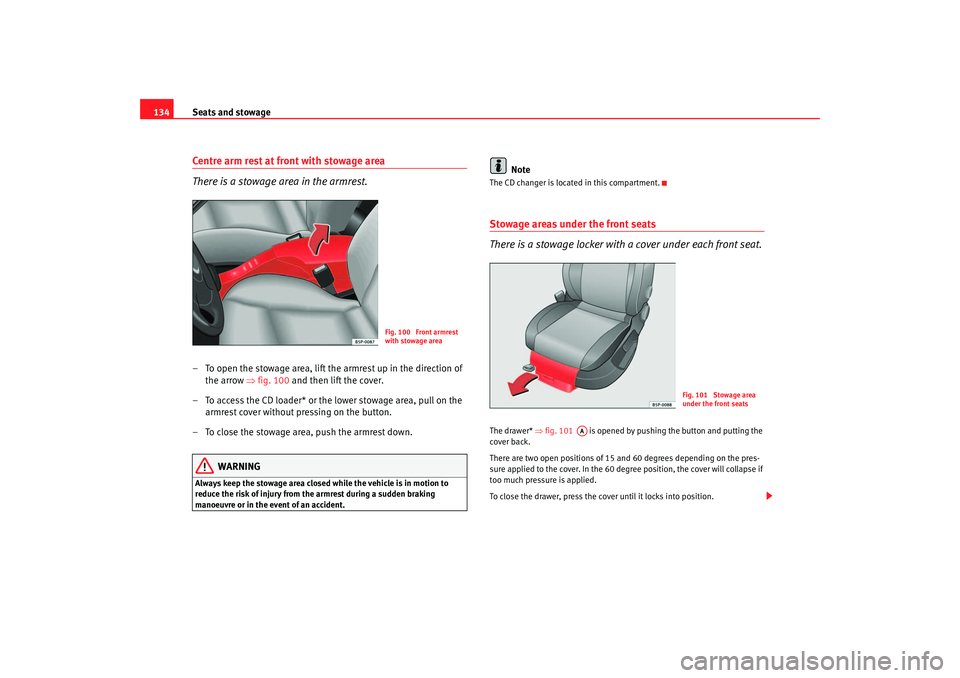
134Centre arm rest at front with stowage area
There is a stowage area in the armrest.– To open the stowage area, lift the armrest up in the direction of
the arrow ⇒fig. 100 and then lift the cover.
– To access the CD loader* or the lower stowage area, pull on the armrest cover without pressing on the button.
– To close the stowage area, push the armrest down.
WARNING
Always keep the stowage area closed while the vehicle is in motion to
reduce the risk of injury from the armrest during a sudden braking
manoeuvre or in the event of an accident.
Note
The CD changer is located in this compartment.Stowage areas under the front seats
There is a stowage locker with a cover under each front seat.The drawer* ⇒fig. 101 is opened by pushing the button and putting the
cover back.
There are two open positions of 15 and 60 degrees depending on the pres-
sure applied to the cover. In the 60 degree position, the cover will collapse if
too much pressure is applied.
To close the drawer, press the cover until it locks into position.
Fig. 100 Front armrest
with stowage area
Fig. 101 Stowage area
under the front seats
AA
altea_ingles_0706.book Seite 134 Mittwoch, 30. August 2006 3:48 15
Page 137 of 302

Seats and stowage135
Safety First
Operating instructions
Tips and Maintenance
Te c h n i c a l D a t a
WARNING
•
The drawers will hold a maximum weight of 1.5 kg.
•
Do not drive with the drawer cover open. There is an injury risk for
passengers if the cargo is released in case of sudden braking or an
accident.
Folding table*
Folding tables are fitted to the rear of the front seat backrests.– To open the table, open it up in the direction of the arrow ⇒fig. 102 .
WARNING
•
The folding tables may not be folded down whilst the vehicle is in
motion and anyone is seated on the second row of seats. Risk of injury
during a sudden braking manoeuvre! The table must therefore be closed
and properly secured whilst the vehicle is in motion.
•
Never place hot drinks in the drink holders. During normal or sudden
driving manoeuvres, sudden braking or an accident, the hot drink could be
spilled. Danger of scalding.Caution
When driving, do not leave open containers in the cup holders. The drink
might be spilt on braking, for exam ple, and could damage the vehicle.
Fig. 102 Folding table on
left front seat
altea_ingles_0706.book Seite 135 Mittwoch, 30. August 2006 3:48 15
Page 139 of 302

Seats and stowage137
Safety First
Operating instructions
Tips and Maintenance
Te c h n i c a l D a t a
Luggage compartment retaining net
There is a retaining net in the luggage compartment for
securing objects.– Use the fastening rings located on the side of the luggage
compartment to attach the retaining net ⇒fig. 105.
Note•
The folding table is designed for a maximum load of 50 kg. For heavier
loads fold up the table and remove.
•
Do not exceed the maximum authorised weight for the vehicle
⇒ page 272.
Other stowage areasOther stowage areas can be found:•
in the centre console,
•
in the door trims (front and rear),
•
in the side trims of the luggage compartment,
•
in the spare wheel recess in the luggage compartment (only on vehicles
with an optional anti-puncture kit*.
The clothes hooks are located on the rear roof handles.
WARNING
•
Do not store loose objects on the dashboard. These objects could be
flung through the passenger compartment when the vehicle is moving (e.g.
while accelerating, braking or cornering) and distract the driver. Risk of
accident.
•
Ensure that no objects can fall from the centre console or other stowage
areas into the driver foot well while the vehicle is moving. In the event of a
sudden braking manoeuvre, you will not be able to use the brake, clutch or
accelerator. Risk of accident.
•
Clothing hung on the coat hooks must not restrict the driver's view.
Risk of accident. The coat hooks are intended only for use with light arti-
cles of clothing. Do not leave any hard, sharp or heavy objects in hanging
articles of clothing. During sudden br aking manoeuvres or accidents, espe-
cially those involving airbag deployment, these objects could injure the
vehicle occupants.
Fig. 105 Retaining net
altea_ingles_0706.book Seite 137 Mittwoch, 30. August 2006 3:48 15