2007 Seat Alhambra maintenance
[x] Cancel search: maintenancePage 19 of 291

Seat belts17
Safety First
Operating instructions
Tips and Maintenance
Te c h n i c a l D a t a
Seat belts IntroductionAlways fasten seat belts before driving!
Properly worn seat belts can save lives!In this chapter you will learn why seat belts are so important, how
they work and how to properly fasten, adjust and wear them.
– Read and observe all the information as well as the warnings in
this chapter.
WARNING
•
If the seat belts are worn incorrectly or not at all, the risk of severe inju-
ries increases.
•
Properly worn seat belts can reduce severe injuries in the event of
sudden braking manoeuvres or accidents. Therefore, you and your passen-
gers should always wear the seat belts properly as long as the vehicle is in
motion.
•
Pregnant women or persons with physical disabilities must also use
seat belts. Like all other occupants, these persons can also sustain severe
injuries if they are not wearing their seat belts properly.
Number of seatsVehicles with five seats
Your vehicle has five passenger places, two individual front seats and three
places on the rear seat.
The front seats and the outer rear seats are fitted with a three-point automatic
seat belt.
Vehicles with seven seats*
The vehicle has seven seats, two seats in the front, three seats in the second
row and two seats in the third row.
WARNING
•
Never transport more people than there are seats available in the
vehicle.
•
Every occupant in the vehicle must properly fasten and wear the seat
belt belonging to his or her seat. Chil dren must be protected with an appro-
priate child restraint system.
Seat belt warning lamp*
The warning lamp acts as a reminder to the driver to fasten
the seat belt.Before you drive:
– Always fasten your seat belt correctly before driving off.
alhambra ingles.book Seite 17 Donnerstag, 19. April 2007 4:04 16
Page 21 of 291

Seat belts19
Safety First
Operating instructions
Tips and Maintenance
Te c h n i c a l D a t a
Why wear seat belts?Frontal collisions and the laws of physics
In the event of a frontal collision, a large amount of kinetic
energy is generated.
The action of the laws of physics in the case of a frontal collision may be
explained in the following way: As the vehicle moves ⇒fig. 5 the vehicle and
the passengers alike accumulate a stored energy called “kinetic energy”.
The amount of “kinetic energy” depends on the speed of the vehicle and the
weight of the vehicle an d passengers. The higher the speed and the greater
the weight, the more energy there is to be “released” in an accident.
The most significant factor, however, is the speed of the vehicle. If the speed
doubles from 25 km/h to 50 km/h, for example, the kinetic energy increases
by a factor of four.
Because the passengers in our example are not restrained by seat belts, the
entire amount of kinetic energy has to be absorbed at the point of impact
⇒ fig. 6 .
Even at speeds of 30 km/h to 50 km/h, the forces acting on bodies in a colli-
sion can easily exceed one tonne (1,000 kg). At greater speed these forces
are even higher.
Passengers not wearing seat belts are not “attached” to the vehicle. In a
frontal collision they will continue to move forward at the speed their vehicle
Fig. 5 Passengers of a
vehicle heading for a brick
wall. They are not wearing
seat belts.
Fig. 6 The vehicle with
unbelted occupants
strikes the wall.
alhambra ingles.book Seite 19 Donnerstag, 19. April 2007 4:04 16
Page 23 of 291

Seat belts21
Safety First
Operating instructions
Tips and Maintenance
Te c h n i c a l D a t a
Seat belts protect
Passengers not wearing seat belts risk severe injuries in the
event of an accident.Properly worn seat belts hold the vehicle occupants in the correct sitting posi-
tions and substantially reduce the kinetic energy in the event of an accident.
Seat belts also help to prevent uncontrolled movements that could lead to
severe injuries. In addition, properly worn seat belts reduce the danger of
being thrown from the car.
Passengers wearing their s eat belts correctly benefit greatly from the ability
of the belts to absorb kinetic energy. The front crumple zones and other
passive safety features (such as the airbag system) are also designed to
absorb the kinetic energy generated in a collision. Taken together, all these
features reduce the forces acting on the occupants and consequently the risk
of injury.
Our examples describe frontal collisions . Of course, properly worn seat belts
reduce substantially the risk of injury in all other types of accidents. This is why it is so important to fasten seat
belts before every trip, even when "just
driving around the corner".
Ensure that your passengers wear their seat belts as well. Accident statistics
have shown properly worn seat belts to be an effective means of substantially
reducing the risk of injury and improvi ng the chances of survival in a serious
accident. Furthermore, properly worn seat belts improve the protection
provided by airbags in the event of an accident. For this reason, wearing a
seat belt is required by law in most countries.
Although your vehicle is equipped with airbags, the seat belts must be
fastened and worn. The front airbags, for example, are only triggered in some
frontal accidents. The front airbags will not be triggered during minor frontal
collisions, minor side collisions, rear collisions, rolls or accidents in which the
airbag trigger threshold in the control unit is not exceeded.
Therefore, you should always wear your seat belt and ensure that your
passengers have fastened their seat belts properly before you drive off!
Safety notes on using seat belts
If seat belts are used correctly, they can reduce the risk of
injury in an accident.– Always wear the seat belt as described in this booklet.
– Ensure that the seat belts can be fastened at all times and are not damaged.
WARNING
•
If the seat belts are worn incorrectly or not at all, the risk of severe inju-
ries increases. The optimal protection from seat belts can be achieved only
if you use them properly.
Fig. 9 Driver protected by
the properly worn seat
belt during a sudden
braking manoeuvre.
alhambra ingles.book Seite 21 Donnerstag, 19. April 2007 4:04 16
Page 25 of 291
Seat belts23
Safety First
Operating instructions
Tips and Maintenance
Te c h n i c a l D a t a
– Adjust the seat and head restraint correctly.
– To fasten the belt, take hold of the latch plate and pull it slowly
across your chest and lap ⇒.
– Insert the latch plate into the buckle for the appropriate seat and push it down until it is securely locked with an audible click
⇒page 22, fig. 10.
– Pull the belt to ensure that the latch plate is securely engaged in the buckle.Every seat belt is equipped with an automatic belt retractor on the shoulder
belt. Full freedom of movement is permi tted when the shoulder belt is pulled
slowly. However, during sudden braking, during travel in mountains or bends
and during acceleration, the automati c retractor on the shoulder belt is
locked.
The automatic belt retractors on the front seats are fitted with belt tension
devices.
WARNING
An incorrectly worn seat belt web can cause severe injuries in the event of
an accident.•
The seat belts offer best protection only when the backrests are in an
upright position and the seat belt s have been fastened properly.
•
Never put the latch plate in the buckle of another seat. If you do this, the
seat belt will not protect you properly and the risk of injury is increased.
•
If an occupant is incorrectly belted in, the belt cannot protect him or her
properly. An incorrectly positioned belt web can cause extremely severe
injuries.
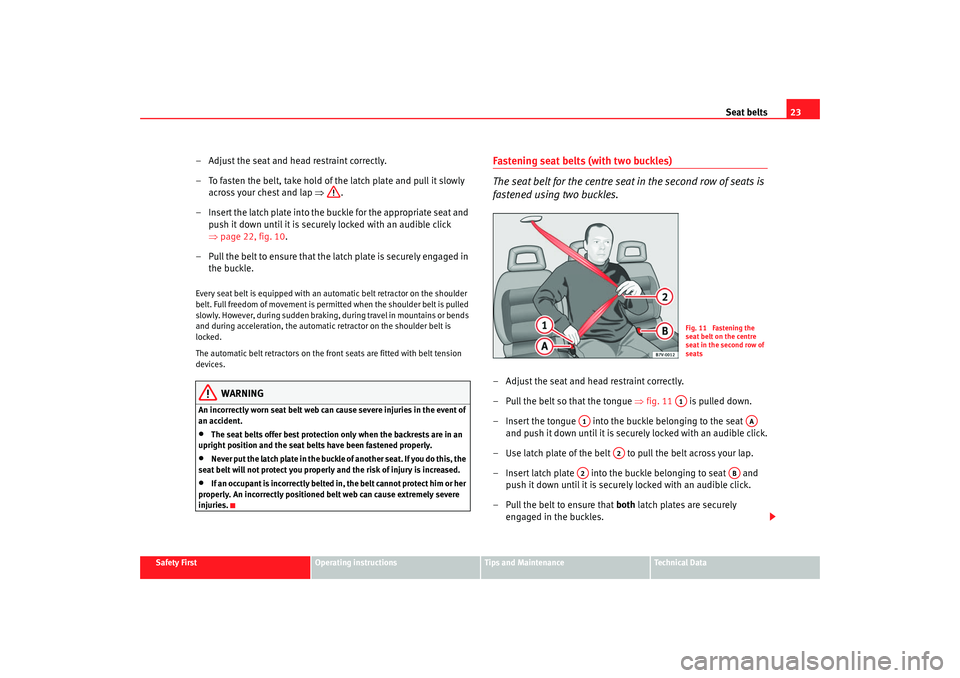
Fastening seat belts (with two buckles)
The seat belt for the centre seat in the second row of seats is
fastened using two buckles.– Adjust the seat and head restraint correctly.
– Pull the belt so that the tongue ⇒fig. 11 is pulled down.
– Insert the tongue into the buckle belonging to the seat and push it down until it is secu rely locked with an audible click.
– Use latch plate of the belt to pull the belt across your lap.
– Insert latch plate into the buckle belonging to seat and push it down until it is securely locked with an audible click.
– Pull the belt to ensure that both latch plates are securely
engaged in the buckles.
Fig. 11 Fastening the
seat belt on the centre
seat in the second row of
seatsA1
A1
AA
A2
A2
AB
alhambra ingles.book Seite 23 Donnerstag, 19. April 2007 4:04 16
Page 27 of 291

Seat belts25
Safety First
Operating instructions
Tips and Maintenance
Te c h n i c a l D a t a
The following features are available to adjust the seat belt in the shoulder
region:
•
Belt height adjustment for the front seats and the outer seats in the
second row,
•
front seat height adjustment*.
WARNING
An incorrectly worn seat belt web can cause severe injuries in the event of
an accident.•
The shoulder part of the seat belt must lie on the centre of the shoulder,
never across the neck. The seat belt must lie flat and fit comfortably on the
torso
•
The lap part of the seat belt must l ie across the pelvis, never across the
stomach. The seat belt must lie flat and fit comfortably on the pelvis Pull
the belt tight if necessary to take up any slack.
•
Read and observe the warnings ⇒page 22.
Pregnant women must also fasten their seat belts properly
The best protection for the unborn child is for the mother to
wear the seat belt properly at all times during the pregnancy.The seat belt provides maximum protection only when the belt web
is properly positioned ⇒page 24.
– Adjust the front seat and head restraint correctly ⇒page 9.
– Holding the latch plate, pull the belt evenly across your chest and as low as possible over the pelvis ⇒ fig. 14.
– Insert the latch plate into the buckle for the corresponding seat and push it down until it is securely locked with an audible click
⇒ .
– Pull the belt to ensure that the latch plate is securely engaged in the buckle.
Fig. 14 Positioning seat
belts during pregnancy
alhambra ingles.book Seite 25 Donnerstag, 19. April 2007 4:04 16
Page 29 of 291
Seat belts27
Safety First
Operating instructions
Tips and Maintenance
Te c h n i c a l D a t a
– Press the red button on the belt buckle ⇒ page 26, fig. 16. The
latch plate is released and springs out ⇒.
– Guide the belt back by hand so that it rolls up easily and the trim will not be damaged.
WARNING
Never unbuckle a seat belt while the vehicle is in motion. If you do, you
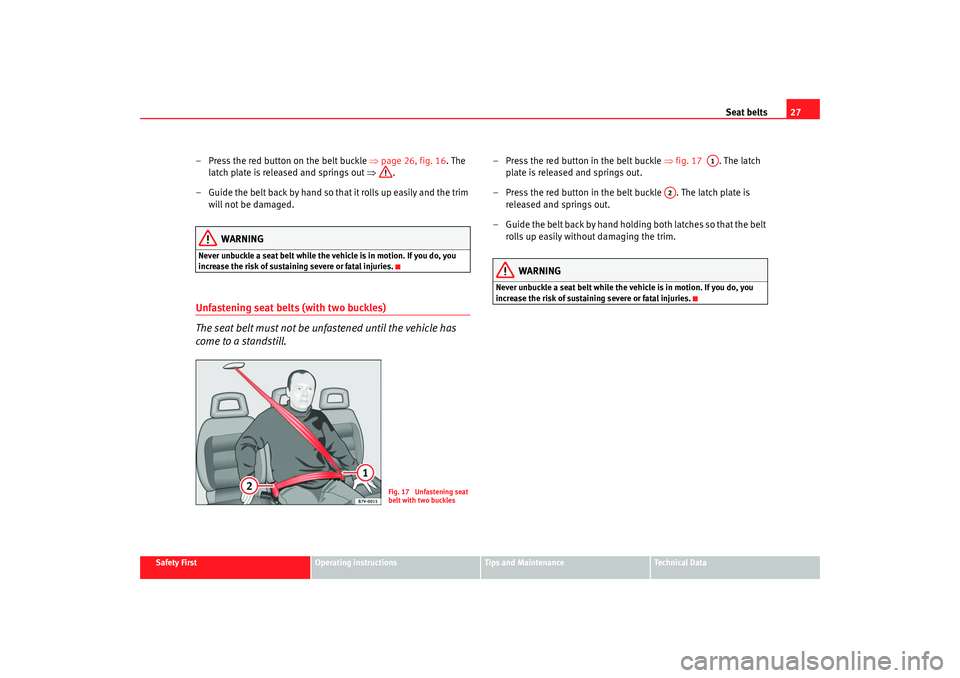
increase the risk of sustaining severe or fatal injuries.Unfastening seat belts (with two buckles)
The seat belt must not be unfastened until the vehicle has
come to a standstill.
– Press the red button in the belt buckle ⇒fig. 17 . The latch
plate is released and springs out.
– Press the red button in the belt buckle . The latch plate is released and springs out.
– Guide the belt back by hand holding both latches so that the belt rolls up easily without damaging the trim.
WARNING
Never unbuckle a seat belt while the vehicle is in motion. If you do, you
increase the risk of sustaining severe or fatal injuries.
Fig. 17 Unfastening seat
belt with two buckles
A1
A2
alhambra ingles.book Seite 27 Donnerstag, 19. April 2007 4:04 16
Page 31 of 291

Seat belts29
Safety First
Operating instructions
Tips and Maintenance
Te c h n i c a l D a t a
Belt retainer*
WARNING
•
When the belt for the outer seats in the centre row is removed insert the
webbing behind the guide of the side trim ⇒fig. 20, in order to lower the
backrest without damaging the webbing.
•
The seat belts must be removed fr om the holder before removing the
individual seats. This means that the belts will not be damaged.
Belt height adjustment
This device enables the positi on of the seat belts to be
adjusted for the height of the wearer at the shoulder area.The seat belt adjustment for the front seats and the outer seats in
the second row can be used to adjust the proper belt web position
at the shoulder.
– Press the upper part ⇒fig. 21 of the shoulder belt guide in the
direction of the arrow and hold it in this position.
– Move the retractor reel up or down to adjust the seat belt.
– Check that the retractor is secure by giving the belt a sharp tug.
Fig. 20 Belt retainer for
outer seats in centre row
Fig. 21 Location of the
belt height adjuster
alhambra ingles.book Seite 29 Donnerstag, 19. April 2007 4:04 16
Page 33 of 291
Seat belts31
Safety First
Operating instructions
Tips and Maintenance
Te c h n i c a l D a t a
So that the effectiveness of the belt tension device is not reduced and that
removed parts do not cause
any injuries or environmental pollution, regula-
tions, which are known to the qualifi ed workshops, must be observed.
WARNING
•
If repairs are not carried out by a professional, or if the belt tension
devices are used incorrectly, the risk of severe or fatal injuries increases.
The belt tension devices may fail to trigger or may trigger in the wrong
circumstances.
•
Never attempt to repair, adjust, remove or install parts of the belt
tension devices or seat belts.
•
The belt tension device and seat be lt including its automatic retractor
cannot be repaired.
•
Any work on the belt tension devi ces and seat belts, including the
removal and refitting of system parts in conjunction with other repair work,
must be performed by a qualified workshop only.
•
The belt tension devices will only provide protection for one accident
and must be changed it they have been activated.
alhambra ingles.book Seite 31 Donnerstag, 19. April 2007 4:04 16