2007 SATURN SKY instrument panel
[x] Cancel search: instrument panelPage 52 of 384

When the passenger sensing system has turned
off the passenger’s frontal airbag, the off indicator
in the instrument panel will light and stay lit to
remind you that the airbag is off. SeePassenger
Airbag Status Indicator on page 131.
If a child restraint has been installed and the on
indicator is lit, turn the vehicle off. Remove the child
restraint from the vehicle and reinstall the child
restraint following the child restraint manufacturer’s
directions and refer toSecuring a Child Restraint
in the Passenger Seat Position on page 38.
If, after reinstalling the child restraint and restarting
the vehicle, the on indicator is still lit, check to
make sure that the vehicle’s seatback is not
pressing the child restraint into the seat cushion.
If this happens, slightly recline the vehicle’s
seatback and adjust the seat cushion if possible.
If the on indicator is still lit, do not install a child
restraint in this vehicle and check with your retailer.
The passenger sensing system is designed to
enable (may inate) the passenger’s frontal airbag
anytime the system senses that a person of adult
size is sitting properly in the passenger’s seat.When the passenger sensing system has allowed
the airbag to be enabled, the on indicator will light
and stay lit to remind you that the airbag is active.
For some children who have outgrown child
restraints and for very small adults, the passenger
sensing system may or may not turn off the
passenger’s frontal airbag, depending upon the
person’s seating posture and body build. Everyone
in your vehicle who has outgrown child restraints
should wear a safety belt properly — whether
or not there is an airbag for that person.
If a person of adult-size is sitting in the
passenger’s seat, but the off indicator is lit, it
could be because that person is not sitting properly
in the seat. If this happens, turn the vehicle off
and ask the person to place the seatback in
the fully upright position, then sit upright in the
seat, centered on the seat cushion, with the
person’s legs comfortably extended. Restart the
vehicle and have the person remain in this position
for about two minutes. This will allow the system
to detect that person and then enable the
passenger’s airbag.
52
ProCarManuals.com
Page 53 of 384

{CAUTION:
If the airbag readiness light in the
instrument panel cluster ever comes on
and stays on, it means that something
may be wrong with the airbag system.
CAUTION: (Continued)
CAUTION: (Continued)
If this ever happens, have the vehicle
serviced promptly, because an adult-size
person sitting in the right front passenger’s
seat may not have the protection of the
frontal airbag. SeeAirbag Readiness Light
on page 130for more on this, including
important safety information.
A thick layer of additional material such as a
blanket, or aftermarket equipment such as seat
covers, seat heaters, and seat massagers
can affect how well the passenger sensing system
operates. Remove any additional material from
the seat cushion before reinstalling or securing
the child restraint and before a small occupant,
including a small adult, sits in the passenger
position. You may want to consider not using
seat covers or other aftermarket equipment if
your vehicle has the passenger sensing system.
SeeAdding Equipment to Your Airbag-Equipped
Vehicle on page 55for more information about
modications that can affect how the system
operates.
53
ProCarManuals.com
Page 55 of 384

Adding Equipment to Your
Airbag-Equipped Vehicle
Q:Is there anything I might add to the front
of the vehicle that could keep the airbags
from working properly?
A:Yes. If you add things that change your
vehicle’s frame, bumper system, height,
front end or side sheet metal, they may keep
the airbag system from working properly.
Also, the airbag system may not work properly
if you relocate any of the airbag sensors.
If you have any questions about this,
you should contact Customer Assistance
before you modify your vehicle. The phone
numbers and addresses for Customer
Assistance are in Step Two of theCustomer
Satisfaction Procedure on page 354.
Q:Because I have a disability, I have to get
my vehicle modied. How can I nd out
whether this will affect my airbag system?
A:Changing or moving any parts of the
front seats, safety belts, the airbag sensing
and diagnostic module, steering wheel,
the instrument panel, or airbag wiring can
affect the operation of the airbag system.
If you have questions, call Customer
Assistance. The phone numbers and
addresses for Customer Assistance are in
Step Two of the Customer Satisfaction
Procedure in this manual. SeeCustomer
Satisfaction Procedure on page 354.
55
ProCarManuals.com
Page 56 of 384

Restraint System Check
Checking the Restraint Systems
Now and then, make sure the safety belt reminder
light and all your belts, buckles, latch plates,
retractors and anchorages are working properly.
Look for any other loose or damaged safety
belt system parts. If you see anything that might
keep a safety belt system from doing its job, have
it repaired. SeeCare of Safety Belts on page 318
for more information.
Torn or frayed safety belts may not protect you in
a crash. They can rip apart under impact forces.
If a belt is torn or frayed, get a new one right away.Also look for any opened or broken airbag covers,
and have them repaired or replaced. The airbag
system does not need regular maintenance.
Notice:If you damage the covering for the
driver’s or the right front passenger’s airbag,
the airbag may not work properly. You may
have to replace the airbag module in the
steering wheel or both the airbag module
and the instrument panel for the right front
passenger’s airbag. Do not open or break
the airbag coverings.
56
ProCarManuals.com
Page 69 of 384
CAUTION: (Continued)
It can cause unconsciousness and even
death. If you must drive with the trunk
lid open or if electrical wiring or other
cable connections must pass through
the seal between the body and the
trunk lid:
Make sure all other windows are shut.
Turn the fan on your heating or
cooling system to its highest speed
and select the control setting that will
force outside air into your vehicle.
See Climate Control System.
If you have air outlets on or under
the instrument panel, open them all
the way.
SeeEngine Exhaust on page 91.
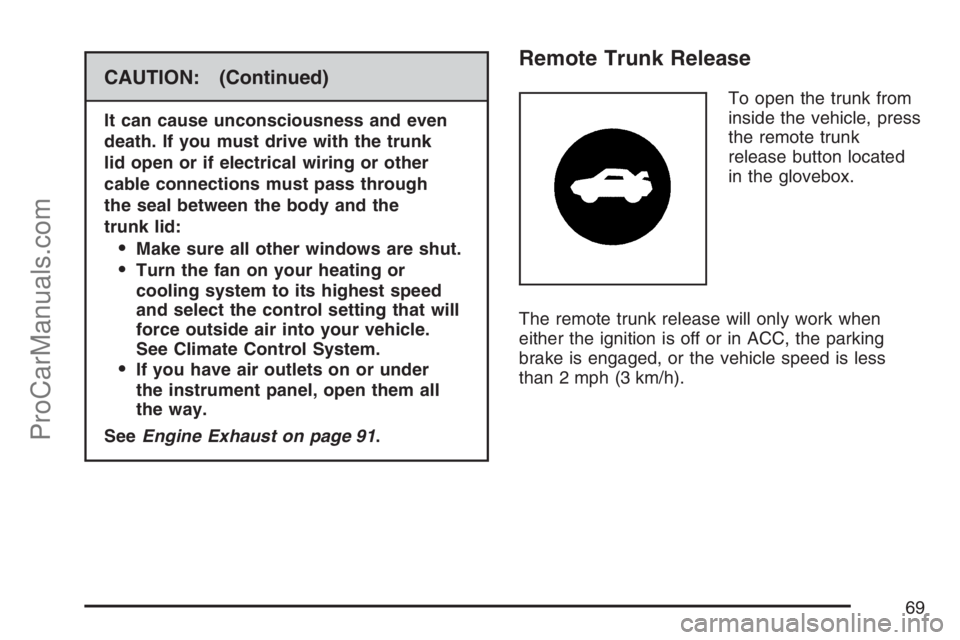
Remote Trunk Release
To open the trunk from
inside the vehicle, press
the remote trunk
release button located
in the glovebox.
The remote trunk release will only work when
either the ignition is off or in ACC, the parking
brake is engaged, or the vehicle speed is less
than 2 mph (3 km/h).
69
ProCarManuals.com
Page 73 of 384

Theft-Deterrent Systems
Vehicle theft is big business, especially in some
cities. Although your vehicle has a number of
theft-deterrent features, we know that nothing we
put on it can make it impossible to steal.
Content Theft-Deterrent
Your vehicle may have a content theft-deterrent
alarm system.
The security light,
located on the
instrument panel cluster,
will turn on to indicate
that arming has
been initiated.
Once the system is armed, the security light will
ash once every three seconds.
If the security light is ashing twice per second,
this means that a door is open.
Arming the System
While the ignition is off, press the remote keyless
entry transmitter lock button, to arm the system.
The system will arm after either of these
things occur:
Thirty seconds after all the doors are closed.
Sixty seconds with any door open.
If you press the lock button on the transmitter a
second time while all the doors are closed,
the system will arm immediately. The system arms
in 60 seconds if a door is open, or after the
open door is closed.
If you do not want to arm the system, lock the car
with the manual door lock knobs.
Disarming the System
You can disarm the system by doing any one of
the following:
Press the unlock button on the remote keyless
entry transmitter.
Turn the ignition on.
73
ProCarManuals.com
Page 75 of 384

PASS-Key®III+
The PASS-Key®III+ system operates on a radio
frequency subject to Federal Communications
Commission (FCC) Rules and with Industry
Canada.
This device complies with Part 15 of the FCC
Rules. Operation is subject to the following
two conditions:
1. This device may not cause harmful
interference.
2. This device must accept any interference
received, including interference that may
cause undesired operation.
This device complies with RSS-210 of Industry
Canada. Operation is subject to the following
two conditions:
1. This device may not cause interference.
2. This device must accept any interference
received, including interference that may
cause undesired operation of the device.
Changes or modications to this system by other
than an authorized service facility could void
authorization to use this equipment.
PASS-Key
®III+ uses a radio frequency transponder
in the key that matches a decoder in your vehicle.
PASS-Key®III+ Operation
Your vehicle is equipped with PASS-Key®III+
(Personalized Automotive Security System)
theft-deterrent system. PASS-Key
®III+ is a
passive theft-deterrent system. This means you do
not have to do anything special to arm or disarm
the system. It works when you insert or remove the
key from the ignition.
When the PASS-Key
®III+ system senses that
someone is using the wrong key, it prevents the
vehicle from starting. Anyone using a trial-and-error
method to start the vehicle will be discouraged
because of the high number of electrical key codes.
If the engine does not start and the security light
on the instrument panel cluster comes on
when trying to start the vehicle, the key may have
a damaged transponder. Turn the ignition off
and try again.
75
ProCarManuals.com
Page 105 of 384

Instrument Panel Overview........................ 108
Hazard Warning Flashers.......................... 110
Other Warning Devices............................. 110
Horn.......................................................... 110
Tilt Wheel.................................................. 110
Turn Signal/Multifunction Lever.................. 111
Turn and Lane-Change Signals................. 112
Headlamp High/Low-Beam Changer.......... 112
Flash-to-Pass............................................ 112
Windshield Wipers..................................... 113
Windshield Washer.................................... 114
Cruise Control........................................... 115
Headlamps................................................ 118
Headlamps on Reminder........................... 119
Daytime Running Lamps (DRL)................. 119
Fog Lamps................................................ 120
Instrument Panel Brightness...................... 120
Entry/Exit Lighting...................................... 120
Mirror Reading Lamps............................... 120
Battery Run-Down Protection..................... 121
Accessory Power Outlet(s)........................ 121
Ashtray(s) and Cigarette Lighter................ 122Climate Controls......................................... 122
Climate Control System............................. 122
Outlet Adjustment...................................... 126
Warning Lights, Gages, and Indicators..... 127
Instrument Panel Cluster........................... 128
Speedometer and Odometer...................... 129
Tachometer............................................... 129
Safety Belt Reminder Light........................ 129
Passenger Safety Belt Reminder Light....... 130
Airbag Readiness Light............................. 130
Passenger Airbag Status Indicator............. 131
Charging System Light.............................. 133
Brake System Warning Light..................... 134
Anti-Lock Brake System Warning Light...... 135
Electronic Stability Control (ESC)/
Traction Control System (TCS) Indicator/
Warning Light (2.0L Engine Only)............. 136
Engine Coolant Temperature
Warning Light........................................ 137
Malfunction Indicator Lamp........................ 138
Oil Pressure Light..................................... 141
Section 3 Instrument Panel
105
ProCarManuals.com