2007 SAAB 9-5 mirror
[x] Cancel search: mirrorPage 177 of 288

177 Starting and driving
Recommendations for cars with manual
gearbox
Rises in coolant temperature are indicated
by the temperature gauge in the main instru-
ment panel.
The following steps are taken in order as the
temperature of the engine increases:
A/C compressor is switched off.
engine torque is reduced.
When continuing your journey, select a gear
in which the engine speed is about
3,000 rpm until the incline eases.
Driving considerations Always take extra care when towing a
trailer, as the car’s handling will be different
and its braking effect reduced. The trailer’s
braking system and suspension also have a
considerable effect on these characteris-
tics, see also ”Driving with a load” page 181.
If the car has automatic transmission, select
position D when ascending steep hills. This
ensures that the adaptive gear change pat-
terns are operational, see page 158. Use
position D or L for steep descents.
Checks before drivingMake sure that the car and camper or trailer
are in good working order. This is essential
since towing a camper or trailer increases
the strain on the car.
Check and if necessary adjust the tire
pressure of the car and camper or trailer.
Make sure all wheel bolts are properly
tightened.
Make sure that the equipment joining the
car and camper or trailer is properly
secured and adjusted.
Make sure the camper or trailer’s electri-
cal cable is properly connected and is not
so long that it drags along the ground.
Also, make sure the cable is not too short
and risks breaking when turning a corner.
Check all bulbs.
Check the car and camper or trailer
brakes.
Make sure that all items on or in the cara-
van or trailer are properly secured.
Make sure that the camper or trailer’s
jockey wheel is raised and locked.
Check the distribution of the load so that
the car and camper or trailer are well bal-
anced.
Check that the rearview mirrors provide
the best possible rearward vision.
Make sure the camper or trailer’s safety
cable is correctly attached.
WARNING
Utilize the braking effect of the engine
(1st, 2nd or 3rd gear) when you are
descending long or steep hills to spare
the brakes.
Brake failure can result from overheated
brakes!
NOTICEIf the ”Automatic transmission3, fault
indicator” indicator comes on, cease
towing until the problem has been recti-
fied.
95_U S _M 07.book Page 177 Friday, June 9, 2006 8:58 AM
ProCarManuals.com
Page 181 of 288

181 Starting and driving
Driving at nightBear in mind the following points when
driving at night:
Nighttime driving requires your full con-
centration.
Do not rush. Count on your journey taking
slightly longer.
The number of drivers under the influence
of drugs is likely to be greater at night than
during the day.
Do not stare at the headlights of oncom-
ing vehicles.
Avoid driving at night if you have poor
eyesight. Night vision deteriorates with
age.
Keep your car's headlights, windows and
mirrors clean. Also, if you wear glasses,
make sure they are clean.
Make sure you are well rested before
starting a long journey. Take a break
every other hour.
Only eat light meals. Heavy meals have a
tendency to induce tiredness.
Driving with a loadThe driving characteristics of the car are
affected by the way it is loaded.
Place heavy loads as far forward and as
low as possible in the trunk.
Secure the load to the tie downs, see
page 131.
The load should be such that the car´s
total weight or axle weight are not
exceeded, see page 258.
Heavy loads mean that the car’s center of
gravity is further back. As a result, the car
will sway more during evasive steering.
Never exceed the permissible load in the
roof box3, even if there is room for more.
Ensure that the tire pressure is correct –
slight overinflation is preferable to under-
inflation.
The braking distance of a loaded car is
always greater. Keep your distance from
the vehicle in front.
Roof loads can negatively affect tele-
communication.
Tire pressure, see page 268 and back
cover.
95_U S _M 07.book Page 181 Friday, June 9, 2006 8:58 AM
ProCarManuals.com
Page 217 of 288

217 Car care and technical information
Maxi fusesThe Maxi fuses are housed in the fuse box
under the hood. These fuses can be
checked in the same way as the other fuses.
The Maxi fuses are designed to protect the
car’s electrical system from being dam-
aged. Each Maxi fuse protects a number of
electrical circuits and functions and there-
fore has a higher rating (amperage) than the
standard fuses. No spare Maxi fuses are
supplied with the car.
DICE / TWICEDICE = Dashboard Integrated Central Elec-
tronics
TWICE = Theft-Warning Central Electronics
DICE and TWICE are electronic control
modules that monitor and control a variety
of functions:
DICE controls (among other things):
Front lights and interior lighting
Instrument illumination
Intermittent wiper operation
Electric heating of rear window and door
mirrors
Cooling fansTWICE controls (among other things):
Central locking.
Car alarm (Anti-theft system)
Engine immobilizer
Autochecking of lights.
Electric heating of rear seat
Safety belt reminder
Electrically adjustable passenger seat
The DICE and TWICE control modules are
linked to a data bus, which is basically an
information carrier that allows information to
be exchanged between all the control mod-
ules and components connected to the bus.
If a fault occurs in any of these components,
diagnostic faults codes are set in the rele-
vant control module, which facilitates fault
diagnosis. We recommend that you contact
an authorized Saab dealer.
The scan tool connector for fault diagnosis
is located under the instrument panel on the
drivers side.NOTICEIf a Maxi fuse blows, it means that there is
a major fault in the electrical system.
Have the car checked without delay by a
workshop. We recommend that you con-
tact an authorized Saab dealer.
IB1795
Maxi fuses under the hood 95_U S _M 07.book Page 217 Friday, June 9, 2006 8:58 AM
ProCarManuals.com
Page 218 of 288

218 Car care and technical information
Fuse panel in instrument panel
# Amp Function
A 30 Trailer lights
B 10 Automatic transmission
C 7.5 Electric door mirrors; DICE: manual beam length
adjustment3
1 15 Brake lights; Park Brake Shift Lock (cars with auto-
matic transmission)
2 15 Reversing lights
3 10 Parking lights and taillights, left
4 10 Parking lights and taillights, right
5 7.5 DICE / TWICE
6 30 Electric windows, right; trailer charging
6B 7.5 Brake lights, trailer
7 10 Engine injectors
8 15 Trunk lighting; trunk lock; door lighting; parking
assistant3; SID
9 15 Audio System; CD changer3
10 15 Heating, rear seat3; moonroof3, remote control
receiver
11 30 Electrically adjusted passenger seat3
12 7.5 Automatic transmission3
13 20 Audio System, amplifier
14 30 Ignition system, engine
15 20 Fuel pump
16 20 DICE (direction indicators)
16B – OnStar3
17 20 Engine-management system; main instrument;
DICE/TWICE
18 40 Door-mirror heating; rear-window heating
19 10 OnStar3; Telematics3
20 15 ACC; interior lighting; rear fog light; high beam flasher
21 10 Audio System; rear-view mirror; load angle sensor3;
navigation3; Cruise Control3
22 40 Interior fan
23 15 Central locking; navigation3; door mirror memory3
24 20 Main light switch
25 30 Electrically adjustable driver’s seat
IB2439
BC123456 A
14
121110987
13
6B
1516
2324
222120191817
16B25262728293031
3635343332
393837
95_U S _M 07.book Page 218 Friday, June 9, 2006 8:58 AM
ProCarManuals.com
Page 219 of 288
219 Car care and technical information
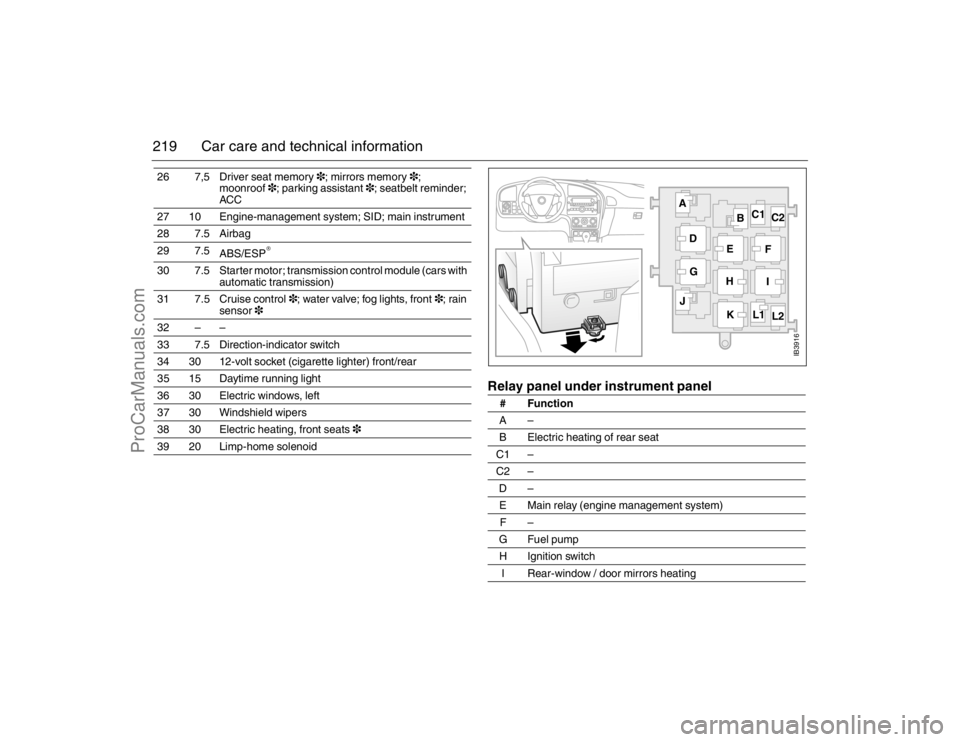
Relay panel under instrument panel
26 7,5 Driver seat memory3; mirrors memory3;
moonroof3; parking assistant3; seatbelt reminder;
ACC
27 10 Engine-management system; SID; main instrument
28 7.5 Airbag
29 7.5
ABS/ESP
®
30 7.5 Starter motor; transmission control module (cars with
automatic transmission)
31 7.5 Cruise control3; water valve; fog lights, front3; rain
sensor3
32 – –
33 7.5 Direction-indicator switch
34 30 12-volt socket (cigarette lighter) front/rear
35 15 Daytime running light
36 30 Electric windows, left
37 30 Windshield wipers
38 30 Electric heating, front seats3
39 20 Limp-home solenoid
# Function
A –
B Electric heating of rear seat
C1 –
C2 –
D–
E Main relay (engine management system)
F–
G Fuel pump
H Ignition switch
I Rear-window / door mirrors heating
IB3916
A
BC1
C2
L2 L1 D
GE
F
H
I
K J
95_U S _M 07.book Page 219 Friday, June 9, 2006 8:58 AM
ProCarManuals.com
Page 241 of 288

241 Car care and technical information
Washing the carWash your car frequently. To facilitate
cleaning, a suitable detergent can be added
to the water, which should be lukewarm.
Saab offers a full line of car care products,
including car wash, for the care of your vehi-
cle. See your dealer for available products
or visit www.saabcatalog.com (U.S. resi-
dents only).
Do not use a pressure washer at close
range on stone chip damage, scratches or
other damage to the paintwork. The paint
can otherwise start to flake.
Remove any bird droppings without delay,
as these can discolor the paintwork and
prove difficult to polish out.
Use a soft cloth moistened with methyl alco-
hol to remove splashes of tar or asphalt. Do
not use strong cleaners, as these can dry
out the paintwork.
The underside of the car also needs wash-
ing regularly, and this should be done extra
thoroughly at the end of winter. Clean the
underside of the car by hand if the car is usu-
ally washed in an automatic car wash with-
out special facilities for underbody cleaning.
Never wash or leave the car to dry in the
sun, but wipe it dry with a chamois leather
immediately after washing to avoid smears
and streaks.
Clean the window glass inside and out using
a high quality window cleaner. This is partic-
ularly important when the car is new, as
upholstery and trim have a tendency to
sweat a little at first.
Keep the glass well cleaned, as this helps to
prevent misting.
NOTICEAvoid using any alcohol-based cleaners
on the front and rear light clusters, as
these can cause cracking of the lenses.
NOTICE The door mirrors must be fully
retracted before the car enters an
automatic car wash.
Remove fixed antennas, e.g. for
mobile phone, before putting car
through an automatic car wash.
Try your brakes on leaving a car wash.
Wet brake discs may reduce the per-
formance of the brakes.
Cars with Saab Parking Assistance:
Do not spray the sensors or closer
than 8 in. (20 cm) to the sensors with
a pressure washer, as this can
damage them.
95_U S _M 07.book Page 241 Friday, June 9, 2006 8:58 AM
ProCarManuals.com
Page 258 of 288

258 SpecificationsGeneral Overall length, including bumpers:
9-5 Sedan _______________________ 190.4 in (4836 mm)
9-5 SportCombi __________________ 190.6 in (4841 mm)
Overall width, including door mirrors ____ 80.4 in (2042 mm)
Maximum height:
9-5 Sedan _______________________ 57.3 in (1454 mm)
9-5 SportCombi __________________ 57.7 in (1465 mm)
Wheelbase _______________________ 106.4 in (2703 mm)
Ground clearance at gross vehicle weight approx. 4.6 in
(116 mm)
Tr a c k :
Front __________________________ 59.9 in (1522 mm) *)
Rear ___________________________ 60.2 in (1528 mm) *)
Turning circle (curb to curb) ___________ 37.1 ft (11.3 m)
Turning circle (measured at vehicle extremi-
ties) _____________________________ 39.0 ft (11.9 m)
Number of seats (incl. driver) _________ 5
*) Specified track applies to wheel sizes:
6 x 15 & 6.5 x 16
VIN on cars sold in
USAVIN on cars sold in CanadaPermissible load (in addition to driver) = GVW minus curb weight
The maximum permissible axle load, front or rear, must not be exceeded.
The maximum permissible axle load, front or rear, must not be exceeded. Chassis number in engine bay Weight ready for driving (i.e. with full fuel
tank, washer-fluid reservoir, standard tools
and spare wheel) ____________________ 3430–3750 lbs.
(1555–1700 kg)
Gross vehicle weight (GVW) ___________ 4380–4680 lbs.
(1980–2125 kg)
Maximum axle load:
Front ___________________________ 2590 lbs. (1175 kg)
Rear, 9-5 Sedan ___________________ 2310 lbs. (1050 kg)
Rear, 9-5 SportCombi ______________ 2480 lbs. (1125 kg)
Weight distribution:
Curb weight, front/rear ______________ 60/40 %
GVW, front/rear ___________________ 50/50 %
Maximum roof load __________________ 220 lbs. (100 kg)
Maximum luggage compartment load§ ___ 176 lbs. (80 kg)
Maximum combined load, luggage
compartment and roof ________________ 264 lbs. (120 kg)
95_U S _M 07.book Page 258 Friday, June 9, 2006 8:58 AM
ProCarManuals.com
Page 271 of 288

271 Index
Index
AA/C system, fault diagnosis
_______ 244
A/C system, maintenance
_________ 243
ABS brakes
____________________ 160
ACC
__________________________ 79
ACC functions
___________________ 82
ACC, automatic climate control
_____ 79
ACC, calibration
_________________ 86
ACC, condensation water
__________ 86
ACC, useful tips
_________________ 86
AUX input
_____________________ 104
Adjusting the steering wheel
_______ 114
Adjustment, seats
________________ 18
Air conditioning (A/C), fault diagnosis
and maintenance ______________ 243
Airbag
_________________________ 29
Alarm _________________________ 50
Alarm functions
__________________ 53
Alarm signals
________________ 50
, 53
Album information
_______________ 104
Alternator
_____________________ 201
Alternator drive belt
__________ 201
, 263
Alternator rating
________________ 263
Antennas
______________________ 109
Anticorrosion treatment
___________ 245
Antidazzle rear-view mirror
________ 121
Anti-skid
______________________ 163
Autochecking of lights on starting
____ 64Auto-dimming rear-view mirror with
garage door opener
____________ 118
Automatic climate control (ACC)
_____ 79
Automatic transmission, technical
data
_________________________ 264
Aviod theft, tip
__________________ 166
BBattery
________________________ 199
Battery charging/replacing
________ 200
Battery, boost starting
____________ 186
Before a long journey ____________ 246
Before towing a camper or trailer
___ 177
Belt guide
______________________ 12
Boost starting using jump leads
____ 186
Brake and clutch fluid
____________ 196
Brake-fluid reservoir
_____________ 196
Brakes, technical data ____________ 265
Bulbs, changing
________________ 204
Bulbs, table of
__________________ 215
Buying new tires ________________ 225
CCD changer
____________________ 100
CHECK messages
_______________ 71
CHECKING
_____________________ 71
Car alarm
______________________ 50
Car care
______________________ 189
Cargo net, 9-5 SportCombi
________ 137Carpeting, care of
_______________ 240
Catalytic converter, important
considerations
_________________ 145
Central locking ___________________ 44
Change language in SID
___________ 72
Change of address notification
_____ 254
Changing a wheel
_______________ 236
Changing bulbs
_________________ 204
Changing wiper blades
___________ 202
Charge mobile phone
____________ 126
Charger/Jump starting ____________ 188
Charging the battery/Jump starting
__ 188
Chassis number
________________ 268
Chassis number, key to
___________ 269
Checks before towing a camper or
trailer
________________________ 177
Child safety
_____________________ 22
Child safety locks, rear doors
_______ 47
Cleaning, engine bay
_____________ 242
Clock
_________________________ 105
Color code, body
________________ 268
Color code, trim _________________ 268
Compact spare wheel
____________ 234
Compass
______________________ 122
Condensation water, ACC
__________ 86
Connecting a portable player ______ 104
Coolant
_______________________ 195
Courtesy Headlight Feature
________ 74
Crash memory, see EDR
_________ 255
Cross modulation
_______________ 110
Cruise control
__________________ 159
Cup holder
_____________________ 128
95_U S _M 07.book Page 271 Friday, June 9, 2006 8:58 AM
ProCarManuals.com