2007 SAAB 9-3 wheel
[x] Cancel search: wheelPage 212 of 304

212 Car carePower steeringCheck the level of the power steering fluid in
the reservoir regularly, in accordance with
the service program.
The wheels should point directly forwards
during this check.
Clean round the cap before unscrewing it.
Wipe the dipstick. To check the level, screw
down the cap completely and then remove
it again.
The oil level should lie between the MAX
and MIN marks when the oil temperature is
about 68°F (+20°C). If the oil is colder, the
level will be lower, and at a higher tempera-
tures the level will be higher.
Top up with CHF 11S or CHF 202 power
steering fluid.
WARNING
Power steering fluid on hot engine
components constitutes a fire risk.
Power steering fluid reservoir, 4-cyl
engine
Power steering fluid reservoir, V6 engine
93_U S _M 07.book Page 212 W ednesday, April 12, 2006 9:30 AM
ProCarManuals.com
Page 225 of 304

225 Car care
Front fog lights3
1 Undo one screw in the wheel housing.
Lower the air shield.
2 Remove the protective cover. Release
the two spring clips securing the bulb.
3 Unplug the connector.
4 Change the bulb. Try not to touch the
glass part of the bulb with your fingers.
The height of the beam can be adjusted
using a screwdriver inserted through the
hole in the lower grille adjacent to the lens.
Side marker lights1 Slide the lens rearward so that its front
part can be pulled out.
2 Fit the new bulb.
3 When refitting, make sure that the
groove in the spring engages the plastic
edge of the bumper trim.
WARNING
Never crawl under a car that is
supported only by a jack. Always use
axle stands.
Refer to the information on jacks on
pages 257 and 258.93_U S _M 07.book Page 225 W ednesday, April 12, 2006 9:30 AM
ProCarManuals.com
Page 236 of 304
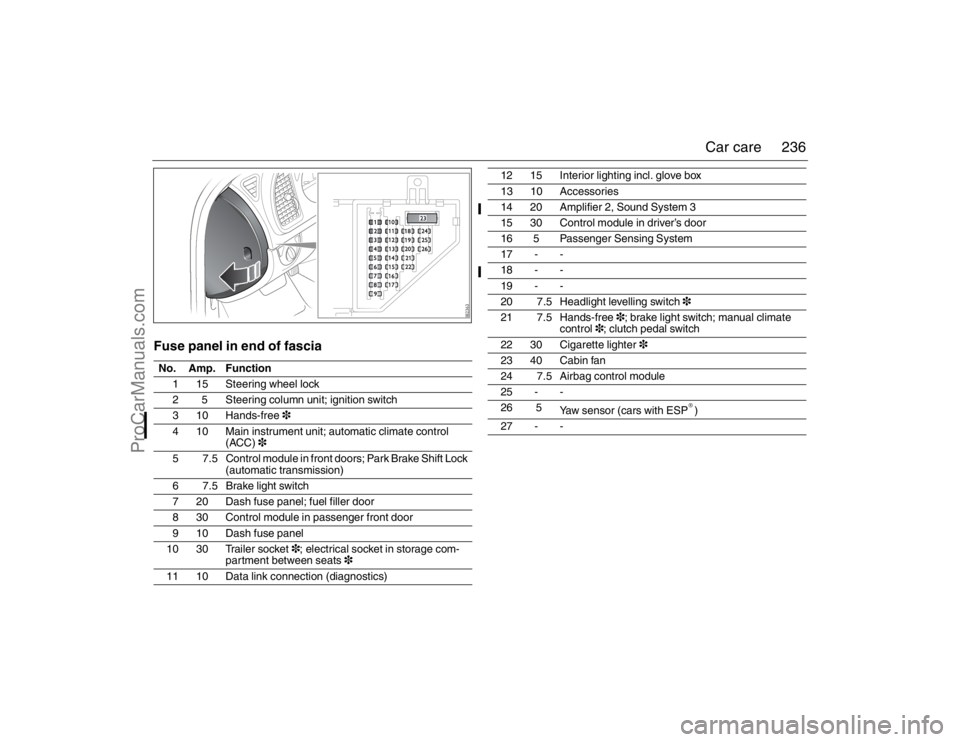
236 Car care
Fuse panel in end of fasciaNo. Amp. Function
1 15 Steering wheel lock
2 5 Steering column unit; ignition switch
3 10 Hands-free3
4 10 Main instrument unit; automatic climate control
(ACC)3
5 7.5 Control module in front doors; Park Brake Shift Lock
(automatic transmission)
6 7.5 Brake light switch
7 20 Dash fuse panel; fuel filler door
8 30 Control module in passenger front door
9 10 Dash fuse panel
10 30 Trailer socket3; electrical socket in storage com-
partment between seats3
11 10 Data link connection (diagnostics)
12 15 Interior lighting incl. glove box
13 10 Accessories
14 20 Amplifier 2, Sound System 3
15 30 Control module in driver’s door
16 5 Passenger Sensing System
17 - -
18 - -
19 - -
20 7.5 Headlight levelling switch3
21 7.5 Hands-free3; brake light switch; manual climate
control3; clutch pedal switch
22 30 Cigarette lighter3
23 40 Cabin fan
24 7.5 Airbag control module
25 - -
26 5
Yaw sensor (cars with ESP
®)
27 - -
93_U S _M 07.book Page 236 W ednesday, April 12, 2006 9:30 AM
ProCarManuals.com
Page 242 of 304

242 Car careHigh speed operation
If you’ll be driving at high speeds, speeds of
100 mph (160 km/h) or higher, where it is
legal, set the cold inflation pressure to the
maximum inflation pressure shown on the
tire sidewall, or to 35 psi (244 kPa), which-
ever is lower. See the example below.
When you end this high-speed driving,
return to the cold inflation pressure shown
on the Tire and Loading Information label.
See on page 251.
Example:
You’ll find maximum load and inflation pres-
sure molded on the tire’s sidewall, in small
letters near the rim flange. It will read some-
thing like this: Maximum load 690 kg
(1521 lbs) 300 kPa (44 psi) Max. Press
For this example, you would set the inflation
pressure for high-speed driving at 35 psi
(244 kPa).When to checkCheck your tires once a month or more.
Don’t forget your compact spare tire. It
should be at 60 psi (420 kPa).
How to CheckUse a good quality pocket-type gage to
check tire pressure. You can’t tell if your
tires are properly inflated simply by looking
at them. Radial tires may look properly
inflated even when they’re underinflated.
Be sure to put the valve caps back on the
valve stems. They help prevent leaks by
keeping out dirt and moisture.Tire Inspection and RotationTires should be rotated every 10,000 miles
(16 000 km).
Any time you notice unusual wear, rotate
your tires as soon as possible and check
wheel alignment. Also check for damaged
tires or wheels. See “When It Is Time for
New Tires” on page 243 and “Wheel
Replacement” on page 247 for more infor-
mation.
The purpose of regular rotation is to achieve
more uniform wear for all tires on the vehi-
cle. The first rotation is the most important.
When rotating your tires, always use the
correct rotation pattern. Left front tire to left
rear. Left rear tire to right front. Right front to
right rear. Right rear to left front.
Don’t include the compact spare tire in your
tire rotation.
After the tires have been rotated, adjust the
front and rear inflation pressures as shown
on the Tire-Loading Information label. Make
WARNING
Driving at high speeds, 100 mph
(160 km/h) or higher, puts an additional
strain on tires.
Sustained high-speed driving causes
excessive heat build up and can cause
sudden tire failure. You could have a
crash and you or others could be killed.
Some high-speed rated tires require infla-
tion pressure adjustment for high speed
operation. When speed limits and road
conditions are such that a vehicle can be
driven at high speeds, make sure the tires
are rated for high speed operation, in
excellent condition, and set to the correct
cold tire inflation pressure for the vehicle
load.93_U S _M 07.book Page 242 W ednesday, April 12, 2006 9:30 AM
ProCarManuals.com
Page 243 of 304

243 Car care
certain that all wheel nuts are properly tight-
ened. See page 258.
Flat spottingAll tires get hot, especially on long journeys
or when the car is driven hard. After the car
has been parked with hot tires and the tires
have cooled down, a flat spot can form in the
tire, where it is in contact with the ground.
The same can occur if the car has not been
moved for a long time.
Flat spots can cause vibration that can be
felt through the steering wheel, similar to
that experienced when the wheels need bal-
ancing.
Flat spots of this type disappear once the
tires get hot again, usually after 10–15 miles
(20–25 km) of driving at cruising speed. If
the outdoor temperature is low it takes a
longer distance.
When It Is Time for New TiresOne way to tell when it’s time for new tires is
to check the treadwear indicators, which will
appear when your tires have only 1/16 inch
(1.6 mm) or less of tread remaining.
You need a new tire if any of the following
statements are true:
You can see the indicators at three or
more places around the tire.
You can see cord or fabric showing
through the tire’s rubber.
The tread or sidewall is cracked, cut or
snagged deep enough to show cord or
fabric.
The tire has a bump, bulge or split.
The tire has a puncture, cut or other
damage that can’t be repaired well
because of the size or location of the
damage.
WARNING
Rust or dirt on a wheel, or on the parts to
which it is fastened, can make wheel nuts
become loose after a time. The wheel
could come off and cause an accident.
When you change a wheel, remove any
rust or dirt from places where the wheel
attaches to the vehicle. In an emergency,
you can use a cloth or a paper towel to do
this; but be sure to use a scraper or wire
brush later, if you need to, to get all the
rust or dirt off. See “Changing a tire” on
page 257.93_U S _M 07.book Page 243 W ednesday, April 12, 2006 9:30 AM
ProCarManuals.com
Page 244 of 304

244 Car careTreadwear indicatorsThe tires incorporate wear indicators in the
form of smooth, treadless strips across the
width, which become visible when only
2/32" (1.6 mm) of tread remains. As soon as
the indicators become visible, new tires
should be fitted without delay.
Make sure you are familiar with the legal
limit for minimum tread depth in your
country and also any regulations gov-
erning the use of winter (snow) tires.
Buying New TiresTo find out what kind and size of tires you
need, look at the Tire-Loading Information
label.
Before changing to wheels/tires of another
size, we recommend that you contact an
authorised Saab workshop regarding
acceptable options. See also page 290
Wheels/tires combinations that are not
approved by Saab can negatively affect the
car’s directional stability, steering and brak-
ing in both wet and dry conditions.The wheels and tires have been carefully
matched to the characteristics of the car and
play a key role in its outstanding roadhold-
ing and handling.
Do not take it for granted that a wheel/tire
combination will work in the best possible
way, just because it can be fitted to the car.
To ensure that the speedometer is as accu-
rate as possible it should be reprogrammed
if wheels of a different dimension are fitted.
Contact a Saab dealer.
Because of front wheel drive, the front tires
tend to wear faster than the rear ones. New
tires should always be fitted in pairs, so that
tires on the same axle have the same
amount of tread.
Store wheels lying flat or hanging – never
standing upright.
Treadwear indicator93_U S _M 07.book Page 244 W ednesday, April 12, 2006 9:30 AM
ProCarManuals.com
Page 245 of 304

245 Car care
Uniform Tire Quality GradingQuality grades can be found where applica-
ble on the tire sidewall between tread shoul-
der and maximum section width. For exam-
ple:
Treadwear 200 Traction AA
Temperature A
The following information relates to the
system developed by the United States
National Highway Traffic Safety Administra-
tion, which grades tires by treadwear, trac-
tion and temperature performance. (This
applies only to vehicles sold in the United
States.) The grades are molded on the side-
walls of most passenger car tires. The Uni-
form Tire Quality Grading system does not
apply to deep tread, winter-type snow tires,
space-saver or temporary use spare tires,
tires with nominal rim diameters of 10 to 12
inches (25 to 30 cm), or to some limited-pro-
duction tires.
While the tires available on General Motors
passenger cars and light trucks may vary
with respect to these grades, they must also
conform to federal safety requirements and
additional General Motors Tire Perfor-
mance Criteria (TPC) standards.
NOTICEWide wheels and tires with side walls that
are too low can:
be damaged in potholes, etc.
cause springs, shock absorbers and
wheel bearings and body mountings
to be overloaded.
affect the function of the Electronic
Stability Program (ESP
®).
The speed and load limits of the tires
must not be exceeded; see page 250.
Wheels larger than 17" must not be fitted
on the Saab 9-3 for reasons above. The
permissible offset is 1.61 inch (41 mm).
WARNING
Mixing tires could cause you to lose
control while driving. If you mix tires of
different sizes or types (radial and bias-
belted tires), the vehicle may not handle
properly, and you could have a crash.
Using tires of different sizes may also
cause damage to your vehicle. Be sure to
use the same size and type tires on all
wheels. It’s all right to drive with your
compact spare temporarily, it was devel-
oped for use on your vehicle. See
“Compact spare” on page 254.
WARNING
If you use bias-ply tires on your vehicle,
the wheel rim flanges could develop
cracks after many miles of driving. A tire
and/or wheel could fail suddenly, causing
a crash. Use only radial-ply tires with the
wheels on your vehicle.
93_U S _M 07.book Page 245 W ednesday, April 12, 2006 9:30 AM
ProCarManuals.com
Page 246 of 304

246 Car careTreadwear
The treadwear grade is a comparative
rating based on the wear rate of the tire
when tested under controlled conditions on
a specified government test course. For
example, a tire graded 150 would wear one
and a half (1.5) times as well on the govern-
ment course as a tire graded 100. The rela-
tive performance of tires depends upon the
actual conditions of their use, however, and
may depart significantly from the norm due
to variations in driving habits, service prac-
tices and differences in road characteristics
and climate.
Traction – AA, A, B, C
The traction grades, from highest to lowest,
are AA, A, B, and C. Those grades repre-
sent the tire’s ability to stop on wet pave-
ment as measured under controlled condi-
tions on specified government test surfaces
of asphalt and concrete. A tire marked C
may have poor traction performance. Warn-
ing: The traction grade assigned to this tire
is based on straight-ahead braking traction
tests, and does not include acceleration,
cornering, hydroplaning, or peak traction
characteristics.Temperature – A, B, C
The temperature grades are A (the highest),
B, and C, representing the tire’s resistance
to the generation of heat and its ability to dis-
sipate heat when tested under controlled
conditions on a specified indoor laboratory
test wheel. Sustained high temperature can
cause the material of the tire to degenerate
and reduce tire life, and excessive temper-
ature can lead to sudden tire failure. The
grade C corresponds to a level of perfor-
mance which all passenger car tires must
meet under the Federal Motor Vehicle
Safety Standard No. 109. Grades B and A
represent higher levels of performance on
the laboratory test wheel than the minimum
required by law.
Warning: The temperature grade for this tire
is established for a tire that is properly
inflated and not overloaded. Excessive
speed, underinflation, or excessive loading,
either separately or in combination, can
cause heat buildup and possible tire failure.
Wheel Alignment and Tire
BalanceThe wheels on your vehicle were aligned
and balanced carefully at the factory to give
you the longest tire life and best overall per-
formance.
Scheduled wheel alignment and wheel bal-
ancing are not needed. However, if you
notice unusual tire wear or your vehicle pull-
ing one way or the other, the alignment may
need to be reset. If you notice your vehicle
vibrating when driving on a smooth road,
your wheels may need to be rebalanced.
93_U S _M 07.book Page 246 W ednesday, April 12, 2006 9:30 AM
ProCarManuals.com