Page 276 of 532

NOTE: If the vehicle is started in extremely cold tem-
peratures, the transmission may not shift into Overdrive
and will automatically select the most desirable gear for
operation at this temperature. Normal operation will
resume when the transmission fluid temperature has
risen to a suitable level. Refer also to the Note under
torque converter clutch, later in this section.
If the transmission temperature gets extremely hot, the
transmission will automatically select the most desirable
gear for operation at this temperature. If the transmission
temperature becomes hot enough the TRANS TEMP light
may illuminate and the transmission may downshift out
of Overdrive until the transmission cools down. After
cooldown, the transmission will resume normal opera-
tion. The transmission will downshift from Overdrive to Drive
if the accelerator pedal is fully depressed at vehicle
speeds above approximately 37 mph (60 km/h) for 6th to
5th and 29 mph (47 km/h) for 5th to 4th.276 STARTING AND OPERATING
Page 278 of 532

WARNING!Do not use the Tow/Haul feature when driving in icy
or slippery conditions as the increased engine brak-
ing can cause the rear wheels to slide and the vehicle
to swing around with the possible loss of vehicle
control, which may cause an accident possibly result-
ing in personal injury or death.
When To Lock Out Overdrive
When driving in hilly areas, towing a trailer, carrying a
heavy load, etc., and frequent 6–5–6 or 5–4–5 transmis-
sion shifting occurs, press the “TOW/HAUL” button.
This will improve performance and reduce the potential
for transmission overheating or failure due to excessive
shifting. Torque Converter Clutch
A feature, designed to improve fuel economy, has been
included in the automatic transmission on your vehicle.
A clutch within the torque converter engages automati-
cally at calibrated speeds. This may result in a slightly
different feeling or response during normal operation in
high gear. When the vehicle speed drops or during
acceleration when the transmission downshifts to 1st
gear, the clutch automatically disengages.
NOTE: The torque converter clutch will not engage
until the transmission fluid and engine coolant are warm
[usually after 1-3 miles (1.6 - 4.8 km) of driving]. Because
the engine speed is higher when the torque converter
clutch is not engaged, it may seem as if the transmission
is not shifting into Overdrive when cold. This is normal.
Pressing the “TOW/HAUL” button, when the transmis-
sion is sufficiently warm, will demonstrate that the
transmission is able to shift into and out of overdrive.278 STARTING AND OPERATING
Page 279 of 532

NOTE: If the vehicle has not been driven in several
days, the first few seconds of operation after shifting the
transmission into gear may seem sluggish. This is due to
the fluid partially draining from the torque converter into
the transmission. This condition is normal and will not
cause damage to the transmission. The torque converter
will refill within five seconds of shifting from Park into
any other gear position.
MANUAL TRANSMISSION
WARNING!You or others could be injured if you leave the
vehicle unattended without having the parking
brake fully applied. The parking brake should al-
ways be applied when the driver is not in the
vehicle, especially on an incline. Truck models with manual transmission are equipped
with a clutch interlocking ignition system. The clutch
pedal must be fully depressed to start the vehicle.
Fully depress the clutch pedal before shifting gears. As
you release the clutch pedal, lightly depress the accelera-
tor pedal.
To shift into Reverse, come to a complete stop. Depress
the clutch and pause briefly to allow the gear train to
stop. Move the shift lever from the Neutral position
straight across and back into Reverse.
Never drive with your foot resting on the clutch pedal, or
attempt to hold the vehicle on a hill with the clutch pedal
partially engaged, as this will cause abnormal wear on
the clutch. STARTING AND OPERATING 279
5
Page 280 of 532

Manual Transmission — 6 Speed (G56)
Your vehicle may be equipped with the G56 manual
transmission. This transmission has a “creeper” 1st gear
which should be used to start from a standing position
when carrying a payload or towing a trailer. Damage to
the clutch can result from starting in 2nd or 3rd gear with
a loaded vehicle. An unloaded vehicle may be launched
in 2nd gear. Use each gear in numerical order – do not
skip a gear.
For most city driving you may find it easier to use only
1st through 5th gear ranges. For steady highway driving
with light accelerations, 6th gear is recommended. To
shift into 5th gear, move the shift lever to the right
beyond the spring pressure point and push it forward.
When shifting from 5th to 4th gear, pull the lever down
toward you in one motion. Do not pull the lever sharply left as you may shift accidentally into 2nd gear and
damage the transmission.
To shift into Reverse, come to a complete stop. Depress
the clutch and pause briefly to allow the gear train to
stop. Reverse has a “crash-through” lockout feature.
Move the shift lever from the Neutral position straight
across, in one swift motion, and down into Reverse.
Recommended Vehicle Shift Speeds
To utilize your manual transmission efficiently for both
fuel economy and performance, it should be upshifted as
listed in recommended shift speed chart. Shift at the
vehicle speeds listed for acceleration. Earlier upshifts
during cruise conditions (steady speeds) will result in
increased fuel economy, and may be used as indicated.280 STARTING AND OPERATING
Page 281 of 532

6 Speed Manual Transmission Shift Speeds in mph
(km//h)
Engine Mode 2 to 3 3 to 4 4 to 5 5 to 6
6.7L
Turbo
Diesel
Engine Accel
&
Cruise 15 (24) 25 (40) 40 (64) 45 (72)
6 Speed Manual Transmission Shift Speeds in mph
(km//h)
En-
gine Mode 1to2 2to3 3to4 4to5 5to6
5.7L
Gas
En-
gine Accel
&
Cruise 15 (24) 25
(40) 40 (64) 45
(72) 50 (81) Downshifting – Gas Engine
Moving from a high gear down to a lower gear is
recommended to preserve brakes when driving down
steep hills. In addition, downshifting at the right time
provides better acceleration when you desire to resume
speed. For acceleration at speeds less than 20 mph (30
km/h), 2nd gear is recommended.
CAUTION!When descending a hill, be very careful to downshift
one gear at a time to prevent overspeeding the
engine which can cause valve damage.
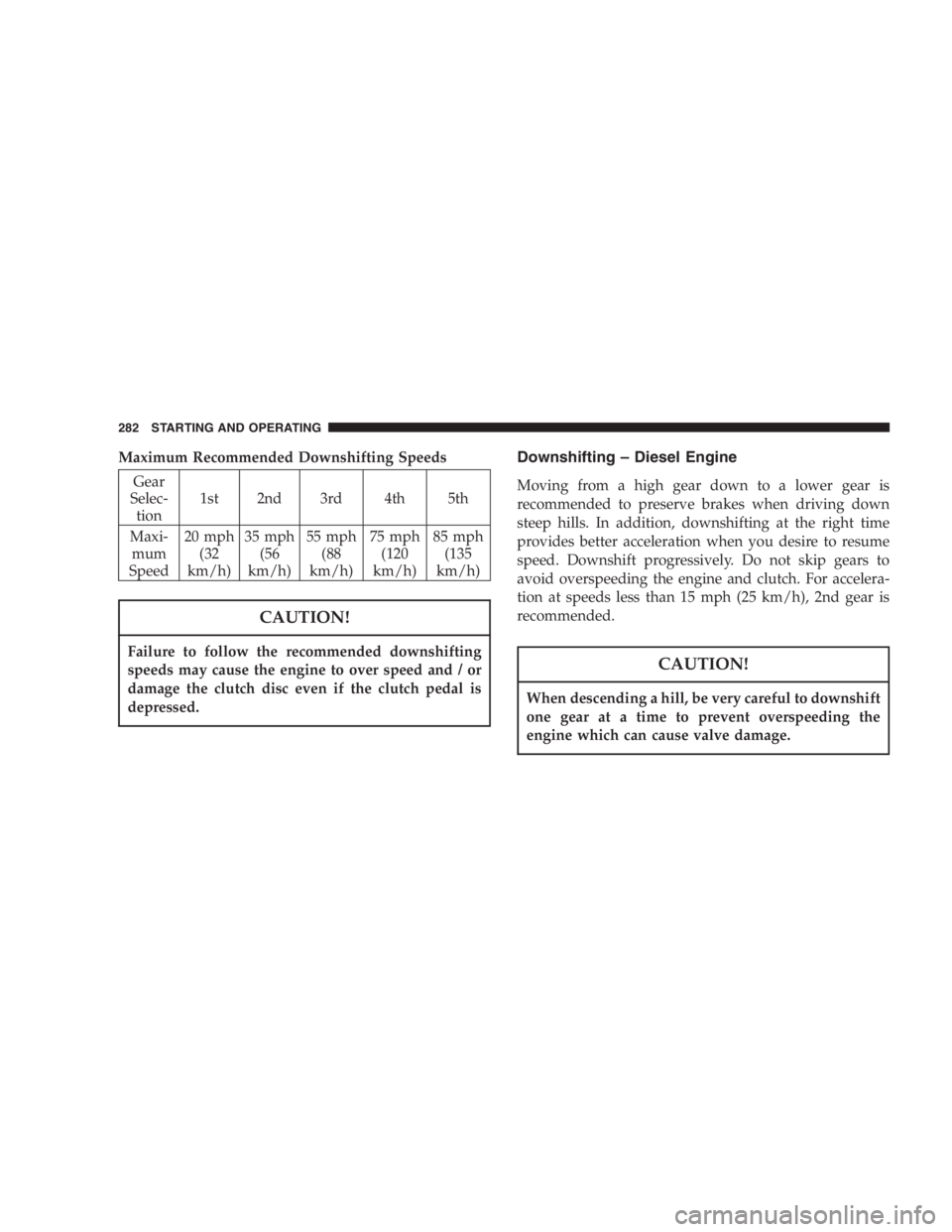
To prevent clutch and transmission damage, your vehicle
should be downshifted at speeds no greater than those
listed in the Maximum Recommended Downshifting
Speed chart. STARTING AND OPERATING 281
5
Page 282 of 532
Maximum Recommended Downshifting Speeds
Gear
Selec-
tion 1st 2nd 3rd 4th 5th
Maxi-
mum
Speed 20 mph
(32
km/h) 35 mph
(56
km/h) 55 mph
(88
km/h) 75 mph
(120
km/h) 85 mph
(135
km/h)
CAUTION!Failure to follow the recommended downshifting
speeds may cause the engine to over speed and / or
damage the clutch disc even if the clutch pedal is
depressed. Downshifting – Diesel Engine
Moving from a high gear down to a lower gear is
recommended to preserve brakes when driving down
steep hills. In addition, downshifting at the right time
provides better acceleration when you desire to resume
speed. Downshift progressively. Do not skip gears to
avoid overspeeding the engine and clutch. For accelera-
tion at speeds less than 15 mph (25 km/h), 2nd gear is
recommended.
CAUTION!When descending a hill, be very careful to downshift
one gear at a time to prevent overspeeding the
engine which can cause valve damage.282 STARTING AND OPERATING
Page 283 of 532

To prevent clutch and transmission damage, your vehicle
should be downshifted at speeds no greater than those
listed in the Maximum Recommended Downshifting
Speed chart.
Maximum Recommended Downshifting Speeds
Gear
Selec-
tion 1st 2nd 3rd 4th 5th
Maxi-
mum
Speed 10 mph
(16
km/h) 19 mph
(31
km/h) 32 mph
(51
km/h) 50 mph
(80
km/h) 68 mph
(109
km/h)
FOUR-WHEEL- DRIVE OPERATION — IF
EQUIPPED
Four-Wheel-Drive Dodge Ram Trucks are equipped with
either a Manually Shifted transfer case or an Electroni-
cally Shifted transfer case. See the operating instructions
for your transfer case, located within this section. Manually Shifted Transfer Case Operating
Information/Precautions
The transfer case provides 4 mode position s-2(r ear)-
wheel-drive high range, 4-wheel-drive high range, neu-
tral, and 4-wheel-drive low range.
This transfer case is intended to be driven in the 2-wheel-
drive position (2H) for normal street and highway con-
ditions such as dry hard surfaced roads.
When additional traction is required the transfer case 4H
and 4L positions can be used to lock the front and rear
driveshafts together and force the front and rear wheels
to rotate at the same speed. This is accomplished by
simply moving the shift lever to the desired positions.
The 4H and 4L positions are intended for loose, slippery
road surfaces only. Driving in the 4H and 4L positions on
dry hard surfaced roads may cause increased tire wear
and damage to the driveline components. STARTING AND OPERATING 283
5
Page 287 of 532

vehicle in motion, the transfer case will engage / disen-
gage faster if you momentarily release the accelerator
pedal after completing the shift. Apply a constant force
when shifting the transfer case lever.
2H or 4H ⇔ 4L
With the vehicle rolling at 2 to 3 mph (3 to 5 km/h), shift
an automatic transmission to N (Neutral) or depress the
clutch on a manual transmission. While the vehicle is
coasting at 2 to 3 mph (3 to 5 km/h), shift the transfer
case lever firmly to the desired position. Do not pause in
transfer case N (Neutral).
NOTE: Pausing in transfer case N (Neutral) in vehicles
equipped with an automatic transmission may require
shutting the engine OFF to avoid gear clash while
completing the shift. If difficulty occurs, shift automatic
transmission to N (Neutral), hold foot on brake, and turn
engine OFF. Make shift to the desired mode. NOTE: Shifting into or out of 4L is possible with the
vehicle completely stopped, however difficulty may oc-
cur due to the mating clutch teeth not being properly
aligned. Several attempts may be required for clutch
teeth alignment and shift completion to occur. The pre-
ferred method is with the vehicle rolling 2 to 3 mph (3 to
5 km/h). Avoid attempting to engage or disengage 4L
with the vehicle moving faster than 2 to 3 mph (3 to 5
km/h).
NOTE: Do not attempt to shift to or from 4L while the
transmission is in gear or clutch is engaged.
Transfer Case Reminder Light
The four-wheel-drive operating light (4WD), located in
the instrument cluster, is used to alert the driver that the
front axle is fully engaged and all four wheels are
driving. STARTING AND OPERATING 287
5