2007 PONTIAC SOLSTICE brakes
[x] Cancel search: brakesPage 219 of 396

{CAUTION:
Coasting downhill in NEUTRAL (N) or with
the ignition off is dangerous. Your brakes
will have to do all the work of slowing
down. They could get so hot that they
would not work well. You would then have
poor braking or even none going down a
hill. You could crash. Always have your
engine running and your vehicle in gear
when you go downhill.
Know how to go down hills. The most important
thing to know is this: let your engine do some of
the slowing down. Shift to a lower gear when
you go down a steep or long hill.
Know how to go uphill. You may want to shift
down to a lower gear. The lower gears help
cool your engine and transmission, and you can
climb the hill better.
Stay in your own lane when driving on two-lane
roads in hills or mountains. Do not swing wide
or cut across the center of the road. Drive at
speeds that let you stay in your own lane.
As you go over the top of a hill, be alert. There
could be something in your lane, like a stalled
car or an accident.
You may see highway signs on mountains that
warn of special problems. Examples are long
grades, passing or no-passing zones, a falling
rocks area, or winding roads. Be alert to these
and take appropriate action.
219
Page 222 of 396

Accelerate gently. Try not to break the fragile
traction. If you accelerate too fast, the drive wheels
will spin and polish the surface under the tires
even more.
Unless you have the Anti-Lock Brake System
(ABS), you will want to brake very gently, too.
If you do have ABS, seeAnti-Lock Brake System
(ABS) on page 195. This system improves
your vehicle’s stability when you make a hard
stop on a slippery road. Whether you have ABS or
not, you will want to begin stopping sooner than
you would on dry pavement. Without ABS, if
you feel your vehicle begin to slide, let up on
the brakes a little. Push the brake pedal down
steadily to get the most traction you can.
Remember, unless you have ABS, if you brake so
hard that your wheels stop rolling, you will just
slide. Brake so your wheels always keep rolling
and you can still steer.
Whatever your braking system, allow greater
following distance on any slippery road.
Watch for slippery spots. The road might
be ne until you hit a spot that is covered
with ice. On an otherwise clear road, icepatches may appear in shaded areas where
the sun cannot reach, such as around clumps
of trees, behind buildings, or under bridges.
Sometimes the surface of a curve or an
overpass may remain icy when the
surrounding roads are clear. If you see a
patch of ice ahead of you, brake before you
are on it. Try not to brake while you are
actually on the ice, and avoid sudden steering
maneuvers.
If You Are Caught in a Blizzard
If you are stopped by heavy snow, you could
be in a serious situation. You should probably
stay with your vehicle unless you know for
sure that you are near help and you can hike
through the snow. Here are some things to do
to summon help and keep yourself and your
passengers safe:
Turn on your hazard ashers.
Tie a red cloth to your vehicle to alert police
that you have been stopped by the snow.
222
Page 233 of 396

Service........................................................ 235
Accessories and Modications................... 235
California Proposition 65 Warning.............. 236
Doing Your Own Service Work.................. 236
Adding Equipment to the Outside
of Your Vehicle...................................... 237
Fuel............................................................. 237
Gasoline Octane........................................ 237
Gasoline Specications.............................. 237
California Fuel........................................... 238
Additives................................................... 238
Fuels in Foreign Countries........................ 239
Filling the Tank......................................... 240
Filling a Portable Fuel Container............... 242
Checking Things Under the Hood.............. 242
Hood Release........................................... 243
Engine Compartment Overview.................. 244
Engine Oil................................................. 247
Engine Oil Life System.............................. 252
Engine Air Cleaner/Filter............................ 254
Automatic Transmission Fluid.................... 256
Manual Transmission Fluid........................ 256
Hydraulic Clutch........................................ 256
Engine Coolant.......................................... 257Coolant Surge Tank Pressure Cap............ 260
Engine Overheating................................... 260
Cooling System......................................... 262
Power Steering Fluid ................................. 268
Windshield Washer Fluid........................... 269
Brakes...................................................... 270
Battery...................................................... 273
Jump Starting............................................ 274
Rear Axle.................................................... 279
Bulb Replacement....................................... 280
Halogen Bulbs........................................... 280
Headlamps................................................ 280
Front Turn Signal, Parking and
Fog Lamps............................................ 281
Taillamps, Turn Signal, and Stoplamps...... 281
Back-Up Lamps......................................... 282
License Plate Lamp................................... 282
Replacement Bulbs................................... 283
Windshield Wiper Blade Replacement....... 283
Tires............................................................ 284
Winter Tires.............................................. 285
Tire Sidewall Labeling............................... 286
Tire Terminology and Denitions............... 289
Section 5 Service and Appearance Care
233
Page 235 of 396

Service
Your dealer knows your vehicle best and wants
you to be happy with it. We hope you will go
to your dealer for all your service needs. You will
get genuine GM parts and GM-trained and
supported service people.
We hope you will want to keep your GM vehicle all
GM. Genuine GM parts have one of these marks:
Accessories and Modications
When you add non-GM accessories to your vehicle
they can affect your vehicle’s performance and
safety, including such things as, airbags, braking,
stability, ride and handling, emissions systems,
aerodynamics, durability, and electronic systems
like anti-lock brakes, traction control and
stability control. Some of these accessories may
even cause malfunction or damage not covered
by warranty.
GM Accessories are designed to complement
and function with other systems on your vehicle.
Your GM dealer can accessorize your vehicle
using genuine GM Accessories. When you go to
your GM dealer and ask for GM Accessories,
you will know that GM-trained and supported
service technicians will perform the work using
genuine GM Accessories.
235
Page 245 of 396

A. Windshield Washer Fluid Reservoir. See
“Adding Washer Fluid” underWindshield
Washer Fluid on page 269.
B. Coolant Surge Tank and Pressure Cap. See
Cooling System on page 262.
C. Brake Master Cylinder Reservoir. See “Brake
Fluid” underBrakes on page 270andHydraulic
Clutch on page 256.
D. Engine Oil Dipstick (Out of View). See
“Checking Engine Oil” underEngine Oil on
page 247.
E. Engine Air Cleaner/Filter. SeeEngine Air
Cleaner/Filter on page 254.F. Engine Oil Fill Cap. See “When to Add Engine
Oil” underEngine Oil on page 247.
G. Power Steering Fluid Reservoir. SeePower
Steering Fluid on page 268.
H. Remote Negative (−) Ground (Out of View).
SeeJump Starting on page 274.
I. Battery (Out of View). SeeBattery on page 273.
J. Remote Positive (+) Terminal. SeeJump
Starting on page 274.
K. Underhood Fuse Block. SeeUnderhood Fuse
Block on page 329.
245
Page 247 of 396
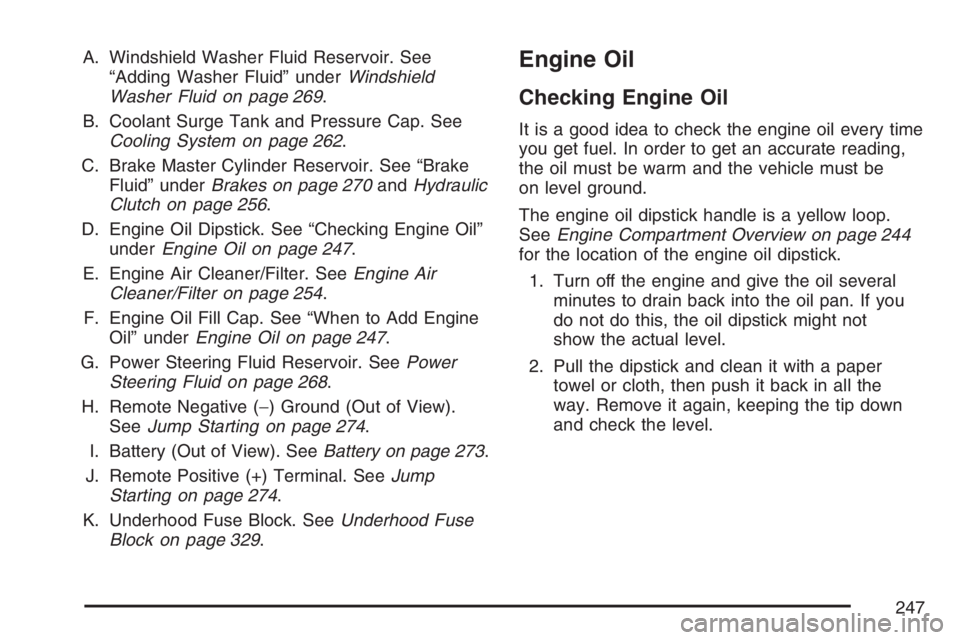
A. Windshield Washer Fluid Reservoir. See
“Adding Washer Fluid” underWindshield
Washer Fluid on page 269.
B. Coolant Surge Tank and Pressure Cap. See
Cooling System on page 262.
C. Brake Master Cylinder Reservoir. See “Brake
Fluid” underBrakes on page 270andHydraulic
Clutch on page 256.
D. Engine Oil Dipstick. See “Checking Engine Oil”
underEngine Oil on page 247.
E. Engine Air Cleaner/Filter. SeeEngine Air
Cleaner/Filter on page 254.
F. Engine Oil Fill Cap. See “When to Add Engine
Oil” underEngine Oil on page 247.
G. Power Steering Fluid Reservoir. SeePower
Steering Fluid on page 268.
H. Remote Negative (−) Ground (Out of View).
SeeJump Starting on page 274.
I. Battery (Out of View). SeeBattery on page 273.
J. Remote Positive (+) Terminal. SeeJump
Starting on page 274.
K. Underhood Fuse Block. SeeUnderhood Fuse
Block on page 329.Engine Oil
Checking Engine Oil
It is a good idea to check the engine oil every time
you get fuel. In order to get an accurate reading,
the oil must be warm and the vehicle must be
on level ground.
The engine oil dipstick handle is a yellow loop.
SeeEngine Compartment Overview on page 244
for the location of the engine oil dipstick.
1. Turn off the engine and give the oil several
minutes to drain back into the oil pan. If you
do not do this, the oil dipstick might not
show the actual level.
2. Pull the dipstick and clean it with a paper
towel or cloth, then push it back in all the
way. Remove it again, keeping the tip down
and check the level.
247
Page 256 of 396

Automatic Transmission Fluid
It is not necessary to check the transmission
uid level. A transmission uid leak is the only
reason for uid loss. If a leak occurs, take
your vehicle to the dealership service department
and have it repaired as soon as possible.
Change the uid and lter at the intervals
listed in the Maintenance Schedule. See
Part A: Scheduled Maintenance Services on
page 336. Be sure to use the transmission uid
listed inPart D: Recommended Fluids and
Lubricants on page 353.
Notice:Use of the incorrect automatic
transmission uid may damage your
vehicle, and the damages may not be
covered by your warranty. Always use
the automatic transmission uid listed
inPart D: Recommended Fluids and
Lubricants on page 353.
Manual Transmission Fluid
It is not necessary to check the manual
transmission uid level. A transmission uid leak
is the only reason for uid loss. If a leak occurs,
take the vehicle to the dealership service
department and have it repaired as soon as
possible. You may also have your uid level
checked by your dealer when you have your
oil changed. SeePart D: Recommended Fluids
and Lubricants on page 353for the proper
uid to use.
Hydraulic Clutch
The hydraulic clutch linkage in your vehicle is
self-adjusting. This system does not have its own
reservoir. It receives uid from the brake master
cylinder reservoir.
SeeBrakes on page 270for more information.
256
Page 270 of 396

Brakes
Brake Fluid
Your brake master
cylinder reservoir is
lled with DOT-3 brake
uid. SeeEngine
Compartment Overview
on page 244for the
location of the reservoir.
There are only two reasons why the brake uid
level in the reservoir might go down. The rst
is that the brake uid goes down to an acceptable
level during normal brake lining wear. When
new linings are put in, the uid level goes back
up. The other reason is that uid is leaking out
of the brake and/or clutch hydraulic system.
If it is, you should have your brake and/or clutch
system xed, since a leak means that sooner
or later your brakes and/or clutch will not
work well, or will not work at all.So, it is not a good idea to top off your brake/clutch
uid. Adding uid will not correct a leak. If you
add uid when your brake linings are worn, then
you will have too much uid when you get
new brake linings. You should add or remove
uid, as necessary, only when work is done on the
brake/clutch hydraulic system.
{CAUTION:
If your vehicle has too much brake uid, it
can spill on the engine. The uid will burn
if the engine is hot enough. You or others
could be burned, and your vehicle could
be damaged. Add brake uid only when
work is done on the brake and/or clutch
hydraulic system.
When your brake uid falls to a low level, your
brake warning light will come on. SeeBrake
System Warning Light on page 134.
270