Page 9 of 486
Front Seats
Manual Seats
{CAUTION:
You can lose control of the vehicle if you
try to adjust a manual driver’s seat while
the vehicle is moving. The sudden
movement could startle and confuse you,
or make you push a pedal when you do
not want to. Adjust the driver’s seat only
when the vehicle is not moving.Lift the bar located under the front of the seat to
unlock it. Slide the seat to where you want it
and release the bar. Try to move the seat with your
body to be sure the seat is locked in place.
9
Page 12 of 486
Reclining Seatbacks
{CAUTION:
You can lose control of the vehicle if you
try to adjust a manual driver’s seat while
the vehicle is moving. The sudden
movement could startle and confuse you,
or make you push a pedal when you do
not want to. Adjust the driver’s seat only
when the vehicle is not moving.
{CAUTION:
If the seatback is not locked, it could
move forward in a sudden stop or crash.
That could cause injury to the person
sitting there. Always push and pull on the
seatback to be sure it is locked.Your seats have manual reclining seatbacks. The
lever used to operate them is located on the
outboard side of the seats.
4-door Model Shown, 2-door Model Similar
12
Page 16 of 486
Seatback Latches
{CAUTION:
You can lose control of the vehicle if you
try to adjust a manual driver’s seat while
the vehicle is moving. The sudden
movement could startle and confuse you,
or make you push a pedal when you do
not want to. Adjust the driver’s seat only
when the vehicle is not moving.
If your vehicle is a coupe or retractable hardtop
model, it has a seatback latch as part of the
manual recline lever. This feature provides easy
access to the rear seats. To operate the seatback
latch, pull up on the manual recline lever. The
seatback will automatically spring forward.
To operate the latch from the rear seat, pull back
on the top of the manual recline lever.
16
Page 120 of 486

PASS-Key®III+
The PASS-Key®III+ system operates on a radio
frequency subject to Federal Communications
Commission (FCC) Rules and with Industry
Canada.
This device complies with Part 15 of the FCC
Rules. Operation is subject to the following two
conditions:
1. This device may not cause harmful
interference.
2. This device must accept any interference
received, including interference that may
cause undesired operation.
This device complies with RSS-210 of Industry
Canada. Operation is subject to the following two
conditions:
1. This device may not cause interference.
2. This device must accept any interference
received, including interference that may
cause undesired operation of the device.
Changes or modications to this system by other
than an authorized service facility could void
authorization to use this equipment.
PASS-Key
®III+ uses a radio frequency
transponder in the key that matches a decoder
in your vehicle.
PASS-Key®III+ Operation
Your vehicle has the PASS-Key®III+
(Personalized Automotive Security System)
theft-deterrent system. PASS-Key
®III+ is a
passive theft-deterrent system. This means you do
not have to do anything special to arm or disarm
the system. It works when you insert or remove the
key from the ignition.
When the PASS-Key
®III+ system senses that
someone is using the wrong key, it prevents the
vehicle from starting. Anyone using a trial-and-error
method to start the vehicle will be discouraged
because of the high number of electrical key codes.
When trying to start the vehicle if the engine does
not start and the SECURITY light comes on, the
key may have a damaged transponder. Turn the
ignition off and try again.
If the engine still does not start, and the key
appears to be undamaged, try another ignition key.
Also, check the fuse. SeeFuses on page 415.Ifthe
engine still does not start with the other key, your
vehicle needs service. If your vehicle does start, the
rst key may be faulty. See your dealer who can
service the PASS-Key
®III+ and have a new key
made. In an emergency, contact Roadside
Assistance.
120
Page 169 of 486
If a bulb is burned out, replace it to help avoid an
accident. If the arrows don’t go on at all when
you signal a turn, check for burned-out bulbs and
then check the fuse. SeeFuses on page 415.
Headlamp High/Low-Beam Changer
To change the headlamps from low beam to
high beam, push the turn signal/multifunction lever
away from you.
When the high beams
are on, a light on the
instrument panel cluster
also will be on if the
ignition is on.
To change the headlamps from high beam to low
beam, pull the turn signal lever toward you.
Flash-to-Pass
This feature lets you use your high-beam
headlamps to signal a driver in front of you that
you want to pass.
To use it, pull the turn signal/multifunction lever
toward you until the high-beam headlamps
come on, then release the lever to turn them off.
Windshield Wipers
Use this lever, located on the right side of the
steering wheel, to operate the windshield wipers.
169
Page 182 of 486

Certain electrical accessories may not be
compatible with the accessory power outlet and
could result in blown vehicle or adapter fuses.
If you experience a problem, see your dealer for
additional information on the accessory power
outlet.
Notice:Adding any electrical equipment to
your vehicle may damage it or keep other
components from working as they should.
The repairs would not be covered by your
warranty. Do not use equipment exceeding
maximum amperage rating of 20 amperes.
Check with your dealer before adding electrical
equipment.
When adding electrical equipment, be sure to
follow the proper installation instructions included
with the equipment.
Notice:Improper use of the power outlet can
cause damage not covered by your warranty.
Do not hang any type of accessory or
accessory bracket from the plug because the
power outlets are designed for accessory
power plugs only.Climate Controls
Climate Control System
With this system you can control the heating,
cooling and ventilation for your vehicle. If
your vehicle has the remote start feature, the
climate control system functions as part of
the remote start feature. SeeRemote Keyless
Entry System Operation on page 101.
Operation
9
(Fan):Turn the left knob clockwise or
counterclockwise to increase or decrease the fan
speed. The fan must be on to run the air
conditioning compressor.
182
Page 207 of 486

Oil Pressure Light
If you have a low engine
oil pressure problem,
this light will stay on after
you start your engine, or
come on when you are
driving. This indicates
that your engine is not
receiving enough oil.
The engine could be low on oil, or could have
some other oil problem. Have it xed immediately.
The oil light could also come on in three other
situations:
When the ignition is on but the engine is not
running, the light will come on as a test to
show you it is working, but the light will go out
when you turn the ignition to START. If it
doesn’t come on with the ignition on, you may
have a problem with the fuse or bulb. Have
it xed right away.
If the vehicle is idling at a stop sign, the light
may blink on and then off.
If you make a hard stop, the light may come
on for a moment. This is normal.
{CAUTION:
Do not keep driving if the oil pressure is
low. If you do, your engine can become so
hot that it catches re. You or others
could be burned. Check your oil as soon
as possible and have your vehicle
serviced.
Notice:Lack of proper engine oil maintenance
may damage the engine. The repairs would
not be covered by your warranty. Always follow
the maintenance schedule in this manual for
changing engine oil.
Security Light
For information
regarding this light, see
Theft-Deterrent
Systems on page 118.
207
Page 295 of 486
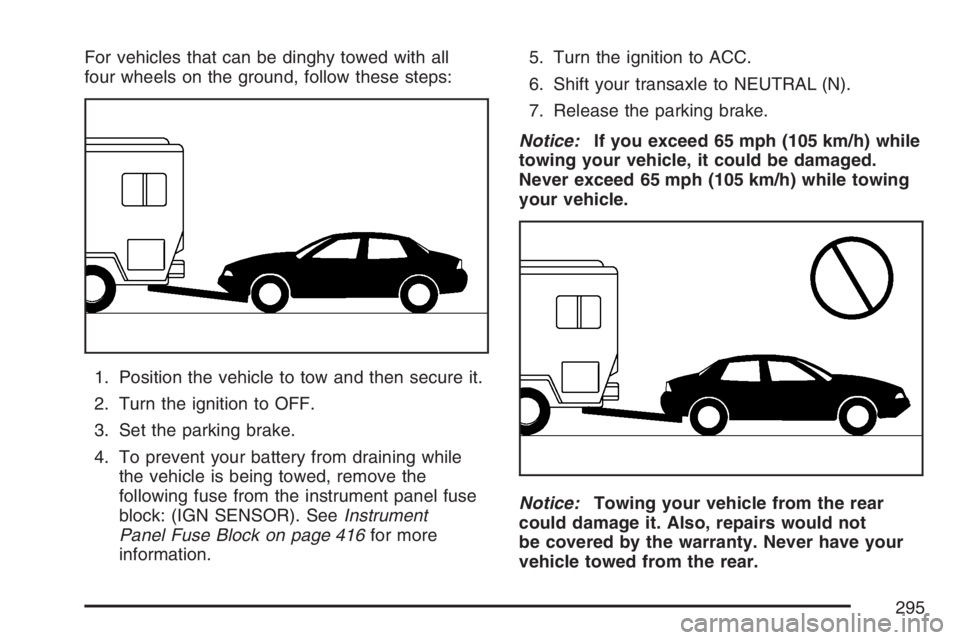
For vehicles that can be dinghy towed with all
four wheels on the ground, follow these steps:
1. Position the vehicle to tow and then secure it.
2. Turn the ignition to OFF.
3. Set the parking brake.
4. To prevent your battery from draining while
the vehicle is being towed, remove the
following fuse from the instrument panel fuse
block: (IGN SENSOR). SeeInstrument
Panel Fuse Block on page 416for more
information.5. Turn the ignition to ACC.
6. Shift your transaxle to NEUTRAL (N).
7. Release the parking brake.
Notice:If you exceed 65 mph (105 km/h) while
towing your vehicle, it could be damaged.
Never exceed 65 mph (105 km/h) while towing
your vehicle.
Notice:Towing your vehicle from the rear
could damage it. Also, repairs would not
be covered by the warranty. Never have your
vehicle towed from the rear.
295