2007 NISSAN QASHQAI Rele
[x] Cancel search: RelePage 10 of 297
Downloaded from www.Manualslib.com manuals search engine LEFT (LHD) AND RIGHT-HAND DRIVE
(RHD) MODELS
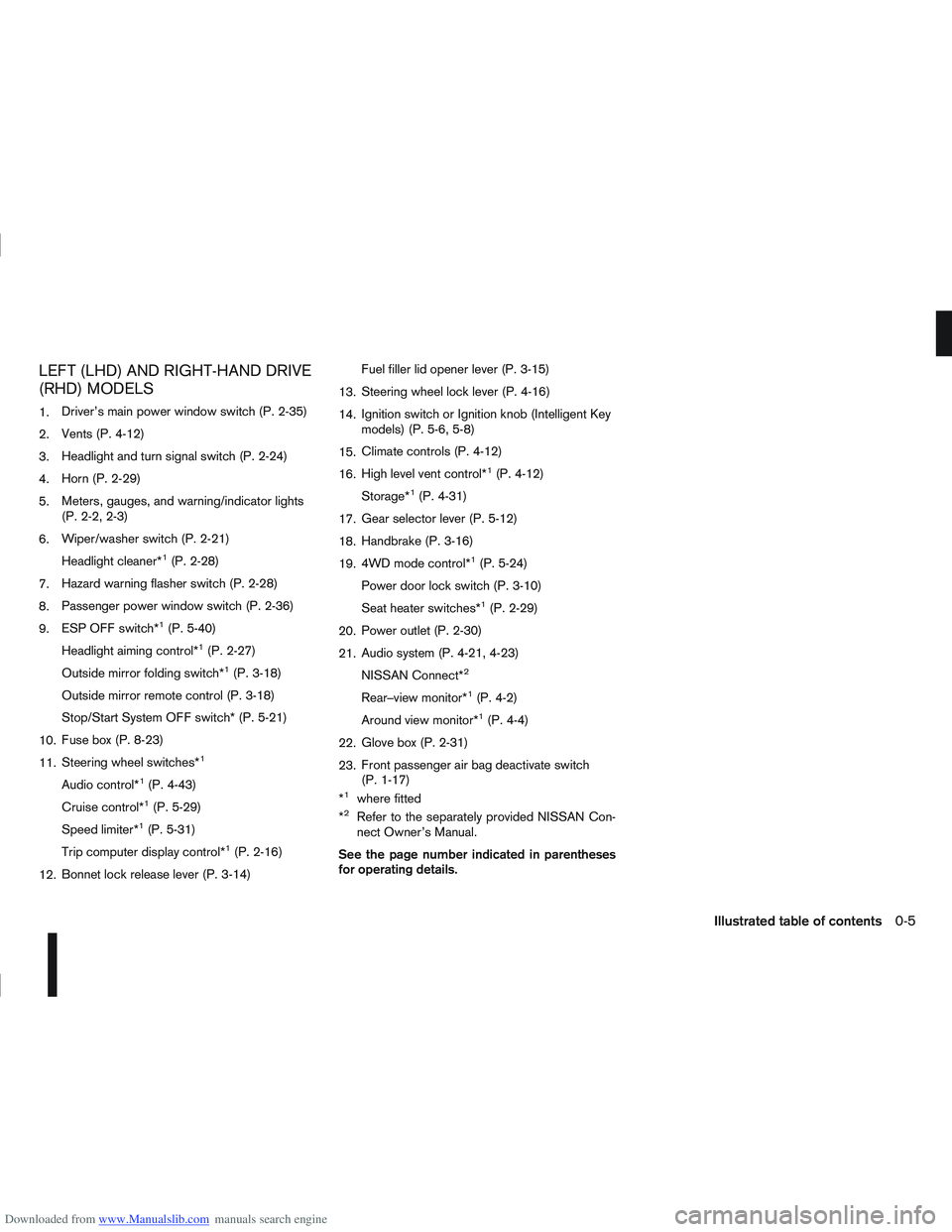
1.Driver’s main power window switch (P. 2-35)
2. Vents (P. 4-12)
3. Headlight and turn signal switch (P. 2-24)
4. Horn (P. 2-29)
5. Meters, gauges, and warning/indicator lights
(P. 2-2, 2-3)
6. Wiper/washer switch (P. 2-21)
Headlight cleaner*
1(P. 2-28)
7. Hazard warning flasher switch (P. 2-28)
8. Passenger power window switch (P. 2-36)
9. ESP OFF switch*
1(P. 5-40)
Headlight aiming control*
1(P. 2-27)
Outside mirror folding switch*
1(P. 3-18)
Outside mirror remote control (P. 3-18)
Stop/Start System OFF switch* (P. 5-21)
10. Fuse box (P. 8-23)
11. Steering wheel switches*
1
Audio control*1(P. 4-43)
Cruise control*
1(P. 5-29)
Speed limiter*
1(P. 5-31)
Trip computer display control*
1(P. 2-16)
12. Bonnet lock release lever (P. 3-14) Fuel filler lid opener lever (P. 3-15)
13. Steering wheel lock lever (P. 4-16)
14. Ignition switch or Ignition knob (Intelligent Key
models) (P. 5-6, 5-8)
15. Climate controls (P. 4-12)
16. High level vent control*
1(P. 4-12)
Storage*
1(P. 4-31)
17. Gear selector lever (P. 5-12)
18. Handbrake (P. 3-16)
19. 4WD mode control*
1(P. 5-24)
Power door lock switch (P. 3-10)
Seat heater switches*
1(P. 2-29)
20. Power outlet (P. 2-30)
21. Audio system (P. 4-21, 4-23)
NISSAN Connect*
2
Rear–view monitor*1(P. 4-2)
Around view monitor*
1(P. 4-4)
22. Glove box (P. 2-31)
23. Front passenger air bag deactivate switch
(P. 1-17)
*
1where fitted
*2Refer to the separately provided NISSAN Con-
nect Owner’s Manual.
See the page number indicated in parentheses
for operating details.
Illustrated table of contents0-5
Page 21 of 297
Downloaded from www.Manualslib.com manuals search engine WARNING
Do not adjust the driver’s seat while driving.
The seat may move suddenly and could cause
loss of control of the vehicle.
After adjustment, gently rock in the seat to
make sure it is securely locked.
The seatback should not be reclined any more
than needed for comfort. Seat belts are most
effective when the passenger sits well back
and upright in the seat. If the seatback is re-
clined, the risk of sliding under the lap belt
and being injured is increased.
When returning the seatbacks to the upright
position, be certain that they are completely
secured in the latched position. If they are not
completely secured, passengers may be in-
jured in an accident or sudden stop. When
operating the seatback release always rock
the seatback afterward to check that it is
locked.
When the vehicle is being used to carry cargo,
properly secure all cargo to help prevent it
from sliding or shifting. Do not place cargo
higher than the seatbacks. In a sudden stop
or collision, unsecured cargo could cause per-
sonal injury.
Never allow anyone to ride in the luggage area
or on the rear seat when it is in the folded-
down position. Use of these areas by passen-
gers without proper restraints could result in
serious injury in an accident or sudden stop.
Closely supervise children when they are
around the vehicle to prevent them from play-
ing and being locked in the luggage compart-
ment where they could be seriously injured.
Keep the vehicle locked with the rear seat-
back securely latched when not in use, and
prevent children from having access to the
vehicle’s keys.FRONT SEATS
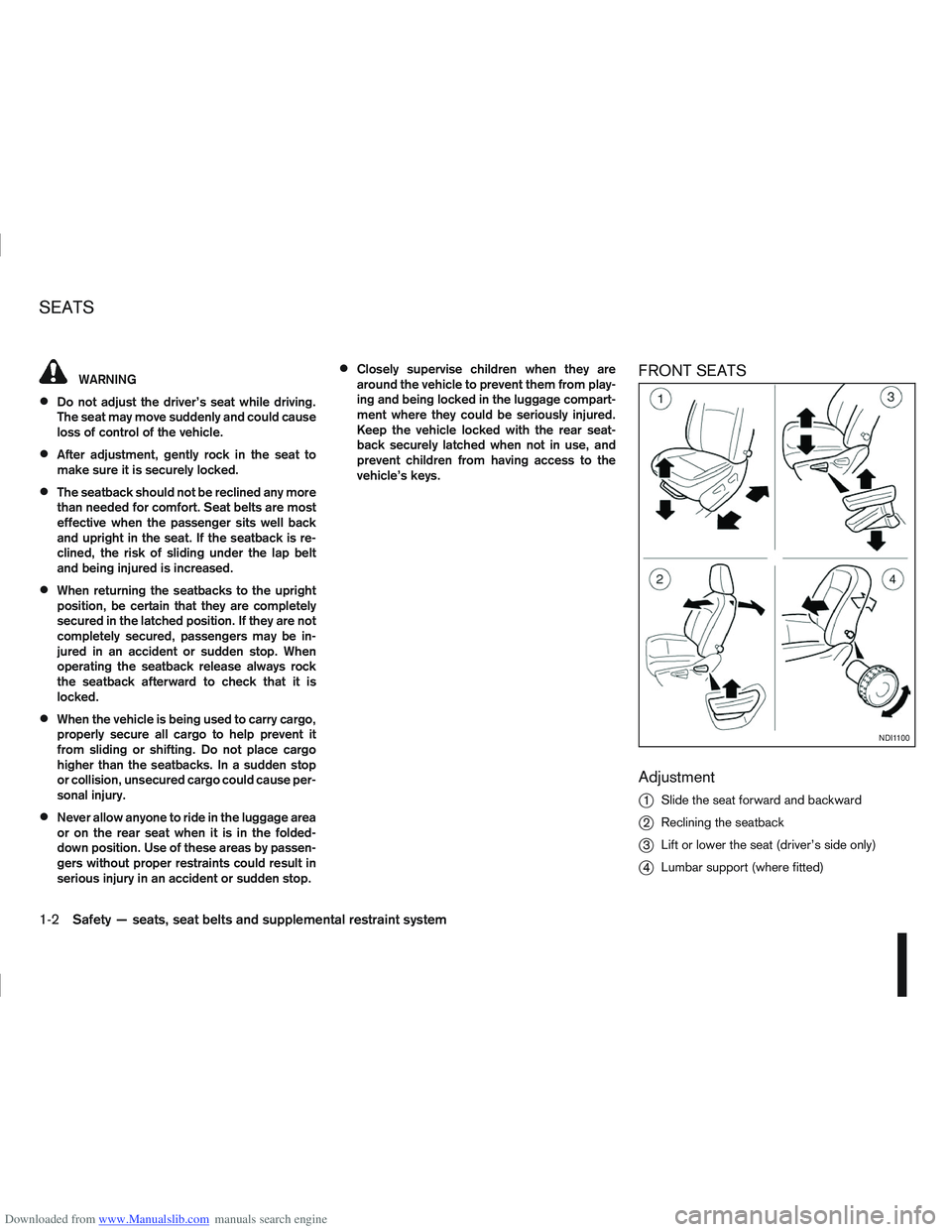
Adjustment
j
1Slide the seat forward and backward
j2Reclining the seatback
j3Lift or lower the seat (driver’s side only)
j4Lumbar support (where fitted)
NDI1100
SEATS
1-2Safety — seats, seat belts and supplemental restraint system
Page 22 of 297
Downloaded from www.Manualslib.com manuals search engine REAR SEAT(S)
Folding (5-seater)
The luggage compartment loading capacity can be
increased by folding the rear seats forward.
To fold the seat:
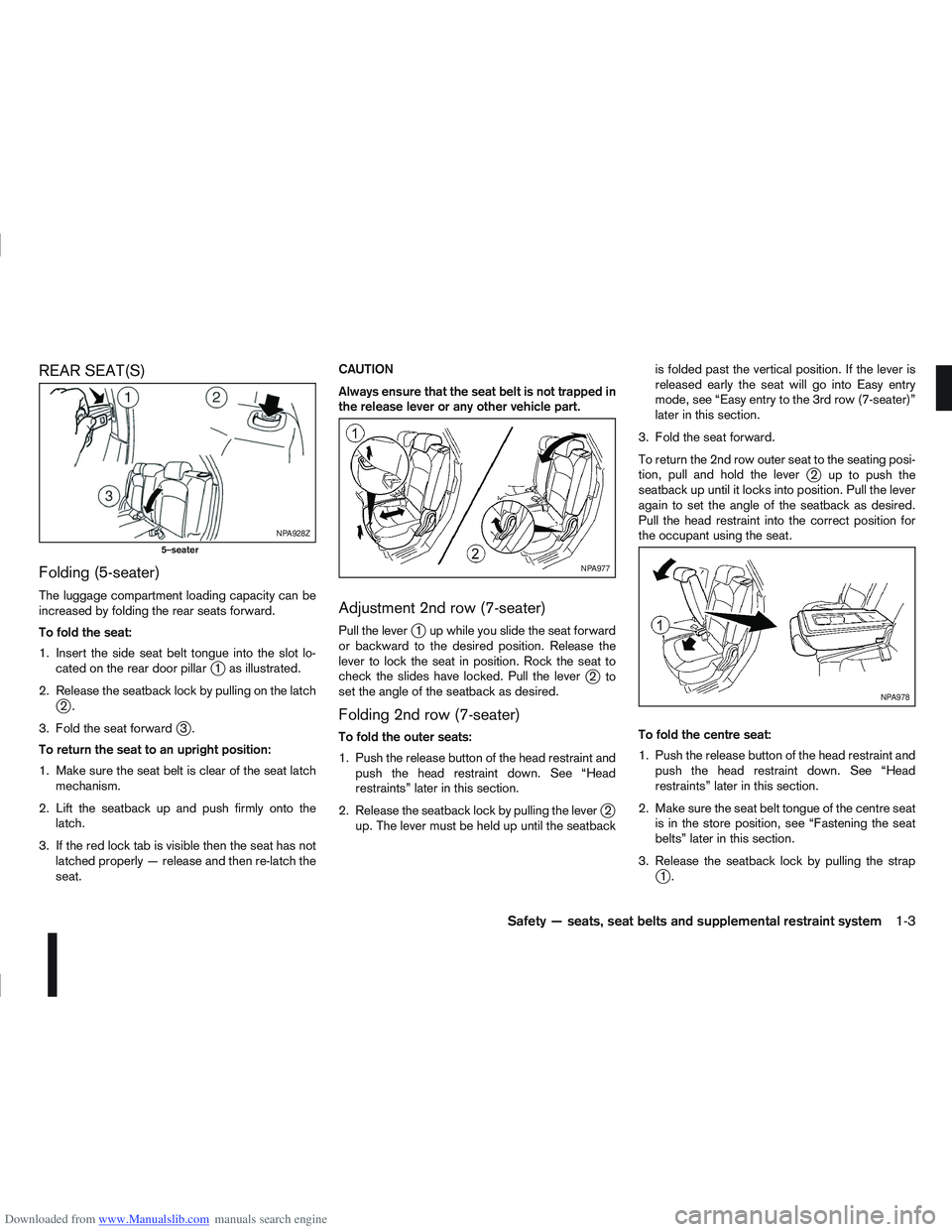
1. Insert the side seat belt tongue into the slot lo-cated on the rear door pillar
j1 as illustrated.
2. Release the seatback lock by pulling on the latch
j2.
3. Fold the seat forward
j3.
To return the seat to an upright position:
1. Make sure the seat belt is clear of the seat latch mechanism.
2. Lift the seatback up and push firmly onto the latch.
3. If the red lock tab is visible then the seat has not latched properly — release and then re-latch the
seat. CAUTION
Always ensure that the seat belt is not trapped in
the release lever or any other vehicle part.
Adjustment 2nd row (7-seater)
Pull the leverj1 up while you slide the seat forward
or backward to the desired position. Release the
lever to lock the seat in position. Rock the seat to
check the slides have locked. Pull the lever
j2to
set the angle of the seatback as desired.
Folding 2nd row (7-seater)
To fold the outer seats:
1. Push the release button of the head restraint and push the head restraint down. See “Head
restraints” later in this section.
2. Release the seatback lock by pulling the lever
j2
up. The lever must be held up until the seatback is folded past the vertical position. If the lever is
released early the seat will go into Easy entry
mode, see “Easy entry to the 3rd row (7-seater)”
later in this section.
3. Fold the seat forward.
To return the 2nd row outer seat to the seating posi-
tion, pull and hold the lever
j2 uptopushthe
seatback up until it locks into position. Pull the lever
again to set the angle of the seatback as desired.
Pull the head restraint into the correct position for
the occupant using the seat.
To fold the centre seat:
1. Push the release button of the head restraint and push the head restraint down. See “Head
restraints” later in this section.
2. Make sure the seat belt tongue of the centre seat is in the store position, see “Fastening the seat
belts” later in this section.
3. Release the seatback lock by pulling the strap
j1.
NPA928Z
5–seater
NPA977
NPA978
Safety — seats, seat belts and supplemental restraint system1-3
Page 23 of 297
Downloaded from www.Manualslib.com manuals search engine 4. Fold the seatback forward.
To return the 2nd row centre seat to its seating posi-
tion, pull the strap to push the seatback up until it
latches into position. Pull the strap again to set the
angle of the seatback as desired. Pull the head re-
straint into the correct position for the occupant us-
ing the seat.
Easy entry to the 3rd row (7-seater)
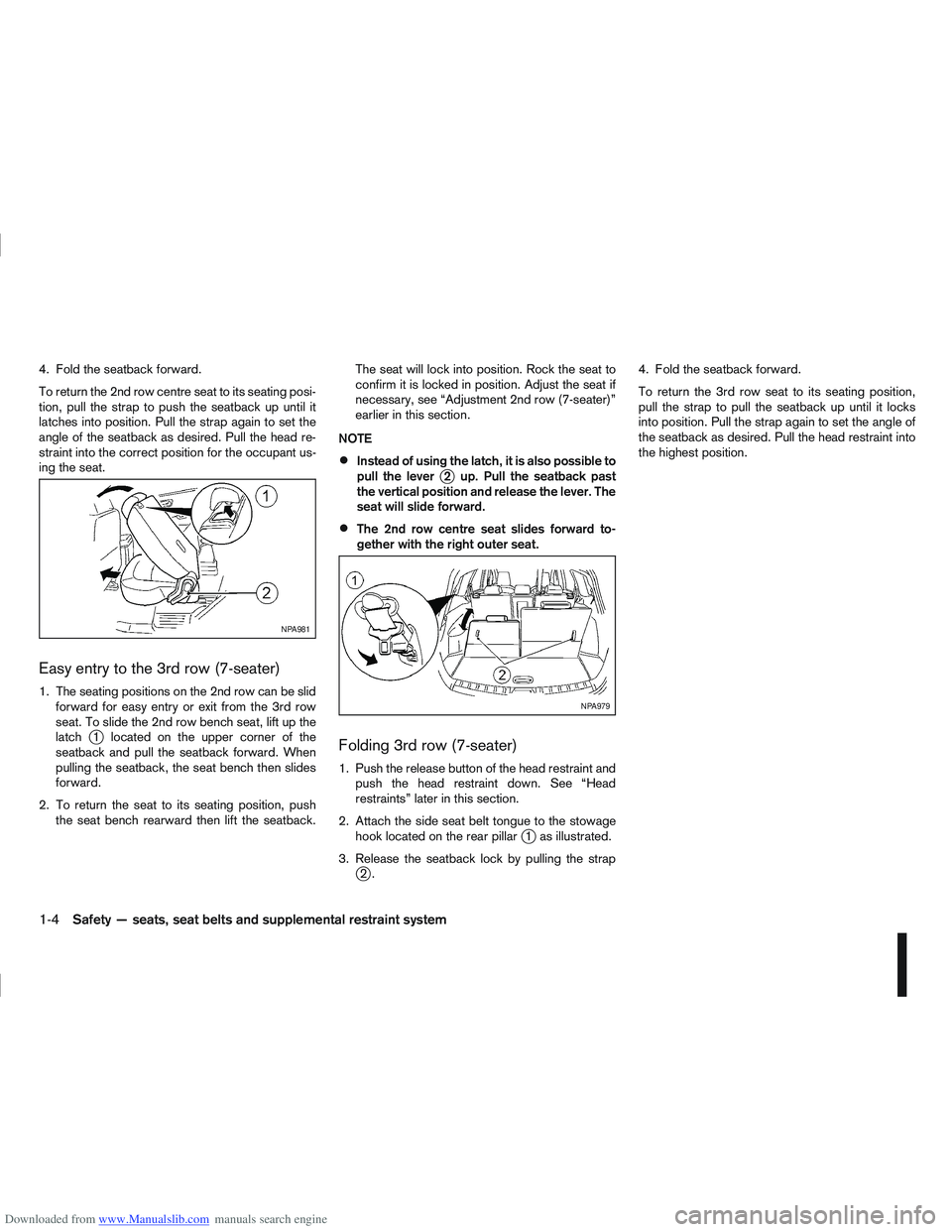
1. The seating positions on the 2nd row can be slidforward for easy entry or exit from the 3rd row
seat. To slide the 2nd row bench seat, lift up the
latch
j1 located on the upper corner of the
seatback and pull the seatback forward. When
pulling the seatback, the seat bench then slides
forward.
2. To return the seat to its seating position, push the seat bench rearward then lift the seatback. The seat will lock into position. Rock the seat to
confirm it is locked in position. Adjust the seat if
necessary, see “Adjustment 2nd row (7-seater)”
earlier in this section.
NOTE
Instead of using the latch, it is also possible to
pull the leverj2 up. Pull the seatback past
the vertical position and release the lever. The
seat will slide forward.
The 2nd row centre seat slides forward to-
gether with the right outer seat.
Folding 3rd row (7-seater)
1. Push the release button of the head restraint and push the head restraint down. See “Head
restraints” later in this section.
2. Attach the side seat belt tongue to the stowage hook located on the rear pillar
j1 as illustrated.
3. Release the seatback lock by pulling the strap
j2. 4. Fold the seatback forward.
To return the 3rd row seat to its seating position,
pull the strap to pull the seatback up until it locks
into position. Pull the strap again to set the angle of
the seatback as desired. Pull the head restraint into
the highest position.
NPA981
NPA979
1-4Safety — seats, seat belts and supplemental restraint system
Page 29 of 297
Downloaded from www.Manualslib.com manuals search engine 3rd row outer seat (7-seater)
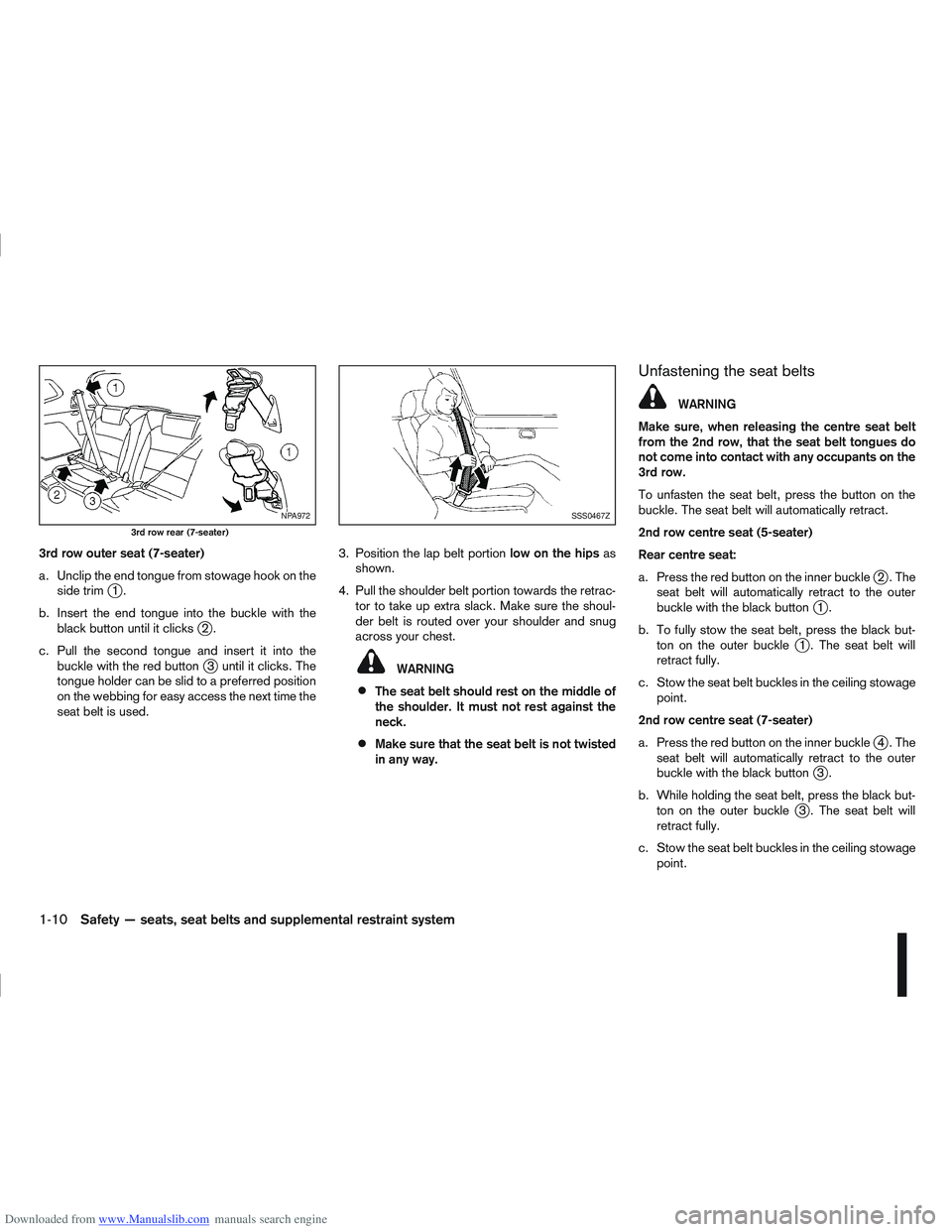
a. Unclip the end tongue from stowage hook on theside trim
j1.
b. Insert the end tongue into the buckle with the black button until it clicks
j2.
c. Pull the second tongue and insert it into the buckle with the red button
j3 until it clicks. The
tongue holder can be slid to a preferred position
on the webbing for easy access the next time the
seat belt is used. 3. Position the lap belt portion
low on the hipsas
shown.
4. Pull the shoulder belt portion towards the retrac- tor to take up extra slack. Make sure the shoul-
der belt is routed over your shoulder and snug
across your chest.WARNING
The seat belt should rest on the middle of
the shoulder. It must not rest against the
neck.
Make sure that the seat belt is not twisted
in any way.
Unfastening the seat belts
WARNING
Make sure, when releasing the centre seat belt
from the 2nd row, that the seat belt tongues do
not come into contact with any occupants on the
3rd row.
To unfasten the seat belt, press the button on the
buckle. The seat belt will automatically retract.
2nd row centre seat (5-seater)
Rear centre seat:
a. Press the red button on the inner buckle
j2.The
seat belt will automatically retract to the outer
buckle with the black button
j1.
b. To fully stow the seat belt, press the black but- ton on the outer buckle
j1 . The seat belt will
retract fully.
c. Stow the seat belt buckles in the ceiling stowage point.
2nd row centre seat (7-seater)
a. Press the red button on the inner buckle
j4.The
seat belt will automatically retract to the outer
buckle with the black button
j3.
b. While holding the seat belt, press the black but- ton on the outer buckle
j3 . The seat belt will
retract fully.
c. Stow the seat belt buckles in the ceiling stowage point.
NPA972
3rd row rear (7-seater)
SSS0467Z
1-10Safety — seats, seat belts and supplemental restraint system
Page 30 of 297
Downloaded from www.Manualslib.com manuals search engine 3rd row outer seat (7-seater)
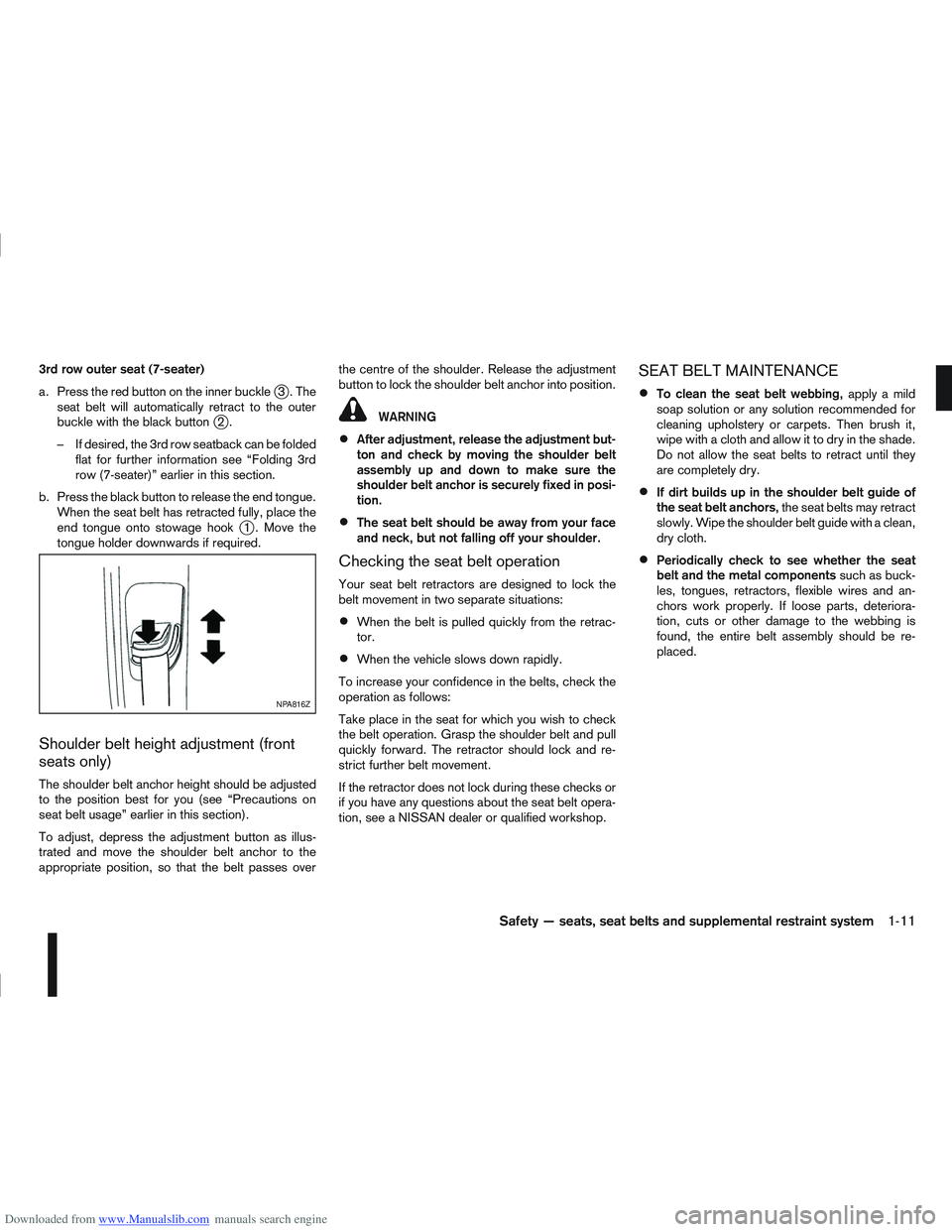
a. Press the red button on the inner buckle
j3.The
seat belt will automatically retract to the outer
buckle with the black button
j2.
– If desired, the 3rd row seatback can be folded flat for further information see “Folding 3rd
row (7-seater)” earlier in this section.
b. Press the black button to release the end tongue. When the seat belt has retracted fully, place the
end tongue onto stowage hook
j1 . Move the
tongue holder downwards if required.
Shoulder belt height adjustment (front
seats only)
The shoulder belt anchor height should be adjusted
to the position best for you (see “Precautions on
seat belt usage” earlier in this section).
To adjust, depress the adjustment button as illus-
trated and move the shoulder belt anchor to the
appropriate position, so that the belt passes over the centre of the shoulder. Release the adjustment
button to lock the shoulder belt anchor into position.
WARNING
After adjustment, release the adjustment but-
ton and check by moving the shoulder belt
assembly up and down to make sure the
shoulder belt anchor is securely fixed in posi-
tion.
The seat belt should be away from your face
and neck, but not falling off your shoulder.
Checking the seat belt operation
Your seat belt retractors are designed to lock the
belt movement in two separate situations:
When the belt is pulled quickly from the retrac-
tor.
When the vehicle slows down rapidly.
To increase your confidence in the belts, check the
operation as follows:
Take place in the seat for which you wish to check
the belt operation. Grasp the shoulder belt and pull
quickly forward. The retractor should lock and re-
strict further belt movement.
If the retractor does not lock during these checks or
if you have any questions about the seat belt opera-
tion, see a NISSAN dealer or qualified workshop.
SEAT BELT MAINTENANCE
To clean the seat belt webbing, apply a mild
soap solution or any solution recommended for
cleaning upholstery or carpets. Then brush it,
wipe with a cloth and allow it to dry in the shade.
Do not allow the seat belts to retract until they
are completely dry.
If dirt builds up in the shoulder belt guide of
the seat belt anchors, the seat belts may retract
slowly. Wipe the shoulder belt guide with a clean,
dry cloth.
Periodically check to see whether the seat
belt and the metal components such as buck-
les, tongues, retractors, flexible wires and an-
chors work properly. If loose parts, deteriora-
tion, cuts or other damage to the webbing is
found, the entire belt assembly should be re-
placed.
NPA816Z
Safety — seats, seat belts and supplemental restraint system1-11
Page 31 of 297
Downloaded from www.Manualslib.com manuals search engine WARNING
The pre-tensioner seat belt cannot be reused
after activation. It must be replaced together
with the retractor as a unit.
If the vehicle is involved in a frontal collision
but the pre-tensioner is not activated, be sure
to have the pre-tensioner system checked
and, if necessary, replaced by a NISSAN
dealer or qualified workshop.
No unauthorised changes should be made to
any components or wiring of the pre-tensioner
seat belt system. This is to prevent accidental
activation of the pre-tensioner seat belt or
damage to the pre-tensioner seat belt opera-
tion. Tampering with the pre-tensioner seat
belt system may result in serious personal in-
jury.
Work on and around the pre-tensioner system
should be done by an authorised NISSAN
dealer or qualified workshop. Installation of
electrical equipment should also be done by a
NISSAN dealer or qualified workshop. Unau-
thorised electrical test equipment and prob-
ing devices should not be used on the pre-
tensioner seat belt system.
If you need to dispose of the pre-tensioner or
scrap the vehicle, contact a NISSAN dealer or
qualified workshop. Correct pre-tensioner
disposal procedures are set forth in the ap-propriate NISSAN Service Manual. Incorrect
disposal procedures could cause personal in-
jury.
The front seat pre-tensioner seat belt system is acti-
vated in conjunction with the front air bag system. It
helps tighten the seat belt when the vehicle is in-
volved in certain types of collisions by restraining
the seat occupants via the seat belt retractor.
The pre-tensioner is encased with the seat belt’s
retractor. These seat belts are used in the same way
as conventional seat belts.
Additionally, the driver’s side pre-tensioner seat belt
system is also equipped with a lap pre-tensioner.
Both the retractor pre-tensioner and lap pre-ten-
sioner provide significant protection against injury in
an accident and increase the safety performance of
your vehicle.
When the pre-tensioner seat belt system activates,
smoke is released and a loud noise may be heard.
The smoke is harmless, but care should be taken
not to inhale it as it may cause irritation and choking.
When the ignition switch is in the ON or START
position, the Supplemental Restraint System (SRS)
air bag warning light will illuminate. The SRS air bag
warning light will turn off after approximately 7 sec-
onds if the system is operational. If any of the follow-
ing conditions occur, the air bag and/or pre-ten-
sioner seat belt need servicing and your vehicle must
be taken to the nearest NISSAN dealer or qualified
workshop.
The air bag warning light remains on after ap-
proximately 7 seconds.
The air bag warning light flashes intermittently.
The air bag warning light does not come on at
all.
Unless checked and repaired, the Supplemental Re-
straint System (SRS) and/or pre-tensioner seat belt
may not function properly. It must be checked and
repaired.
When selling your vehicle, we request that you in-
form the buyer about the pre-tensioner seat belt sys-
tem and guide the buyer to the appropriate sections
in this Owner’s Manual.
PRE-TENSIONER SEAT BELT
SYSTEM
1-12Safety — seats, seat belts and supplemental restraint system
Page 33 of 297
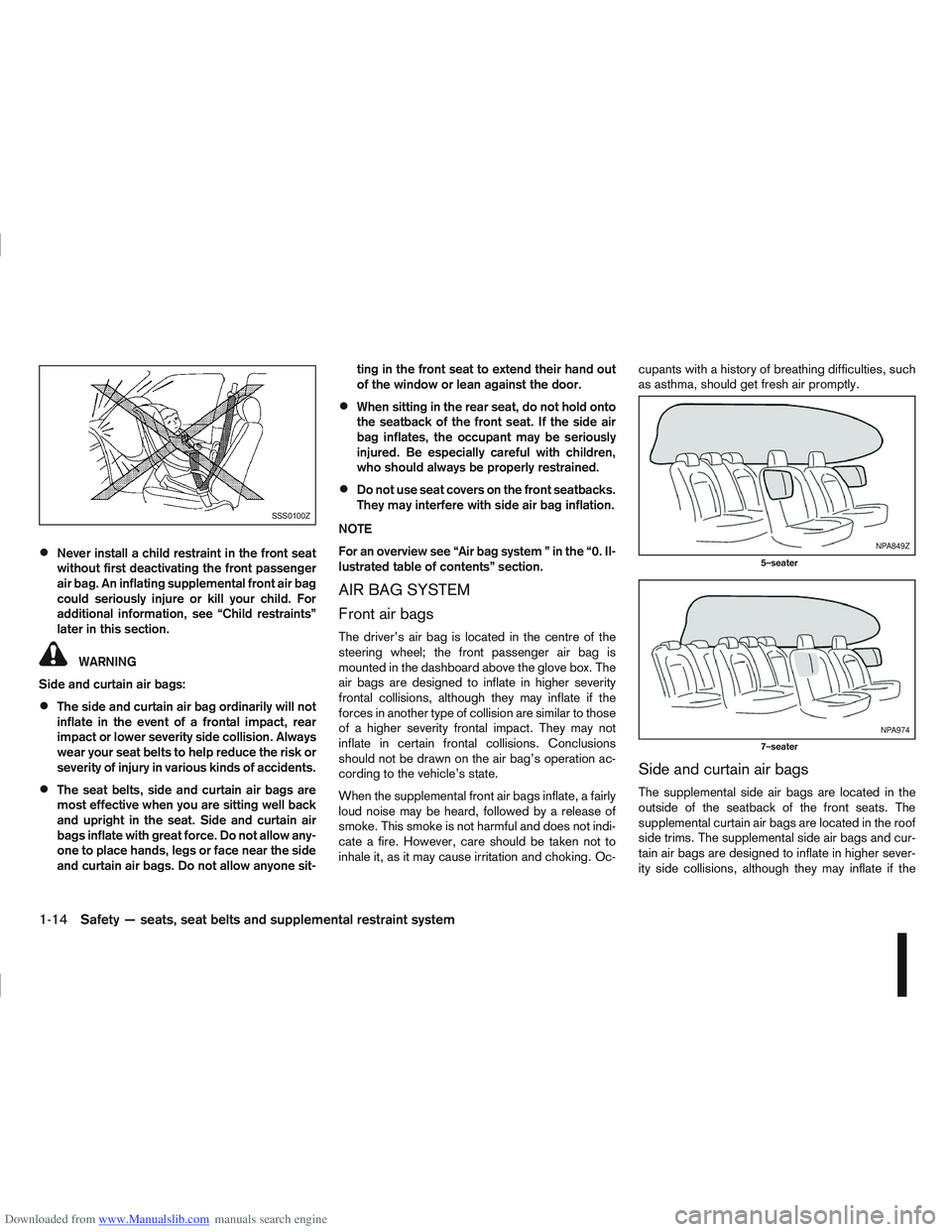
Downloaded from www.Manualslib.com manuals search engine Never install a child restraint in the front seat
without first deactivating the front passenger
air bag. An inflating supplemental front air bag
could seriously injure or kill your child. For
additional information, see “Child restraints”
later in this section.
WARNING
Side and curtain air bags:
The side and curtain air bag ordinarily will not
inflate in the event of a frontal impact, rear
impact or lower severity side collision. Always
wear your seat belts to help reduce the risk or
severity of injury in various kinds of accidents.
The seat belts, side and curtain air bags are
most effective when you are sitting well back
and upright in the seat. Side and curtain air
bags inflate with great force. Do not allow any-
one to place hands, legs or face near the side
and curtain air bags. Do not allow anyone sit- ting in the front seat to extend their hand out
of the window or lean against the door.
When sitting in the rear seat, do not hold onto
the seatback of the front seat. If the side air
bag inflates, the occupant may be seriously
injured. Be especially careful with children,
who should always be properly restrained.
Do not use seat covers on the front seatbacks.
They may interfere with side air bag inflation.
NOTE
For an overview see “Air bag system ” in the “0. Il-
lustrated table of contents” section.
AIR BAG SYSTEM
Front air bags
The driver’s air bag is located in the centre of the
steering wheel; the front passenger air bag is
mounted in the dashboard above the glove box. The
air bags are designed to inflate in higher severity
frontal collisions, although they may inflate if the
forces in another type of collision are similar to those
of a higher severity frontal impact. They may not
inflate in certain frontal collisions. Conclusions
should not be drawn on the air bag’s operation ac-
cording to the vehicle’s state.
When the supplemental front air bags inflate, a fairly
loud noise may be heard, followed by a release of
smoke. This smoke is not harmful and does not indi-
cate a fire. However, care should be taken not to
inhale it, as it may cause irritation and choking. Oc- cupants with a history of breathing difficulties, such
as asthma, should get fresh air promptly.
Side and curtain air bags
The supplemental side air bags are located in the
outside of the seatback of the front seats. The
supplemental curtain air bags are located in the roof
side trims. The supplemental side air bags and cur-
tain air bags are designed to inflate in higher sever-
ity side collisions, although they may inflate if the
SSS0100Z
NPA849Z
5–seater
NPA974
7–seater
1-14Safety — seats, seat belts and supplemental restraint system