Page 235 of 345
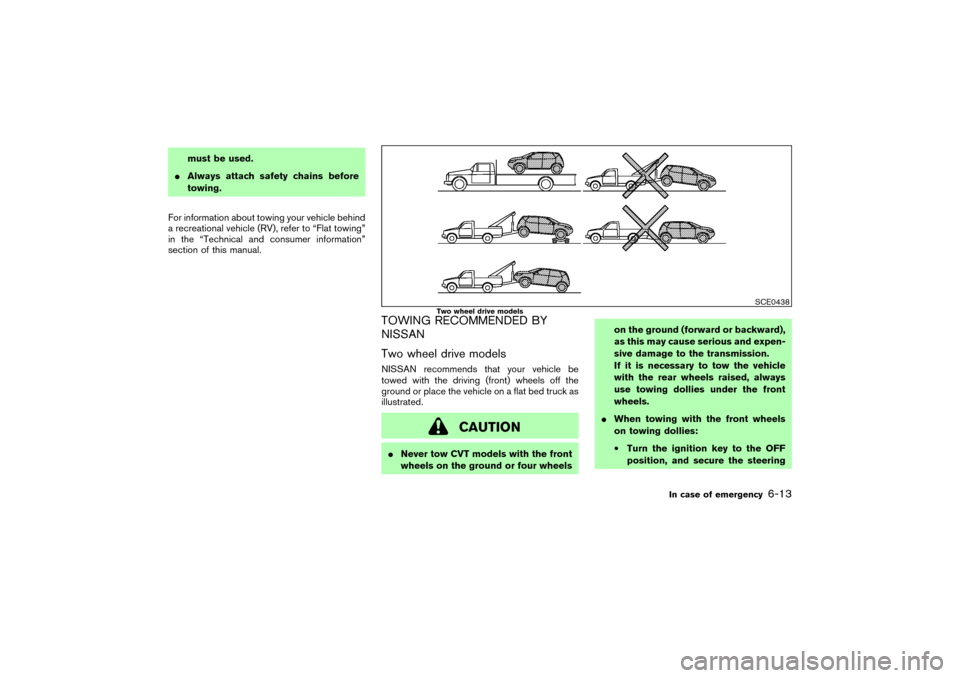
�HEADED UPHILL WITH CURB:
�2
Turn the wheels away from the curband
move the vehicle back until the curb side
wheel gently touches the curb.
�HEADED UPHILL OR DOWNHILL, NO
CURB:
�3
Turn the wheels toward the side of the road
so the vehicle will move away from the center
of the road if it moves.
4. Turn the ignition switch to the LOCK position
and remove the key.The power assisted steering is designed to use
a hydraulic pump, driven by the engine, to assist
steering.
If the engine stops or drive belt breaks, you will
still have control of the vehicle. However, much
greater steering effort is needed, especially in
sharp turns or at low speeds.
WARNING
If the engine is not running or is turned
off while driving, the power assist for
the steering will not work. Steering will
be much harder to operate.
BRAKING PRECAUTIONSThe brake system has two separate hydraulic
circuits. If one circuit malfunctions, you will still
have braking at two wheels.Vacuum assisted brakeThe brake booster aids braking by using engine
vacuum. If the engine stops, you can stop the
vehicle by depressing the brake pedal. However,
greater foot pressure on the brake pedal will be
required to stop the vehicle and the stopping
distance will be longer.Wet brakesWhen the vehicle is washed or driven through
water, the brakes may get wet. As a result, your
braking distance will be longer and the vehicle
may pull to one side during braking.
To dry brakes, drive the vehicle at a safe speed
while lightly tapping the brake pedal to heat-up
the brakes. Do this until the brakes return to
normal. Avoid driving the vehicle at high speeds
until the brakes function correctly.Parking brake break-inBreak in the parking brake shoes whenever the
stopping effect of the parking brake is weakened
or whenever the parking brake shoes and/or
drums/rotors are replaced, in order to assure the
POWER STEERING BRAKE SYSTEM
5-30
Starting and driving
�
06.7.5/Z50-D/V5.0
�
Page 244 of 345
6 In case of emergencyFlat tire ...................................................................................... 6-2
Tire pressure monitoring system .................................. 6-2
Changing a flat tire .......................................................... 6-2
Jump starting ........................................................................... 6-9
Push starting......................................................................... 6-11If your vehicle overheats .................................................... 6-11
Towing your vehicle ............................................................ 6-12
Towing recommended by NISSAN........................... 6-13
Vehicle recovery (Freeing a stuck vehicle) ............. 6-15
�
06.7.5/Z50-D/V5.0
�
Page 255 of 345
tioner temperature control to maximum hot
and fan control to high speed.
3. If engine overheating is caused by climbing a
long hill on a hot day, run the engine at a fast
idle (approximately 1,500 rpm) until the tem-
perature gauge indication returns to normal.
4. Get out of the vehicle. Look and listen for
steam or coolant escaping from the radiator
before opening the hood. (If steam or coolant
is escaping, turn off the engine.) Do not open
the hood further until no steam or coolant can
be seen.
5. Open the engine hood.
WARNING
If steam or water is coming from the
engine, stand clear to prevent getting
burned.
6. Visually check if the cooling fan is running.
The radiator hoses and radiator should not
leak water.
If coolant is leaking or the cooling fan does
not run, stop the engine.
WARNING
�Be careful not to allow your hands,
hair, jewelry or clothing to come into
contact with, or get caught in, drive
belt, or cooling fan.
�The engine cooling fan can start at
any time when the coolant tempera-
ture is high.
7. After the engine cools down, check the cool-
ant level in the reservoir tank with the engine
running. Add coolant to the reservoir tank if
necessary. Have your vehicle repaired at the
nearest NISSAN dealer.When towing your vehicle, all State, provincial
and local regulations for towing must be fol-
lowed. Incorrect towing equipment could dam-
age your vehicle. Towing instructions are avail-
able from a NISSAN dealer. Local service
operators are generally familiar with the appli-
cable laws and procedures for towing. To assure
proper towing and to prevent accidental damage
to your vehicle, NISSAN recommends having a
service operator tow your vehicle. It is advisable
to have the service operator carefully read the
following precautions.
WARNING
�Never ride in a vehicle that is being
towed.
�Never get under your vehicle after it
has been lifted by a tow truck.
CAUTION
�When towing, make sure that the
transmission, axles, steering system
and powertrain are in working condi-
tion. If any unit is damaged, dolliesTOWING YOUR VEHICLE
6-12
In case of emergency
�
06.7.5/Z50-D/V5.0
�
Page 256 of 345
must be used.
�Always attach safety chains before
towing.
For information about towing your vehicle behind
a recreational vehicle (RV), refer to “Flat towing”
in the “Technical and consumer information”
section of this manual.
TOWING RECOMMENDED BY
NISSAN
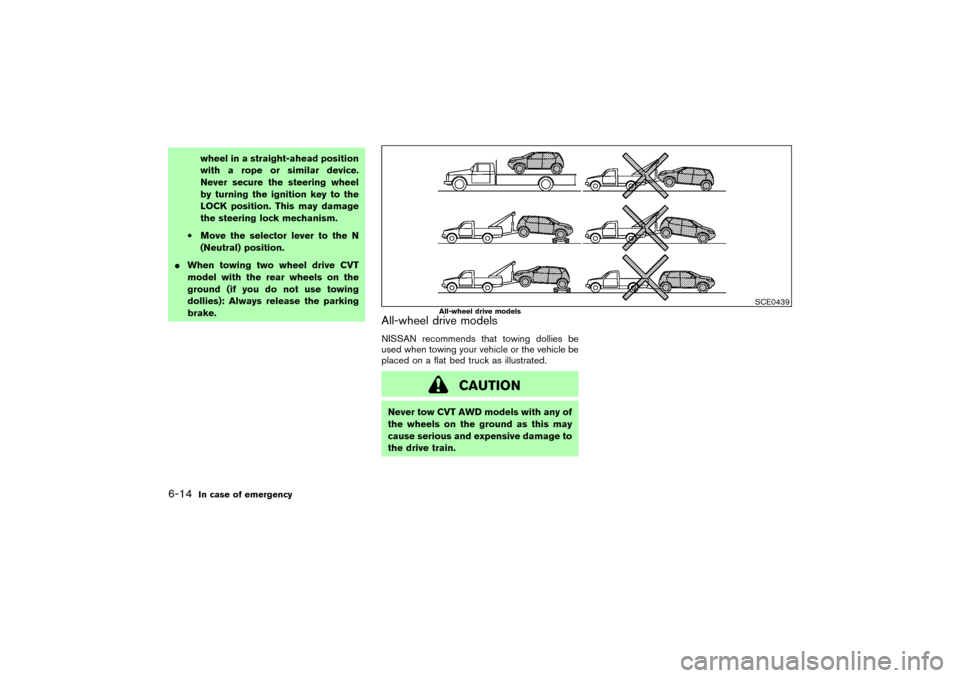
Two wheel drive modelsNISSAN recommends that your vehicle be
towed with the driving (front) wheels off the
ground or place the vehicle on a flat bed truck as
illustrated.
CAUTION
�Never tow CVT models with the front
wheels on the ground or four wheelson the ground (forward or backward),
as this may cause serious and expen-
sive damage to the transmission.
If it is necessary to tow the vehicle
with the rear wheels raised, always
use towing dollies under the front
wheels.
�When towing with the front wheels
on towing dollies:
•Turn the ignition key to the OFF
position, and secure the steering
SCE0438
Two wheel drive models
In case of emergency
6-13
�
06.7.5/Z50-D/V5.0
�
Page 257 of 345
wheel in a straight-ahead position
with a rope or similar device.
Never secure the steering wheel
by turning the ignition key to the
LOCK position. This may damage
the steering lock mechanism.
•Move the selector lever to the N
(Neutral) position.
�When towing two wheel drive CVT
model with the rear wheels on the
ground (if you do not use towing
dollies): Always release the parking
brake.
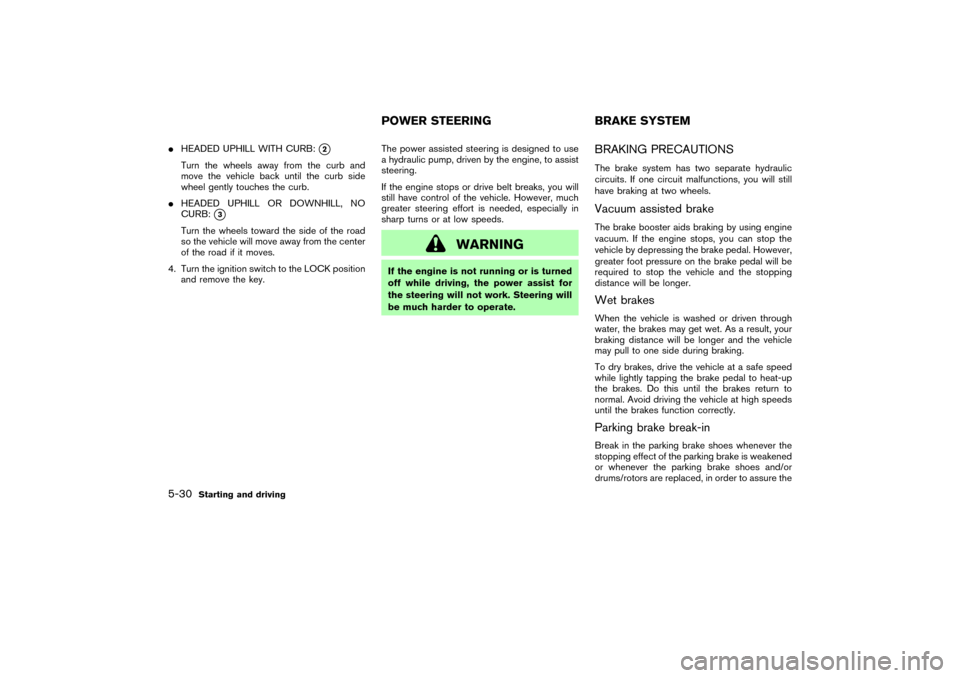
All-wheel drive modelsNISSAN recommends that towing dollies be
used when towing your vehicle or the vehicle be
placed on a flat bed truck as illustrated.
CAUTION
Never tow CVT AWD models with any of
the wheels on the ground as this may
cause serious and expensive damage to
the drive train.
SCE0439
All-wheel drive models
6-14
In case of emergency
�
06.7.5/Z50-D/V5.0
�
Page 258 of 345
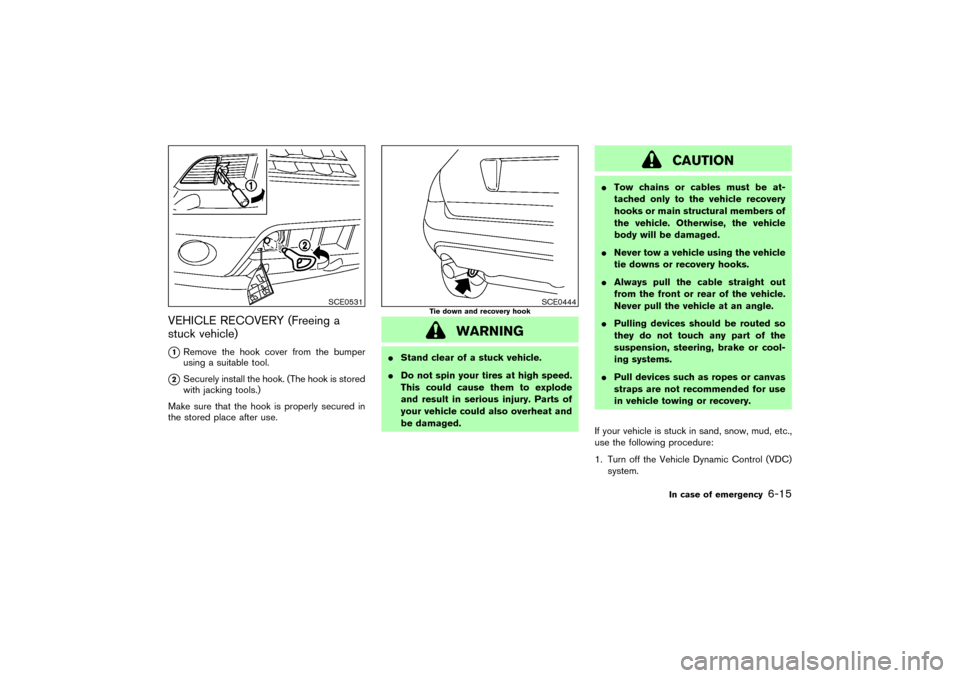
VEHICLE RECOVERY (Freeing a
stuck vehicle)
�1Remove the hook cover from the bumper
using a suitable tool.
�2Securely install the hook. (The hook is stored
with jacking tools.)
Make sure that the hook is properly secured in
the stored place after use.
WARNING
�Stand clear of a stuck vehicle.
�Do not spin your tires at high speed.
This could cause them to explode
and result in serious injury. Parts of
your vehicle could also overheat and
be damaged.
CAUTION
�Tow chains or cables must be at-
tached only to the vehicle recovery
hooks or main structural members of
the vehicle. Otherwise, the vehicle
body will be damaged.
�Never tow a vehicle using the vehicle
tie downs or recovery hooks.
�Always pull the cable straight out
from the front or rear of the vehicle.
Never pull the vehicle at an angle.
�Pulling devices should be routed so
they do not touch any part of the
suspension, steering, brake or cool-
ing systems.
�Pull devices such as ropes or canvas
straps are not recommended for use
in vehicle towing or recovery.
If your vehicle is stuck in sand, snow, mud, etc.,
use the following procedure:
1. Turn off the Vehicle Dynamic Control (VDC)
system.
SCE0531
SCE0444
Tie down and recovery hook
In case of emergency
6-15
�
06.7.5/Z50-D/V5.0
�
Page 259 of 345
2. Make sure the area in front and behind the
vehicle is clear of obstructions.
3. Turn the steering wheel right and left to clear
an area around the front tires.
4. Slowly rock the vehicle forward and back-
ward.
�Shift back and forth between R (reverse) and
D (drive).
�Apply the accelerator as little as possible to
maintain the rocking motion.
�Release the accelerator pedal before shifting
between R and D.
�Do not spin the tires above 35 MPH (55
km/h).
5. If the vehicle cannot be freed after a few tries,
contact a professional towing service to re-
move the vehicle.6-16
In case of emergency
�
06.7.5/Z50-D/V5.0
�
Page 263 of 345
(where it would be difficult to remove).
�Wipe off excess tire dressing using a dry
towel. Make sure the tire dressing is com-
pletely removed from the tire tread/grooves.
�Allow the tire dressing to dry as recom-
mended by tire dressing manufacturer.Occasionally remove loose dust from the interior
trim, plastic parts and seats using a vacuum
cleaner or soft bristled brush. Wipe the vinyl and
leather surfaces with a clean, soft cloth damp-
ened in mild soap solution, then wipe clean with
a dry soft cloth.
Regular care and cleaning is required in order to
maintain the appearance of the leather.
Before using any fabric protector, read the
manufacturer’s recommendations. Some fabric
protectors contain chemicals that may stain or
bleach the seat material.
Use a cloth dampened only with water, to clean
the meter and gauge lens.
CAUTION
�Never use benzine, thinner, or any
similar material.
�Small dirt particles can be abrasive
and damaging to leather surfaces
and should be removed promptly. Do
not use saddle soap, car waxes, pol-
ishes, oils, cleaning fluids, solvents,
detergents or ammonia-based clean-
ers as they may damage the naturalleather finish.
�Never use fabric protectors unless
recommended by the manufacturer.
�Do not use glass or plastic cleaner on
meter or gauge lens covers. It may
damage the lens cover.
FLOOR MATSThe use of Genuine NISSAN floor mats can
extend the life of your vehicle carpet and make it
easier to clean the interior.No matter what
mats are used, be sure they are fitted for
your vehicle and are properly positioned in
the footwell to prevent interference with
pedal operation.Mats should be maintained
with regular cleaning and replaced if they be-
come excessively worn.
CLEANING INTERIOR
7-4
Appearance and care
�
06.7.5/Z50-D/V5.0
�