Page 87 of 172

85
OVERVIEW REPAIRS OPERATIONCONTROLS DATA INDEX
GLOVE COMPARTMENT To openPull the handle.
The light goes on.To closeFold the door up.
To prevent injury in the event of an
accident, close the glove compart-
ment immediately after use.<
VentilationTo allow ventilation:
Turn the rotary switch to the horizontal
position.
To shut off ventilation:
Turn the rotary switch to the vertical posi-
tion, see arrow.
Depending on the temperature set-
ting of the air conditioning or the
automatic climate control, high tempera-
tures may result in the glove compart-
ment.<
Connection for external audio device*1 Cigarette lighter socket for power supply
2 Socket for sound output
You can connect an external audio device
such as a CD or MP3 player and play audio
recordings over the vehicle loudspeakers.
To do so, open the glove compartment and
connect the device's headphones or line-
out terminal to socket 2.
The volume and tone settings are adjusted
over the car radio, refer to the Owner's
Manual for Radio.
Shut off ventilation to the glove com-
partment while an audio device is
connected. Otherwise the device may be
damaged due to thermal exposure.<
Page 88 of 172
86
CENTER ARMREST
*
DRINKS HOLDERS, ASHTRAY
Storage compartmentsDepending on the equipment version
*, the
center armrest between the front seats
contains a compartment or a base plate for
a mobile phone.
To open:
Slide the cover backwards.
The cover slides along guide rails and
can be opened fully by pushing it
back and lifting it slightly.<
To close:
Push the cover forwards.
Beverage holdersBeverage holders are at the front or top of
the center console. Another is located at
the end of the center console in the rear.
Do not place any glass containers in
the beverage holders, as this
increases the risk of injury in the event of
an accident.
age holders in the center console.
Page 89 of 172
87
OVERVIEW REPAIRS OPERATIONCONTROLS DATA INDEX
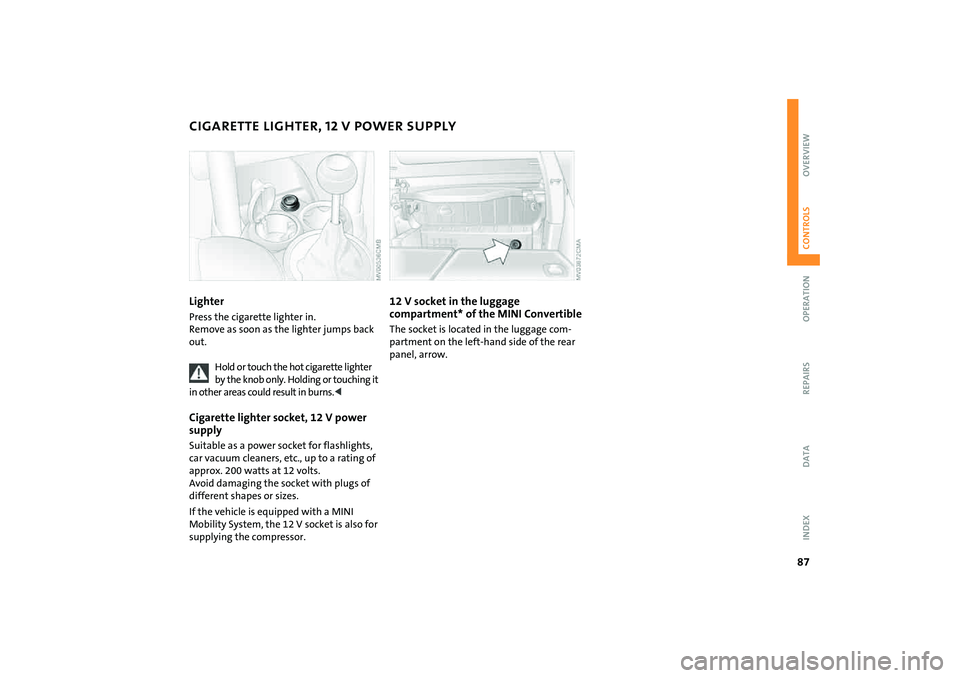
CIGARETTE LIGHTER, 12 V POWER SUPPLYLighterPress the cigarette lighter in.
Remove as soon as the lighter jumps back
out.
Hold or touch the hot cigarette lighter
by the knob only. Holding or touching it
in other areas could result in burns.
supplySuitable as a power socket for flashlights,
car vacuum cleaners, etc., up to a rating of
approx. 200 watts at 12 volts.
Avoid damaging the socket with plugs of
different shapes or sizes.
If the vehicle is equipped with a MINI
Mobility System, the 12 V socket is also for
supplying the compressor.
12 V socket in the luggage
compartment* of the MINI ConvertibleThe socket is located in the luggage com-
partment on the left-hand side of the rear
panel, arrow.
Page 96 of 172
94
LOADING CARGOStowing cargo >Place heavy cargo as far forward as possi-
ble, directly behind the backrests, and as
low as possible
>Cover sharp edges and corners
>Do not pile objects higher than the top
edges of the backrests.
For very heavy cargo when the rear seat is
unoccupied, fasten each safety belt in the
opposite buckle. This provides additional
stabilization for the backrests.
Securing the loadAs an example, the illustration shows the
luggage compartment of the MINI.
>Secure smaller and lighter items using
the luggage compartment net
* or elas-
tic straps
>Secure larger and heavier items with
load-securing devices
*. Lashing eyelets
are provided at the inner corners of the
luggage compartment for attaching
these load-securing devices.
Comply with the information enclosed
with the load-securing devices.
Page 100 of 172

98
BREAK-IN PROCEDURES GENERAL DRIVING NOTESMoving parts need to be given some time
until they can interact smoothly with one
another. To ensure that your vehicle pro-
vides maximum economy throughout a
long service life, we request that you com-
ply with the following information:EngineComply with the local speed limits.
Up to 1,250 miles/2,000 km:
Drive at varying engine and road speeds,
but do not exceed the following:
4,500 rpm or
95 mph / 150 km/h.
Absolutely avoid putting the accelerator in
full-throttle or kickdown position.
After 1,250 miles/2,000 km:
Engine and road speeds can be gradually
increased.
TiresDue to technical factors associated with
their manufacture, tires do not achieve
their full traction potential until after an
initial break-in period. Therefore drive care-
fully during the first 200 miles/300 km.Brake systemApprox. 300 miles/500 km must be driven
before the brake pads and rotors achieve
the optimum pad-surface and wear pat-
terns required for trouble-free operation
and an extended service life.ClutchRoughly 300 miles/500 km must be driven
before the clutch starts to operate at opti-
mum efficiency. Remember to engage the
clutch carefully during this initial period.After a part replacementYou should again comply with these break-
in procedures if parts mentioned above
have to be replaced later in the vehicle's
life.
Interior mirror, automatic dimming*While the vehicle is being driven forward,
these mirrors dim light through an infi-
nitely variable range depending on the
light's incidence. Two photocells in the
interior rearview mirror serve this purpose.
One is positioned on the underside of the
mirror frame, while the other is slightly off-
set on the back of the mirror.
In order for the photocells to work opti-
mally, keep them clean and do not cover
the area between the interior rearview mir-
ror and the windshield. Do not place stick-
ers or toll tags on the windshield in front of
the mirror.
Page 101 of 172

99
OVERVIEW REPAIRSOPERATIONCONTROLS DATA INDEX
GENERAL DRIVING NOTESSafe braking Your vehicle is equipped with ABS as a stan-
dard feature. If you are in a situation which
requires full braking, it is best to brake
using maximum brake pressure. Since the
vehicle remains maneuverable, you can still
go around any obstacles with the smallest
possible steering movements.
The pulsation of the brake pedal, together
with the sound of hydraulic regulation,
indicates to you that ABS is actively taking
effect.
Wet roads:
It is a good idea to periodically dry the
brakes with a gentle application when driv-
ing in rain and on wet roads. Monitor traffic
conditions to ensure that this maneuver
does not hinder other road users. The
resulting heat dries brake rotors and pads.
Then if the braking force is needed, it is
immediately available.
Driving downhill:
To prevent overheating and the
resulting reduced efficiency of the
brake system, drive down extended or
steep mountain gradients in the gear
which requires the least brake applications.
Otherwise, even light but consistent pres-
sure on the brake can lead to high tempera-
tures, brake wear and possibly even brake
failure.<
The braking effect of the engine can be
increased by downshifting in the manual
mode of the automatic transmission, to
first gear if necessary, refer to page58. This
protects the brakes from excessive loads.
Do not coast with the clutch
depressed, the transmission in idle or
the engine switched off. Otherwise, the
engine provides no braking effect, and
there is no power-assist for braking or
steering.
Make sure that there are no floor mats,
floor carpets or other objects in the vicinity
of the pedals; otherwise pedal function
could be impeded.<
Corrosion on the brake rotors:
When the vehicle is driven only occasion-
ally, during extended periods when the
vehicle is not used at all, and in operating
conditions where brake applications are
less frequent, there is an increased ten-
dency for corrosion of the brake rotors and
accumulation of contamination on the
brake pads. This occurs because the mini-
mal pressure that must be exerted by the
pads to clean the rotors by brake applica-
tions is not reached.
Corrosion on brake rotors is signaled by a
running or pulsation during braking; even
extended subsequent braking will not cure
this phenomenon.Brake pads
Sensors in the left front and right
rear brake pads monitor pad condi-
tion. When the brake pads have
worn to the permissible limit, this is indi-
cated by the brake wear warning light,
refer to page18.
Hydroplaning
When driving on wet or slushy roads,
reduce road speed. If you do not, a
wedge of water can form between tires
and road surface. This phenomenon is char-
acterized by a partial or complete loss of
contact between the tires and the road sur-
face. The ultimate results are loss of steer-
ing and braking control.<
Page 115 of 172
113
OVERVIEW REPAIRSOPERATIONCONTROLS DATA INDEX
NEW WHEELS AND TIRES SNOW CHAINS
*
Special characteristics of winter tires
The manufacturer of your MINI recom-
mends winter tires for driving in adverse
winter road conditions. While all-season
tires with the M+S designation provide bet-
ter winter traction than summer tires, they
generally do not achieve the full perfor-
mance of winter tires.
Observe speed ratings:
Never exceed the maximum speed
for which the winter tires are rated.
them against light whenever possible. Pro-
tect the tires against contact with oil,
grease and fuel. Do not exceed the tire
inflation pressure specified on the tire side-
wall.
Only certain types of snow chains have
been tested by the manufacturer of your
MINI, classified as road-safe and recom-
mended. Contact your MINI Dealer for
more details. Their use is only permitted in
pairs on the front wheels on winter tires of
the following types:
>175/65 R 15 M+S
>175/60 R 16 M+S.
When fitting, comply with the manufac-
turer's instructions. With chains, do not
exceed a speed of 30 mph / 50 km/h.
Do not initialize the Flat Tire Monitor
after attaching snow chains to the
tires.
When driving with snow chains, it can be
helpful to switch off the ASC or DSC for a
brief period, refer to page72.<
Page 121 of 172

119
OVERVIEW REPAIRSOPERATIONCONTROLS DATA INDEX
COOLANTAs an example, the illustration shows the
coolant tank of the MINI COOPER and the
MINI COOPER Convertible.Checking coolant level 1. The engine must be at ambient temper-
ature
2. MINI COOPER and MINI COOPER Con-
vertible:
Slowly pull the cap of the expansion
tank by the tab until the excess pressure
can escape. Then remove the cap com-
pletely.
MINI COOPER S and MINI COOPER S Con-
vertible:
Slightly unscrew the cap of the expan-
sion tank counterclockwise until the
excess pressure can escape. Then
remove the cap completely
3. The coolant level is correct if it is
between the MIN and MAX markings on
the transparent expansion tank
4. If necessary, slowly add coolant until the
correct level is reached; do not overfill
5. MINI COOPER and MINI COOPER Con-
vertible:
Reattach the cap and press it down
firmly
MINI COOPER S and MINI COOPER S Con-
vertible:
Screw the cap back on and tighten it
firmly
6. Have the cause of the coolant loss
removed as soon as possible.