Page 24 of 473
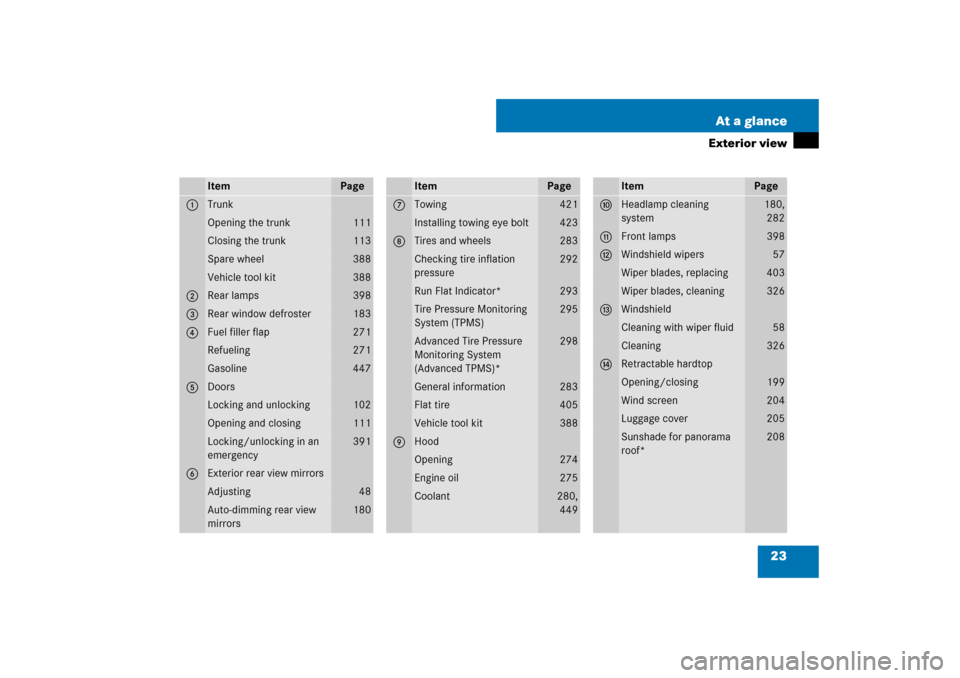
23 At a glance
Exterior view
Item
Page
1
TrunkOpening the trunk
111
Closing the trunk
113
Spare wheel
388
Vehicle tool kit
388
2
Rear lamps
398
3
Rear window defroster
183
4
Fuel filler flap
271
Refueling
271
Gasoline
447
5
DoorsLocking and unlocking
102
Opening and closing
111
Locking/unlocking in an
emergency
391
6
Exterior rear view mirrorsAdjusting
48
Auto-dimming rear view
mirrors
180
Item
Page
7
Towing
421
Installing towing eye bolt
423
8
Tires and wheels
283
Checking tire inflation
pressure
292
Run Flat Indicator*
293
Tire Pressure Monitoring
System (TPMS)
295
Advanced Tire Pressure
Monitoring System
(Advanced TPMS)*
298
General information
283
Flat tire
405
Vehicle tool kit
388
9
HoodOpening
274
Engine oil
275
Coolant
280,
449
Item
Page
a
Headlamp cleaning
system
180,
282
b
Front lamps
398
c
Windshield wipers
57
Wiper blades, replacing
403
Wiper blades, cleaning
326
d
WindshieldCleaning with wiper fluid
58
Cleaning
326
e
Retractable hardtopOpening/closing
199
Wind screen
204
Luggage cover
205
Sunshade for panorama
roof*
208
Page 60 of 473

59 Getting started
Driving
Problems while driving
The engine runs erratically and misfires�
An ignition cable may be damaged.
�
The engine electronics may not be op-
erating properly.
�
Unburned gasoline may have entered
the catalytic converter and damaged it.
�
Give very little gas.
�
Have the problem repaired by an au-
thorized Mercedes-Benz Center as
soon as possible.The coolant temperature gauge is
above 248°F (120°C)
The coolant is too hot and is no longer
cooling the engine.
�
Stop the vehicle as soon as possible in
a safe location and turn off the engine.
Allow engine and coolant to cool.
�
Check the coolant level and add cool-
ant if necessary (
�page 280).In case of accident
If the vehicle is leaking gasoline:
�
Do not start the engine under any cir-
cumstances.
�
Notify local fire and/or police authori-
ties.
If the extent of the damage cannot be de-
termined:
�
Notify an authorized Mercedes-Benz
Center.
If no damage can be determined on the
�
major assemblies
�
fuel system
�
engine mount:
�
Start the engine in the usual manner.
Page 274 of 473
273 Operation
At the gas station
Coolant level
For information on checking the coolant
level, see “Coolant” (
�page 280).
Engine oil level
For more information on checking the en-
gine oil level, see “Engine oil”
(
�page 275).
Vehicle lighting
Check function and cleanliness. For more
information, see “Replacing bulbs”
(�page 397).
Exterior lamp switch, see “Switching on
headlamps” (
�page 55).
Tire inflation pressure
For information on checking the tire infla-
tion pressure, see “Checking tire inflation
pressure” (
�page 292).
Page 281 of 473
280 OperationEngine compartmentCoolantThe engine coolant is a mixture of water
and anticorrosion/antifreeze. To check
the coolant level, the vehicle must be
parked on level ground and the engine
must be cool.
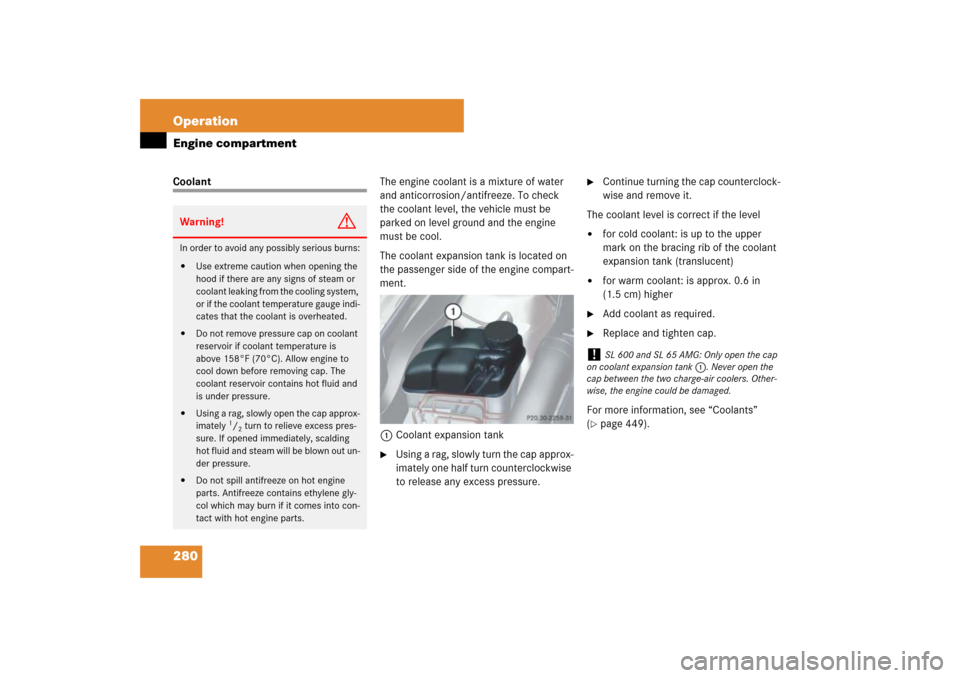
The coolant expansion tank is located on
the passenger side of the engine compart-
ment.
1Coolant expansion tank
�
Using a rag, slowly turn the cap approx-
imately one half turn counterclockwise
to release any excess pressure.
�
Continue turning the cap counterclock-
wise and remove it.
The coolant level is correct if the level
�
for cold coolant: is up to the upper
mark on the bracing rib of the coolant
expansion tank (translucent)
�
for warm coolant: is approx. 0.6 in
(1.5 cm) higher
�
Add coolant as required.
�
Replace and tighten cap.
For more information, see “Coolants”
(
�page 449).
Warning!
G
In order to avoid any possibly serious burns:�
Use extreme caution when opening the
hood if there are any signs of steam or
coolant leaking from the cooling system,
or if the coolant temperature gauge indi-
cates that the coolant is overheated.
�
Do not remove pressure cap on coolant
reservoir if coolant temperature is
above 158°F (70°C). Allow engine to
cool down before removing cap. The
coolant reservoir contains hot fluid and
is under pressure.
�
Using a rag, slowly open the cap approx-
imately
1/2 turn to relieve excess pres-
sure. If opened immediately, scalding
hot fluid and steam will be blown out un-
der pressure.
�
Do not spill antifreeze on hot engine
parts. Antifreeze contains ethylene gly-
col which may burn if it comes into con-
tact with hot engine parts.
!
SL 600 and SL 65 AMG: Only open the cap
on coolant expansion tank1. Never open the
cap between the two charge-air coolers. Other-
wise, the engine could be damaged.
Page 338 of 473
337 Practical hints
What to do if …
Problem
Possible cause/consequence
Suggested solution
ú
(USA only)
±
(Canada only)
The yellow engine malfunction
indicator lamp comes on while
driving.
Your fuel tank is empty.
�
After refueling, start, turn off, and re-
start the engine three or four times in
succession.
The limp-home mode is canceled. You
do not need to have your vehicle
checked.
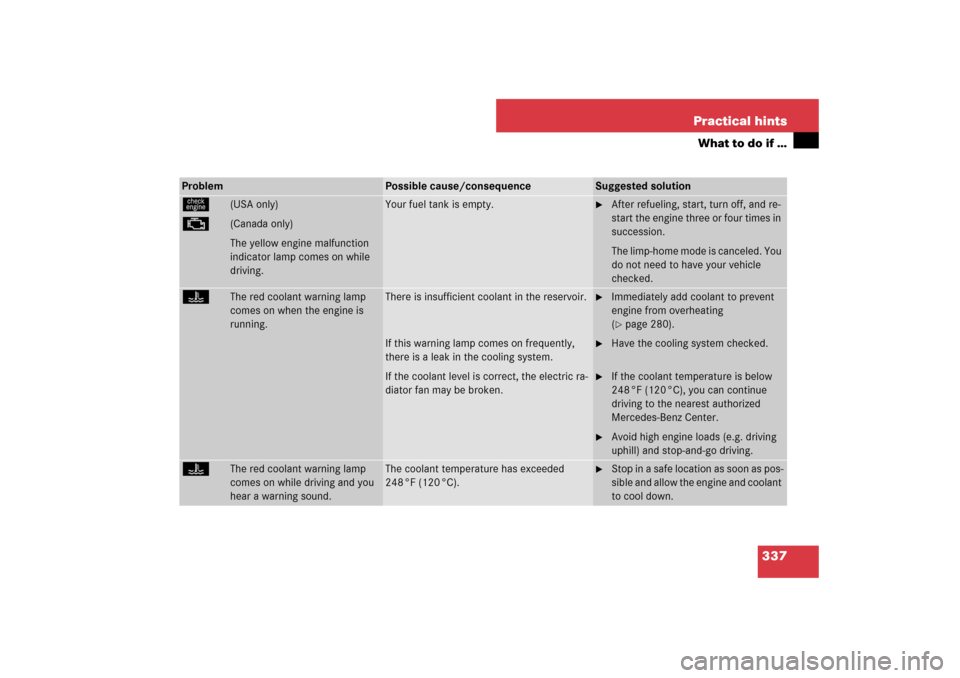
D
The red coolant warning lamp
comes on when the engine is
running.
There is insufficient coolant in the reservoir.
If this warning lamp comes on frequently,
there is a leak in the cooling system.
If the coolant level is correct, the electric ra-
diator fan may be broken.
�
Immediately add coolant to prevent
engine from overheating
(�page 280).
�
Have the cooling system checked.
�
If the coolant temperature is below
248 °F (120 °C), you can continue
driving to the nearest authorized
Mercedes-Benz Center.
�
Avoid high engine loads (e.g. driving
uphill) and stop-and-go driving.
D
The red coolant warning lamp
comes on while driving and you
hear a warning sound.
The coolant temperature has exceeded
248 °F (120 °C).
�
Stop in a safe location as soon as pos-
sible and allow the engine and coolant
to cool down.
Page 374 of 473
373 Practical hints
What to do if …
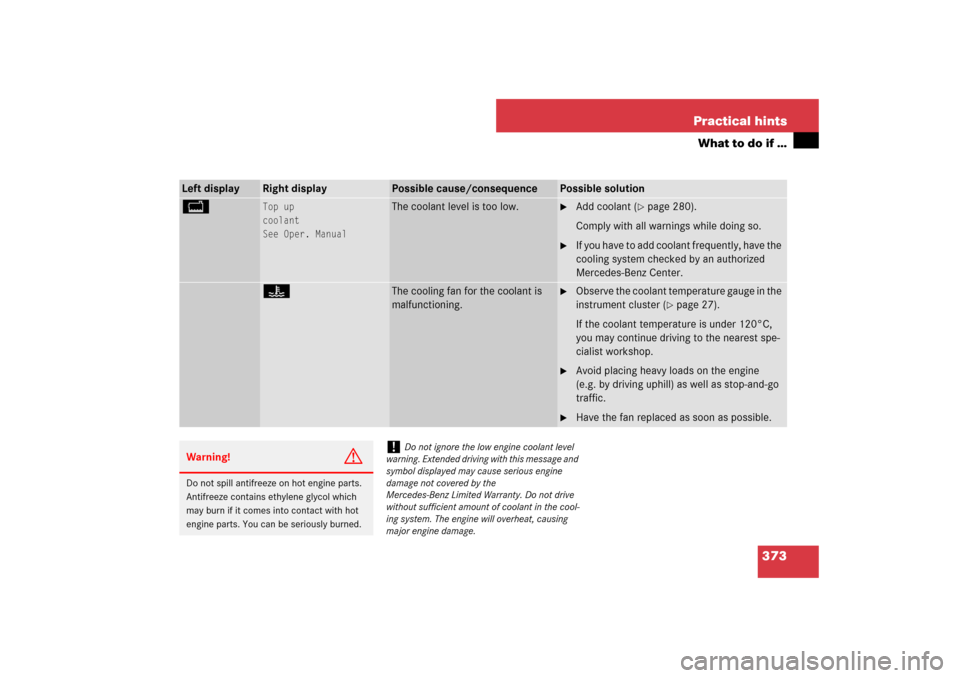
Left display
Right display
Possible cause/consequence
Possible solution
B
Top up
coolant
See Oper. Manual
The coolant level is too low.
�
Add coolant (
�page 280).
Comply with all warnings while doing so.
�
If you have to add coolant frequently, have the
cooling system checked by an authorized
Mercedes-Benz Center.
•
The cooling fan for the coolant is
malfunctioning.
�
Observe the coolant temperature gauge in the
instrument cluster (
�page 27).
If the coolant temperature is under 120°C,
you may continue driving to the nearest spe-
cialist workshop.
�
Avoid placing heavy loads on the engine
(e.g. by driving uphill) as well as stop-and-go
traffic.
�
Have the fan replaced as soon as possible.
Warning!
G
Do not spill antifreeze on hot engine parts.
Antifreeze contains ethylene glycol which
may burn if it comes into contact with hot
engine parts. You can be seriously burned.
!
Do not ignore the low engine coolant level
warning. Extended driving with this message and
symbol displayed may cause serious engine
damage not covered by the
Mercedes-Benz Limited Warranty. Do not drive
without sufficient amount of coolant in the cool-
ing system. The engine will overheat, causing
major engine damage.