Page 329 of 473
328 OperationVehicle careLight alloy wheels
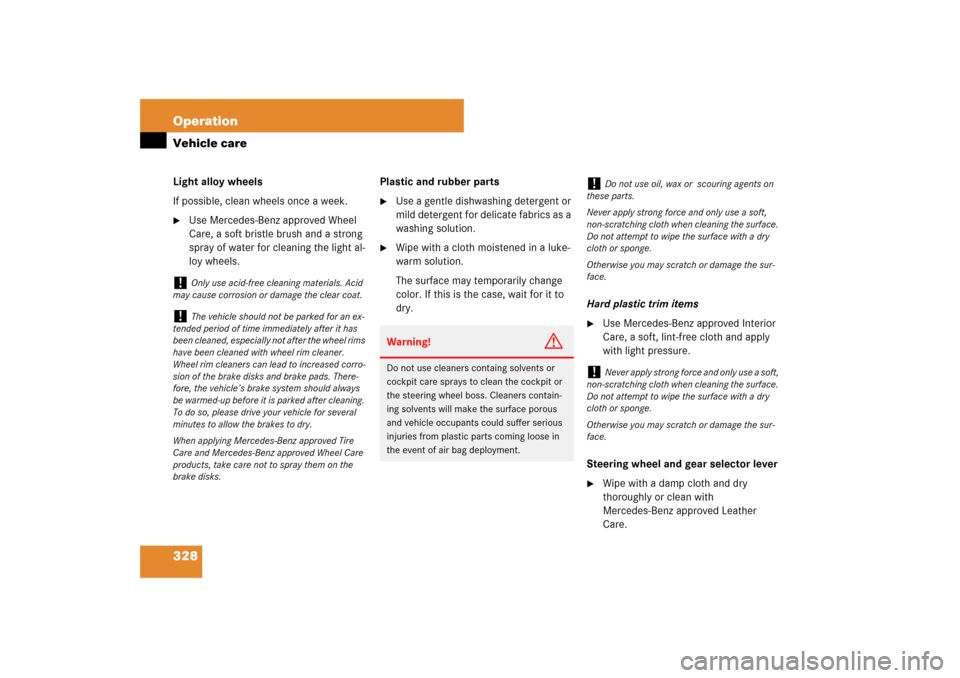
If possible, clean wheels once a week.�
Use Mercedes-Benz approved Wheel
Care, a soft bristle brush and a strong
spray of water for cleaning the light al-
loy wheels.Plastic and rubber parts
�
Use a gentle dishwashing detergent or
mild detergent for delicate fabrics as a
washing solution.
�
Wipe with a cloth moistened in a luke-
warm solution.
The surface may temporarily change
color. If this is the case, wait for it to
dry.Hard plastic trim items
�
Use Mercedes-Benz approved Interior
Care, a soft, lint-free cloth and apply
with light pressure.
Steering wheel and gear selector lever
�
Wipe with a damp cloth and dry
thoroughly or clean with
Mercedes-Benz approved Leather
Care.
!
Only use acid-free cleaning materials. Acid
may cause corrosion or damage the clear coat.
!
The vehicle should not be parked for an ex-
tended period of time immediately after it has
been cleaned, especially not after the wheel rims
have been cleaned with wheel rim cleaner.
Wheel rim cleaners can lead to increased corro-
sion of the brake disks and brake pads. There-
fore, the vehicle’s brake system should always
be warmed-up before it is parked after cleaning.
To do so, please drive your vehicle for several
minutes to allow the brakes to dry.
When applying Mercedes-Benz approved Tire
Care and Mercedes-Benz approved Wheel Care
products, take care not to spray them on the
brake disks.
Warning!
G
Do not use cleaners containg solvents or
cockpit care sprays to clean the cockpit or
the steering wheel boss. Cleaners contain-
ing solvents will make the surface porous
and vehicle occupants could suffer serious
injuries from plastic parts coming loose in
the event of air bag deployment.
!
Do not use oil, wax or scouring agents on
these parts.
Never apply strong force and only use a soft,
non-scratching cloth when cleaning the surface.
Do not attempt to wipe the surface with a dry
cloth or sponge.
Otherwise you may scratch or damage the sur-
face.
!
Never apply strong force and only use a soft,
non-scratching cloth when cleaning the surface.
Do not attempt to wipe the surface with a dry
cloth or sponge.
Otherwise you may scratch or damage the sur-
face.
Page 332 of 473
331 Practical hints
What to do if …
Where will I find ...?
Locking/unlocking in an
emergency
Replacing SmartKey batteries
Replacing bulbs
Replacing wiper blades
Flat tire
Batteries
Jump starting
Towing the vehicle
Fuses
Page 334 of 473
333 Practical hints
What to do if …
Problem
Possible cause/consequence
Suggested solution
v
The yellow ABS/ESP
® warning
lamp flashes while driving.
The ESP
®, ABS, or traction control has come
into operation because of detected traction
loss in at least one tire.
The cruise control and the Distronic* system
are deactivated.
�
When driving off, apply as little throt-
tle as possible.
�
While driving, ease up on the acceler-
ator.
�
Adapt your speed and driving to the
prevailing road and weather condi-
tions.
�
Do not deactivate the ESP
®.
Exceptions: (
�page 91).
Failure to follow these instructions in-
creases the risk of an accident.
Page 344 of 473
343 Practical hints
What to do if …
Problem
Possible cause/consequence
Suggested solution
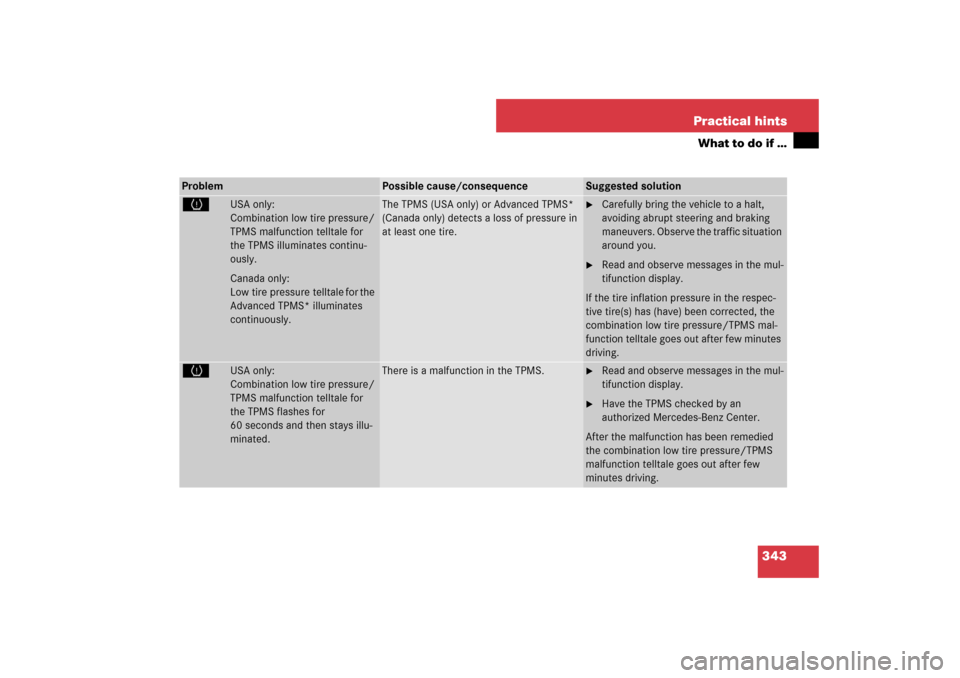
H
USA only:
Combination low tire pressure/
TPMS malfunction telltale for
the TPMS illuminates continu-
ously.
Canada only:
Low tire pressure telltale for the
Advanced TPMS* illuminates
continuously.
The TPMS (USA only) or Advanced TPMS*
(Canada only) detects a loss of pressure in
at least one tire.
�
Carefully bring the vehicle to a halt,
avoiding abrupt steering and braking
maneuvers. Observe the traffic situation
around you.
�
Read and observe messages in the mul-
tifunction display.
If the tire inflation pressure in the respec-
tive tire(s) has (have) been corrected, the
combination low tire pressure/TPMS mal-
function telltale goes out after few minutes
driving.
H
USA only:
Combination low tire pressure/
TPMS malfunction telltale for
the TPMS flashes for
60 seconds and then stays illu-
minated.
There is a malfunction in the TPMS.
�
Read and observe messages in the mul-
tifunction display.
�
Have the TPMS checked by an
authorized Mercedes-Benz Center.
After the malfunction has been remedied
the combination low tire pressure/TPMS
malfunction telltale goes out after few
minutes driving.
Page 345 of 473
344 Practical hintsWhat to do if …Warning!
G
Each tire, including the spare (if provided),
should be checked monthly when cold and
inflated to the inflation pressure recom-
mended by the vehicle manufacturer on the
vehicle placard or the tire inflation pressure
label. If your vehicle has tires of a different
size than the size indicated on the vehicle
placard or the tire inflation pressure label,
you should determine the proper tire infla-
tion pressure for those tires.
As an added safety feature, your vehicle has
been equipped with a tire pressure monitor-
ing system (TPMS) that illuminates a low tire
pressure telltale when one or more of your
tires is significantly under-inflated. Accord-
ingly, when the low tire pressure telltale illu-
minates, you should stop and check your
tires as soon as possible, and inflate them to
the proper pressure. Driving on a significant-
ly underinflated tire causes the tire to over-
heat and can lead to tire failure.
Underinflation also reduces fuel efficiency
and tire tread life, and may affect the vehi-
cle’s handling and stopping ability. Please
note that the TPMS is not a substitute for
proper tire maintenance, and it is the driv-
er’s responsibility to maintain correct tire
pressure, even if underinflation has not
reached the level to trigger illumination of
the TPMS low tire pressure telltale.
USA only:
Your vehicle has also been equipped with a
TPMS malfunction indicator to indicate
when the system is not operating properly.
The TPMS malfunction indicator is com-
bined with the low tire pressure telltale.
When the system detects a malfunction, the
telltale will flash for approximately
one minute and then remain continuously
illuminated. This sequence will continue
upon subsequent vehicle start-ups as long
as the malfunction exists. When the mal-
function indicator is illuminated, the system
may not be able to detect or signal low tire
pressure as intended.
TPMS malfunctions may occur for a variety
of reasons, including the installation of in-
compatible replacement or alternate tires or
wheels on the vehicle that prevent the TPMS
from functioning properly. Always check the
TPMS malfunction telltale after replacing
one or more tires or wheels on your vehicle
to ensure that the replacement or alternate
tires and wheels allow the TPMS to continue
to function properly.
Page 363 of 473

362 Practical hintsWhat to do if …Left display
Right display
Possible cause/consequence
Possible solution
Check tires
Then restart
Run Flat Indicator
There was a warning message
about a loss in the tire inflation
pressure and the Run Flat Indica-
tor has not been reactivated yet.
�
Make sure that the correct tire inflation
pressure is set for each tire.
�
Then reactivate the Run Flat Indicator.
Run Flat Indicator
inoperative
The Run Flat Indicator is
malfunctioning.
�
Have the Run Flat Indicator checked by an
authorized Mercedes-Benz Center.
The Run Flat Indicator has been
switched off due to an error.
Tire pressure
Check tires
The Run Flat Indicator indicates
that the pressure is too low in one
or more tires.
�
Carefully bring the vehicle to a halt, avoiding
abrupt steering and braking maneuvers. Ob-
serve the traffic situation around you.
�
Check and adjust tire inflation pressure as
required (
�page 292).
�
If necessary, change the wheel
(�page 405).
�
Reactivate the Run Flat Indicator after ad-
justing the tire inflation pressure values
(�page 294).
Page 364 of 473
363 Practical hints
What to do if …
Left display
Right display
Possible cause/consequence
Possible solution
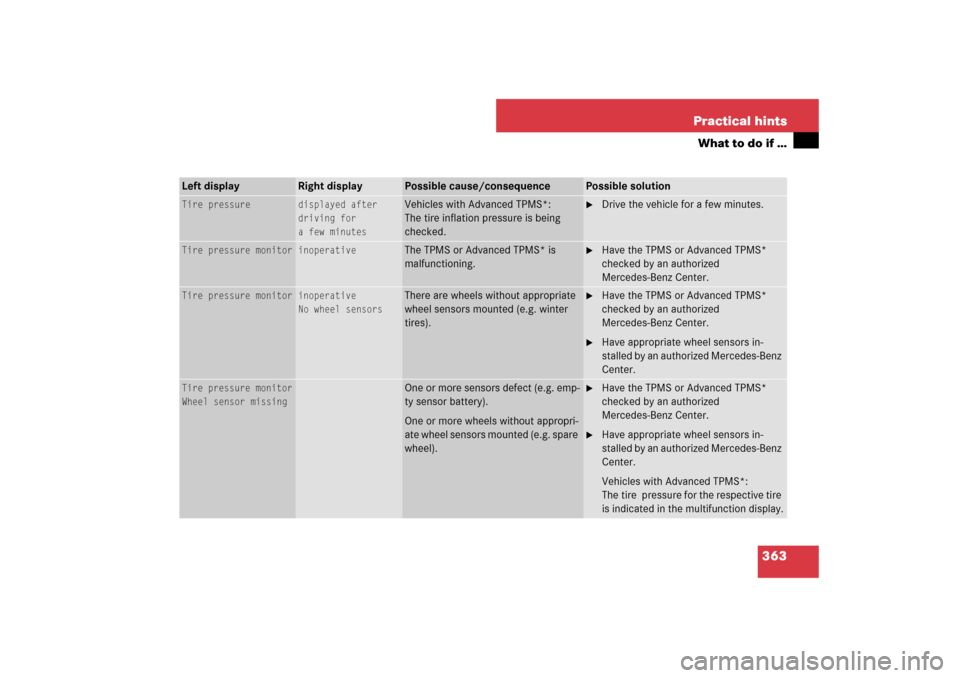
Tire pressure
displayed after
driving for
a few minutes
Vehicles with Advanced TPMS*:
The tire inflation pressure is being
checked.
�
Drive the vehicle for a few minutes.
Tire pressure monitor
inoperative
The TPMS or Advanced TPMS* is
malfunctioning.
�
Have the TPMS or Advanced TPMS*
checked by an authorized
Mercedes-Benz Center.
Tire pressure monitor
inoperative
No wheel sensors
There are wheels without appropriate
wheel sensors mounted (e.g. winter
tires).
�
Have the TPMS or Advanced TPMS*
checked by an authorized
Mercedes-Benz Center.
�
Have appropriate wheel sensors in-
stalled by an authorized Mercedes-Benz
Center.
Tire pressure monitor
Wheel sensor missing
One or more sensors defect (e.g. emp-
ty sensor battery).
One or more wheels without appropri-
ate wheel sensors mounted (e.g. spare
wheel).
�
Have the TPMS or Advanced TPMS*
checked by an authorized
Mercedes-Benz Center.
�
Have appropriate wheel sensors in-
stalled by an authorized Mercedes-Benz
Center.
Vehicles with Advanced TPMS*:
The tire pressure for the respective tire
is indicated in the multifunction display.
Page 365 of 473
364 Practical hintsWhat to do if …Left display
Right display
Possible cause/consequence
Possible solution
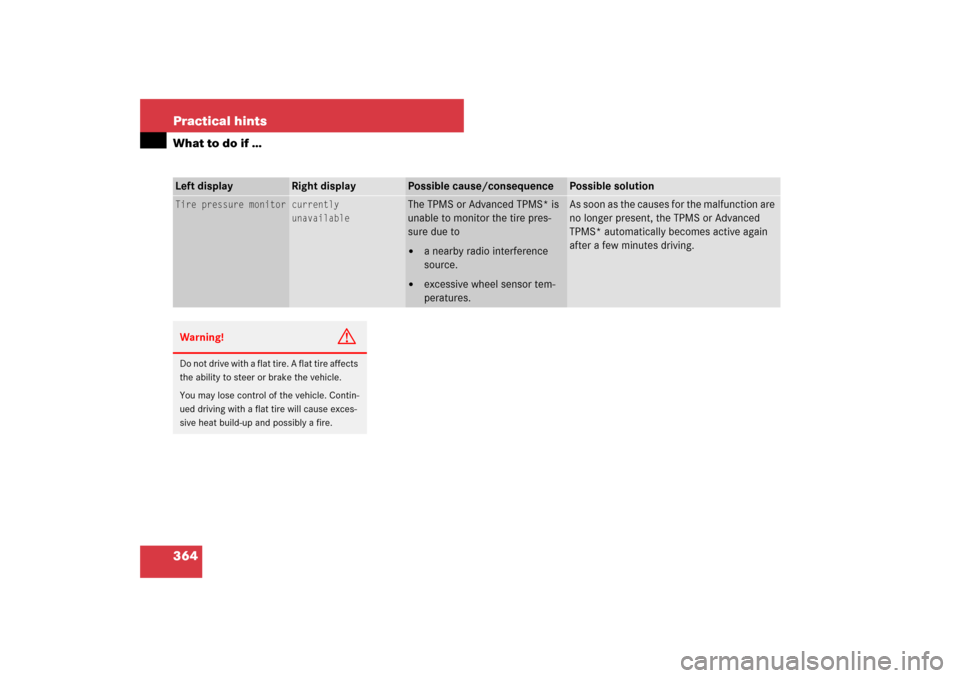
Tire pressure monitor
currently
unavailable
The TPMS or Advanced TPMS* is
unable to monitor the tire pres-
sure due to�
a nearby radio interference
source.
�
excessive wheel sensor tem-
peratures.
As soon as the causes for the malfunction are
no longer present, the TPMS or Advanced
TPMS* automatically becomes active again
after a few minutes driving.
Warning!
G
Do not drive with a flat tire. A flat tire affects
the ability to steer or brake the vehicle.
You may lose control of the vehicle. Contin-
ued driving with a flat tire will cause exces-
sive heat build-up and possibly a fire.