Page 402 of 705
401 Controls in detail
Driving systems
Airmatic (S 550 only)
Airmatic automatically selects the opti-
mum suspension tuning and ride height for
your vehicle.
Airmatic consists of two components:�
Level control system
�
Adaptive Damping System (ADS)
The ADS automatically selects the opti-
mum damping for the respective driv-
ing conditions. At the same time the
suspension is set to either sporty or
regular.Vehicle level control with Airmatic
Your vehicle automatically adjusts its ride
height to:
�
reduce fuel consumption
�
increase vehicle stability
The vehicle chassis ride height is raised or
lowered according to the selected level
setting and to the vehicle speed:
�
With increasing speed, ride height is re-
duced by up to approximately 0.8 in
(20 mm).
�
With decreasing speed, the ride height
is again raised to the selected vehicle
level.The following vehicle level settings can be
selected when the vehicle is stationary:
Select the “Raised” level setting only when
required by current driving conditions.
Otherwise:
�
Fuel consumption may increase.
�
Handling may be impaired.
i
These height adjustments are so small that
you may not notice any change.
LevelNormal
For driving on normal roads.
The indicator lamp is off.
Raised
For driving on rough roads or
with snow chains. The indica-
tor lamp is on.
Page 404 of 705
403 Controls in detail
Driving systems
Active Body Control (ABC)*
The ABC system automatically selects the
optimum suspension tuning and ride
height for your vehicle.
The ABC system consists of an active, hy-
draulically controlled suspension and
damping system.
Vehicle level control with ABC*
Your vehicle automatically adjusts its ride
height to:�
reduce fuel consumption
�
increase vehicle stability
The vehicle chassis ride height is raised or
lowered according to the selected level
setting and to the vehicle speed:
�
With increasing speed, ride height is re-
duced by up to approximately 0.6 in
(15 mm).
�
With decreasing speed, the ride height
is again raised to the selected vehicle
level.The following vehicle level settings can be
selected when the vehicle is stationary:
Select the “Raised” level setting only when
required by current driving conditions.
Otherwise:
�
Fuel consumption may increase.
�
Handling may be impaired.
i
These height adjustments are so small that
you may not notice any change.
LevelNormal
For driving on normal roads.
The indicator lamp is off.
Raised
For driving on rough roads or
with snow chains. The indica-
tor lamp is on.
i
The selected vehicle level setting remains
stored in memory even if the engine is turned off
and restarted.
Warning!
G
To help avoid personal injury, keep hands
and feet away from wheel housing area, and
stay away from under the vehicle when low-
ering the vehicle chassis.
Page 407 of 705

406 Controls in detailDriving systemsRange of the sensorsFront sensors
Rear sensorsMinimum distance
If the system detects an obstacle in this
range, all the distance warning segments
illuminate and you hear a warning signal. If
the obstacle is closer than the minimum
distance, the actual distance may no long-
er be indicated by the system.i
To function properly, the sensors must be
free of dirt, ice, snow and slush. Clean the sen-
sors regularly, being careful not to scratch or
damage the sensors, see “Cleaning the Park-
tronic* system sensors” (
�page 538).
Center
approx. 40 in (100 cm)
Corners
approx. 24 in (60 cm)
Center
approx. 48 in (120 cm)
Corners
approx. 32 in (80 cm)
!
During parking maneuvers, pay special at-
tention to objects located above or below the
height of the sensors (e.g. street curbs, painted
posts, or trailer hitches etc.). The Parktronic sys-
tem will not detect such objects at close range
and damage to your vehicle or the object may re-
sult.
Ultrasonic signals from outside sources (e.g.
truck air brakes, car wash, or jackhammers) may
impair the operation of the Parktronic system.
Center
approx. 8 in (20 cm)
Corners
approx. 6 in (15 cm)
Page 437 of 705
436 Controls in detailTrunkOpening trunk
A minimum height clearance of 5.9 ft.
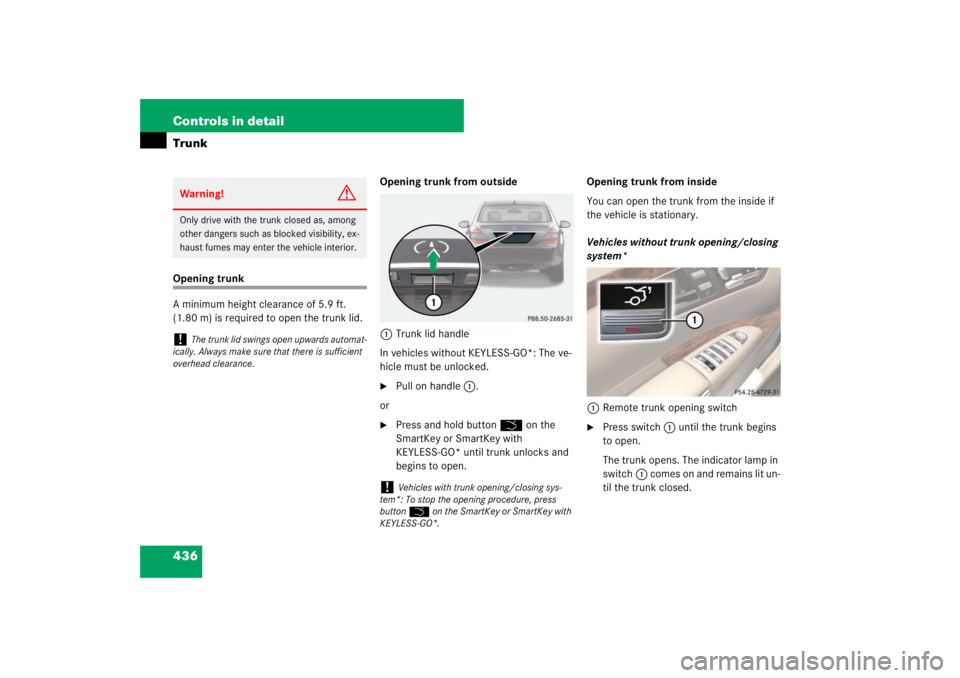
(1.80 m) is required to open the trunk lid.Opening trunk from outside
1Trunk lid handle
In vehicles without KEYLESS-GO*: The ve-
hicle must be unlocked.
�
Pull on handle1.
or
�
Press and hold button Š on the
SmartKey or SmartKey with
KEYLESS-GO* until trunk unlocks and
begins to open.Opening trunk from inside
You can open the trunk from the inside if
the vehicle is stationary.
Vehicles without trunk opening/closing
system*
1Remote trunk opening switch
�
Press switch1 until the trunk begins
to open.
The trunk opens. The indicator lamp in
switch1 comes on and remains lit un-
til the trunk closed.
Warning!
G
Only drive with the trunk closed as, among
other dangers such as blocked visibility, ex-
haust fumes may enter the vehicle interior.!
The trunk lid swings open upwards automat-
ically. Always make sure that there is sufficient
overhead clearance.
!
Vehicles with trunk opening/closing sys-
tem*: To stop the opening procedure, press
buttonŠ on the SmartKey or SmartKey with
KEYLESS-GO*.
Page 438 of 705
437 Controls in detailTrunk
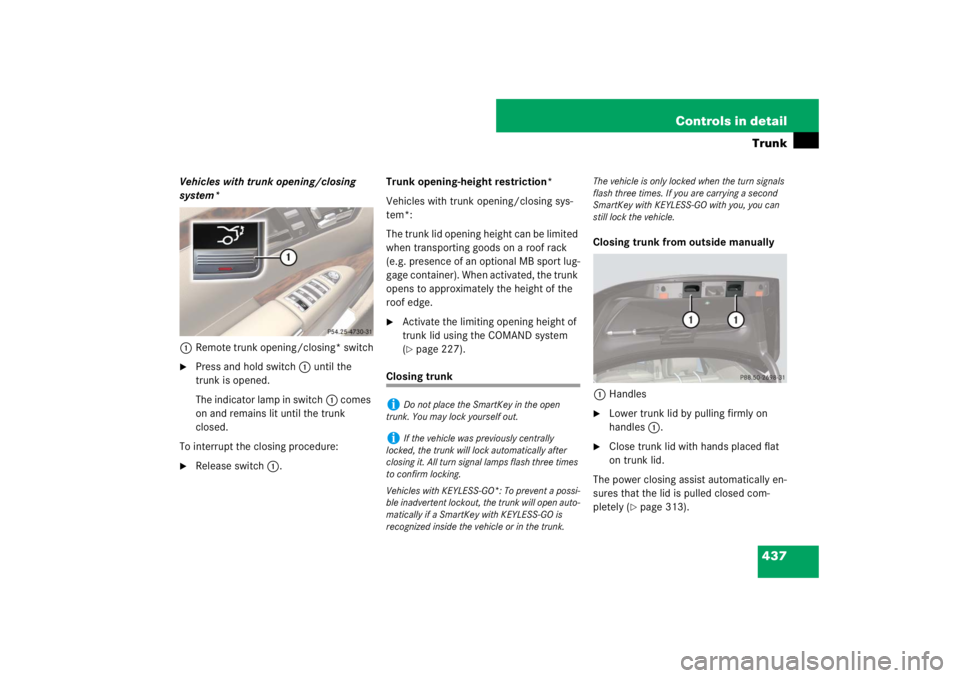
Vehicles with trunk opening/closing
system*
1Remote trunk opening/closing* switch�
Press and hold switch1 until the
trunk is opened.
The indicator lamp in switch1 comes
on and remains lit until the trunk
closed.
To interrupt the closing procedure:
�
Release switch1.Trunk opening-height restriction*
Vehicles with trunk opening/closing sys-
tem*:
The trunk lid opening height can be limited
when transporting goods on a roof rack
(e.g. presence of an optional MB sport lug-
gage container). When activated, the trunk
opens to approximately the height of the
roof edge.
�
Activate the limiting opening height of
trunk lid using the COMAND system
(�page 227).
Closing trunkClosing trunk from outside manually
1Handles
�
Lower trunk lid by pulling firmly on
handles1.
�
Close trunk lid with hands placed flat
on trunk lid.
The power closing assist automatically en-
sures that the lid is pulled closed com-
pletely (
�page 313).
i
Do not place the SmartKey in the open
trunk. You may lock yourself out.
i
If the vehicle was previously centrally
locked, the trunk will lock automatically after
closing it. All turn signal lamps flash three times
to confirm locking.
Vehicles with KEYLESS-GO*: To prevent a possi-
ble inadvertent lockout, the trunk will open auto-
matically if a SmartKey with KEYLESS-GO is
recognized inside the vehicle or in the trunk. The vehicle is only locked when the turn signals
flash three times. If you are carrying a second
SmartKey with KEYLESS-GO with you, you can
still lock the vehicle.
Page 453 of 705
452 Controls in detailLoading and storingCup holders
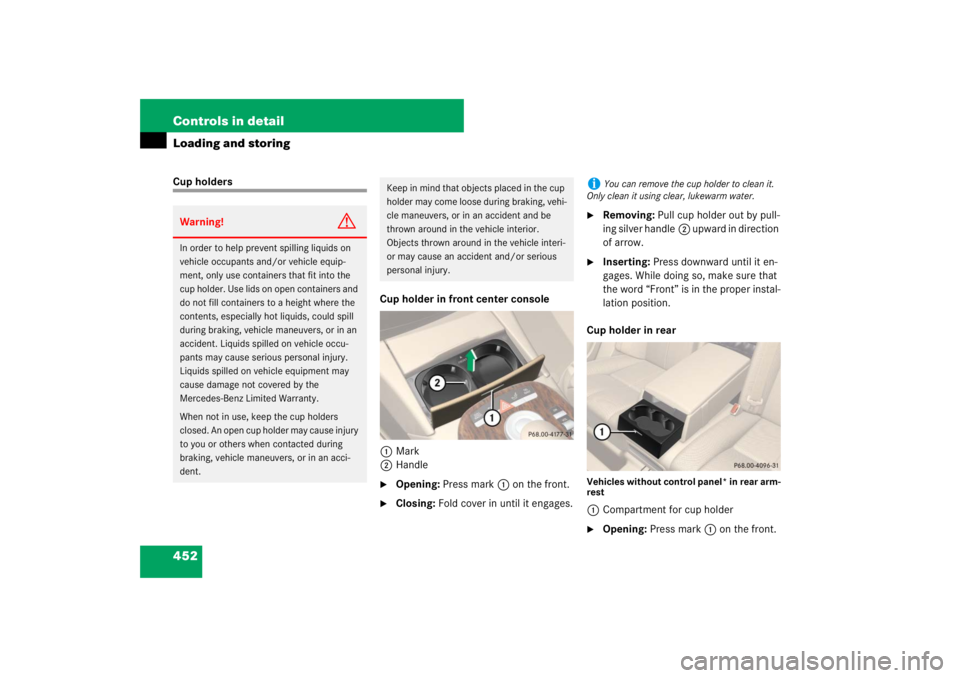
Cup holder in front center console
1Mark
2Handle
�
Opening: Press mark1 on the front.
�
Closing: Fold cover in until it engages.
�
Removing: Pull cup holder out by pull-
ing silver handle2 upward in direction
of arrow.
�
Inserting: Press downward until it en-
gages. While doing so, make sure that
the word “Front” is in the proper instal-
lation position.
Cup holder in rear
Vehicles without control panel* in rear arm-
rest1Compartment for cup holder�
Opening: Press mark1 on the front.
Warning!
G
In order to help prevent spilling liquids on
vehicle occupants and/or vehicle equip-
ment, only use containers that fit into the
cup holder. Use lids on open containers and
do not fill containers to a height where the
contents, especially hot liquids, could spill
during braking, vehicle maneuvers, or in an
accident. Liquids spilled on vehicle occu-
pants may cause serious personal injury.
Liquids spilled on vehicle equipment may
cause damage not covered by the
Mercedes-Benz Limited Warranty.
When not in use, keep the cup holders
closed. An open cup holder may cause injury
to you or others when contacted during
braking, vehicle maneuvers, or in an acci-
dent.
Keep in mind that objects placed in the cup
holder may come loose during braking, vehi-
cle maneuvers, or in an accident and be
thrown around in the vehicle interior.
Objects thrown around in the vehicle interi-
or may cause an accident and/or serious
personal injury.
i
You can remove the cup holder to clean it.
Only clean it using clear, lukewarm water.
Page 493 of 705
492 OperationEngine compartmentHood
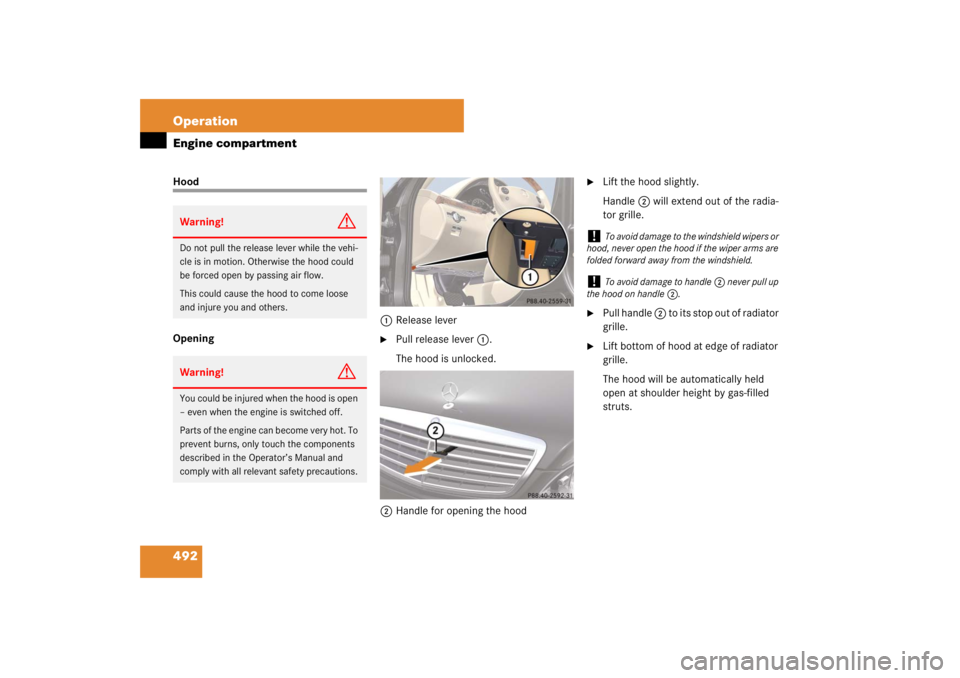
Opening1Release lever
�
Pull release lever 1.
The hood is unlocked.
2Handle for opening the hood
�
Lift the hood slightly.
Handle2 will extend out of the radia-
tor grille.
�
Pull handle 2 to its stop out of radiator
grille.
�
Lift bottom of hood at edge of radiator
grille.
The hood will be automatically held
open at shoulder height by gas-filled
struts.
Warning!
G
Do not pull the release lever while the vehi-
cle is in motion. Otherwise the hood could
be forced open by passing air flow.
This could cause the hood to come loose
and injure you and others.Warning!
G
You could be injured when the hood is open
– even when the engine is switched off.
Parts of the engine can become very hot. To
prevent burns, only touch the components
described in the Operator’s Manual and
comply with all relevant safety precautions.
!
To avoid damage to the windshield wipers or
hood, never open the hood if the wiper arms are
folded forward away from the windshield.
!
To avoid damage to handle2 never pull up
the hood on handle2.
Page 494 of 705
493 Operation
Engine compartment
Closing�
Let the hood drop from a height of ap-
proximately 1 ft. (30 cm).
The hood will lock audibly.
�
Check to make sure the hood is fully
closed.
If you can raise the hood at a point
above the headlamps, then it is not
properly closed. Open it again and let it
drop with somewhat greater force.
Warning!
G
To help prevent personal injury, stay clear of
moving parts when the hood is open and the
engine is running. Make sure the hood is
properly closed before driving. When closing
the hood, use extreme caution not to catch
hands or fingers.
The radiator fan may continue to run for ap-
proximately 30 seconds or even restart af-
ter the engine has been turned off. Stay
clear of fan blades.Warning!
G
If you see flames or smoke coming from the
engine compartment, or if the coolant tem-
perature gauge indicates that the engine is
overheated, do not open the hood. Move
away from vehicle and do not open the hood
until the engine has cooled down. If neces-
sary, call the fire department.
Warning!
G
The engine is equipped with a transistorized
ignition system. Because of the high voltage
it is dangerous to touch any components (ig-
nition coils, spark plug sockets, diagnostic
socket) of the ignition system�
with the engine running
�
while starting the engine
�
if ignition is “on” and the engine is
cranked manually
Warning!
G
Be careful that you do not close the hood on
anyone.
Make sure that the hood is securely en-
gaged before driving off. Do not continue
driving if the hood can no longer engage af-
ter an accident, for example. The hood could
otherwise come loose while the vehicle is in
motion and endanger you and others.