Page 458 of 522
457 Practical hints
Flat tire
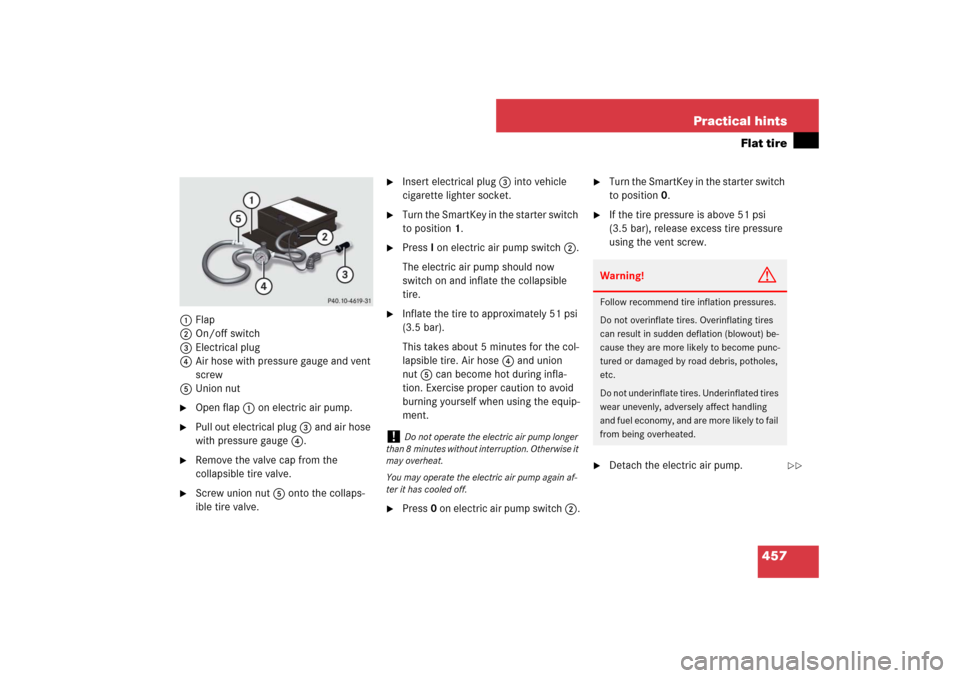
1Flap
2On/off switch
3Electrical plug
4Air hose with pressure gauge and vent
screw
5Union nut�
Open flap 1 on electric air pump.
�
Pull out electrical plug 3 and air hose
with pressure gauge 4.
�
Remove the valve cap from the
collapsible tire valve.
�
Screw union nut5 onto the collaps-
ible tire valve.
�
Insert electrical plug 3 into vehicle
cigarette lighter socket.
�
Turn the SmartKey in the starter switch
to position1.
�
PressI on electric air pump switch 2.
The electric air pump should now
switch on and inflate the collapsible
tire.
�
Inflate the tire to approximately 51 psi
(3.5 bar).
This takes about 5 minutes for the col-
lapsible tire. Air hose 4 and union
nut5 can become hot during infla-
tion. Exercise proper caution to avoid
burning yourself when using the equip-
ment.
�
Press0 on electric air pump switch 2.
�
Turn the SmartKey in the starter switch
to position0.
�
If the tire pressure is above 51 psi
(3.5 bar), release excess tire pressure
using the vent screw.
�
Detach the electric air pump.
!
Do not operate the electric air pump longer
than 8 minutes without interruption. Otherwise it
may overheat.
You may operate the electric air pump again af-
ter it has cooled off.
Warning!
G
Follow recommend tire inflation pressures.
Do not overinflate tires. Overinflating tires
can result in sudden deflation (blowout) be-
cause they are more likely to become punc-
tured or damaged by road debris, potholes,
etc.
Do not underinflate tires. Underinflated tires
wear unevenly, adversely affect handling
and fuel economy, and are more likely to fail
from being overheated.
��
Page 461 of 522

460 Practical hintsBatteryThe battery is located on the right hand
side of the trunk under the luggage box
(�page 433).
Vehicles with spare wheel1Positive terminal
2Negative terminal
3Battery bracket
4Battery ventilation hose
Warning!
G
Failure to follow these instructions can re-
sult in severe injury or death.
Observe all safety instructions and precau-
tions when handling automotive batteries
(�page 331).
Never lean over batteries while connecting,
you might get injured.
Battery fluid contains sulfuric acid. Do not
allow this fluid to come in contact with eyes,
skin or clothing. In case it does, immediately
flush affected area with water and seek
medical help if necessary.
A battery will also produce hydrogen gas,
which is flammable and explosive. Keep
flames or sparks away from battery, avoid
improper connection of jumper cables,
smoking etc.
!
Depending on vehicle production date, the
battery is a V
alve-R
egulated L
ead A
cid (VRLA)
battery, also referred to as “fleece” battery:
Such batteries do not require topping-up of the
electrolyte level. VRLA batteries therefore do not
have cell caps and the battery cover is non-re-
movable. Do not attempt to open the battery as
otherwise the battery will be damaged.
Even though VRLA batteries do not require top-
ping-up of the electrolyte level and cannot be
opened to check the electrolyte level, the bat-
tery condition must be checked periodically by
performing a battery conductance test. Refer to
Maintenance Booklet for battery condition test-
ing intervals.
The factory-equipped VRLA battery is
leak-proofed. Only use a battery as replacement
that has the same security features and is of
identical size, voltage, and capacity as the
factory-equipped battery.
Page 499 of 522

498 Technical dataFuels, coolants, lubricants etc.Coolants
The engine coolant is a mixture of water
and anticorrosion/antifreeze, which pro-
vides:�
Corrosion protection
�
Freeze protection
�
Boiling protection (by increasing the
boiling point)
The cooling system was filled at the factory
with a coolant providing freeze protection
to approximately -35°F (-37°C) and corro-
sion protection.
If the antifreeze mixture is effective to
-35°F (-37°C), the boiling point of the cool-
ant in the pressurized cooling system is
reached at approximately 266°F (130°C).The coolant solution must be used year
round to provide the necessary corrosion
protection and increase boil-over protec-
tion. Refer to Maintenance Booklet for re-
placement interval.
Coolant system design and coolant used
determine the replacement interval. The
replacement interval published in the
Maintenance Booklet is only applicable if
MB 325.0 Anticorrosion/Antifreeze solu-
tion or other Mercedes-Benz approved
products of equal specification are used to
renew the coolant concentration or bring it
back up to the proper level.
For information on other Mercedes-Benz
approved products of equal specification,
refer to the Factory Approved Service
Products pamphlet (USA only) or contact
an authorized Mercedes-Benz Center.
To provide important corrosion protection,
the solution must be at least 50% anticor-
rosion/antifreeze (equivalent to freeze
protection to approximately -35°F
[-37°C]). If you use a solution that is more than 55%
anticorrosion/antifreeze (freeze protec-
tion to approximately -49°F [-45°C]), the
engine temperature will increase due to
the lower heat transfer capability of the so-
lution. Therefore, do not use more than
this amount of anticorrosion/antifreeze.
If the coolant level is low, water and
MB 325.0 Anticorrosion/Antifreeze
should be used to bring it up to the proper
level (have cooling system checked for
signs of leakage). Please make sure the
mixture is in accordance with label instruc-
tions.
The water in the cooling system must meet
minimum requirements, which are usually
satisfied by normal drinking water. If you
are not sure about the water quality, con-
sult an authorized Mercedes-Benz Center.
!
Add premixed coolant solution only. Adding
water and MB 325.0 Anticorrosion/Antifreeze
separately from each other, could cause engine
damage not covered by the Mercedes-Benz
Limited Warranty.
Page 517 of 522

516 IndexTechnical data
Air conditioning refrigerant 495
Brake fluid 495
Capacities fuels, coolants, lubricants
etc. 491
Coolant 498
Electrical system 488
Engine 479
Engine oil additives 495
Engine oils 495
Fuel requirements 496
Gasoline additives 497
Premium unleaded gasoline 496
Rims and tires 481
Weight 490
Windshield washer and headlamp
cleaning system 494
Tele Aid 294
Emergency calls 295
Information 298
Initiating an emergency call
manually 297
Messages in display 429
Remote door unlock 300
Roadside Assistance 297
SOS button 297Stolen Vehicle Recovery
services 301
System self-check 295
Telephone* 28, 181, 291
Answering/ending a call 182
Changing mobile phone cradle 293
Compartment 285
Hands-free microphone 31
Inserting in mobile phone cradle 292
Installing a different mobile phone
cradle 294
Message in display 430
Operation 181
Phone book 183
Redialing 183
Temperature
Coolant 149
Interior temperature 210, 227
Outside 170
Setting display unit 170
Tether attachment points, see Children in
the vehicle
Tie-down rings, Trunk 280
Tightening torque 458
Time 172, 173
Setting minutes 172TIN 361
Tire
Vehicle maximum load on 362
Tire and Loading Information
Placard 337
Tire and loading terminology 359
Tire Identification Number see TIN
Tire inflation pressure
Checking 341
Checking tire pressure electronically
with the Advanced Tire Pressure
Monitoring System (Advanced
TPMS)*, (Canada only) 345
Tire inflation pressure see the placard on
the fuel filler flap
Tire load rating 361
Tire ply composition and material
used 361
Tire speed rating 362
Page:
< prev 1-8 9-16 17-24