Page 211 of 481

210 Controls in detailPower windowsSummer opening feature
If the weather is warm, you can ventilate
the vehicle before driving off by simulta-
neously:�
opening the side windows
�
opening the tilt/sliding sunroof
�
turning on the seat ventilation* for the
driver’s seat
SmartKey
�
Aim transmitter eye of the SmartKey or
SmartKey with KEYLESS-GO* at the
driver’s outside door handle. The
SmartKey or SmartKey with
KEYLESS-GO* must be in close proxim-
ity to the driver’s outside door handle.
�
Press and hold buttonΠuntil the
windows and the tilt/sliding sunroof
have reached the desired position.
�
Release buttonΠto interrupt pro-
cedure.
Convenience closing feature
When you lock the vehicle, you can close
the windows, tilt/sliding sunroof simulta-
neously.�
Aim transmitter eye of the SmartKey at
the driver’s outside door handle
(�page 210). The SmartKey or
SmartKey with KEYLESS-GO* must be
in close proximity to the driver’s out-
side door handle.
�
Press and hold button‹ until the
windows, the tilt/sliding sunroof are
completely closed.
i
The seat ventilation* for the driver’s seat is
automatically set to the highest level if activated
via summer opening feature.
Page 216 of 481

215 Controls in detail
Driving systems
�Driving systems
The following driving systems are
explained on the following pages:�
Cruise control and Distronic*, with
which the vehicle can maintain a preset
speed
�
Airmatic DC adjusts the vehicle sus-
pension characteristics automatically
and controls the vehicle level
�
Parktronic system*, which assists the
driver during parking maneuvers
For information on the BAS, ABS, ESP
® and
EBP, see “Driving safety systems”
(
�page 91).
Cruise control
The cruise control automatically maintains
the speed you set for your vehicle.
Use of cruise control is recommended for
driving at a constant speed for extended
periods of time. You can set or resume
cruise control at any speed above 20 mph
(30 km/h).
The cruise control function is operated by
means of the cruise control lever.
The cruise control lever is the uppermost
lever on the left-hand side of the steering
column (
�page 24).
Warning!
G
The cruise control is a convenience system
designed to assist the driver during vehicle
operation. The driver is and must always
remain responsible for the vehicle’s speed
and for safe brake operation.
Only use the cruise control if the road,
traffic, and weather conditions make it ad-
visable to travel at a steady speed.�
The use of cruise control can be danger-
ous on winding roads or in heavy traffic
because conditions do not allow safe
driving at a steady speed.
�
The use of cruise control can be danger-
ous on slippery roads. Rapid changes in
tire traction can result in wheel spin and
loss of control.
�
Deactivate the cruise control when driv-
ing in fog.
The “Resume” function should only be oper-
ated if the driver is fully aware of the previ-
ously set speed and wishes to resume this
particular preset speed.
Page 232 of 481
231 Controls in detail
Driving systems
Airmatic DC (Dual Control)
Airmatic automatically selects the opti-
mum suspension tuning and ride height for
your vehicle. The Airmatic consists of two
components:�
Adaptive Damping System (ADS)
�
Vehicle level control
The ADS automatically selects the opti-
mum damping for the respective driving
conditions. At the same time the suspen-
sion is set to either Sport 1, Sport 2 or
Comfort.
Suspension tuning
The suspension tuning is set according to:
�
Your driving style
�
Road surface conditions
�
Your choice of suspension style,
Sport 1, Sport 2 or Comfort, which you
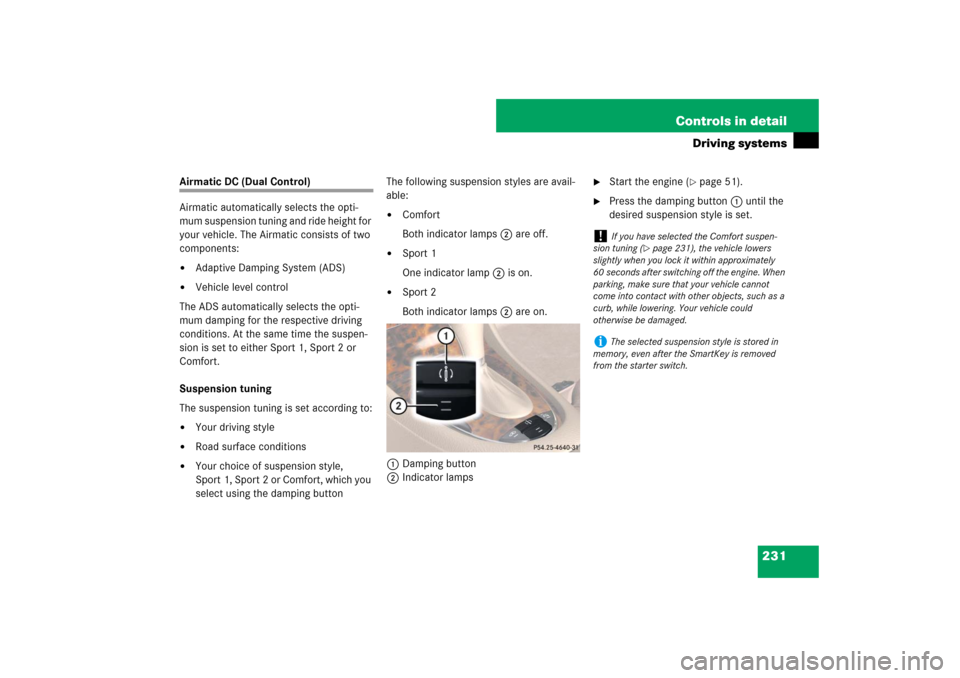
select using the damping buttonThe following suspension styles are avail-
able:
�
Comfort
Both indicator lamps2 are off.
�
Sport 1
One indicator lamp2 is on.
�
Sport 2
Both indicator lamps2 are on.
1Damping button
2Indicator lamps
�
Start the engine (
�page 51).
�
Press the damping button1 until the
desired suspension style is set.
!
If you have selected the Comfort suspen-
sion tuning (
�page 231), the vehicle lowers
slightly when you lock it within approximately
60 seconds after switching off the engine. When
parking, make sure that your vehicle cannot
come into contact with other objects, such as a
curb, while lowering. Your vehicle could
otherwise be damaged.
i
The selected suspension style is stored in
memory, even after the SmartKey is removed
from the starter switch.
Page 233 of 481

232 Controls in detailDriving systemsVehicle level control
Your vehicle automatically adjusts its ride
height to�
increase vehicle safety
�
reduce fuel consumption
The following vehicle chassis ride heights
can be selected:
�
Normal
�
Raised
The vehicle chassis ride height is raised or
lowered according to the selected level
setting and to the vehicle speed:
�
At a speed exceeding approximately
68 mph (110 km/h) with normal level
set or exceeding 75 mph (120 km/h)
with raised level set, the ride height is
reduced automatically. The table on
the next page provides an overview of
the vehicle levels.
�
With decreasing speed, the ride height
is again raised to the normal level.
Select the raised level only when required
by current driving conditions. Otherwise
�
handling may be impaired
�
fuel consumption may increase
i
These height adjustments are so small that
you may not notice any change.Warning!
G
To help avoid personal injury, keep hands
and feet away from wheel housing area, and
stay away from under the vehicle when low-
ering the vehicle chassis.
Page 234 of 481
233 Controls in detail
Driving systems
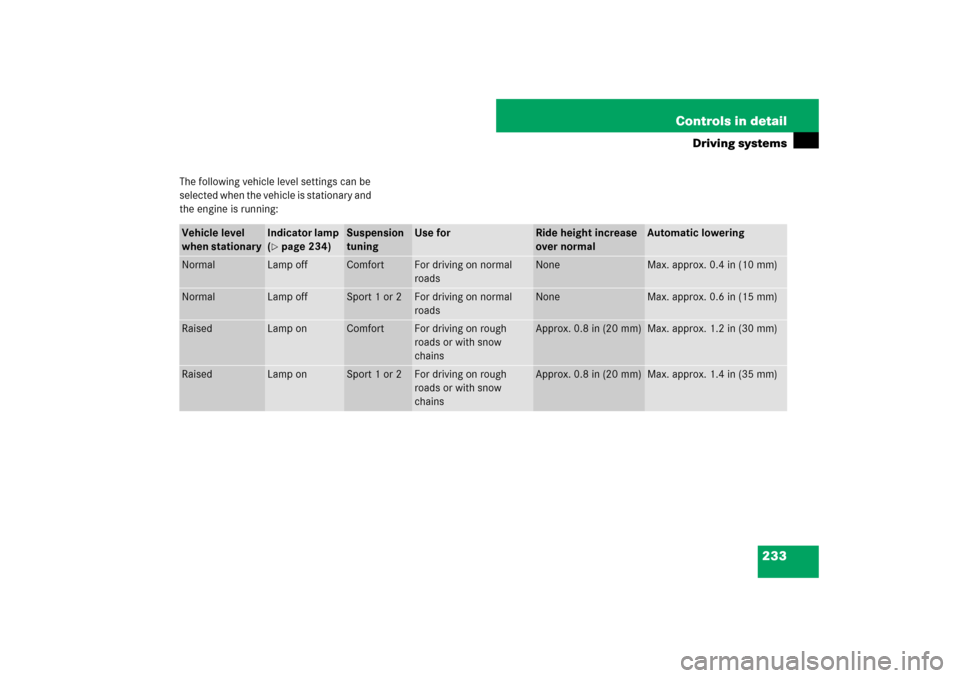
The following vehicle level settings can be
selected when the vehicle is stationary and
the engine is running:Vehicle level
when stationary
Indicator lamp
(�page 234)
Suspension
tuning
Use for
Ride height increase
over normal
Automatic lowering
Normal
Lamp off
Comfort
For driving on normal
roads
None
Max. approx. 0.4 in (10 mm)
Normal
Lamp off
Sport 1 or 2
For driving on normal
roads
None
Max. approx. 0.6 in (15 mm)
Raised
Lamp on
Comfort
For driving on rough
roads or with snow
chains
Approx. 0.8 in (20 mm)
Max. approx. 1.2 in (30 mm)
Raised
Lamp on
Sport 1 or 2
For driving on rough
roads or with snow
chains
Approx. 0.8 in (20 mm)
Max. approx. 1.4 in (35 mm)
Page 235 of 481
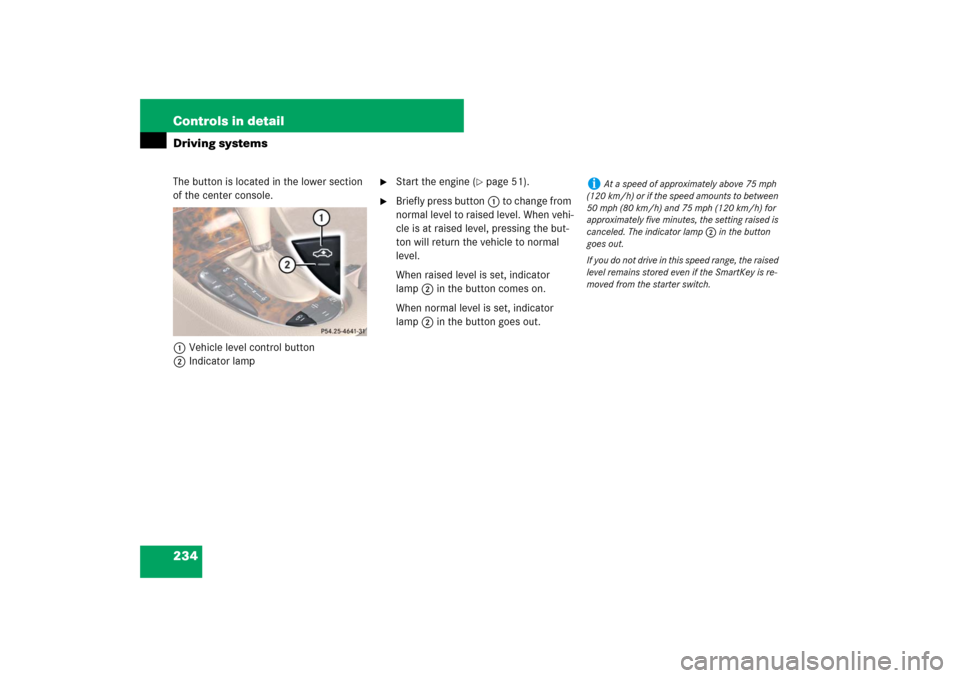
234 Controls in detailDriving systemsThe button is located in the lower section
of the center console.
1Vehicle level control button
2Indicator lamp
�
Start the engine (
�page 51).
�
Briefly press button1 to change from
normal level to raised level. When vehi-
cle is at raised level, pressing the but-
ton will return the vehicle to normal
level.
When raised level is set, indicator
lamp2 in the button comes on.
When normal level is set, indicator
lamp2 in the button goes out.
i
At a speed of approximately above 75 mph
(120 km/h) or if the speed amounts to between
50 mph (80 km/h) and 75 mph (120 km/h) for
approximately five minutes, the setting raised is
canceled. The indicator lamp2 in the button
goes out.
If you do not drive in this speed range, the raised
level remains stored even if the SmartKey is re-
moved from the starter switch.
Page 274 of 481

273 Operation
Driving instructions
Refer to the description of the Brake Assist
System (BAS) (
�page 92).Brake pad wear or a leak in the system may
be the reason for low brake fluid in the res-
ervoir.
The brake fluid level in the reservoir may
be too low if the brake warning lamp in the
instrument cluster comes on and an
acoustic warning sounds although the
parking brake is released (
�page 344).
Observe additional messages in the multi-
function display that may appear
(
�page 372).
Have the brake system inspected immedi-
ately. Contact an authorized
Mercedes-Benz Center.
All checks and service work on the brake
system should be carried out by qualified
technicians only. Contact an authorized
Mercedes-Benz Center.
Only install brake pads and brake fluid
recommended by Mercedes-Benz.After hard braking, it is advisable to drive
on for some time, rather than immediately
park, so that the air stream will cool down
the brakes faster.
Warning!
G
Make sure not to endanger any other road
users when carrying out these braking ma-
neuvers.
Warning!
G
If other than recommended brake pads are
installed, or other than recommended brake
fluid is used, the braking properties of the
vehicle can be degraded to an extent that
safe braking is substantially impaired. This
could result in an accident.
Be certain to read and observe the warning
notices on brake pad replacement
(�page 371).
!
When driving down long and steep grades,
relieve the load on the brakes by shifting into a
lower gear to use the engine’s braking power.
This helps prevent overheating of the brakes and
reduces brake pad wear.
Page 277 of 481

276 OperationDriving instructionsSpecified tire inflation pressures must be
maintained. This applies particularly if the
tires are subjected to high loads (e.g. high
speeds, heavy loads, high ambient temper-
atures).For more information, see “Tires and
wheels” (
�page 293).
Hydroplaning
Depending on the depth of the water layer
on the road, hydroplaning may occur, even
at low speeds and with new tires. Reduce
vehicle speed, avoid track grooves in the
road and apply brakes cautiously in the
rain.
Tire traction
The safe speed on a wet, snow covered or
icy road is always lower than on a dry road.
You should pay particular attention to the
condition of the road whenever the outside
temperatures are close to the freezing
point.
Warning!
G
Although the applicable federal motor vehi-
cle safety laws consider a tire to be worn
when the treadwear indicators (TWI) be-
come visible at approximately
1/16in
(1.6 mm), we recommend that you do not
allow your tires to wear down to that level.
As tread depth approaches
1/8in (3 mm),
the adhesion properties on a wet road are
sharply reduced.
Depending upon the weather and/or road
surface (conditions), the tire traction varies
widely.
Warning!
G
Do not drive with a flat tire. A flat tire affects
the ability to steer or brake the vehicle. You
may lose control of the vehicle. Continued
driving with a flat tire or driving at high
speed with a flat tire will cause excessive
heat build-up and possibly a fire.
Warning!
G
If ice has formed on the road, tire traction
will be substantially reduced. Under such
weather conditions, drive, steer and brake
with extreme caution.