Page 428 of 723
427 Controls in detail
Driving systems
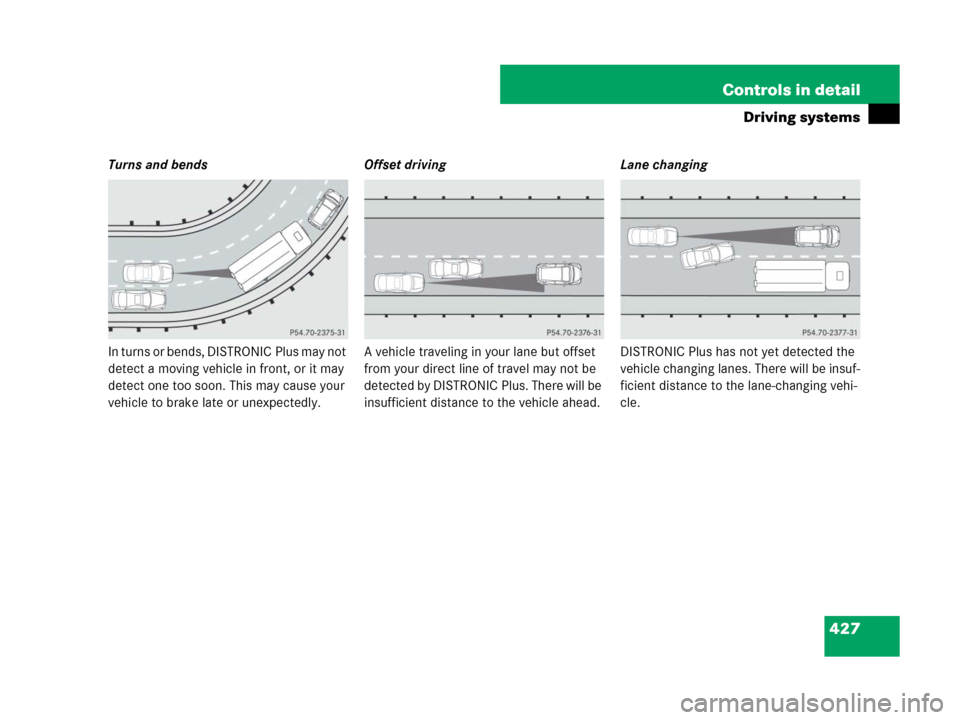
Turns and bends
In turns or bends, DISTRONIC Plus may not
detect a moving vehicle in front, or it may
detect one too soon. This may cause your
vehicle to brake late or unexpectedly.Offset driving
A vehicle traveling in your lane but offset
from your direct line of travel may not be
detected by DISTRONIC Plus. There will be
insufficient distance to the vehicle ahead.Lane changing
DISTRONIC Plus has not yet detected the
vehicle changing lanes. There will be insuf-
ficient distance to the lane-changing vehi-
cle.
Page 429 of 723
428 Controls in detail
Driving systems
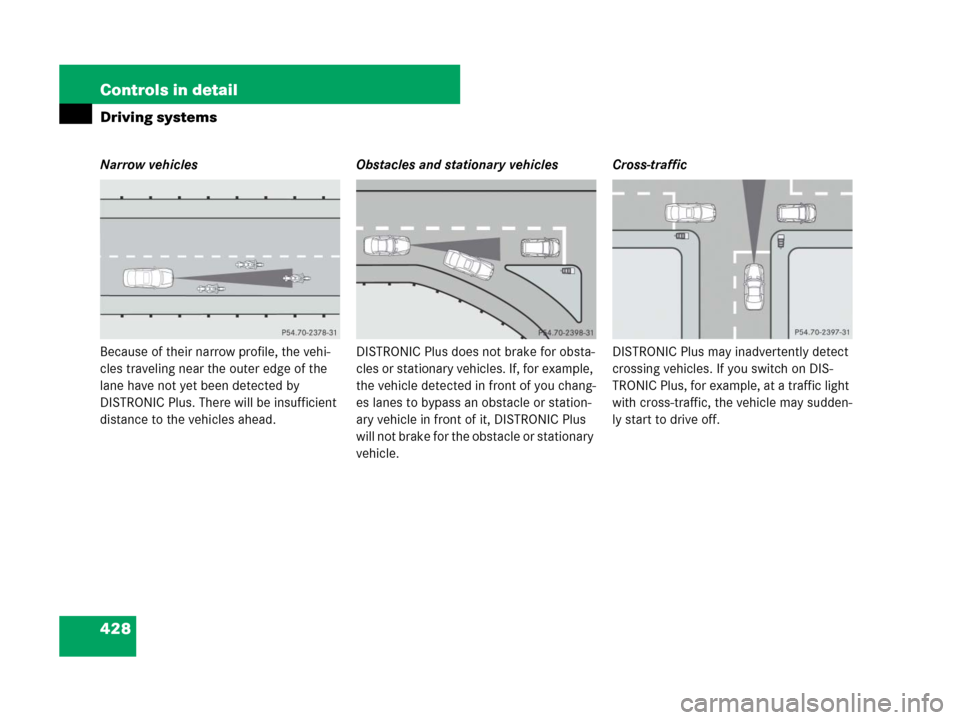
Narrow vehicles
Because of their narrow profile, the vehi-
cles traveling near the outer edge of the
lane have not yet been detected by
DISTRONIC Plus. There will be insufficient
distance to the vehicles ahead.Obstacles and stationary vehicles
DISTRONIC Plus does not brake for obsta-
cles or stationary vehicles. If, for example,
the vehicle detected in front of you chang-
es lanes to bypass an obstacle or station-
ary vehicle in front of it, DISTRONIC Plus
will not brake for the obstacle or stationary
vehicle.Cross-traffic
DISTRONIC Plus may inadvertently detect
crossing vehicles. If you switch on DIS-
TRONIC Plus, for example, at a traffic light
with cross-traffic, the vehicle may sudden-
ly start to drive off.
Page 432 of 723
431 Controls in detail
Driving systems
Parktronic system*
The Parktronic system is an electronic
parking aid with ultrasonic sensors that
helps you while parking.
It visually and audibly indicates the relative
distance between the vehicle and an ob-
stacle.
The Parktronic system is automatically ac-
tivated when you switch on the ignition, re-
lease the electronic parking brake or start
the engine and engage gear D, R or N.The Parktronic system deactivates at
speeds over approximately 11 mph
(18 km/h). At lower speeds the Parktronic
system turns on again.
The Parktronic system also deactivates
when you set the automatic transmission
to P or secure the vehicle in place with the
electronic parking brake and switch off the
engine.
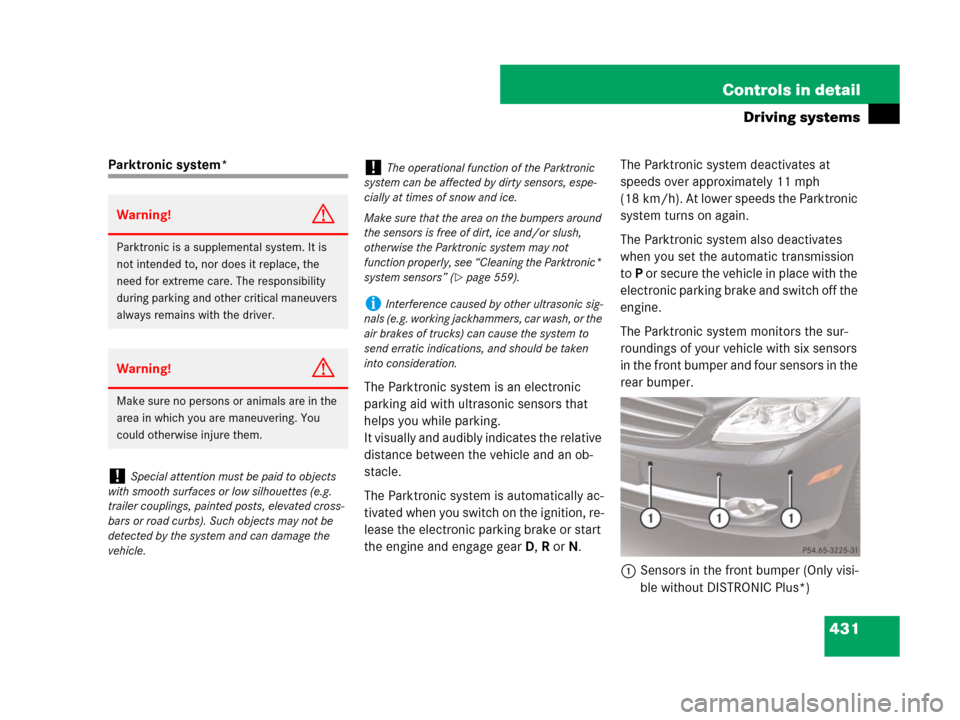
The Parktronic system monitors the sur-
roundings of your vehicle with six sensors
in the front bumper and four sensors in the
rear bumper.
1Sensors in the front bumper (Only visi-
ble without DISTRONIC Plus*)
Warning!G
Parktronic is a supplemental system. It is
not intended to, nor does it replace, the
need for extreme care. The responsibility
during parking and other critical maneuvers
always remains with the driver.
Warning!G
Make sure no persons or animals are in the
area in which you are maneuvering. You
could otherwise injure them.
!Special attention must be paid to objects
with smooth surfaces or low silhouettes (e.g.
trailer couplings, painted posts, elevated cross-
bars or road curbs). Such objects may not be
detected by the system and can damage the
vehicle.
!The operational function of the Parktronic
system can be affected by dirty sensors, espe-
cially at times of snow and ice.
Make sure that the area on the bumpers around
the sensors is free of dirt, ice and/or slush,
otherwise the Parktronic system may not
function properly, see “Cleaning the Parktronic*
system sensors” (
�page 559).
iInterference caused by other ultrasonic sig-
nals (e.g. working jackhammers, car wash, or the
air brakes of trucks) can cause the system to
send erratic indications, and should be taken
into consideration.
Page 437 of 723
436 Controls in detail
Driving systems
When travelling in Canada in a vehicle not
registered in Canada, you must switch off
the radar sensor system* (
�page 272).
Canadian law does not permit the use of
the radar sensor system* (
�page 272) for
vehicles from outside of Canada. When you
switch off the radar sensor system*, the
following functions are deactivated:
�BAS Plus* (�page 67)
�DISTRONIC Plus* (�page 411)
�Park Assist
�PRE-SAFE® Brake* (�page 73)
It visually and audibly indicates the relative
distance between the vehicle and an
obstacle.
Park Assist is automatically activated
when the engine is running and the trans-
mission is in position D, R or N.
The Park Assist system deactivates at
speeds over approximately 11 mph
(18 km/h). At lower speeds the Parktronic
system turns on again.Park Assist is also switched off when you
set the automatic transmission to P or
switch off the engine.
While the transmission is in position N,
Park Assist is switched off if you secure the
vehicle in place with the electronic parking
brake.
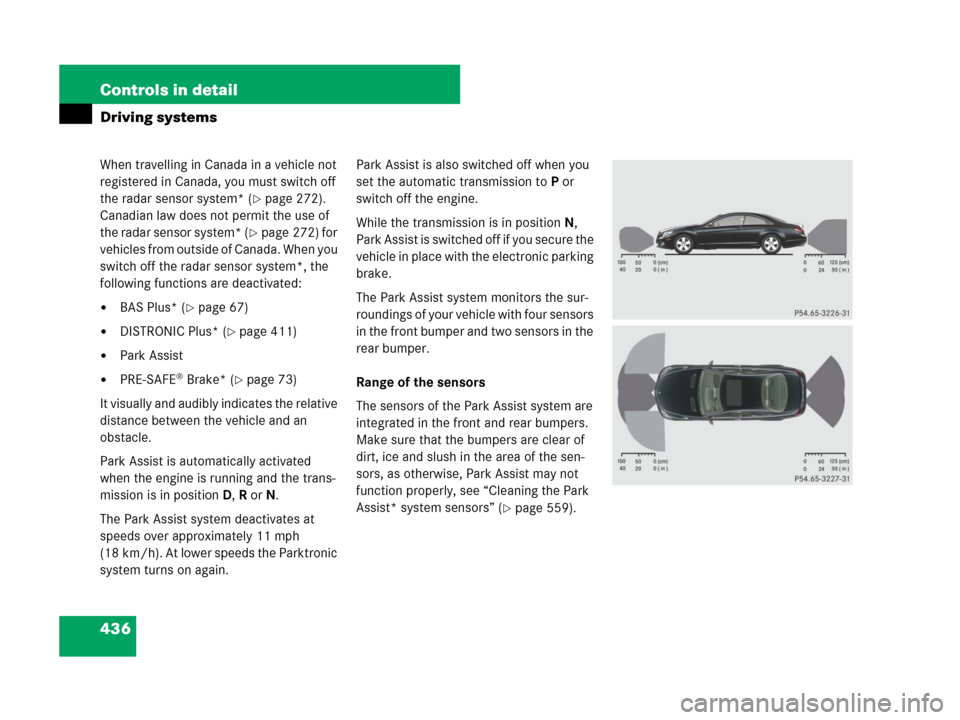
The Park Assist system monitors the sur-
roundings of your vehicle with four sensors
in the front bumper and two sensors in the
rear bumper.
Range of the sensors
The sensors of the Park Assist system are
integrated in the front and rear bumpers.
Make sure that the bumpers are clear of
dirt, ice and slush in the area of the sen-
sors, as otherwise, Park Assist may not
function properly, see “Cleaning the Park
Assist* system sensors” (
�page 559).
Page 507 of 723
504 Operation
Driving instructions
Tire speed rating
Regardless of the tire speed rating, local
speed limits should be obeyed. Use pru-
dent driving speeds appropriate to prevail-
ing conditions.
An electronic speed limiter prevents your
vehicle from exceeding a speed of
130 mph (210 km/h).The factory equipped tires on your vehicle
may have a tire speed rating above the
maximum speed permitted by the elec-
tronic speed limiter.
Make sure your tires have the required tire
speed rating as specified for your vehicle in
the “Technical data” section (
�page 678),
for example when purchasing new tires.
For information on how to identify the tire
speed rating on a tire’s sidewall, see “Tire
size designation, load and speed rating”
(
�page 536).
If you are uncertain about the correct read-
ing of the information given on a tire’s side-
wall, any authorized Mercedes-Benz
Center will be glad to assist you.
Winter driving instructions
The most important rule for slippery or icy
roads is to drive sensibly and to avoid
abrupt acceleration, braking and steering
maneuvers. Do not use the cruise control
or DISTRONIC Plus* system under such
conditions.
When the vehicle is in danger of skidding,
move gear selector lever to position N. Try
to keep the vehicle under control by cor-
rective steering action.
Warning!G
Even when permitted by law, never operate
a vehicle at speeds greater than the maxi-
mum speed rating of the tires.
Exceeding the maximum speed for which
tires are rated can lead to sudden tire fail-
ure, causing loss of vehicle control and pos-
sibly resulting in an accident and/or serious
personal injury and possible death, for you
and for others.
iFor information on speed ratings for winter
tires, see (
�page 539) and (�page 549).
iFor information on driving with snow chains,
see “Snow chains” (
�page 550).
Warning!G
On slippery road surfaces, never downshift
in order to obtain braking action. This could
result in drive wheel slip and reduced vehi-
cle control. Your vehicle’s ABS will not pre-
vent this type of control loss.
Page 561 of 723
558 Operation
Vehicle care
Headlamps, tail lamps, side markers,
turn signal lenses
�Use a mild car wash detergent, such as
Mercedes-Benz approved Car
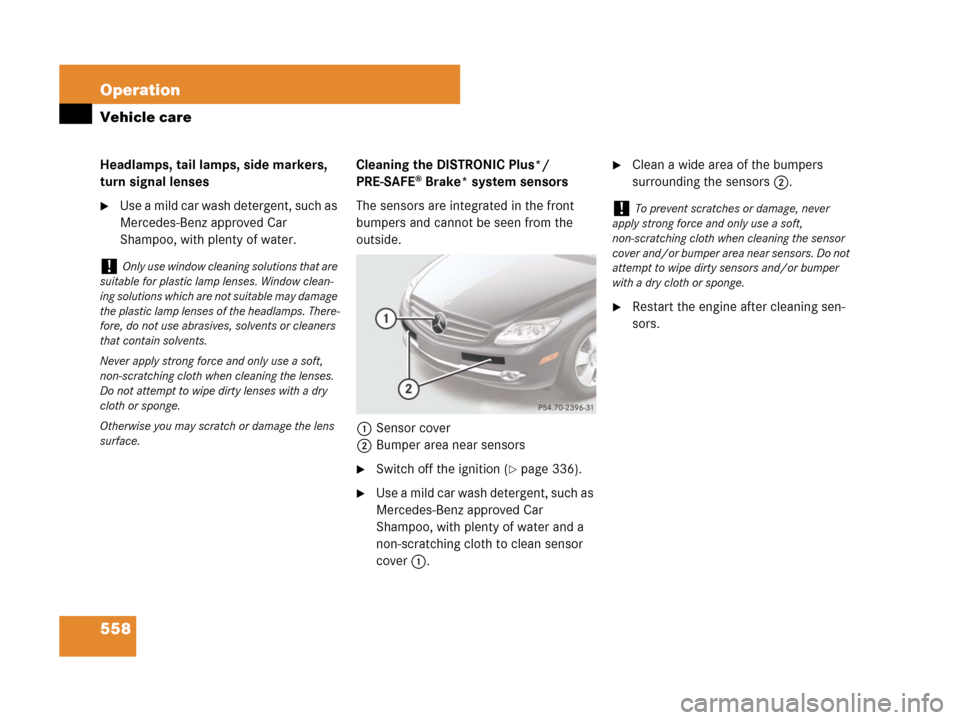
Shampoo, with plenty of water.Cleaning the DISTRONIC Plus*/
PRE-SAFE
® Brake* system sensors
The sensors are integrated in the front
bumpers and cannot be seen from the
outside.
1Sensor cover
2Bumper area near sensors
�Switch off the ignition (�page 336).
�Use a mild car wash detergent, such as
Mercedes-Benz approved Car
Shampoo, with plenty of water and a
non-scratching cloth to clean sensor
cover1.
�Clean a wide area of the bumpers
surrounding the sensors2.
�Restart the engine after cleaning sen-
sors.
!Only use window cleaning solutions that are
suitable for plastic lamp lenses. Window clean-
ing solutions which are not suitable may damage
the plastic lamp lenses of the headlamps. There-
fore, do not use abrasives, solvents or cleaners
that contain solvents.
Never apply strong force and only use a soft,
non-scratching cloth when cleaning the lenses.
Do not attempt to wipe dirty lenses with a dry
cloth or sponge.
Otherwise you may scratch or damage the lens
surface.
!To prevent scratches or damage, never
apply strong force and only use a soft,
non-scratching cloth when cleaning the sensor
cover and/or bumper area near sensors. Do not
attempt to wipe dirty sensors and/or bumper
with a dry cloth or sponge.
Page 569 of 723

566 Practical hints
What to do if …?
Lamps in instrument cluster
General information:
If any of the following lamps in the instru-
ment cluster fails to come on during the
bulb self-check when switching on the igni-
tion, have the respective bulb checked and
replaced if necessary.
ProblemPossible cause/consequenceSuggested solution
-The yellow Antilock
Brake System (ABS)
indicator lamp comes on
while the engine is run-
ning.The ABS has detected a malfunction and
has switched off. The BAS, ESP®, EBP and
PRE-SAFE® are also switched off (see mes-
sages in multifunction display).
The brake system is still functioning nor-
mally but without the ABS available.
If the ABS control unit is malfunctioning,
other systems such as Parktronic*,
DISTRONIC Plus*, navigation system, Park
Assist* and the automatic transmission
may also be malfunctioning.
�Continue driving with added caution.
Wheels may lock during hard braking,
reducing steering capability.
�Read and observe messages in the mul-
tifunction display (
�page 580).
�Have the system checked at an autho-
rized Mercedes-Benz Center as soon as
possible.
Failure to follow these instructions increas-
es the risk of an accident.
Page 575 of 723
572 Practical hints
What to do if …?
ProblemPossible cause/consequenceSuggested solution
lPRE-SAFE® Brake*: The red dis-
tance warning lamp comes on
while driving.You are too close to the vehicle in front of
you to maintain selected speed.�Apply the brakes immediately to in-
crease the following distance.
lDISTRONIC Plus* or PRE-SAFE®
Brake*: The red distance warn-
ing lamp comes on while driving
and an acoustic warning
sounds.You are gaining too rapidly on the vehicle
ahead of you.�Apply the brakes immediately.
DISTRONIC Plus* or PRE-SAFE® Brake* has
recognized a stationary obstacle on your
probable line of travel.�Apply the brakes immediately.
�Carefully observe the traffic situation.
You may need to brake or maneuver to
avoid hitting an obstacle.
vThe yellow ESP® warning lamp
flashes while driving.The ESP® or electronic traction system has
come into operation because of detected
traction loss in at least one tire.
Cruise control and DISTRONIC Plus* are de-
activated.�When driving off, apply as little throttle
as possible.
�While driving, ease up on the accelera-
tor.
�Adapt your speed and driving to the pre-
vailing road and weather conditions.
�Do not deactivate the ESP®. Exceptions:
(
�page 71).
Failure to follow these instructions increas-
es the risk of an accident.