2007 LINCOLN TOWN CAR ignition
[x] Cancel search: ignitionPage 248 of 328
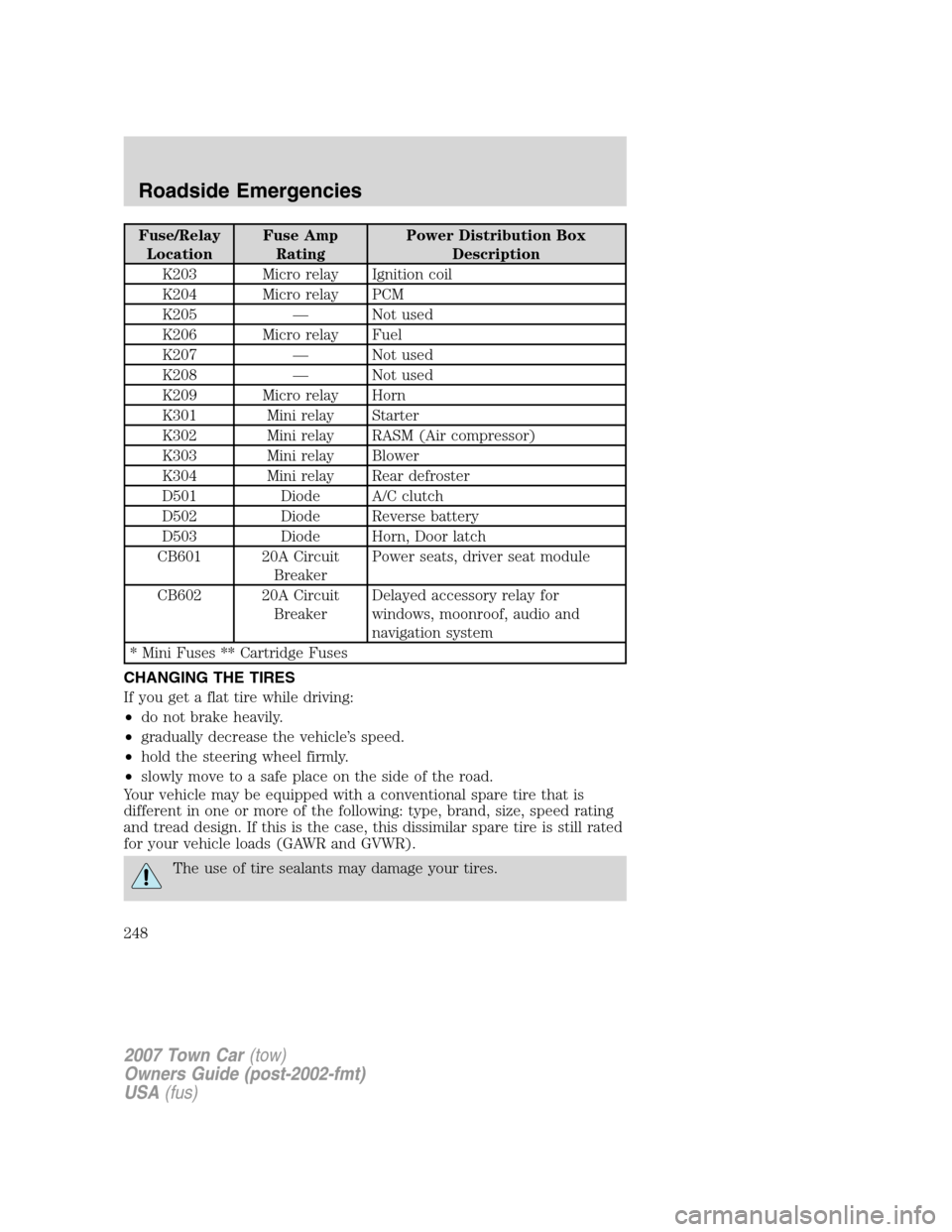
Fuse/Relay
LocationFuse Amp
RatingPower Distribution Box
Description
K203 Micro relay Ignition coil
K204 Micro relay PCM
K205 — Not used
K206 Micro relay Fuel
K207 — Not used
K208 — Not used
K209 Micro relay Horn
K301 Mini relay Starter
K302 Mini relay RASM (Air compressor)
K303 Mini relay Blower
K304 Mini relay Rear defroster
D501 Diode A/C clutch
D502 Diode Reverse battery
D503 Diode Horn, Door latch
CB601 20A Circuit
BreakerPower seats, driver seat module
CB602 20A Circuit
BreakerDelayed accessory relay for
windows, moonroof, audio and
navigation system
* Mini Fuses ** Cartridge Fuses
CHANGING THE TIRES
If you get a flat tire while driving:
•do not brake heavily.
•gradually decrease the vehicle’s speed.
•hold the steering wheel firmly.
•slowly move to a safe place on the side of the road.
Your vehicle may be equipped with a conventional spare tire that is
different in one or more of the following: type, brand, size, speed rating
and tread design. If this is the case, this dissimilar spare tire is still rated
for your vehicle loads (GAWR and GVWR).
The use of tire sealants may damage your tires.
2007 Town Car(tow)
Owners Guide (post-2002-fmt)
USA(fus)
Roadside Emergencies
248
Page 297 of 328
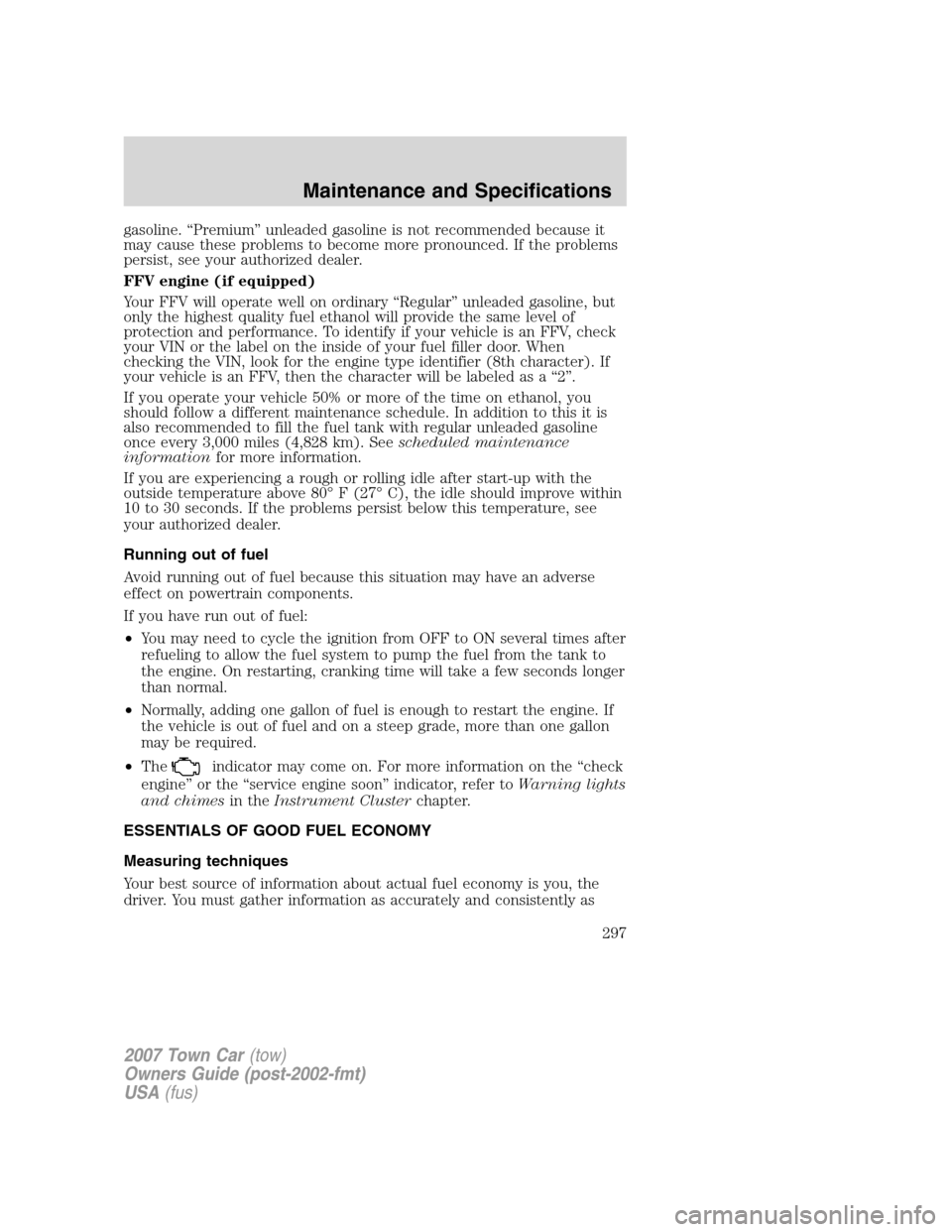
gasoline. “Premium” unleaded gasoline is not recommended because it
may cause these problems to become more pronounced. If the problems
persist, see your authorized dealer.
FFV engine (if equipped)
Your FFV will operate well on ordinary “Regular” unleaded gasoline, but
only the highest quality fuel ethanol will provide the same level of
protection and performance. To identify if your vehicle is an FFV, check
your VIN or the label on the inside of your fuel filler door. When
checking the VIN, look for the engine type identifier (8th character). If
your vehicle is an FFV, then the character will be labeled as a “2”.
If you operate your vehicle 50% or more of the time on ethanol, you
should follow a different maintenance schedule. In addition to this it is
also recommended to fill the fuel tank with regular unleaded gasoline
once every 3,000 miles (4,828 km). Seescheduled maintenance
informationfor more information.
If you are experiencing a rough or rolling idle after start-up with the
outside temperature above 80° F (27° C), the idle should improve within
10 to 30 seconds. If the problems persist below this temperature, see
your authorized dealer.
Running out of fuel
Avoid running out of fuel because this situation may have an adverse
effect on powertrain components.
If you have run out of fuel:
•You may need to cycle the ignition from OFF to ON several times after
refueling to allow the fuel system to pump the fuel from the tank to
the engine. On restarting, cranking time will take a few seconds longer
than normal.
•Normally, adding one gallon of fuel is enough to restart the engine. If
the vehicle is out of fuel and on a steep grade, more than one gallon
may be required.
•The
indicator may come on. For more information on the “check
engine” or the “service engine soon” indicator, refer toWarning lights
and chimesin theInstrument Clusterchapter.
ESSENTIALS OF GOOD FUEL ECONOMY
Measuring techniques
Your best source of information about actual fuel economy is you, the
driver. You must gather information as accurately and consistently as
2007 Town Car(tow)
Owners Guide (post-2002-fmt)
USA(fus)
Maintenance and Specifications
297
Page 298 of 328
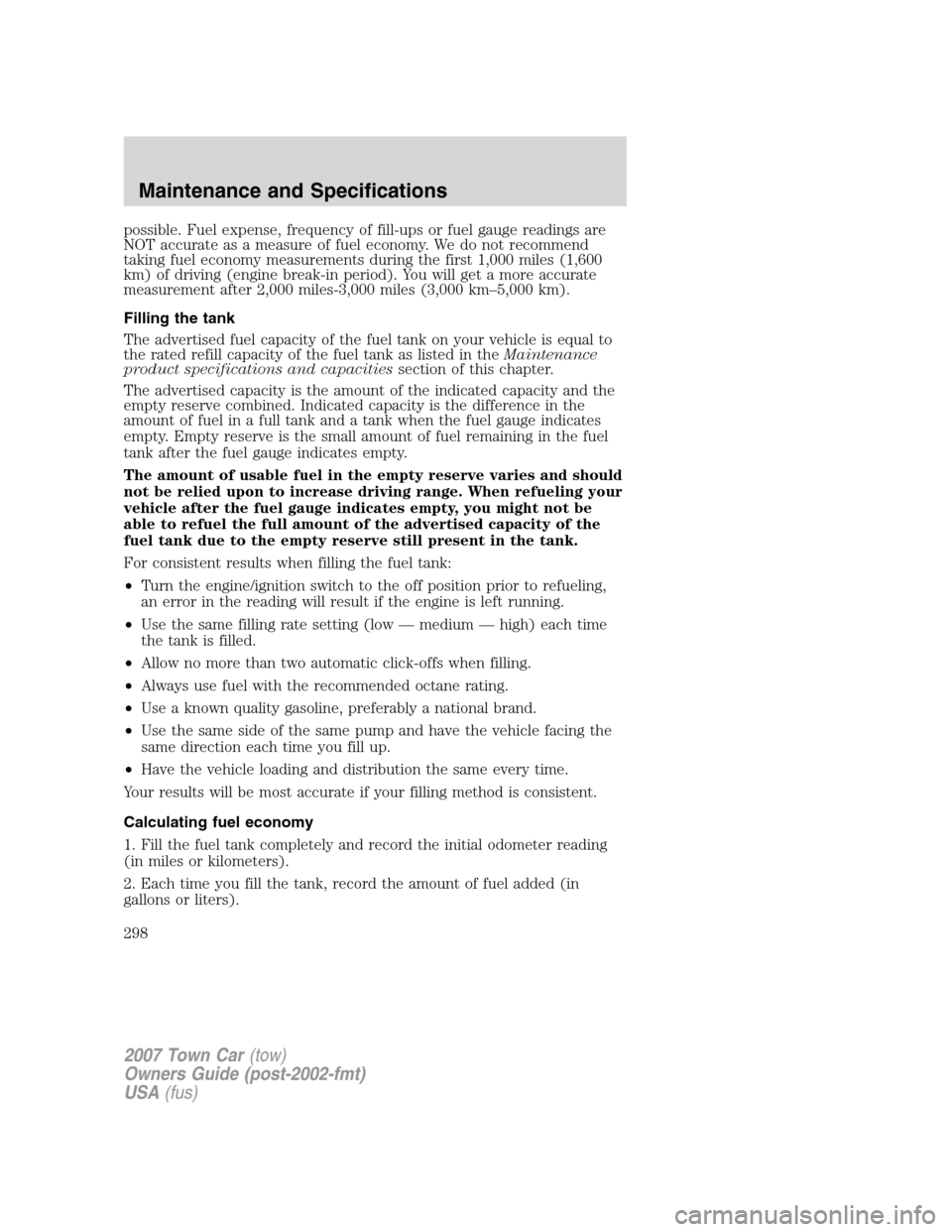
possible. Fuel expense, frequency of fill-ups or fuel gauge readings are
NOT accurate as a measure of fuel economy. We do not recommend
taking fuel economy measurements during the first 1,000 miles (1,600
km) of driving (engine break-in period). You will get a more accurate
measurement after 2,000 miles-3,000 miles (3,000 km–5,000 km).
Filling the tank
The advertised fuel capacity of the fuel tank on your vehicle is equal to
the rated refill capacity of the fuel tank as listed in theMaintenance
product specifications and capacitiessection of this chapter.
The advertised capacity is the amount of the indicated capacity and the
empty reserve combined. Indicated capacity is the difference in the
amount of fuel in a full tank and a tank when the fuel gauge indicates
empty. Empty reserve is the small amount of fuel remaining in the fuel
tank after the fuel gauge indicates empty.
The amount of usable fuel in the empty reserve varies and should
not be relied upon to increase driving range. When refueling your
vehicle after the fuel gauge indicates empty, you might not be
able to refuel the full amount of the advertised capacity of the
fuel tank due to the empty reserve still present in the tank.
For consistent results when filling the fuel tank:
•Turn the engine/ignition switch to the off position prior to refueling,
an error in the reading will result if the engine is left running.
•Use the same filling rate setting (low — medium — high) each time
the tank is filled.
•Allow no more than two automatic click-offs when filling.
•Always use fuel with the recommended octane rating.
•Use a known quality gasoline, preferably a national brand.
•Use the same side of the same pump and have the vehicle facing the
same direction each time you fill up.
•Have the vehicle loading and distribution the same every time.
Your results will be most accurate if your filling method is consistent.
Calculating fuel economy
1. Fill the fuel tank completely and record the initial odometer reading
(in miles or kilometers).
2. Each time you fill the tank, record the amount of fuel added (in
gallons or liters).
2007 Town Car(tow)
Owners Guide (post-2002-fmt)
USA(fus)
Maintenance and Specifications
298
Page 301 of 328
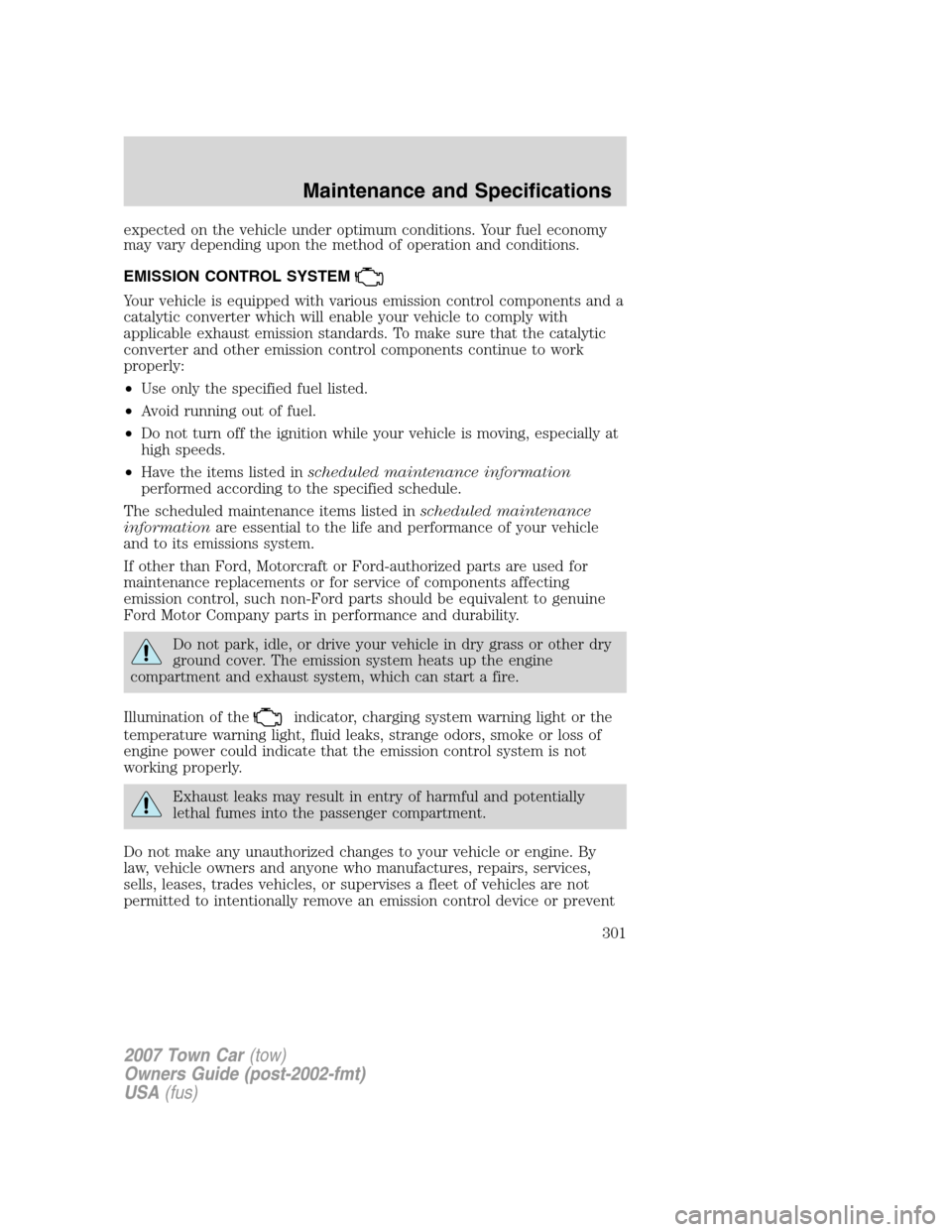
expected on the vehicle under optimum conditions. Your fuel economy
may vary depending upon the method of operation and conditions.
EMISSION CONTROL SYSTEM
Your vehicle is equipped with various emission control components and a
catalytic converter which will enable your vehicle to comply with
applicable exhaust emission standards. To make sure that the catalytic
converter and other emission control components continue to work
properly:
•Use only the specified fuel listed.
•Avoid running out of fuel.
•Do not turn off the ignition while your vehicle is moving, especially at
high speeds.
•Have the items listed inscheduled maintenance information
performed according to the specified schedule.
The scheduled maintenance items listed inscheduled maintenance
informationare essential to the life and performance of your vehicle
and to its emissions system.
If other than Ford, Motorcraft or Ford-authorized parts are used for
maintenance replacements or for service of components affecting
emission control, such non-Ford parts should be equivalent to genuine
Ford Motor Company parts in performance and durability.
Do not park, idle, or drive your vehicle in dry grass or other dry
ground cover. The emission system heats up the engine
compartment and exhaust system, which can start a fire.
Illumination of the
indicator, charging system warning light or the
temperature warning light, fluid leaks, strange odors, smoke or loss of
engine power could indicate that the emission control system is not
working properly.
Exhaust leaks may result in entry of harmful and potentially
lethal fumes into the passenger compartment.
Do not make any unauthorized changes to your vehicle or engine. By
law, vehicle owners and anyone who manufactures, repairs, services,
sells, leases, trades vehicles, or supervises a fleet of vehicles are not
permitted to intentionally remove an emission control device or prevent
2007 Town Car(tow)
Owners Guide (post-2002-fmt)
USA(fus)
Maintenance and Specifications
301
Page 312 of 328
ENGINE DATA
Engine 4.6L SOHC V8
engine4.6L FFV SOHC V8
engine
Cubic inches 281 281
Required fuel 87 octane 87 octane or Ethanol
(E-85)
Firing order 1-3-7-2-6-5-4-8 1-3-7-2-6-5-4-8
Ignition system Coil on plug Coil on plug
Spark plug gap 0.052–0.056 inch
(1.32–1.42 mm)0.041–0.047 inch
(1.04–1.20 mm)
Compression ratio 9.4:1 9.4:1
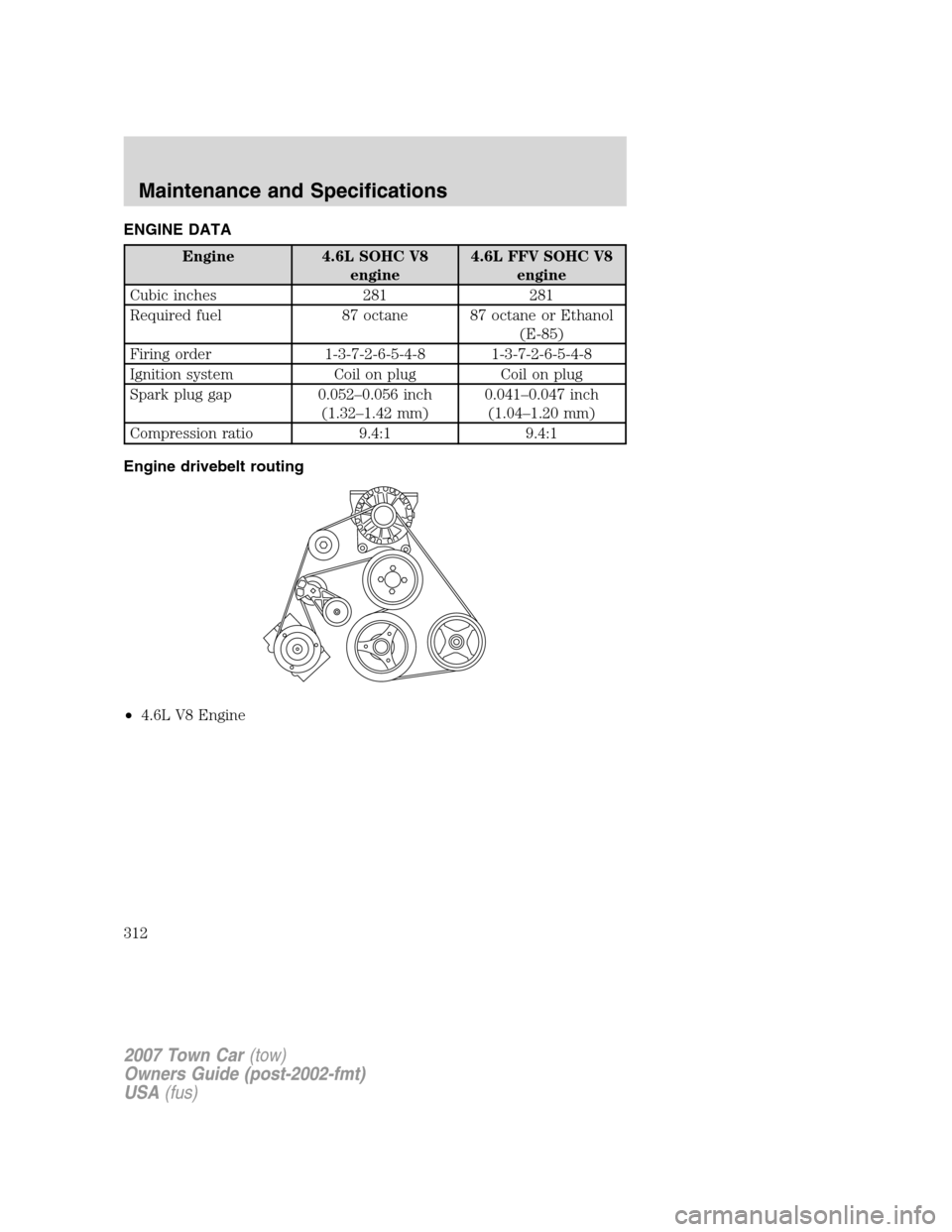
Engine drivebelt routing
•4.6L V8 Engine
2007 Town Car(tow)
Owners Guide (post-2002-fmt)
USA(fus)
Maintenance and Specifications
312
Page 319 of 328
cap ...........................................294
capacity ...................................309
choosing the right fuel ...........295
comparisons with EPA fuel
economy estimates .................300
detergent in fuel .....................295
filling your vehicle
with fuel ..................291, 294, 298
filter, specifications ........291, 307
fuel filler door override ..........137
fuel filler door release ............136
fuel pump shut-off switch .....241
improving fuel economy ........297
octane rating ...................296, 312
quality ......................................296
running out of fuel .................297
safety information relating to
automotive fuels .....................291
Fuel - flex fuel vehicle
(FFV) .........................291, 295–296
Fuses ..................................242–243
G
Gas cap (see Fuel cap) ............294
Gas mileage
(see Fuel economy) .................297
Gauges .........................................13
H
Hazard flashers .........................241
Head restraints .........................155
Headlamps ...................................97
aiming ........................................99
autolamp system .......................97
bulb specifications ..................102
daytime running lights .............98
flash to pass ..............................98
high beam .................................98replacing bulbs .......................103
turning on and off ....................97
Homelink wireless control
system ........................................120
Hood ..........................................277
I
Ignition ...............................223, 312
Illuminated visor mirror ...........109
Infant seats
(see Safety seats) .....................191
Inspection/maintenance (I/M)
testing ........................................302
Instrument panel
cleaning ...................................272
cluster ........................................10
lighting up panel and
interior .......................................99
J
Jack ............................................248
positioning ...............................248
storage .....................................248
Jump-starting your vehicle ......255
K
Keyless entry system ...............147
keypad .....................................147
locking and unlocking doors ..148
programming entry code .......147
Keys ...................................138, 152
positions of the ignition .........223
L
Lamps
autolamp system .......................97
2007 Town Car(tow)
Owners Guide (post-2002-fmt)
USA(fus)
Index
319