2007 LINCOLN MKX power steering
[x] Cancel search: power steeringPage 223 of 320

•Some noise is normal during operation. If the noise is excessive, check
for a low power steering fluid level before seeking service by your
authorized dealer.
•Heavy or uneven steering efforts may be caused by a low power
steering fluid level. Check for a low power steering fluid level before
seeking service by your authorized dealer.
•Do not fill the power steering fluid reservoir above the MAX mark on
the reservoir.
If the power steering system breaks down (or if the engine is turned
off), you can steer the vehicle manually, but it takes more effort.
If the steering wanders or pulls, check for:
•an improperly inflated tire
•uneven tire wear
•loose or worn suspension components
•loose or worn steering components
•improper steering alignment
A high crown in the road or high crosswinds may also make the steering
seem to wander/pull.
AUTOMATIC TRANSMISSION OPERATION
Brake-shift interlock
This vehicle is equipped with a brake-shift interlock feature that prevents
the gearshift lever from being moved from P (Park) when the ignition is
in the RUN position unless brake pedal is depressed.
If you cannot move the gearshift lever out of P (Park) with ignition in
the RUN position and the brake pedal depressed:
2007 MKX(mkx)
Owners Guide (post-2002-fmt)
USA(fus)
Driving
223
Page 229 of 320

ALL WHEEL DRIVE (AWD) SYSTEM (IF EQUIPPED)
Your vehicle may be equipped with a full-time All Wheel Drive (AWD)
system. With the AWD option, power will be delivered to the front
wheels and distributed to the rear wheels as needed. The AWD system is
active all the time and requires no input from the operator.
All components of the AWD system are sealed for life and require no
maintenance.
If your vehicle is equipped with AWD, a spare tire of a different size
other than the tire provided should never be used. A dissimilar spare tire
size (other than the spare tire provided) or major dissimilar tire sizes
between the front and rear axles could cause the AWD system to stop
functioning and default to front wheel drive and could damage the
system.
Note:Your AWD vehicle is not intended for severe off-road use. The
AWD feature gives your vehicle some limited off-road capabilities in
which driving surfaces are relatively level, obstruction-free and otherwise
similar to normal on-road driving conditions. Operating your vehicle
under other than those conditions could subject the vehicle to excessive
stress which might result in damage which is not covered under your
warranty.
Driving off-highway with AWD vehicles
AWD vehicles are equipped for driving on sand, snow, mud and rough
roads and have operating characteristics that are somewhat different
from conventional vehicles, both on and off the highway.
When driving at slow speeds off-highway under high outside
temperatures, use L (Low) gear when possible. L (Low) gear operation
will maximize the engine and transmission cooling capability.
Under severe operating conditions, the A/C may cycle on and off to
protect overheating of the engine.
Basic operating principles
•Drive slower in strong crosswinds which can affect the normal steering
characteristics of your vehicle.
•Be extremely careful when driving on pavement made slippery by
loose sand, water, gravel, snow or ice.
2007 MKX(mkx)
Owners Guide (post-2002-fmt)
USA(fus)
Driving
229
Page 231 of 320

Emergency maneuvers
•In an unavoidable emergency situation where a sudden sharp turn
must be made, remember to avoid “over-driving” your vehicle (i.e.,
turn the steering wheel only as rapidly and as far as required to avoid
the emergency). Excessive steering will result in less vehicle control,
not more. Additionally, smooth variations of the accelerator and/or
brake pedal pressure should be utilized if changes in vehicle speed are
called for. Avoid abrupt steering, acceleration or braking which could
result in an increased risk of loss of vehicle control, vehicle rollover
and/or personal injury. Use all available road surface to return the
vehicle to a safe direction of travel.
•In the event of an emergency stop, avoid skidding the tires and do not
attempt any sharp steering wheel movements.
•If the vehicle goes from one type of surface to another (i.e., from
concrete to gravel) there will be a change in the way the vehicle
responds to a maneuver (steering, acceleration or braking). Again,
avoid these abrupt inputs.
AWD Systems (if equipped)
With AWD, the vehicle uses all four wheels to power the vehicle. This
increases traction, enabling you to drive over terrain and road conditions
that a conventional two-wheel drive vehicle cannot.
Sand
When driving over sand, try to keep all four wheels on the most solid
area of the trail. Avoid reducing the tire pressures but shift to a lower
gear and drive steadily through the terrain. Apply the accelerator slowly
and avoid spinning the wheels.
Do not drive your AWD vehicle in deep sand for an extended period of
time. This will cause the AWD system to overheat. If the rear tires stop
spinning while the front tires spin in deep sand, turn off the vehicle and
allow the AWD system to cool down for a minimum of 15 minutes. After
the system has cooled down, normal AWD function will return. When
driving at slow speeds in deep sand under high outside temperatures,
use L (Low) gear when possible. L (Low) gear operation will maximize
the engine and transmission cooling capability.
Under severe operating conditions, the A/C may cycle on and off to
protect overheating of the engine.
Avoid excessive speed because vehicle momentum can work against you
and cause the vehicle to become stuck to the point that assistance may
2007 MKX(mkx)
Owners Guide (post-2002-fmt)
USA(fus)
Driving
231
Page 233 of 320

the route you will use. Do not drive over the crest of a hill without
seeing what conditions are on the other side. Do not drive in reverse
over a hill without the aid of an observer.
When climbing a steep slope or hill, start in a lower gear rather than
downshifting to a lower gear from a higher gear once the ascent has
started. This reduces strain on the engine and the possibility of stalling.
If you do stall out, do not try to turnaround because you might roll over.
It is better to back down to a safe location.
Apply just enough power to the wheels to climb the hill. Too much
power will cause the tires to slip, spin or lose traction, resulting in loss of
vehicle control.
Descend a hill in the same gear you
would use to climb up the hill to
avoid excessive brake application
and brake overheating. Do not
descend in neutral; instead,
disengage overdrive or manually
shift to a lower gear. When
descending a steep hill, avoid
sudden hard braking as you could
lose control. The front wheels have
to be turning in order to steer the
vehicle.
Your vehicle has anti-lock brakes, therefore apply the brakes steadily. Do
not “pump” the brakes.
Driving on snow and ice
Note:Excessive tire slippage can cause transaxle damage.
AWD vehicles have advantages over 2WD vehicles in snow and ice but
can skid like any other vehicle.
Should you start to slide while driving on snowy or icy roads, turn the
steering wheel in the direction of the slide until you regain control.
Avoid sudden applications of power and quick changes of direction on
snow and ice. Apply the accelerator slowly and steadily when starting
from a full stop.
Avoid sudden braking as well. Although an AWD vehicle may accelerate
better than a two-wheel drive vehicle in snow and ice, it won’t stop any
faster, because as in other vehicles, braking occurs at all four wheels. Do
not become overconfident as to road conditions.
2007 MKX(mkx)
Owners Guide (post-2002-fmt)
USA(fus)
Driving
233
Page 240 of 320

Fuse/Relay
LocationFuse Amp
RatingPassenger Compartment Fuse
Panel Description
10 15A Backlighting, Puddle lamps
11 10A All wheel drive
12 7.5A Power mirror switch, Driver side
power seat memory, Driver seat
module – Keep alive power (KA)
13 7.5A Not used
14 10A Power liftgate module
15 10A Climate control
16 15A Not used (Spare)
17 20A All power lock motor feeds,
Liftgate release, Moon roof
18 20A THX system
19 25A Rear wiper
20 15A Datalink
21 15A Fog lamps
22 15A Park lamps
23 15A High beam headlamps
24 20A Horn relay
25 10A Demand lamps/Interior lamps
26 10A Instrument panel cluster
27 20A Ignition switch
28 5A Radio
29 5A Instrument panel cluster
30 5A Overdrive cancel switch
31 10A Compass, Automatic dimming rear
view mirror
32 10A Not used (Spare)
33 10A Not used (Spare)
34 5A Steering angle sensor
35 10A Rear park assist, AWD, Heated
seat module
36 5A PATS transceiver
2007 MKX(mkx)
Owners Guide (post-2002-fmt)
USA(fus)
Roadside Emergencies
240
Page 275 of 320

IDENTIFYING COMPONENTS IN THE ENGINE COMPARTMENT
3.5L V6 engine
1. Engine coolant reservoir
2. Power steering fluid reservoir
3. Brake fluid reservoir
4. Battery
5. Power distribution box
6. Air filter assembly
7. Transmission fluid dipstick
8. Engine oil dipstick
9. Engine oil filler cap
10. Windshield washer fluid reservoir
2007 MKX(mkx)
Owners Guide (post-2002-fmt)
USA(fus)
Maintenance and Specifications
275
Page 288 of 320

Continued operation will increase the engine temperature:
•The engine will completely shut down.
•Steering and braking effort will increase.
Once the engine temperature cools, the engine can be re-started. Take
your vehicle to an authorized dealer as soon as possible to minimize
engine damage.
When fail-safe mode is activated
You have limited engine power when in the fail-safe mode, so drive the
vehicle with caution. The vehicle will not be able to maintain high speed
operation and the engine will run rough. Remember that the engine is
capable of completely shutting down automatically to prevent engine
damage, therefore:
1. Pull off the road as soon as safely possible and turn off the engine.
2. Arrange for the vehicle to be taken to an authorized dealer.
3. If this is not possible, wait a short period for the engine to cool.
4. Check the coolant level and replenish if low.
Never remove the coolant reservoir cap while the engine is
running or hot.
5. Restart the engine and take your vehicle to an authorized dealer.
Driving the vehicle without repairing the engine problem
increases the chance of engine damage. Take your vehicle to an
authorized dealer as soon as possible.
FUEL FILTER
Your vehicle is equipped with a lifetime fuel filter that is integrated with
the fuel tank. Regular maintenance or replacement is not needed.
WHAT YOU SHOULD KNOW ABOUT AUTOMOTIVE FUELS
Important safety precautions
Do not overfill the fuel tank. The pressure in an overfilled tank
may cause leakage and lead to fuel spray and fire.
2007 MKX(mkx)
Owners Guide (post-2002-fmt)
USA(fus)
Maintenance and Specifications
288
Page 299 of 320
The OBD-II system is designed to check the emission control system
during normal driving. A complete check may take several days. If the
vehicle is not ready for I/M testing, the following driving cycle consisting
of mixed city and highway driving may be performed:
15 minutes of steady driving on an expressway/highway followed by 20
minutes of stop-and-go driving with at least four 30-second idle periods.
Allow the vehicle to sit for at least eight hours without starting the
engine. Then, start the engine and complete the above driving cycle. The
engine must warm up to its normal operating temperature. Once started,
do not turn off the engine until the above driving cycle is complete. If
the vehicle is still not ready for I/M testing, the above driving cycle will
have to be repeated.
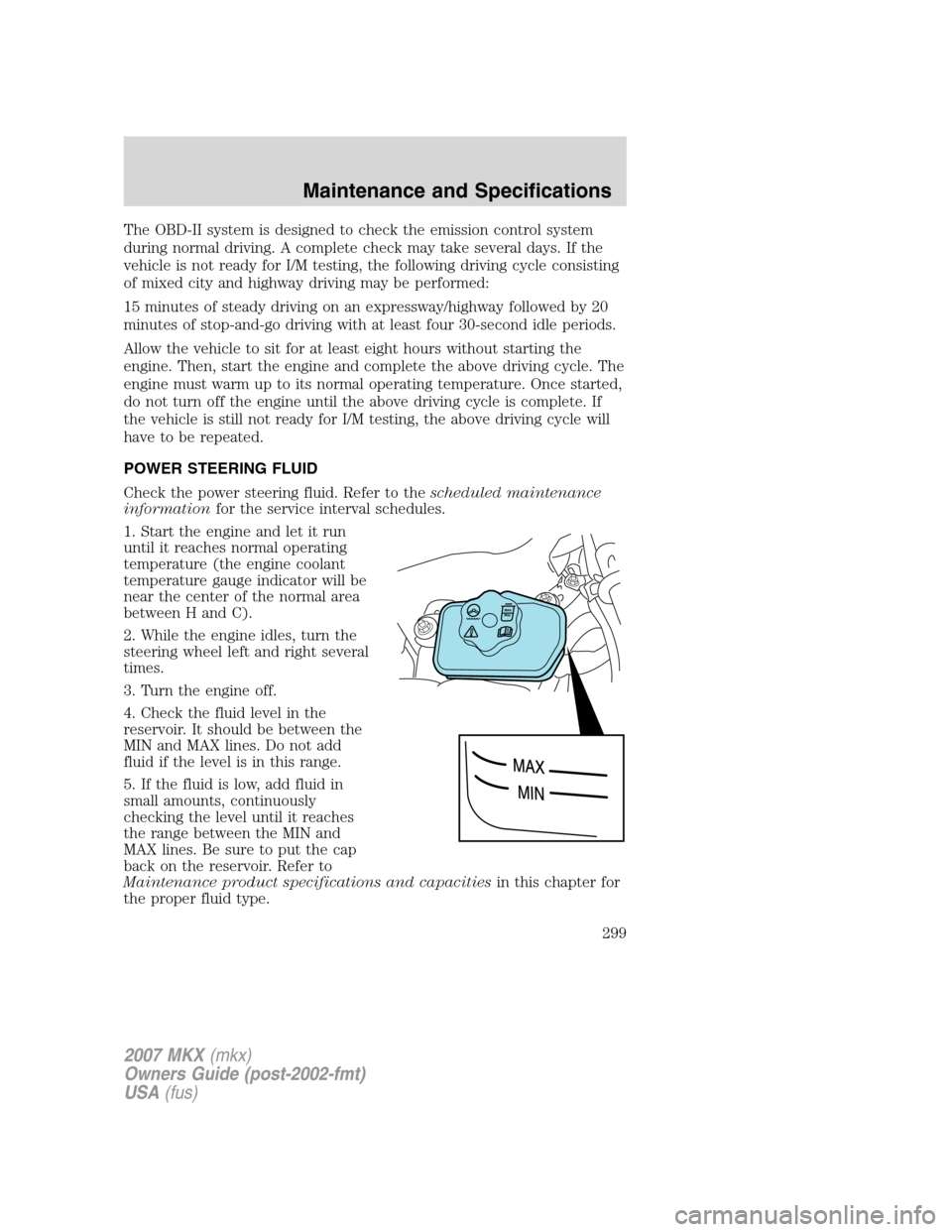
POWER STEERING FLUID
Check the power steering fluid. Refer to thescheduled maintenance
informationfor the service interval schedules.
1. Start the engine and let it run
until it reaches normal operating
temperature (the engine coolant
temperature gauge indicator will be
near the center of the normal area
between H and C).
2. While the engine idles, turn the
steering wheel left and right several
times.
3. Turn the engine off.
4. Check the fluid level in the
reservoir. It should be between the
MIN and MAX lines. Do not add
fluid if the level is in this range.
5. If the fluid is low, add fluid in
small amounts, continuously
checking the level until it reaches
the range between the MIN and
MAX lines. Be sure to put the cap
back on the reservoir. Refer to
Maintenance product specifications and capacitiesin this chapter for
the proper fluid type.
2007 MKX(mkx)
Owners Guide (post-2002-fmt)
USA(fus)
Maintenance and Specifications
299