Page 82 of 562

62
1-7. Safety information
■Operating conditions (front airbags)
●The SRS front airbags will deploy if the severity of the frontal impact is above the
designed threshold level, comparable to an approximate 15 mph (25 km/h) col-
lision, when the vehicle impacts straight into a fixed barrier that does not move
or deform.
However, this threshold velocity will be considerably higher if the vehicle strikes
an object, such as a parked vehicle or sign pole, which can move or deform on
impact, or if the vehicle is involved in an underride collision (e.g. a collision in
which the front of the vehicle “underrides”, or goes under, the bed of a truck, etc.).
●It is possible that in some collisions where the forward deceleration of the vehi-
cle is very close to the designed thresh old level, the SRS front airbags and the
seat belt pretensioners ma y not activate together.
●The SRS front passenger airbags will not activate, if there is no passenger sitting
in the front passenger seat. However, th e front passenger airbag may deploy, if
heavy luggage is put, even if the seat is unoccupied. ( P. 7 2 )
■Operating conditions (side and curtain shield airbags)
●The SRS side airbags and curtain shield ai rbags are designed to inflate when the
passenger compartment is subjected to a severe impact from the side.
●The SRS front side airbag on the passenger seat will not activate, if there is no
passenger sitting in the front passenger seat. However, the front side airbag on
the passenger seat may deploy, if heavy luggage is put, even if the seat is unoc-
cupied. ( P. 7 2 )
■Conditions under which the SRS airbags may deploy (inflate), other than a colli-
sion
The SRS front airbags may also deploy if a serious impact occurs to the underside of
your vehicle. Some examples are shown in the illustration.
●Hitting a curb, edge of pavement or hard
surface
●Falling into or jumping over a deep hole
●Landing hard or vehicle falling
Page 247 of 562

227
3-3. Using the audio system
3
Interior features
■MP3 and WMA files
MP3 (MPEG Audio LAYER 3) is a standard audio compression format.
Files can be compressed to approximately 1 /10 of their original size by using MP3
compression.
WMA (Windows Media
TMAudio) is a Microsoft audio compression format.
This format compresses audio data to a size smaller than that of the MP3 format.
There is a limit to the MP3 and WMA file standards and to the media/formats
recorded by them that can be used.
●MP3 file compatibility
• Compatible standards
MP3 (MPEG1 LAYER3, MPEG2 LSF LAYER3)
• Compatible sampling frequencies
MPEG1 LAYER3: 32, 44.1, 48 (kHz)
MPEG2 LSF LAYER3: 16, 22.05, 24 (kHz)
• Compatible bit rates
MPEG1 LAYER3: 64, 80, 96, 112, 128, 160, 192, 224, 256, 320 (kbps)
• MPEG2 LSF LAYER3: 64, 80, 96 , 112, 128, 144, 160 (kbps)
*: Compatible with VBR
• Compatible channel modes: stereo, joint stereo, dual channel and monaural
●WMA file compatibility
• Compatible standards
WMA Ver. 7, 8, 9
• Compatible sampling frequencies
32, 44.1, 48 (kHz)
• Compatible bit rates
Ver. 7, 8: CBR 48, 64, 80, 96, 128, 160, 192 (kbps)
Ver. 9: CBR 48, 64, 80, 96, 128, 160, 192, 256, 320 (kbps)
*: Only compatible with 2-channel playback
●Compatible media
Media that can be used for MP3 and WMA playback are CD-Rs and CD-RWs.
Playback in some instances may not be po ssible, depending on the status of the
CD-R or CD-RW. Playback may not be poss ible or the audio may jump if the disc
is scratched or marked with fingerprints.
Page 508 of 562
488
5-2. Steps to take in an emergency
If the vehicle battery is discharged
The following procedures may be used to start the engine if the vehicle’s
battery is discharged.
You can call your Lexus dealer, Roadside Assistance or Lexus Customer
Se
rvice Assistance.
If you have a set of jumper (or booster) cables and a second vehicle
with a 12-volt battery, you can jump start your Lexus following the steps
below.
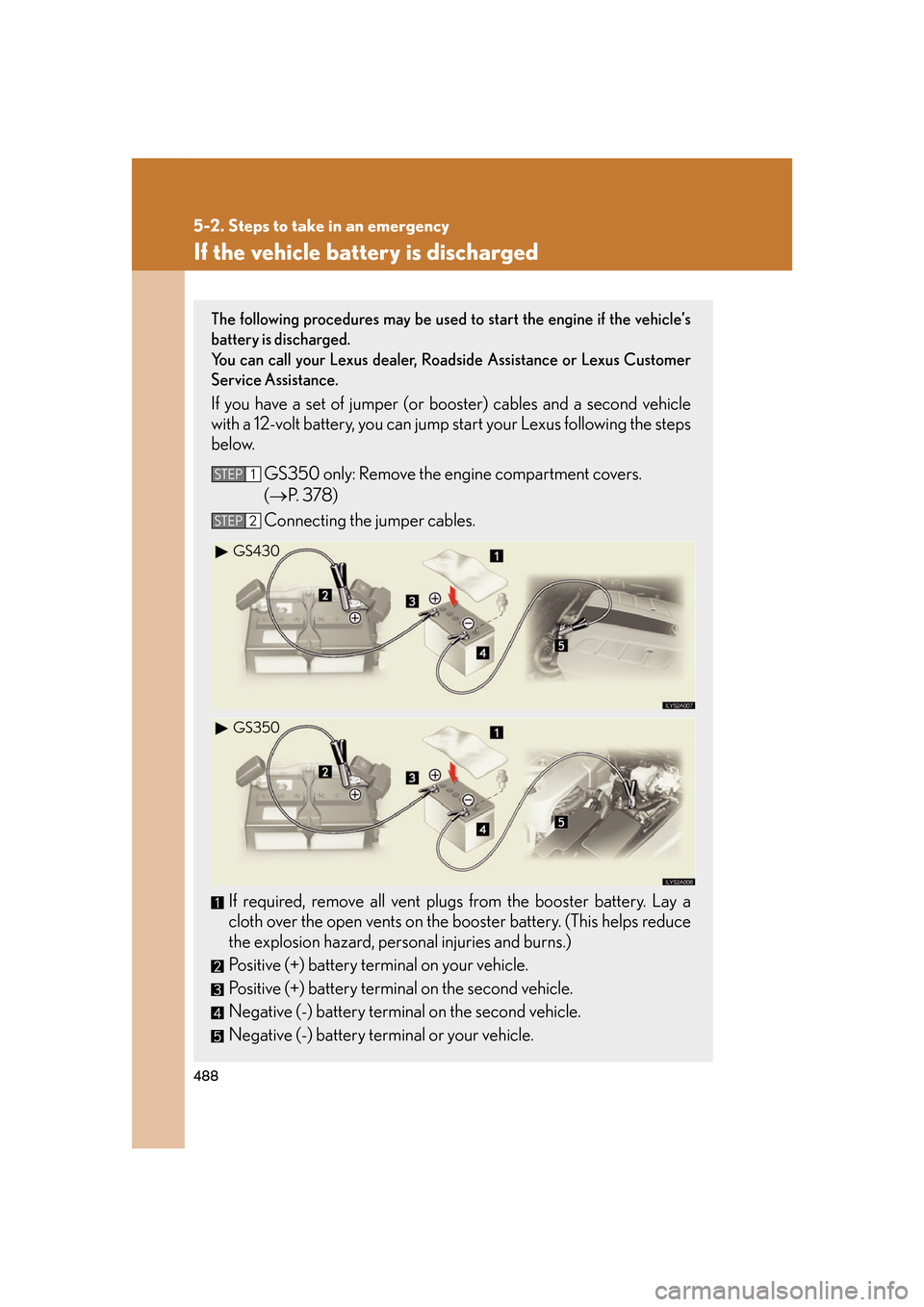
GS350 only: Remove the engine compartment covers.
( P. 3 7 8 )
Connecting the jumper cables.
If required, remove all vent pl ugs from the booster battery. Lay a
cloth over the open vents on the booster batter
y. (This helps reduce
the explosion hazard, personal injuries and burns.)
Positive (+) battery terminal on your vehicle.
Positive (+) battery terminal on the second vehicle.
Negative (-) battery terminal on the second v
ehicle.
Negative (-) battery terminal or your vehicle.
STEP1
STEP2
GS430
GS350
Page 509 of 562

5
When trouble arises
489
5-2. Steps to take in an emergency
■Avoiding a discharged battery
●Turn off the headlights and the audio system while the engine is turned off.
●Turn off any unnecessary electrical compon ents when the vehicle is running at a
low speed for an extended period, such as in heavy traffic, etc.
■When the battery is removed or discharged
The following systems must be initialized.
●Po w e r w i n d o w s (P. 4 3 )
●Variable gear ratio steering (P. 1 5 9 )
●Tire pressure warning system (P. 3 9 3 )
●Intuitive parking assist (P. 1 3 6)
Start the engine of the second vehicle. Increase the engine
speed slightly and maintain at that level for approximately five
minutes to recharge the battery of your vehicle.
Open and close any of the doors with the engine s
witch “OFF”.
Maintain the engine speed on th e second v
ehicle and turn the
engine switch to the “IG-ON” mode, then start the vehicle’s
engine.
Once the vehicle’s engine ha s star
ted, remove the jumper
cables in the exact reverse ord er in which they w
ere con-
nected.
Once the engine starts, have the ve hicle check
ed at your Lexus dealer
as soon as possible.
STEP3
STEP4
STEP5
STEP6
Page 510 of 562

490
5-2. Steps to take in an emergency
CAUTION
■Avoiding battery fires or explosions
Observe the following precautions to prevent accidentally igniting the flammable
gas that may be emitted from the battery.
●Make sure the jumper cable is connected to the correct terminal and that it is not
unintentionally in contact with any pa rt other than the intended terminal.
●Do not allow the jumper cables to come into contact with the “+” and “-” termi-
nals.
●Do not allow open flame or use matches, cigarette lighters or smoke near the
battery.
■Battery precautions
The battery contains poisonous and corrosive acidic electrolyte, while related parts
contain lead and lead compounds. Observe the following precautions when han-
dling the battery:
●When working with the battery, always we ar safety glasses and take care not to
allow any battery fluids (acid) to come into contact with skin, clothing or the vehi-
cle body.
●Do not lean over the battery.
●In the event that battery fluid comes into contact with the skin or eyes, immedi-
ately wash the affected area with water and seek medical attention.
Place a wet sponge or cloth over the affected area until medical attention can be
received.
●Always wash your hands after handling the battery support, terminals, and other
battery-related parts.
●Do not allow children near the battery.
Page 511 of 562
5
When trouble arises
491
5-2. Steps to take in an emergency
NOTICE
■To prevent damaging the vehicle
Do not pull- or push-start the vehicle, because the three-way catalytic converter
may overheat and become a fire hazard.
■When handling jumper cables
Be careful that the jumper cables do not become tangled in the cooling fan or any
of the belts when connecting or disconnecting them.