2007 KIA Sportage seats
[x] Cancel search: seatsPage 53 of 350
Knowing your vehicle44
3
1
2
3
4
5
6
7
8
9
Restraint of larger children As children grow, they may need to
use new child-restraint systems,
including larger child seats or boost-
er seats, which are appropriate for
their increased size.
A child who has outgrown available
child-restraint systems should use
the belts provided in the vehicle.
When seated in the rear outboard
seats, the child should be restrained
by the lap/shoulder belt.
If the shoulder belt portion slightly
touches the child’s neck or face, try
placing the child closer to the center
of the vehicle. If the shoulder belt still
touches their face or neck they need
to be returned to a child restraint sys-
tem. In addition, after-market devices
are available from independent man-
ufacturers which help pull the shoul-
der belt down and away from the
child’s face or neck.
WARNING
- Infants and
young children
Infants and young children are at much greater risk of serious
injury or death in an accident
or sudden stop if they are unre-
strained or restrained improp-
erly. Follow all instructions in
this section and the instruc-
tions that came with an
approved child safety system.
The child restraint must be cor-
rectly installed in the vehicle,
and the child must be correctly
placed in the child restraint.
All children under 12 are safest in the back seat.
Never install a child or infant seat in the front passenger
position. The baby will be
injured or killed by the airbag
if it deploys.
Never allow a child to stand or
kneel on the seat of a moving
vehicle.
WARNING
- Children on laps
Never hold a child on your lap or
in your arms in a moving vehi-
cle.
Even a very strong person can-
not hold onto a child in the
event of even a minor collision.
CAUTION
- Hot metal parts
Safety belts and seats canbecome hot in a vehicle that hasbeen closed during warm/hotweather; they could burn achild. Check seat covers andbuckles before you place a childanywhere near them.
Page 54 of 350
345
Knowing your vehicle
1
2
3
4
5
6
7
8
9
Child restraint system For small children and babies, the
use of a child seat or infant seat is
strongly recommended and is
required by law in almost all states.
This child seat or infant seat should
be of appropriate size for the child
and should be installed in accor-
dance with the manufacturer's
instructions.
Children riding in the car should sit
on the rear seat and must always be
properly restrained to minimize the
risk of injury in an accident, sudden
stop or sudden maneuver. According
to accident statistics, children are
safer when properly restrained in the
rear seats than in the front seat.Children could be injured or killed in
a crash if their restraints are not
properly secured. For small children
and babies, a child seat or infant seat
must be used. Before buying a par-
ticular child restraint system, make
sure it fits your car and seat belts,
and fits your child. Follow all the
instructions provided by the child
seat manufacturer when installing
the child restraint system.
WARNING
- Shoulder
belts on small children
Never allow a shoulder belt to be in contact with a child’s
neck or face while the vehicle
is in motion.
If safety belts are not properly worn and adjusted, there is a
risk of death or serious injury
to such a child.
Page 56 of 350
347
Knowing your vehicle
1
2
3
4
5
6
7
8
9
Installing a child restraint system For safety reasons, we recommend
that the child restraint system be
used in the rear seats.
Never place a rear-facing child
restraint in the front passenger
seat, because of the danger that
an inflating passenger side air bag
could impact the rear-facing child
restraint and kill the child.
Since all passenger safety belts
move freely under normal conditions
and only lock under extreme or
emergency conditions (emergency
lock mode), you must manually
change these safety belts to the auto
lock mode to secure a child restraint.
(Continued)
Never allow a child to stand upor kneel while the vehicle is
moving.
Never use an infant carrier or child seat that "hooks" over a
seatback. It will not provide
adequate protection in an
accident.
Never allow a child to be held while they are in a moving
vehicle, as this could result in
serious injury to the child in
the event of an accident or a
sudden stop. Holding a child
in a moving vehicle does not
provide the child with any pro-
tection during an accident,
even if the person holding the
child is wearing a seat belt.
WARNING
- Child seat
installation
Before installing the child restraint system, read the
instructions supplied by the
child restraint system manu-
facturer.
If the safety belt does not operate as described in this
section, have the system
checked immediately by your
authorized Kia dealer.
Failure to observe this manu- al's instructions regarding
child restraint system and the
instructions provided with the
child restraint system could
increase the chance and/or
severity of injury in an acci-
dent.
Page 57 of 350
Knowing your vehicle48
3
1
2
3
4
5
6
7
8
9
Placing a passenger safety
belt into the auto lock modeThe use of the auto lock mode will
ensure that the normal movement of
the child in the vehicle does not
cause the safety belt to be pulled out
and loosen the firmness of its hold
on the child restraint system. To
secure a child restraint system, use
the following procedure.
Installing a child restraint system by
lap/shoulder belt
To install a child restraint system on
the outboard or center rear seats, do
the following:
1. Place the child restraint system inthe seat and route the lap/shoul-
der belt around or through the
restraint, following the restraint
manufacturer’s instructions. Be
sure the safety belt webbing is not
twisted. 2. Fasten the lap/shoulder belt latch
into the buckle. Listen for the dis-
tinct “click” sound.
Position the release button so that itis easy to access in case of anemergency.
E2MS103005
E2BLD310
Page 59 of 350
Knowing your vehicle50
3
1
2
3
4
5
6
7
8
9
7. Double check that the retractor is
in the “Auto Lock” mode by
attempting to pull more of the safe-
ty belt out of the retractor. If you
cannot, the retractor is in the “Auto
Lock” mode.
To remove the child restraint, press
the release button on the buckle and
then pull the lap/shoulder belt out of
the restraint and allow the safety belt
to retract fully.
When the safety belt is allowed to
retract to its fully stowed position,
the retractor will automatically
switch from the “Auto Lock” mode
to the emergency lock mode for
normal adult usage.
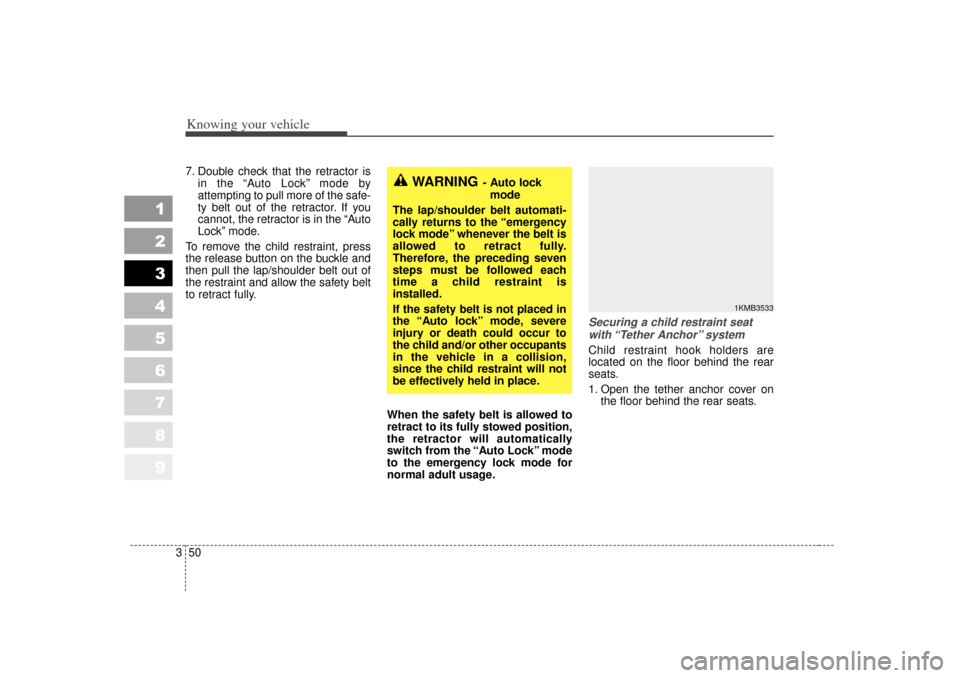
Securing a child restraint seatwith “Tether Anchor” system Child restraint hook holders are
located on the floor behind the rear
seats.
1. Open the tether anchor cover on the floor behind the rear seats.
WARNING
- Auto lock
mode
The lap/shoulder belt automati-
cally returns to the “emergency
lock mode” whenever the belt is
allowed to retract fully.
Therefore, the preceding seven
steps must be followed each
time a child restraint is
installed.
If the safety belt is not placed in
the “Auto lock” mode, severe
injury or death could occur to
the child and/or other occupants
in the vehicle in a collision,
since the child restraint will not
be effectively held in place.
1KMB3533
Page 61 of 350
Knowing your vehicle52
3
1
2
3
4
5
6
7
8
9
Child seat lower anchorsSome child seat manufacturers
make child restraint seats that are
labeled as International Standards
Organization Fixed (ISOFIX) or
ISOFIX-compatible child restraint
seats. These seats include two rigid
or webbing mounted attachments
that connect to two ISOFIX anchors
at specific seating positions in your
vehicle. This type of child restraint
seat eliminates the need to use seat
belts to attach the child seat in the
rear seats. There is a symbol located on the
lower portion of each side of the rear
seatbacks. These symbols indicate
the position of the lower anchors for
child restraints so equipped.
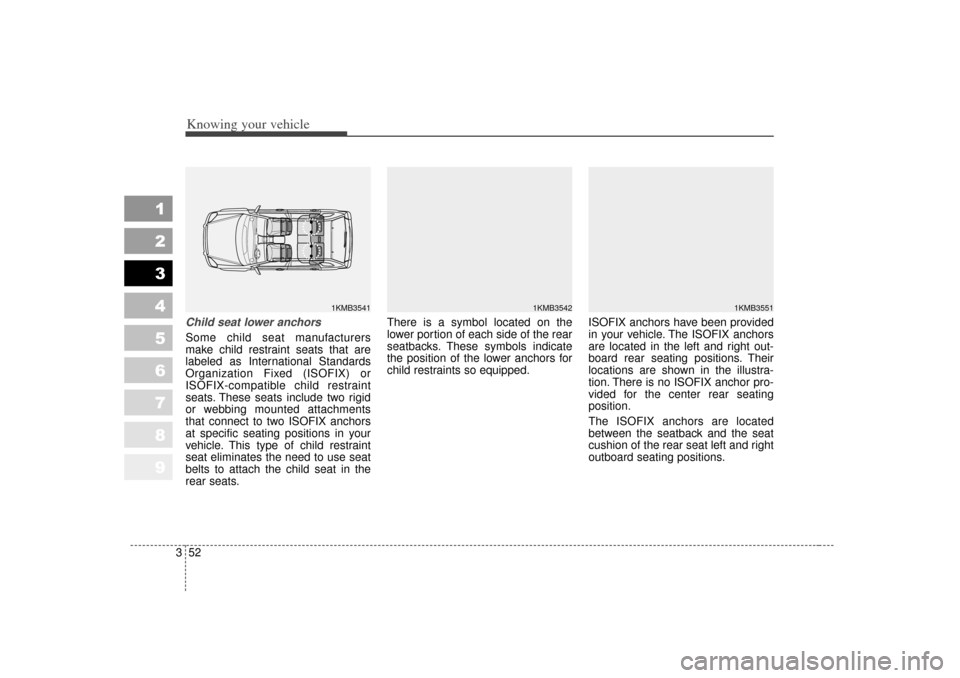
ISOFIX anchors have been provided
in your vehicle. The ISOFIX anchors
are located in the left and right out-
board rear seating positions. Their
locations are shown in the illustra-
tion. There is no ISOFIX anchor pro-
vided for the center rear seating
position.
The ISOFIX anchors are located
between the seatback and the seat
cushion of the rear seat left and right
outboard seating positions.
1KMB3541
1KMB3542
1KMB3551
Page 62 of 350
353
Knowing your vehicle
1
2
3
4
5
6
7
8
9
Follow the child seat manufacturer’s
instructions to properly install child
restraint seats with ISOFIX or
ISOFIX-compatible attachments.
Once you have installed the ISOFIX
child restraint, assure that the seat is
properly attached to the ISOFIX and
tether anchors. Also, test the child
restraint seat before you place the
child in it. Tilt the seat from side to
side. Also try to tug the seat forward.
Check to see if the anchors hold the
seat in place.
WARNING -
ISOFIX
Anchors
If the child restraint is not
anchored properly, the risk of a
child being seriously injured or
killed in a collision greatly
increases.
WARNING -
ISOFIX lower
anchors
ISOFIX lower anchors are only
to be used with the left and right
rear outboard seating positions.
Never attempt to attach an
ISOFIX equipped seat in the
center seating position. You
may damage the anchors or the
anchors may fail and break in a
collision.
WARNING
When using the vehicle’s
“ISOFIX” system to install a
child restraint system in the rear
seat, all unused vehicle rear
seat belt metal latch plates or
tabs must be latched securely in
their seat belt buckles and the
seat belt webbing must be
retracted behind the child
restraint to prevent the child
from reaching and taking hold
of unretracted seat belts.
Unlatched metal latch plates or
tabs may allow the child to
reach the unretracted seat belts
which may result in strangula-
tion and a serious injury or
death to the child in the child
restraint.
Page 66 of 350
357
1
2
3
4
5
6
7
8
9
Knowing your vehicle
Airbag system components The main components of your SRS
are:
To indicate that your vehicle isequipped with airbags, the corre-
sponding airbag covers are
marked with “SRS AIRBAG”.
- Driver’s airbag (see page 3- 59)
- Passenger’s airbag (see page 3- 60)
- Side airbag (if equipped, see page 3- 67)
- Curtain airbag (if equipped, see page 3- 67)
A diagnostic system that continual- ly monitors the system operation.
Airbag warning light to warn you of a possible problem with the sys-
tem.
Emergency power backup in case your car’s electrical system is dis-
connected in a crash. The SRS uses a collection of sen-
sors to gather information about the
driver’s and front passenger’s seat
position, the driver’s and front pas-
senger’s safety belt usage and
impact severity.
The driver's and front passenger's
seat position sensors, which are
installed on the seat track let the
airbag control module know where
the seats are positioned. Similarly,
the safety belt usage sensors mea-
sure if the driver and front passen-
ger’s safety belts are fastened. These
sensors provide the ability to control
the SRS deployment based on how
close the driver’s seat is to the steer-
ing wheel, how close the passen-
ger’s seat is to the instrument panel,
whether or not the safety belts are
fastened, and the severity of the
impact.
(Continued)
If your vehicle has been sub-
jected to flood conditions (e.g.
soaked carpeting/standing
water on the floor of the vehi-
cle, etc.) or if your vehicle has
become flood damaged in any
way, do not attempt to start
the vehicle or put the key in
the ignition. Have the vehicle
towed to an authorized Kia
dealer for inspection and nec-
essary repairs.
Disregarding this precaution
may cause an unexpected
airbag deployment, which
could result in serious per-
sonal injury or death.