Page 235 of 312
617
In case of an emergency
1
2
3
4
5
6
7
8
910
Driver-side knee bolster
Description Fuse rating Protected component
START10A Start motor
SRF/D_LOCK 20A Sunroof, Door lock
HAZARD 10A Hazard warning flasher
A/CON 10A Air conditioner
CLUSTER 10A Cluster
RKE 10A Remote keyless entry
S/HTR 20A Seat warmer
C/LIGHTER 15A Cigar lighter
A/BAG 15A Airbag
R/WIPER 15A Rear wiper
AUDIO 10A Audio
ABS 10A Anti-lock brake system
ACC/PWR 15A Accessory / Power socket
ROOM 15A Room lamp
IGN 10A Ignition
ECU 10A Engine control unit
TAIL RH 10A Tail light (right)
T/SIG 10A Turn signal light
RR/HTR 30A Rear window defroster
P/WDW LH 25A Power window (left)
HTD/MIRR 10A Outside rearview mirror heater
P/WDW RH 25A Power window (right)
TAIL LH 10A Tail light (left)
Description Fuse rating Protected component
RR/HTR - Rear window defroster relay
RESISTOR - Resistor
P/WDW - Power window relay
POWER - Accessory / Power socket relay
TAIL - Tail light relay
Page 238 of 312
In case of an emergency20
6
1
2
3
4
5
6
7
8
910
When towing your vehicle in an
emergency without wheel dollies :
1. Set the ignition switch in the ACC
position.
2. Place the transaxle shift lever in N (Neutral).
3. Release the parking brake.
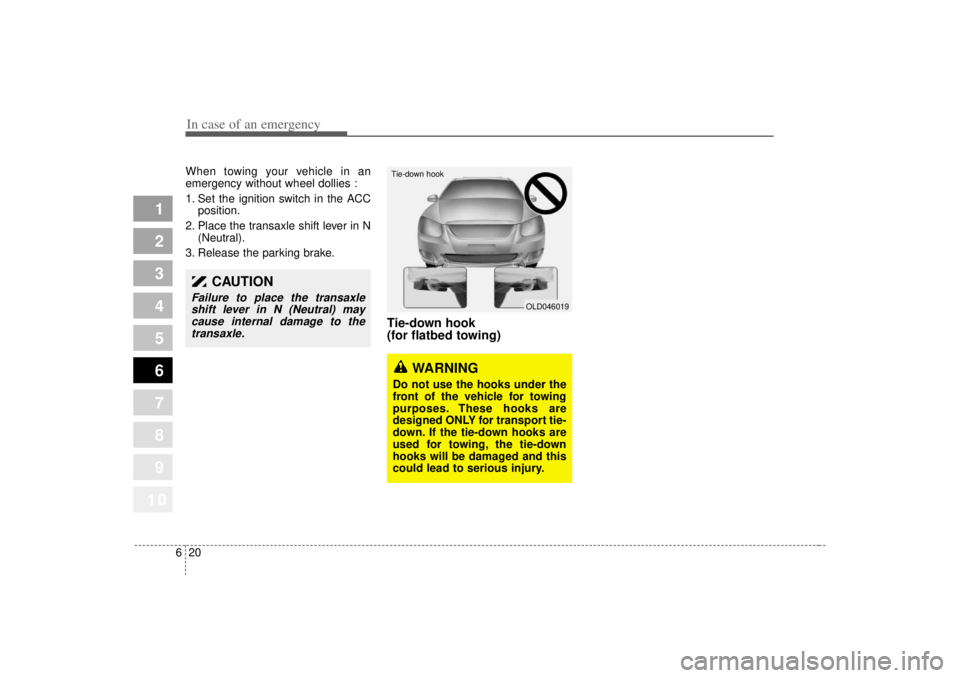
Tie-down hook
(for flatbed towing)
OLD046019
Tie-down hook
CAUTION
Failure to place the transaxle
shift lever in N (Neutral) maycause internal damage to thetransaxle.
WARNING
Do not use the hooks under the
front of the vehicle for towing
purposes. These hooks are
designed ONLY for transport tie-
down. If the tie-down hooks are
used for towing, the tie-down
hooks will be damaged and this
could lead to serious injury.
Page 239 of 312

621
In case of an emergency
1
2
3
4
5
6
7
8
910
Towing with a vehicle other
than a tow truck If towing is necessary, we recom-
mend you to have it done by an
Authorized Kia dealer or a commer-
cial tow truck service.
If towing service is not available in an
emergency, your vehicle may be
temporarily towed using a cable or
chain secured to the emergency tow-
ing hook under the front or rear of the
vehicle. Use extreme caution when
towing the vehicle. A driver must be
in the vehicle to steer it and operate
the brakes.Towing in this manner may be done
only on hard-surfaced roads for a
short distance and at low speeds.
Also, the wheels, axles, power train,
steering and brakes must all be in
good condition.
Do not use the tow hooks to pull a
vehicle out of mud, sand or other
conditions from which the vehicle
cannot be driven out under its own
power.
Avoid towing a vehicle heavier than the vehicle doing the towing.
The drivers of both vehicles should communicate with each other fre-
quently.
OLD046020
FrontOLD046021
Rear
Page 241 of 312

623
In case of an emergency
1
2
3
4
5
6
7
8
910
When your vehicle is being
towed by another vehicle
other than a tow truck (In case
of an emergency) Turn the ignition switch to ACC sothe steering wheel isn’t locked.
Place the transaxle shift lever in N (Neutral).
Release the parking bake.
Vehicle equipped with automatic transaxles should not exceed 28
mph (45 km/h) and should not be
towed more than 50 miles (80 km).
Vehicle equipped with manual transmissions should not be towed
in excess of 55 mph (88 km/h) and
should not be towed more than
400 miles (645 km). Press the brake pedal with more
force than normal since you will
have reduced brake performance.
More steering effort will be required because the power steer-
ing system will be disabled.
If you are driving down a long hill, the brakes may overheat and brake
performance will be reduced. Stop
often and let the brakes cool off.
Tips for towing a stuck vehicleThe following methods are effective
when your vehicle is stuck in mud,
sand or similar substances that pre-
vent the vehicle from being driven
out under its own power.
Remove the soil and sand, etc.from the front and the back of the
tires.
Place a stone or wood under the tires.
CAUTION
To prevent internal damage tothe transaxle, never tow yourvehicle from the rear (back-wards) with all four tires in con-tact with the surface.
Page 245 of 312
627
In case of an emergency
1
2
3
4
5
6
7
8
910
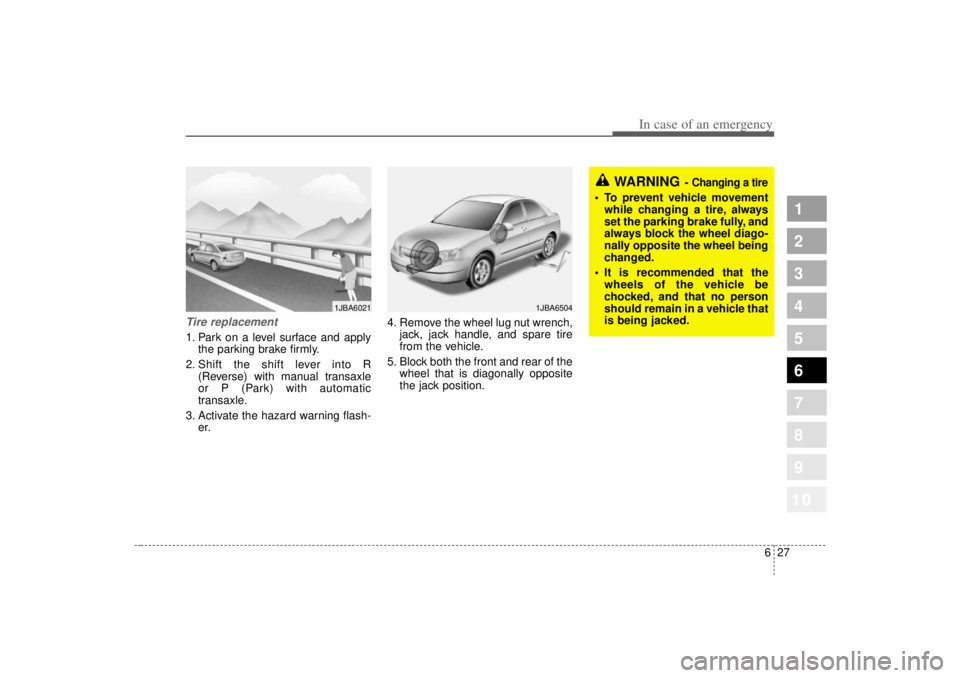
Tire replacement 1. Park on a level surface and applythe parking brake firmly.
2. Shift the shift lever into R (Reverse) with manual transaxle
or P (Park) with automatic
transaxle.
3. Activate the hazard warning flash- er. 4. Remove the wheel lug nut wrench,
jack, jack handle, and spare tire
from the vehicle.
5. Block both the front and rear of the wheel that is diagonally opposite
the jack position.
WARNING
- Changing a tire
To prevent vehicle movementwhile changing a tire, always
set the parking brake fully, and
always block the wheel diago-
nally opposite the wheel being
changed.
It is recommended that the wheels of the vehicle be
chocked, and that no person
should remain in a vehicle that
is being jacked.
1JBA6021
1JBA6504
Page 247 of 312

629
In case of an emergency
1
2
3
4
5
6
7
8
910
11. Once the wheel lug nuts havebeen tightened, lower the vehicle
fully to the ground and continue to
tighten the lug nuts until they are
fully secured. Tighten the wheel
lug nuts firmly in a “X” pattern.
If you are unsure of the tightness
of the wheel lug nuts, have them
checked at the nearest service
station. The specified tightening
torque is 65-79 lbft (9~11 kgm,
88-107 Nm). Improperly tight-
ened wheel lug nuts could cause
brake pedal vibration while brak-
ing. To prevent the jack, jack handle,
wheel lug nut wrench and spare tire
from rattling while the vehicle is in
motion, store them properly.
CAUTION
Your vehicle has metric threads
on the wheel bolts and nuts.Make certain during wheelremoval that the same nutsremoved are reinstalled - or, ifreplaced, that nuts with metricthreads and the same chamferconfiguration are used.Installation of a non-metricthread nut on a metric bolt orvice-versa will not secure thewheel to the hub properly andwill damage the bolt so that itmust be replaced.
Note that most lug nuts do nothave metric threads. Be sure touse extreme care in checkingfor thread style before installingaftermarket lug nuts or wheels.If in doubt, consult anAuthorized Kia Dealer.
WARNING
- Wheel bolts
If the bolts are damaged or if
non-metric nut is used on a met-
ric bolts or vice versa, they may
lose their ability to retain the
wheel. This could lead to the
loss of the wheel resulting in
severe injury or death.
WARNING
Check the inflation pressures as
soon as possible after installing
the spare tire. Adjust it to the
specified pressure, if necessary.
Refer to Section 8, Specifications.
OLD046018
Page 248 of 312
1
2
3
4
5
6
7
8
9101
2
3
4
5
6
7
8
910
Maintenance services / 7-2
Normal maintenance schedule / 7-4
Severe maintenance schedule / 7-7
Owner maintenance / 7-8
Engine compartment / 7-11
Engine oil and oil filter / 7-12
Engine cooling system / 7-13
Brakes and clutch / 7-16
Parking brake / 7-17
Power steering / 7-18
Manual transaxle / 7-19
Automatic transaxle / 7-21
Lubricants and fluids / 7-21
Air cleaner / 7-22
Climate control air filter / 7-24
Wiper blades / 7-26
Battery / 7-28
Tires and wheels / 7-31
Bulb replacement / 7-43
Exterior care / 7-50
Interior care / 7-54
Maintenance
Page 250 of 312

73
Maintenance
1
2
3
4
5
6
7
8
910
Scheduled maintenance serv-
ice Follow Normal Maintenance
Schedule if the vehicle is usually
operated where none of the following
conditions apply. If any of the follow-
ing conditions apply, follow
Maintenance Under Severe Usage
Conditions.
• Repeated short distance driving.
Driving in dusty conditions orsandy areas.
Extensive use of brakes.
Driving in areas where salt or other corrosive materials are being used.
Driving on rough or muddy roads.
Driving in mountainous areas.
Extended periods of idling or low speed operation.
Driving for a prolonged period in cold temperatures and/or extreme-
ly humid climates.
More than 50% driving in heavy city traffic during hot weather
above 90°F (32°C).
If your vehicle is operated under theabove conditions, you shouldinspect, replace or refill more fre-quently than the following NormalMaintenance Schedule. After 120months or 150,000 miles (240,000km) continue to follow the prescribedmaintenance intervals.