2007 KIA SPECTRA5 belt
[x] Cancel search: beltPage 63 of 312

Knowing your vehicle52
3
1
2
3
4
5
6
7
8
910
CAUTION
If the seat position sensor is not
working properly, the SRS airbag warning light ( ) on theinstrument panel will illuminateeven if there is no malfunctionof the SRS air bag system,because the SRS air bag warn-ing light is connected with theseat position sensor. If the SRSair bag warning light does notilluminate when the ignition keyis turned to the "ON" position, ifit remains illuminated afterblinking for approximately 6seconds, or if it illuminateswhile the vehicle is being driv-en, have an authorized Kia deal-er inspect the seat position sen-sor and the advanced SRS airbag system as soon as possi-ble.
WARNING
Modification to the seat struc- ture can adversely affect the
seat position sensor and
cause the air bag to deploy at
a different level than should
be provided.
Failure to properly wear safety belts can increase the risk or
severity of injury by causing
the air bags to deploy at a dif-
ferent level than should be
provided.
Do not place any objects underneath the front seats
which could damage the seat
position sensor or interfere
with the occupant classifica-
tion system.
Do not place any objects that may cause magnetic fields
near the front seat. These may
cause a malfunction of the
seat position sensor.
(Continued)
(Continued)
Ignoring the SRS indicatorlight (air bag indicator and
passenger air bag off indica-
tor) can result in serious or
fatal injury if the air bags
occupant classification sys-
tem or pretensioners do not
work properly. Have your car
checked by a dealer as soon
as possible if the SRS warning
light alerts you to a potential
problem.
Sitting improperly or out of position can result in serious
or fatal injury in a crash. All
occupants should sit upright
in their seats with their feet on
the floor until the vehicle is
parked and the ignition key is
removed.
Page 66 of 312
355
1
2
3
4
5
6
7
8
910
Knowing your vehicle
Always be sure that you and all vehi-
cle occupants are seated and
restrained properly (sitting upright
with the seat in an upright position,
centered on the seat cushion, with
the person's legs comfortably
extended, feet on the floor, and wear-
ing the safety belt properly) for the
most effective protection by the air
bag and the safety belt.
The OCS may not function proper-
ly if the passenger takes actions
which can defeat the detection sys-
tem. These include:
(1) Failing to sit in an upright posi- tion.
(2) Leaning against the door or cen- ter console.
(3) Sitting towards the sides or the front of the seat.
(4) Putting legs on the dashboard or resting them on other locations
which reduce the passenger
weight on the front seat.
(5) Improperly wearing the safety
belt.
(6) Reclining the seat back.
The “PASSENGER AIR BAG OFF”
indicator illuminates after the igni-
tion key is turned to the “ON”posi-
tion or after the engine is started. If
the front passenger's seat is occu-
pied by a very small person or is
occupied by someone who is
improperly seated, the “PASSEN-
GER AIR BAG OFF” indicator will
remain illuminated and the front
passenger air bag will not deploy in
frontal crashes. If the front passen-
ger’ s seat is occupied by an adult
size person seated properly, the
“PASSENGER AIR BAG OFF” indi-
cator will turn off after approxi-
mately 4 seconds and the front
passenger's air bag will deploy in
frontal collision.
CAUTION
If the occupant classification system is not working properly,the air bag warning light ( ) onthe instrument panel will illumi-nate. If there is a malfunction ofthe occupant classification sys-tem, the "PASSENGER AIR BAGOFF" indicator will not illumi-nate and the front passenger'sair bag will deploy in frontalcrashes even if there is child orno occupant in the front pas-senger’s seat. If the SRS air bagwarning light does not illumi-nate when the ignition key isturned to "ON" position, if itremains illuminated after blink-ing for approximately six sec-onds, or if it illuminates whilethe vehicle is being driven, havean authorized Kia dealer inspectthe occupant classification sys-tem with the SRS air bag systemas soon as possible.
Page 67 of 312
Knowing your vehicle56
3
1
2
3
4
5
6
7
8
910
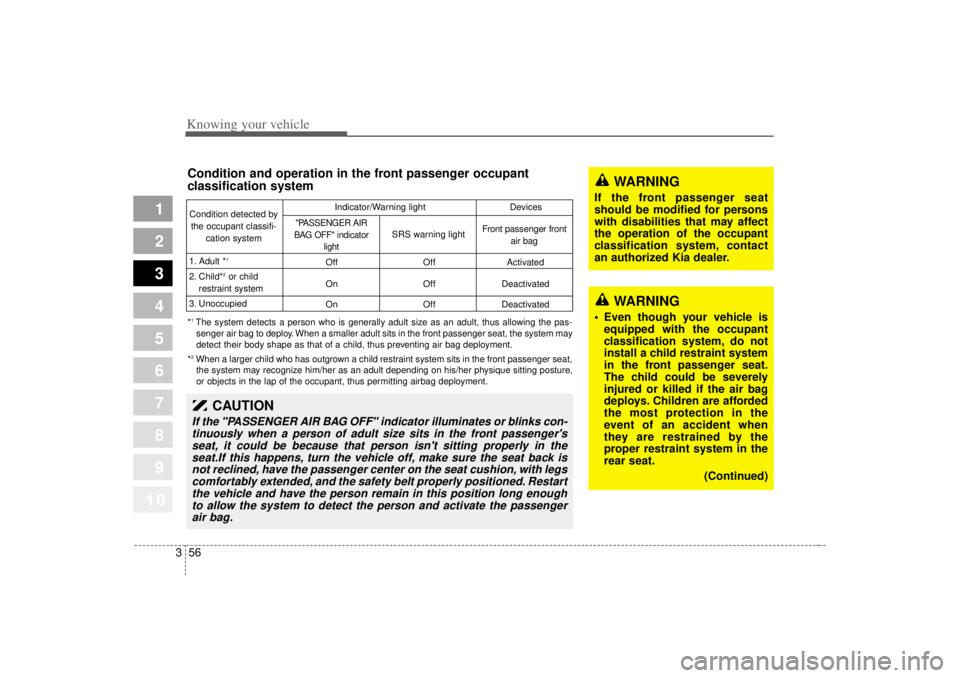
Condition and operation in the front passenger occupant
classification systemCondition detected by
the occupant classifi- cation system
1. Adult *
1
2. Child*
2or child
restraint system
3. Unoccupied Off
On
On Off
Off
OffActivated
Deactivated
Deactivated
"PASSENGER AIR
BAG OFF" indicator light
SRS warning light Front passenger front
air bag
Indicator/Warning light Devices
*1The system detects a person who is generally adult size as an adult, thus allowing the pas-
senger air bag to deploy. When a smaller adult sits in the front passenger seat, the system may
detect their body shape as that of a child, thus preventing air bag deployment.
*2When a larger child who has outgrown a child restraint system sits in the front passenger seat, the system may recognize him/her as an adult depending on his/her physique sitting posture,
or objects in the lap of the occupant, thus permitting airbag deployment.
CAUTION
If the "PASSENGER AIR BAG OFF" indicator illuminates or blinks con- tinuously when a person of adult size sits in the front passenger'sseat, it could be because that person isn't sitting properly in theseat.If this happens, turn the vehicle off, make sure the seat back isnot reclined, have the passenger center on the seat cushion, with legscomfortably extended, and the safety belt properly positioned. Restartthe vehicle and have the person remain in this position long enoughto allow the system to detect the person and activate the passengerair bag.
WARNING
If the front passenger seat
should be modified for persons
with disabilities that may affect
the operation of the occupant
classification system, contact
an authorized Kia dealer.
WARNING
Even though your vehicle is equipped with the occupant
classification system, do not
install a child restraint system
in the front passenger seat.
The child could be severely
injured or killed if the air bag
deploys. Children are afforded
the most protection in the
event of an accident when
they are restrained by the
proper restraint system in the
rear seat.
(Continued)
Page 68 of 312

357
1
2
3
4
5
6
7
8
910
Knowing your vehicle
(Continued)
If the "PASSENGER AIR BAGOFF" indicator is illuminated
when the front passenger's
seat is occupied by a person
of adult size who is seated
properly, or if the "PASSEN-
GER AIR BAG OFF" indicator"
is not illuminated when the
front passenger's seat is
unoccupied or occupied by a
very small person, the occu-
pant classification system is
not working properly. Have
your vehicle immediately
inspected by your Kia dealer if
the occupant classification
system is not working proper-
ly.
(Continued)
(Continued)
If a very low weight adult isseated in the front passenger
seat, the occupant classifica-
tion system may or may not
turn off the right front passen-
ger air bag, depending upon
the person's seating position
and body type. Everyone in
your vehicle should wear a
safety belt properly -- whether
or not there is an air bag for
that person.
If the front seat passenger changes their seating position
(for example, by not sitting
upright, by sitting on the edge
of the seat, or by otherwise
being out of position), the
"PASSENGER AIR BAG OFF"
indicator may be turned on,
and the passenger air bag
may not deploy in a collision.
Always be sure to sit properly
in the front passenger seat
and wear the safety belt prop-
erly.
(Continued)
(Continued)
1KMN36611KMN3662
- Never put a heavy load in thefront passenger seat.
- Never excessively recline the front passenger seatback.
(Continued)
Page 70 of 312

359
1
2
3
4
5
6
7
8
910
Knowing your vehicle
✽ ✽NOTICE• If luggage or other objects are
placed on the front passenger's
seat or if the temperature of the
seat changes while the seat is unoc-
cupied, the "PASSENGER AIR
BAG OFF" indicator may blink.
These conditions do not indicate a
problem.
• Do not put heavy objects on the front passenger's seat. This may
cause front passenger air bag
deployment in the event of an acci-
dent, thus increasing your repair
costs.
WARNING
- Front passen-
ger seating
The front seat passenger air bag is much larger than the
steering wheel air bag and
inflates with considerably
more force. It can seriously
hurt or kill a passenger who is
not in the proper position and
wearing the safety belt proper-
ly. The front passengers
should always move their seat
as far back as practical and sit
back in their seat.
It is essential that the front passengers always wear their
safety belts when vehicle is in
motion, even when the vehicle
is moving in a parking lot or
up a driveway into garage.
(Continued)
(Continued)
Any other such replacement or
modification could adversely
affect the operation of the
occupant classification sys-
tem and your advanced air
bags. For the same reason, do
not attach anything to the
seat, dashboard or door, even
temporarily. If the system is
adversely affected, it could
cause severe personal
injuries or death in a collision.
Do not place sharp objects on the front passenger seat.
These can damage the occu-
pant classification system, if
they puncture the seat cush-
ion.
Do not install accessory seat covers on the front seats,
since these will interfere with
proper sensor operation.
Page 71 of 312

Knowing your vehicle60
3
1
2
3
4
5
6
7
8
910
Side air bag (if equipped)Side air bags are stored in the left
side of the driver’ s seat and right side
of the front passenger’ s seat.
If air bag inflation conditions are met
(side collision), they will inflate.
1LDA2056
1LDN2050/1LDN2051
(Continued)
If the driver brakes the vehicle heavily prior to an impact,
unbelted occupants will be
thrown forward. If the front
passenger is not wearing the
safety belts, they will be
directly in front of the air bag
when deployment occurs. In
that situation, serious injury
or death is possible.
Never allow front passenger to put their hands, feet or face
on or close to the instrument
panel. In the event of air bag
deployment, such a misposi-
tioned occupant would be
likely to suffer severe injury or
death.
Never allow children, pregnant women or weak persons to sit
in the front passenger seat.
They may be seriously injured
by the air bag inflation when
air bag deploys.
(Continued)
(Continued)
Do not use child restraint sys-tems on the front passenger's
seat, as inflation may cause
death or severe personal
injury.
Do not put objects or stickers on the instrument panel. Do
not apply any accessory to the
front windshield. Do not install
aftermarket mirrors or acces-
sories on the factory-installed
rearview mirror. Any of these
could interfere with the
deployment of the air bag or
could hit your body at high
speed and cause severe bodi-
ly injury and even death.
Page 73 of 312

Knowing your vehicle62
3
1
2
3
4
5
6
7
8
910
WARNING
- Side and cur-
tain air bags
In order for side and curtain air bags to provide the best
protection, both front seat
occupants and both outboard
rear occupants should sit in
an upright position with the
safety belts properly fastened.
Importantly, children should
sit in a proper child restraint
system in the rear seat.
When children are seated in the rear outboard seats, they
must be seated in the proper
child restraint system. Make
sure to put the child restraint
system as far away from the
door side as possible, and
secure the child restraint sys-
tem in a locked position.
(Continued)
(Continued)
If a small child is seated onthe rear outboard seat cush-
ion, it is probable that they will
below the deployment level of
the side curtain airbag and
thus not protected by that
airbag.
Do not allow the passengers to lean their heads or bodies
onto doors, put their arms on
the doors, stretch their arms
out of the window, or place
objects between the doors
and passengers when they are
seated on seats equipped with
side air bags.
Never try to open or repair any components of the side cur-
tain air bag system. This
should only be done by an
authorized Kia dealer.
Failure to follow the above men-
tioned instructions can result in
severe injury or death to the
vehicle occupants in an acci-
dent.
Page 76 of 312

365
1
2
3
4
5
6
7
8
910
Knowing your vehicle
Side air bag (if equipped)
Side air bags (side and curtain air
bags) are designed to inflate when
an impact is detected by side colli-
sion sensors depending on the
strength, speed or angles of impact
of side impact of side impact collision
or rollover.Although the front air bags (driver
’s
and front passenger’ s air bags) are
designed to inflate only in frontal col-
lision, it may inflate in any collision if
front impact sensors detect a suffi-
cient impact. Side air bags (side and
curtain air bags) are designed to
inflate only in side impact collision, it
may inflate in any collision if side
impact sensors detect a sufficient
impact. If the vehicle chassis is impacted by
bumps or objects on unimproved
roads or sidewalks, air bags may
deploy. Drive carefully on unim-
proved roads or on surfaces not
designed for vehicle traffic.
To protect occupants, front air bags
or pre-tensioner safety belts may
deploy in certain side impact colli-
sions.
1JBA3514OUN026090