Page 274 of 325
7
Maintenance services / 7-2
Maintenance schedule / 7-3
Owner maintenance / 7-7
Engine compartment / 7-10
Engine oil / 7-11
Engine cooling system / 7-12
Brake fluid / 7-14
Power steering / 7-15
Automatic transmission / 7-16
Lubricants and fluids / 7-18
Air cleaner / 7-19
Climate control air filter / 7-20
Wiper blades / 7-20
Battery / 7-22
Tires and wheels / 7-25
Lubricant specifications / 7-37
Exterior care / 7-39
Interior care / 7-42
Maintenance
Page 275 of 325

Maintenance27MAINTENANCE SERVICESYou should exercise the utmost care to
prevent damage to your vehicle and
injury to yourself whenever performing
any maintenance or inspection proce-
dures.
Should you have any doubts concerning
the inspection or servicing of your vehi-
cle, we strongly recommend that you
have an Authorized Kia Dealer perform
this work.
An Authorized Kia Dealer has factory-
trained technicians and genuine Kia
parts to service your vehicle properly. For
expert advice and quality service, see an
Authorized Kia Dealer.
Inadequate, incomplete or insufficient
servicing may result in operational prob-
lems with your vehicle that could lead to
vehicle damage, an accident, or person-
al injury.
Owner’s responsibility Maintenance Service and Record
Retention are the owner's responsibil-
ity.
You must retain documents that show
proper maintenance has been performed
on your vehicle in accordance with the
scheduled maintenance service charts
shown on the following pages. You need
this information to establish your compli-
ance with the servicing and maintenance
requirements of your Kia warranties.
Detailed warranty information is provided
in your Warranty & Consumer Information
manual.Repairs and adjustments required as a
result of improper maintenance or a lack
of required maintenance are not covered.
We strongly recommend that all vehicle
maintenance be performed by an author-
ized Kia dealer using genuine Kia parts.
Page 282 of 325
79
Maintenance
Owner maintenance precautions Improper or incomplete service may
result in problems. This section gives
instructions only for the maintenance
items that are easy to perform.
As explained earlier in this section, sev-
eral procedures can be done only by an
Authorized Kia Dealer with special tools.✽ ✽NOTICEImproper owner maintenance during
the warranty period may affect warran-
ty coverage. For details, read the sepa-
rate Kia Warranty & Consumer
Information Manual provided with the
vehicle. If you're unsure about any serv-
icing or maintenance procedure, have it
done by an Authorized Kia Dealer.
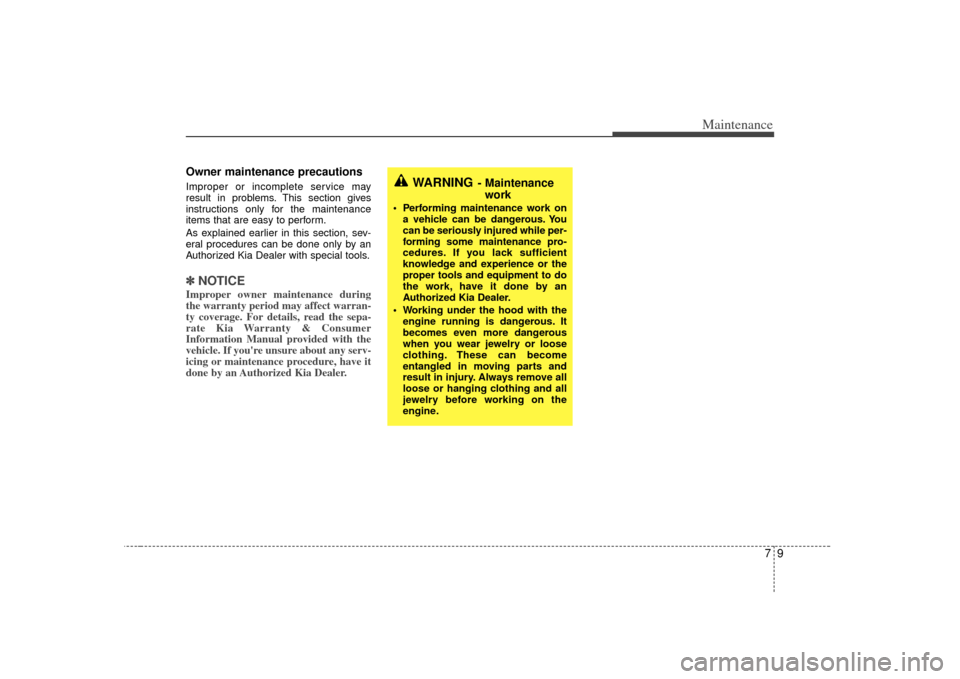
WARNING
- Maintenance
work
Performing maintenance work on
a vehicle can be dangerous. You
can be seriously injured while per-
forming some maintenance pro-
cedures. If you lack sufficient
knowledge and experience or the
proper tools and equipment to do
the work, have it done by an
Authorized Kia Dealer.
Working under the hood with the engine running is dangerous. It
becomes even more dangerous
when you wear jewelry or loose
clothing. These can become
entangled in moving parts and
result in injury. Always remove all
loose or hanging clothing and all
jewelry before working on the
engine.
Page 296 of 325
723
Maintenance
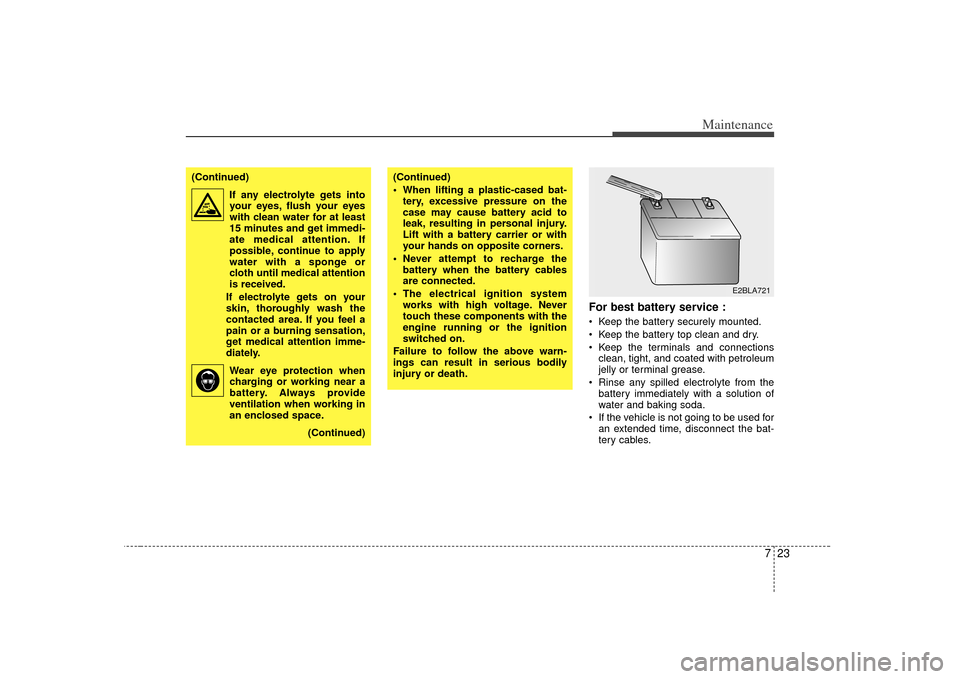
For best battery service : Keep the battery securely mounted.
Keep the battery top clean and dry.
Keep the terminals and connectionsclean, tight, and coated with petroleum
jelly or terminal grease.
Rinse any spilled electrolyte from the battery immediately with a solution of
water and baking soda.
If the vehicle is not going to be used for an extended time, disconnect the bat-
tery cables.
(Continued)
If any electrolyte gets intoyour eyes, flush your eyes
with clean water for at least
15 minutes and get immedi-
ate medical attention. If
possible, continue to apply
water with a sponge or
cloth until medical attention
is received.
If electrolyte gets on your
skin, thoroughly wash the
contacted area. If you feel a
pain or a burning sensation,
get medical attention imme-
diately.
Wear eye protection whencharging or working near a
battery. Always provide
ventilation when working in
an enclosed space.
(Continued)
(Continued)
When lifting a plastic-cased bat-tery, excessive pressure on the
case may cause battery acid to
leak, resulting in personal injury.
Lift with a battery carrier or with
your hands on opposite corners.
Never attempt to recharge the battery when the battery cables
are connected.
The electrical ignition system works with high voltage. Never
touch these components with the
engine running or the ignition
switched on.
Failure to follow the above warn-
ings can result in serious bodily
injury or death.
E2BLA721
Page 305 of 325
Maintenance32
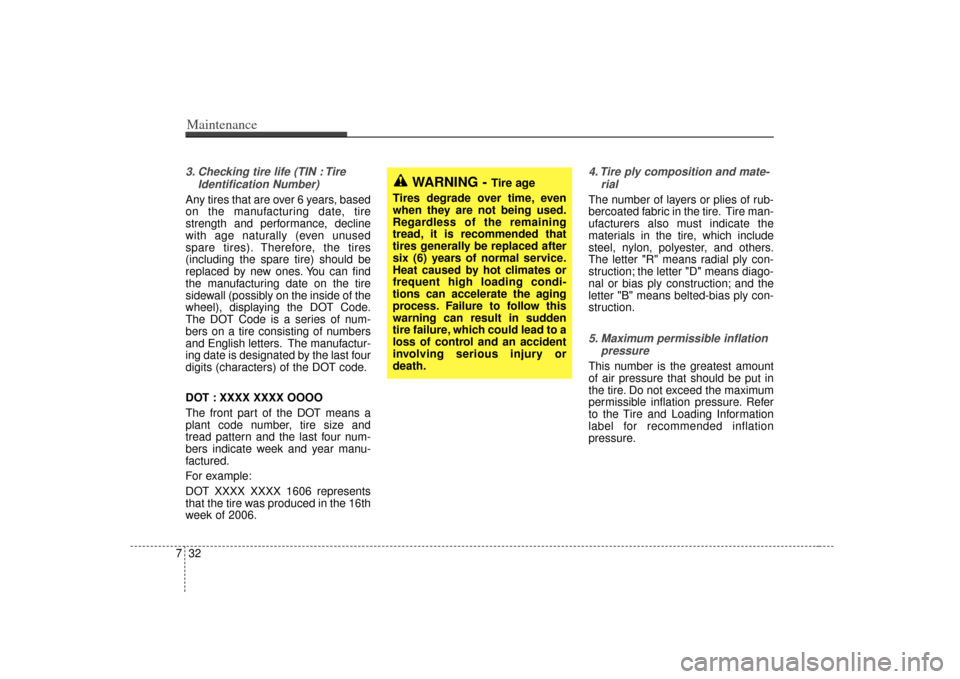
73. Checking tire life (TIN : Tire
Identification Number) Any tires that are over 6 years, based
on the manufacturing date, tire
strength and performance, decline
with age naturally (even unused
spare tires). Therefore, the tires
(including the spare tire) should be
replaced by new ones. You can find
the manufacturing date on the tire
sidewall (possibly on the inside of the
wheel), displaying the DOT Code.
The DOT Code is a series of num-
bers on a tire consisting of numbers
and English letters. The manufactur-
ing date is designated by the last four
digits (characters) of the DOT code.
DOT : XXXX XXXX OOOO
The front part of the DOT means a
plant code number, tire size and
tread pattern and the last four num-
bers indicate week and year manu-
factured.
For example:
DOT XXXX XXXX 1606 represents
that the tire was produced in the 16th
week of 2006.
4. Tire ply composition and mate-rialThe number of layers or plies of rub-
bercoated fabric in the tire. Tire man-
ufacturers also must indicate the
materials in the tire, which include
steel, nylon, polyester, and others.
The letter "R" means radial ply con-
struction; the letter "D" means diago-
nal or bias ply construction; and the
letter "B" means belted-bias ply con-
struction.5. Maximum permissible inflationpressureThis number is the greatest amount
of air pressure that should be put in
the tire. Do not exceed the maximum
permissible inflation pressure. Refer
to the Tire and Loading Information
label for recommended inflation
pressure.
WARNING -
Tire age
Tires degrade over time, even
when they are not being used.
Regardless of the remaining
tread, it is recommended that
tires generally be replaced after
six (6) years of normal service.
Heat caused by hot climates or
frequent high loading condi-
tions can accelerate the aging
process. Failure to follow this
warning can result in sudden
tire failure, which could lead to a
loss of control and an accident
involving serious injury or
death.
Page 306 of 325

733
Maintenance
6. Maximum load ratingThis number indicates the maximum
load in kilograms and pounds that
can be carried by the tire. When
replacing the tires on the vehicle,
always use a tire that has the same
load rating as the factory installed
tire.7. Uniform tire quality grading The following information relates to
the tire grading system developed by
the Canadian Motor Vehicle
Standard Safety (CMVSS) for grad-
ing tires by tread wear, traction and
temperature performance.Tread wear
The tread wear grade is a compara-
tive rating based on the wear rate of
the tire when tested under controlled
conditions on a specified govern-
ment test course. For example, a tire
graded 150 would wear one-and-a-
half times as well on the government
course as a tire graded 100.
The relative performance of tires
depends upon the actual conditions
of their use. However, performance
may differ from the norm because of
variations in driving habits, service
practices and differences in road
characteristics and climate.
These grades are molded on the
side-walls of passenger vehicle tires.
The tires available as standard or
optional equipment on Kia vehicles
may vary with respect to grade.Traction - AA, A, B & C
The traction grades, from highest to
lowest, are AA, A, B and C. The
grades represent the tires ability to
stop on wet pavement as measured
under controlled conditions on spec-
ified government test surfaces of
asphalt and concrete. A tire marked
C may have poor traction perform-
ance.
Temperature -A, B & C
The temperature grades are A (the
highest), B and C. The grades repre-
sent the tire’s resistance to the gen-
eration of heat and its ability to dissi-
pate heat when tested under con-
trolled conditions on a specified
indoor laboratory test wheel.
Page 311 of 325
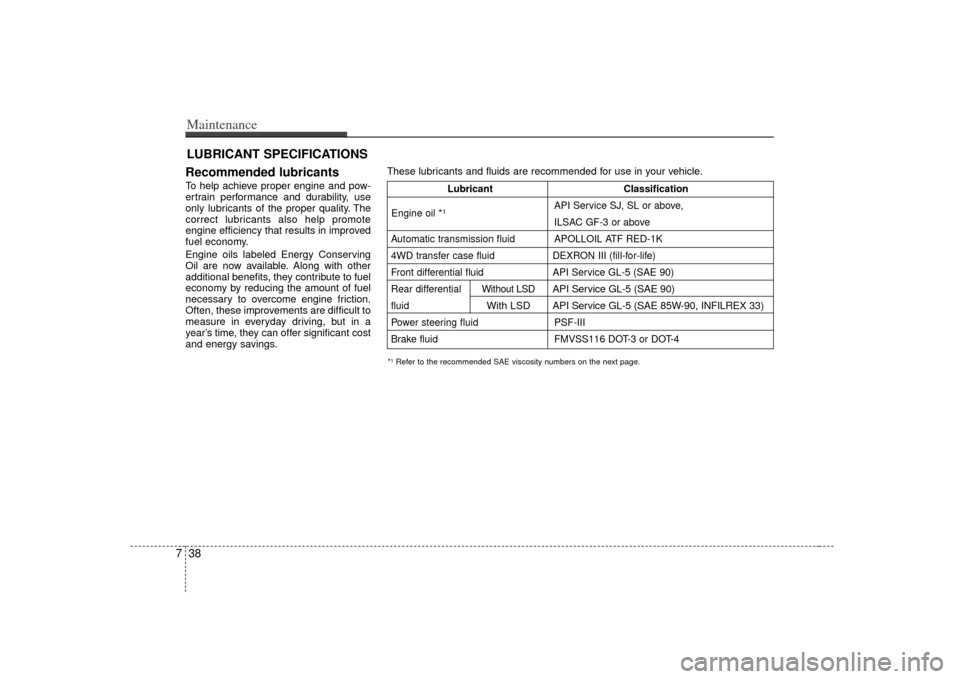
Maintenance38
7LUBRICANT SPECIFICATIONS
Recommended lubricants To help achieve proper engine and pow-
ertrain performance and durability, use
only lubricants of the proper quality. The
correct lubricants also help promote
engine efficiency that results in improved
fuel economy.
Engine oils labeled Energy Conserving
Oil are now available. Along with other
additional benefits, they contribute to fuel
economy by reducing the amount of fuel
necessary to overcome engine friction.
Often, these improvements are difficult to
measure in everyday driving, but in a
year’s time, they can offer significant cost
and energy savings.
*¹ Refer to the recommended SAE viscosity numbers on the next page.These lubricants and fluids are recommended for use in your vehicle.
Lubricant Classification
API Service SJ, SL or above,
ILSAC GF-3 or above
Automatic transmission fluid APOLLOIL ATF RED-1K
4WD transfer case fluid DEXRON III (fill-for-life)
Front differential fluid API Service GL-5 (SAE 90)
Rear differential Without LSD
API Service GL-5 (SAE 90)
fluid
With LSDAPI Service GL-5 (SAE 85W-90, INFILREX 33)
Power steering fluid PSF-III
Brake fluid FMVSS116 DOT-3 or DOT-4Engine oil
*¹
Page 321 of 325
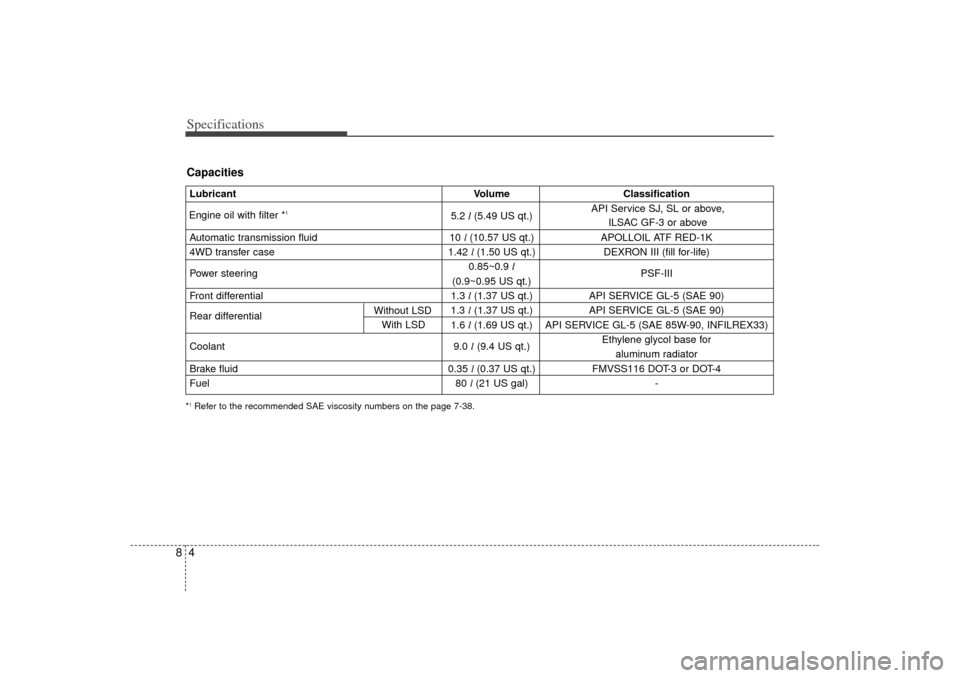
Specifications48Capacities*1Refer to the recommended SAE viscosity numbers on the page 7-38.LubricantVolume Classification
5.2 l (5.49 US qt.)
Automatic transmission fluid 10 l (10.57 US qt.) APOLLOIL ATF RED-1K
4WD transfer case 1.42 l (1.50 US qt.) DEXRON III (fill for-life)
Power steering 0.85~0.9
l
PSF-III
(0.9~0.95 US qt.)
Front differential 1.3 l (1.37 US qt.) API SERVICE GL-5 (SAE 90)
Rear differential 1.3
l(1.37 US qt.) API SERVICE GL-5 (SAE 90)
1.6 l (1.69 US qt.) API SERVICE GL-5 (SAE 85W-90, INFILREX33)
Coolant 9.0 l(9.4 US qt.) Ethylene glycol base for
aluminum radiator
Brake fluid 0.35 l (0.37 US qt.) FMVSS116 DOT-3 or DOT-4
Fuel 80 l (21 US gal) -Engine oil with filter *
1
Without LSD
With LSD API Service SJ, SL or above,
ILSAC GF-3 or above