2007 KIA Sorento steering wheel
[x] Cancel search: steering wheelPage 146 of 325
Driving your vehicle16
4 You must learn how to corner in a 4WD
vehicle as soon as possible. Do not rely
on your experience in conventional
2WD vehicles in choosing a safe cor-
nering speed. You must drive more
slowly.
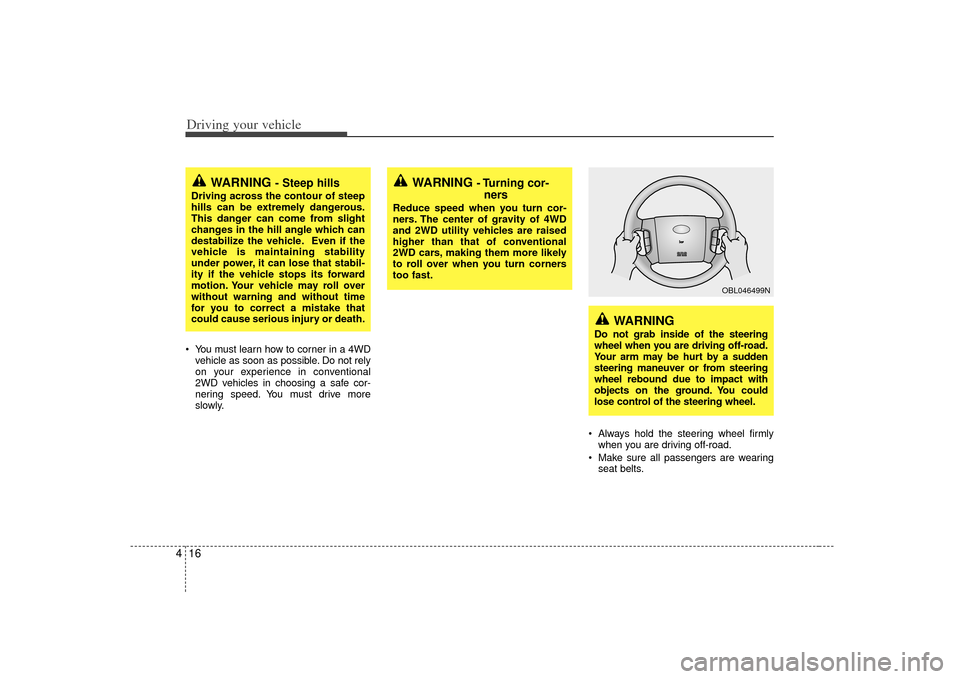
Always hold the steering wheel firmlywhen you are driving off-road.
Make sure all passengers are wearing seat belts.
WARNING
- Steep hills
Driving across the contour of steep
hills can be extremely dangerous.
This danger can come from slight
changes in the hill angle which can
destabilize the vehicle. Even if the
vehicle is maintaining stability
under power, it can lose that stabil-
ity if the vehicle stops its forward
motion. Your vehicle may roll over
without warning and without time
for you to correct a mistake that
could cause serious injury or death.
WARNING
- Turning cor-ners
Reduce speed when you turn cor-
ners. The center of gravity of 4WD
and 2WD utility vehicles are raised
higher than that of conventional
2WD cars, making them more likely
to roll over when you turn corners
too fast.
WARNING
Do not grab inside of the steering
wheel when you are driving off-road.
Your arm may be hurt by a sudden
steering maneuver or from steering
wheel rebound due to impact with
objects on the ground. You could
lose control of the steering wheel.
OBL046499N
Page 147 of 325

417
Driving your vehicle
If you need to drive in water, stop yourvehicle, set your transfer knob to 4LO
or LOW and drive at less than 8 km/h
(5 mph). Do not drive in water if the level is high-
er than the bottom of the wheel hubs.
Check your brake condition once you are out of mud or water. Press the
brake pedal several times as you move
slowly until you feel normal braking
forces return.
Shorten your scheduled maintenance interval if you drive off-road in condi-
tions such as sand, mud or water (see
“Scheduled Maintenance’’ in the
Index). Always wash your car thor-
oughly.
The full time four wheel drive vehicle cannot be towed by an ordinarily tow
truck. Make sure that the vehicle is
towed with its four wheels raised off the
ground.
Since the driving torque is always applied to the 4 wheels the perform-
ance of the 4WD vehicle is greatly
affected by the condition of the tires.
Be sure to equip them with all four tires
with same size and type.
WARNING
If you are driving in heavy wind, the
vehicle’s higher center of gravity
decreases your steering control.
Drive more slowly than you would
in calm conditions.
WARNING
- Drivingthrough water
If you are driving too fast in water,
the water spray can get into the
engine compartment and wet the
ignition system, causing your vehi-
cle to suddenly stop. If this hap-
pens and your vehicle is in a tilted
position, your vehicle may roll over.
WARNING
Your vehicle is equipped with tires
designed to provide for safe ride
and handling capability.
Do not use a size and type of tire
and wheel that is different from the
one that is originally installed on
your vehicle. It can affect the safety
and performance of your vehicle,
which could lead to handling failure
or rollover and serious injury.
When replacing the tires, be sure to
equip all four tires with the tire and
wheel of the same size, type, tread,
brand and load-carrying capacity. If
you nevertheless decide to equip
your vehicle with any tire/wheel
combination not recommended by
Kia for off road driving, you should
not use these tires for highway driv-
ing.
Page 149 of 325
419
Driving your vehicle
A limited slip differential if equipped, is for
the rear wheel differential only. The fea-
tures of this limited slip differential are
described below;
Just as with conventional differential, the
wheel on one side is allowed to turn at a
different speed from the wheel on the
other side when the vehicle is cornering.
The difference between the limited slip
differential and a conventional differential
is that if the wheel on one side of the
vehicle loses traction, a greater amount
of torque is applied to the rear wheel on
the other side to improve traction.
WARNING
To avoid injury, never run the
engine with one wheel off the
ground, such as when changing a
tire.
WARNING
Avoid high cornering speed.
Do not make quick steering wheelmovements, such as sharp lane
changes or fast, sharp turns.
The risk of rollover is greatly increased if you lose control of
your vehicle at high speeds.
In a collision crash, an unbelted person is significantly more likely
to die compared to a person
wearing a seat belt.
Loss of control often occurs if two or more wheels drop off the
roadway and the driver over
steers to re-enter the roadway.
In the event your vehicle leaves the roadway, do not steer sharply.
Instead, slow down before pulling
back into the travel lanes.
LIMITED SLIP DIFFERENTIAL (IF EQUIPPED)
Page 155 of 325

425
Driving your vehicle
Power steeringPower Steering uses energy from the
engine to assist you in steering the vehi-
cle. If the engine is off or if the power
steering system becomes inoperative,
the vehicle may still be steered, but it will
require increased steering effort.
Should you notice any change in the
effort required to steer during normal
vehicle operation, have the power steer-
ing checked by an Authorized Kia Dealer.
✽ ✽
NOTICEIf the power steering drive belt breaks
or if the power steering pump malfunc-
tions, the steering effort will greatly
increase.
✽ ✽
NOTICEIf the vehicle is parked for extended
periods outside in cold weather (below -
10°C/14°F), the power steering may
require increased effort when the engine
is first started. This is caused by
increased fluid viscosity due to the cold
weather and does not indicate a mal-
function.
When this happens, increase the engine
RPM by depressing accelerator until the
RPM reaches 1,500 rpm then release or
let the engine idle for two or three min-
utes to warm up the fluid.
STEERING WHEEL
CAUTION
Never hold the steering wheel
against a stop (extreme right or leftturn) for more than 5 seconds with the engine running. Holding thesteering wheel for more than 5 sec-onds in either position may causedamage to the power steering pump.
Page 156 of 325
Driving your vehicle26
4Tilt steering (if equipped)A tilt steering wheel allows you to adjust
the steering wheel before you drive. You
can also raise it to the highest level to
give your legs more room when you exit
and enter the vehicle.
The steering wheel should be positioned
so that it is comfortable for you to drive,
while permitting you to see the instru-
ment panel warning lights and gauges.
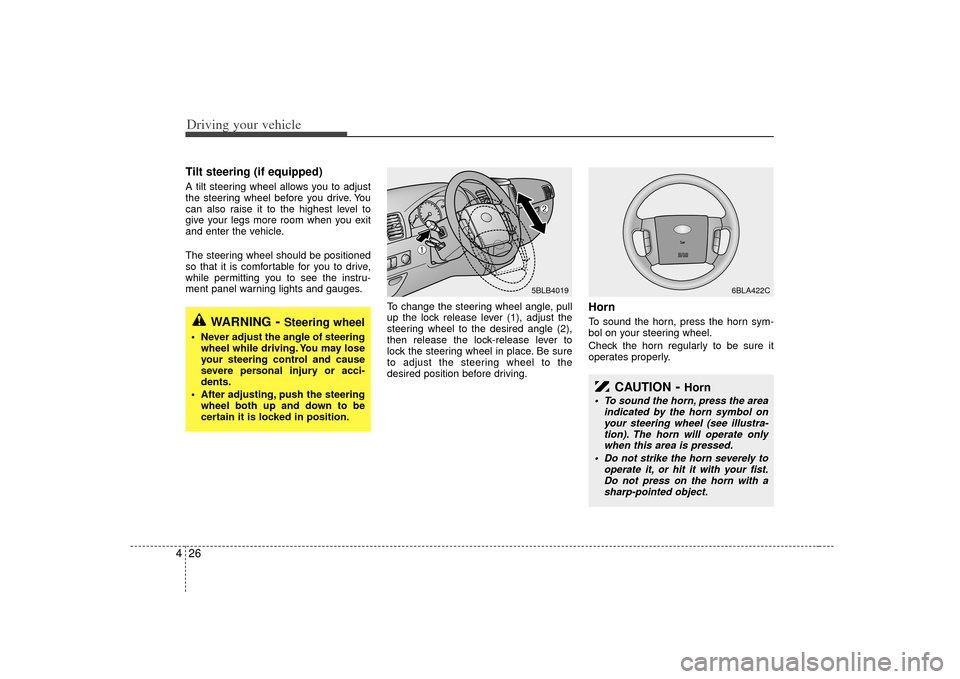
To change the steering wheel angle, pull
up the lock release lever (1), adjust the
steering wheel to the desired angle (2),
then release the lock-release lever to
lock the steering wheel in place. Be sure
to adjust the steering wheel to the
desired position before driving.
HornTo sound the horn, press the horn sym-
bol on your steering wheel.
Check the horn regularly to be sure it
operates properly.
WARNING
- Steering wheel
Never adjust the angle of steeringwheel while driving. You may lose
your steering control and cause
severe personal injury or acci-
dents.
After adjusting, push the steering wheel both up and down to be
certain it is locked in position.
5BLB4019
6BLA422C
➀
➁
CAUTION
- Horn
To sound the horn, press the area indicated by the horn symbol onyour steering wheel (see illustra-tion). The horn will operate only when this area is pressed.
Do not strike the horn severely to operate it, or hit it with your fist.Do not press on the horn with asharp-pointed object.
Page 157 of 325
427
Driving your vehicle
The cruise control system allows you to
program the vehicle to maintain a con-
stant speed without resting your foot on
the accelerator pedal.
With cruise control, you can set and
automatically maintain any speed of
between 40 km/h (24 mph) and
160 km/h (96 mph).
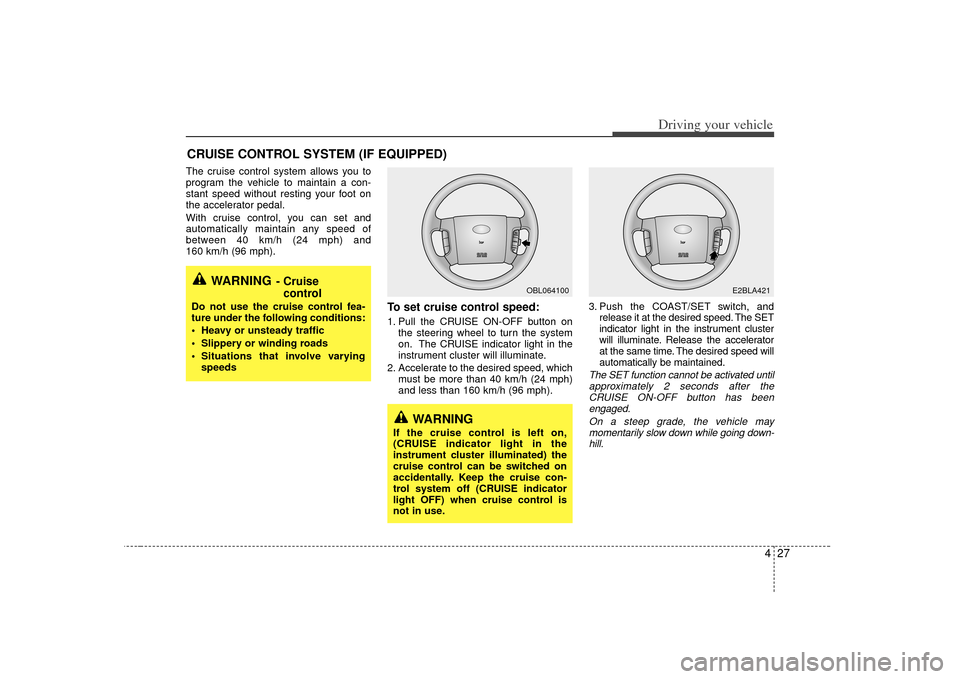
To set cruise control speed:1. Pull the CRUISE ON-OFF button onthe steering wheel to turn the system
on. The CRUISE indicator light in the
instrument cluster will illuminate.
2. Accelerate to the desired speed, which must be more than 40 km/h (24 mph)
and less than 160 km/h (96 mph). 3. Push the COAST/SET switch, and
release it at the desired speed. The SET
indicator light in the instrument cluster
will illuminate. Release the accelerator
at the same time. The desired speed will
automatically be maintained.
The SET function cannot be activated untilapproximately 2 seconds after theCRUISE ON-OFF button has beenengaged.
On a steep grade, the vehicle maymomentarily slow down while going down-hill.
CRUISE CONTROL SYSTEM (IF EQUIPPED)
WARNING
- Cruise control
Do not use the cruise control fea-
ture under the following conditions:
Heavy or unsteady traffic
Slippery or winding roads
Situations that involve varying
speeds
WARNING
If the cruise control is left on,
(CRUISE indicator light in the
instrument cluster illuminated) the
cruise control can be switched on
accidentally. Keep the cruise con-
trol system off (CRUISE indicator
light OFF) when cruise control is
not in use.
OBL064100
E2BLA421
Page 158 of 325
Driving your vehicle28
4To cancel cruise control, do one
of the following: Press the brake pedal.
Press the clutch pedal with a manual
transmission or shift into N (Neutral)
with an automatic transmission.
Press the CANCEL switch located on the steering wheel.
Press the COAST/SET and RES/ ACCEL switches at the same time.Each of these actions will cancel cruisecontrol operation (the SET indicator lightin the instrument cluster will go OFF), butit will not turn the system off. If you wishto resume cruise control operation, push the RES/ACCEL switch located on yoursteering wheel. You will return to yourpreviously preset speed.
To turn cruise control off, do one
of the following: Push the CRUISE ON-OFF button (the CRUISE indicator light in the instru-
ment cluster will go OFF).
Turn the ignition off.Both of these actions cancel cruise con- trol operation. If you want to resumecruise control operation, repeat the stepsprovided in “To Set Cruise ControlSpeed” on the previous page.
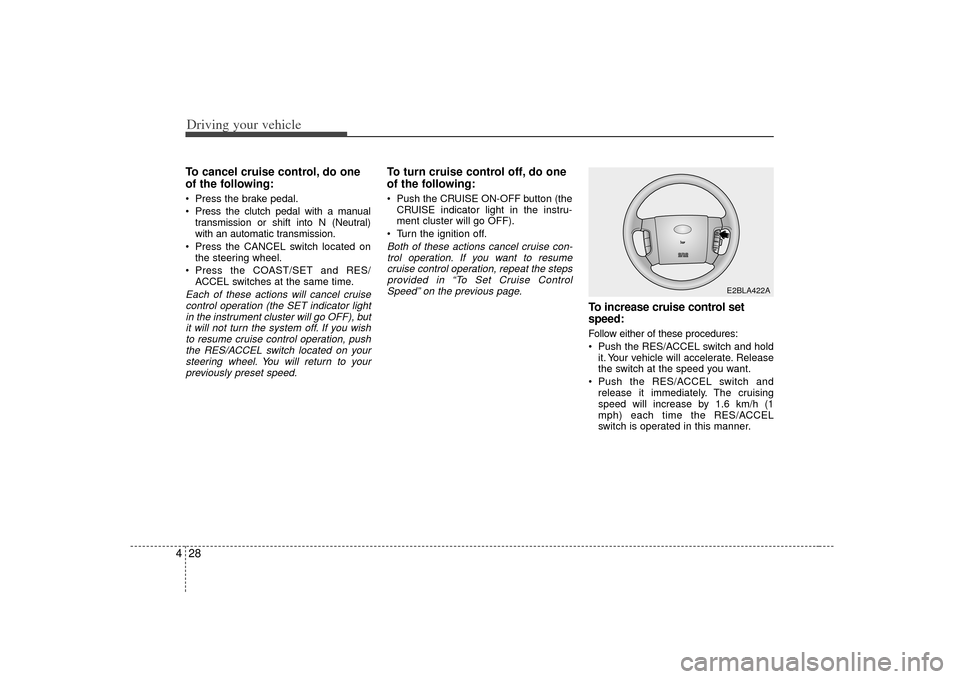
To increase cruise control set
speed:Follow either of these procedures:
Push the RES/ACCEL switch and hold it. Your vehicle will accelerate. Release
the switch at the speed you want.
Push the RES/ACCEL switch and release it immediately. The cruising
speed will increase by 1.6 km/h (1
mph) each time the RES/ACCEL
switch is operated in this manner.
E2BLA422A
Page 214 of 325

Driving tips65SUGGESTIONS FOR ECONOMICAL OPERATIONYour vehicle's fuel economy depends
mainly on your style of driving, where you
drive and when you drive.
Each of these factors affects how many
kilometers (miles) you can get from a
liter (gallon) of fuel. To operate your vehi-
cle as economically as possible, use the
following driving suggestions to help
save money in both fuel and repairs:
Avoid lengthy warm-up idling. Once theengine is running smoothly, begin driv-
ing. Remember, engine warm-up may
take a little longer on cold days.
Save fuel by accelerating slowly after stopping.
Keep the engine in tune and follow the recommended periodic maintenance
schedule. This will increase the life of
all parts and lower your operating
costs. Do not use the air conditioner unnec-
essarily.
Slow down when driving on rough roads.
For longer tire life and better fuel econ- omy, always keep the tires inflated to
the recommended pressures.
Maintain a safe distance from other vehicles to avoid sudden stops. This
will reduce wear on brake linings and
pads. Driving in such a way will also
save fuel because extra fuel is required
to accelerate back to driving speed.
Do not carry unnecessary weight in the vehicle.
Do not rest your foot on the brake pedal while driving. This can cause
needless wear, possible damage to the
brakes, and poor fuel economy.
Improper wheel alignment results in faster tire wear and lower fuel econo-
my. Open windows at high speeds can
reduce fuel economy.
Fuel economy is less in crosswinds and headwinds. To help offset some of
this loss, slow down when driving in
these conditions.
Keeping a vehicle in good operating con-
dition is important both for economy and
safety. Therefore, have an authorized Kia
dealer perform scheduled inspections
and maintenance.
WARNING
- Engine off dur- ing motion
Never turn the engine off to coast
down hills or anytime the vehicle is
in motion. The power steering and
power brakes will not function with-
out the engine running. Instead,
keep the engine on and downshift
to an appropriate gear for engine
braking effect.