2007 KIA Sorento seats
[x] Cancel search: seatsPage 46 of 325
337
Knowing your vehicle
Restraint of pregnant women Pregnant women should wear lap/shoul-
der belt assemblies whenever possible
according to specific recommendations
by their doctors. The lap portion of the
belt should be worn AS SNUGLY AND
LOW AS POSSIBLE.
Restraint of infants and small
children To increase their safety, infants and
young children should always be
restrained by a restraint system
approved for their age and size.
Never allow a child to stand or kneel on
the seat of a moving vehicle. Never allow
a safety belt to be placed around both a
child and an adult or around two children
at the same time.
It is best for children to be seated in the
rear seats.
Many companies manufacture child
restraint systems (often called child
seats) for infants and small children. An
acceptable child restraint system must
always satisfy Canadian Motor Vehicle
Safety Standards and your applicable
state laws. Make sure that any child-
restraint system you use in your vehicle
is labelled as complying with Federal
Safety Standards.
The child-restraint system should be
chosen to fit both the size of the child and
the size of the vehicle seat. Be sure to fol-
low any instructions provided by the
child-restraint system manufacturer
when installing the child-restraint system.
WARNING
- Pregnantwomen
Pregnant women must never place
the lap portion of the safety belt
over the area of the abdomen where
the fetus is located or above the
abdomen where the belt could
crush the fetus during an impact.
WARNING
- Children on laps
Never hold a child on your lap or in
your arms in a moving vehicle.
Even a very strong person cannot
hold onto a child in the event of
even a minor collision.
WARNING
- Hot metal parts
Safety belts and seats can become
hot in a vehicle that has been
closed during warm/hot weather;
they could burn a child. Check seat
covers and buckles before you
place a child anywhere near them.
Page 47 of 325
Knowing your vehicle38
3
WARNING
- Shoulder belts
on small children
Never allow a shoulder belt to be
in contact with a child’s neck or
face while the vehicle is in
motion.
If safety belts are not properly worn and adjusted, there is a risk
of death or serious injury to such
a child.
Restraint of larger children As children grow, they may need to use
new child-restraint systems, including
larger child seats or booster seats, which
are appropriate for their increased size.
A child who has outgrown available child-
restraint systems should use the belts
provided in the vehicle. When seated in
the rear outboard seats, the child should
be restrained by the lap/shoulder belt.
If the shoulder belt portion slightly touch-
es the child’s neck or face, try placing the
child closer to the center of the vehicle. If
the shoulder belt still touches their face
or neck they need to be returned to a
child restraint system. In addition, after-
market devices are available from inde-
pendent manufacturers which help pull
the shoulder belt down and away from
the child’s face or neck.
WARNING
- Infants and
young children
Infants and young children are at
much greater risk of serious injury
or death in an accident or sudden
stop if they are unrestrained or
restrained improperly. Follow all
instructions in this section and the
instructions that came with an
approved child safety system. The
child restraint must be correctly
installed in the vehicle, and the
child must be correctly placed in
the child restraint.
All children under 12 are safest in the back seat.
Never install a rear facing infant seat in the front passenger posi-
tion. The baby will be injured or
killed by the air bag if it deploys.
Never allow a child to stand or
kneel on the seat of a moving vehi-
cle.
Page 48 of 325
339
Knowing your vehicle
Child restraint system For small children and babies, the use of
a child seat or infant seat is strongly rec-
ommended and is required by law in
almost all states. This child seat or infant
seat should be of appropriate size for the
child and should be installed in accor-
dance with the manufacturer's instruc-
tions.
Children riding in the car should sit on
the rear seat and must always be proper-
ly restrained to minimize the risk of injury
in an accident, sudden stop or sudden
maneuver. According to accident statis-
tics, children are safer when properly
restrained in the rear seats than in the
front seat.
Children could be injured or killed in a
crash if their restraints are not properly
secured. For small children and babies, a
child seat or infant seat must be used.
Before buying a particular child restraint
system, make sure it fits your car and
seat belts, and fits your child. Follow all
the instructions provided by the child
seat manufacturer when installing the
child restraint system.
WARNING
- Child
restraints
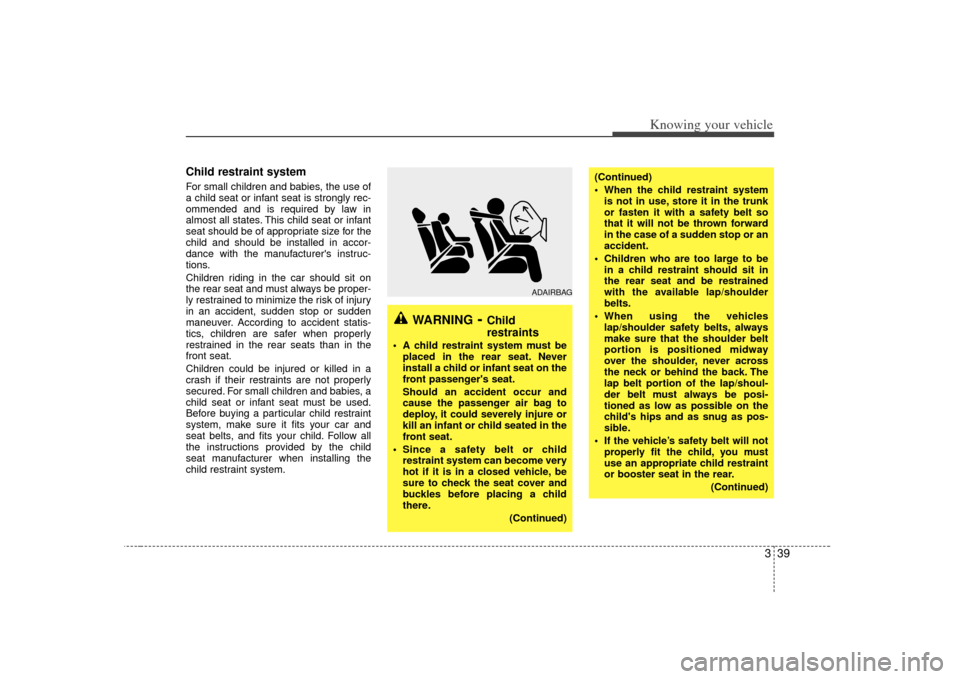
A child restraint system must beplaced in the rear seat. Never
install a child or infant seat on the
front passenger's seat.
Should an accident occur and
cause the passenger air bag to
deploy, it could severely injure or
kill an infant or child seated in the
front seat.
Since a safety belt or child restraint system can become very
hot if it is in a closed vehicle, be
sure to check the seat cover and
buckles before placing a child
there.
(Continued)
(Continued)
When the child restraint systemis not in use, store it in the trunk
or fasten it with a safety belt so
that it will not be thrown forward
in the case of a sudden stop or an
accident.
Children who are too large to be in a child restraint should sit in
the rear seat and be restrained
with the available lap/shoulder
belts.
When using the vehicles lap/shoulder safety belts, always
make sure that the shoulder belt
portion is positioned midway
over the shoulder, never across
the neck or behind the back. The
lap belt portion of the lap/shoul-
der belt must always be posi-
tioned as low as possible on the
child's hips and as snug as pos-
sible.
If the vehicle’s safety belt will not properly fit the child, you must
use an appropriate child restraint
or booster seat in the rear.
(Continued)
ADAIRBAG
Page 49 of 325

Knowing your vehicle40
3
Installing a child restraint system For safety reasons, we recommend that
the child restraint system be used in the
rear seats.
Never place a rear-facing child
restraint in the front passenger seat,
because of the danger that an inflat-
ing passenger side air bag could
impact the rear-facing child restraint
and kill the child.
Since all passenger safety belts move
freely under normal conditions and only
lock under extreme or emergency condi-
tions (emergency lock mode), you must
manually change these safety belts to
the auto lock mode to secure a child
restraint.
(Continued)
Never allow a child to stand up or
kneel while the vehicle is moving.
Never use an infant carrier or child seat that "hooks" over a
seatback. It will not provide ade-
quate protection in an accident.
Never allow a child to be held while they are in a moving vehi-
cle, as this could result in serious
injury to the child in the event of
an accident or a sudden stop.
Holding a child in a moving vehi-
cle does not provide the child
with any protection during an
accident, even if the person hold-
ing the child is wearing a seat
belt.
WARNING
- Child seat
installation
Before installing the childrestraint system, read the instruc-
tions supplied by the child
restraint system manufacturer.
If the safety belt does not operate as described in this section, have
the system checked immediately
by your authorized Kia dealer.
Failure to observe this manual's instructions regarding child
restraint system and the instruc-
tions provided with the child
restraint system could increase
the chance and/or severity of
injury in an accident.
Page 50 of 325
341
Knowing your vehicle
Placing a passenger safety belt intothe auto lock modeThe use of the auto lock mode will
ensure that the normal movement of the
child in the vehicle does not cause the
safety belt to be pulled out and loosen
the firmness of its hold on the child
restraint system. To secure a child
restraint system, use the following proce-
dure.
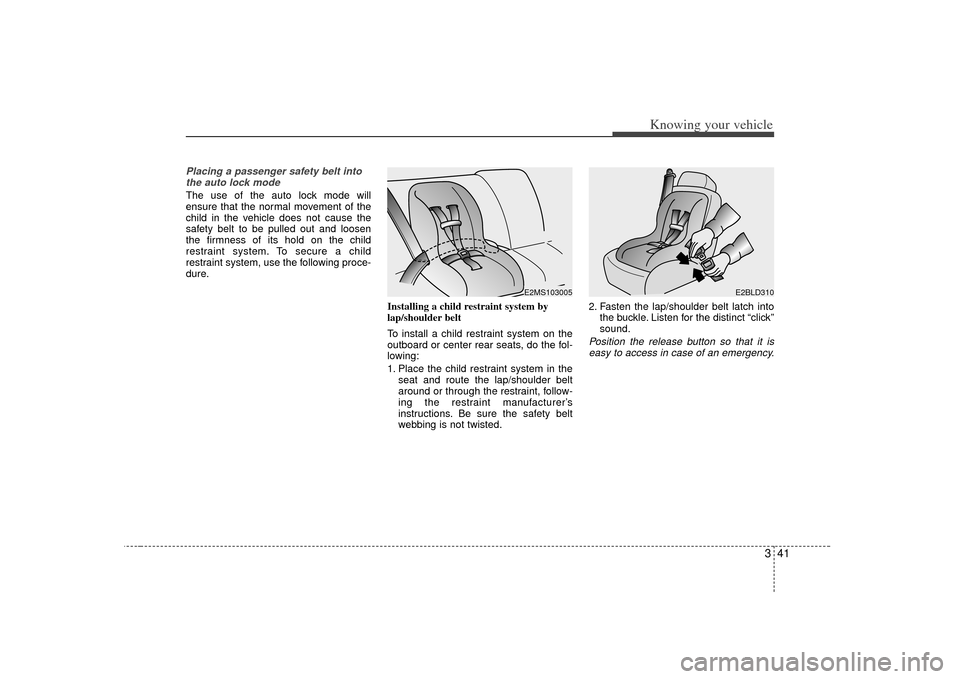
Installing a child restraint system by
lap/shoulder belt
To install a child restraint system on the
outboard or center rear seats, do the fol-
lowing:
1. Place the child restraint system in theseat and route the lap/shoulder belt
around or through the restraint, follow-
ing the restraint manufacturer’s
instructions. Be sure the safety belt
webbing is not twisted. 2. Fasten the lap/shoulder belt latch into
the buckle. Listen for the distinct “click”
sound.
Position the release button so that it iseasy to access in case of an emergency.
E2MS103005
E2BLD310
Page 52 of 325
343
Knowing your vehicle
7. Double check that the retractor is inthe “Auto Lock” mode by attempting to
pull more of the safety belt out of the
retractor. If you cannot, the retractor is
in the “Auto Lock” mode.
To remove the child restraint, press the
release button on the buckle and then
pull the lap/shoulder belt out of the
restraint and allow the safety belt to
retract fully.
When the safety belt is allowed to
retract to its fully stowed position, the
retractor will automatically switch
from the “Auto Lock” mode to the
emergency lock mode for normal
adult usage.
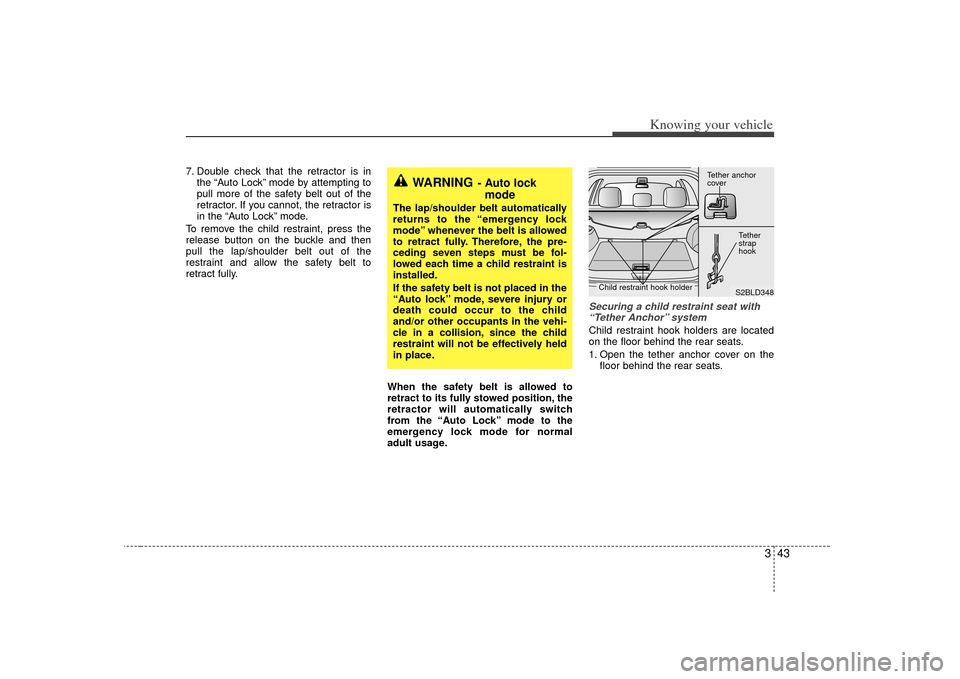
Securing a child restraint seat with“Tether Anchor” system Child restraint hook holders are located
on the floor behind the rear seats.
1. Open the tether anchor cover on the floor behind the rear seats.
WARNING
- Auto lockmode
The lap/shoulder belt automatically
returns to the “emergency lock
mode” whenever the belt is allowed
to retract fully. Therefore, the pre-
ceding seven steps must be fol-
lowed each time a child restraint is
installed.
If the safety belt is not placed in the
“Auto lock” mode, severe injury or
death could occur to the child
and/or other occupants in the vehi-
cle in a collision, since the child
restraint will not be effectively held
in place.
S2BLD348
Tether anchor
coverTether
strap
hook
Child restraint hook holder
Page 54 of 325
345
Knowing your vehicle
Child seat lower anchorsSome child seat manufacturers make
child restraint seats that are labeled as
LATCH or LATCH compatible. LATCH
stands for "Lower Anchors and Tethers
for Children". These seats include two
rigid or webbing mounted attachments
that connect to two LATCH anchors at
specific seating positions in your vehicle.
This type of child restraint seat elimi-
nates the need to use seat belts to attach
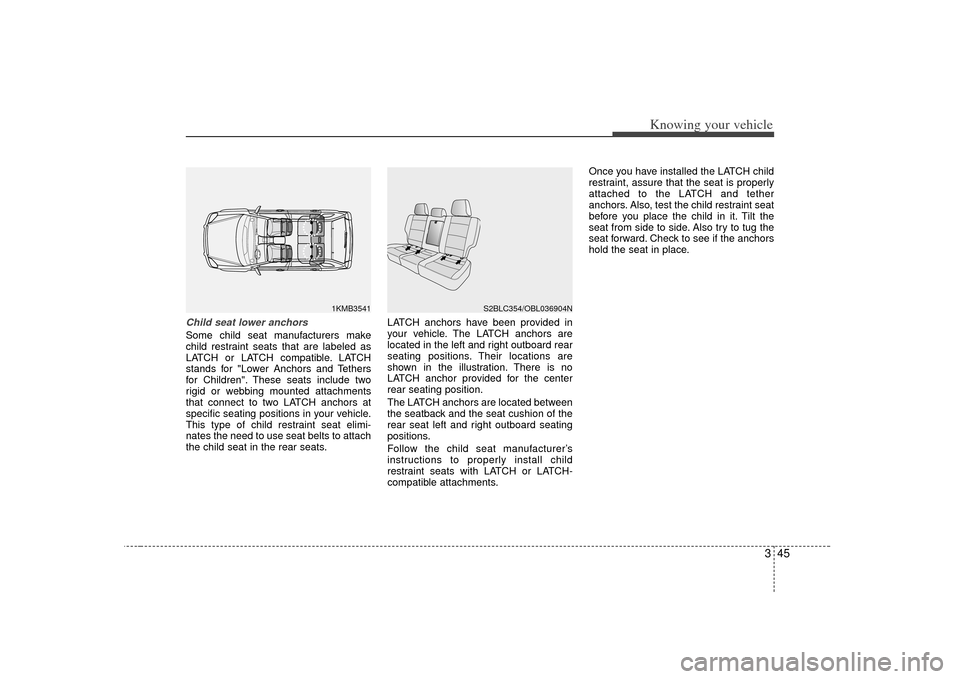
the child seat in the rear seats.LATCH anchors have been provided in
your vehicle. The LATCH anchors are
located in the left and right outboard rear
seating positions. Their locations are
shown in the illustration. There is no
LATCH anchor provided for the center
rear seating position.
The LATCH anchors are located between
the seatback and the seat cushion of the
rear seat left and right outboard seating
positions.
Follow the child seat manufacturer’s
instructions to properly install child
restraint seats with LATCH or LATCH-
compatible attachments.Once you have installed the LATCH child
restraint, assure that the seat is properly
attached to the LATCH and tether
anchors. Also, test the child restraint seat
before you place the child in it. Tilt the
seat from side to side. Also try to tug the
seat forward. Check to see if the anchors
hold the seat in place.
1KMB3541
S2BLC354/OBL036904N
Page 59 of 325

Knowing your vehicle50
3
Driver’s air bagThe driver’s air bag is stored in the cen-
ter of the steering wheel.
WARNING
Ignoring the SRS indictor light
(air bag indicator and passenger
air bag off indicator) can result in
serious or fatal injury if the air
bags occupant classification sys-
tem or pretensioners do not work
properly. Have your car checked
by a dealer as soon as possible if
the SRS warning light alerts you
to a potential problem.
Sitting improperly or out of posi- tion can result in serious or fatal
injury in a crash. All occupants
should sit upright in their seats
with their feet on the floor until
the vehicle is parked and the igni-
tion key is removed.
E2BLA422BHLZ2120
WARNING
You must always sit as far backfrom the steering wheel air bag as
possible (chest at least 250 mm
(10 inches) away from the steer-
ing wheel), while still maintaining
a comfortable seating position for
good vehicle control, in order to
reduce the risk of injury or death
in a collision.
Never place objects over the air bag storage compartments or
between the air bags and your-
self. Due to the speed and force of
the air bag inflation, such objects
could hit your body at high speed
and cause severe bodily injury
and even death.
Do not put stickers or ornaments on the steering wheel cover.
These may interfere with the
deployment of the air bag.