2007 KIA Sorento four wheel
[x] Cancel search: four wheelPage 219 of 325

511
Driving tips
USING FOUR-WHEEL DRIVEDriving on snow- or ice-covered
roads ("4HI, 4LO" for part-time
4WD operation or "AUTO" for full-
time 4WD operation) Use snow tires. See “Tires” in this sec-tion for more information.
Keep an adequate distance between yourself and other vehicles.
Avoid sudden braking, acceleration or steering. These actions can cause your
vehicle to lose traction.
Driving in sand or mud ("4HI,
4LO" for part-time 4WD operation
or "AUTO" for full-time 4WD oper-
ation) Avoid sudden braking, acceleration orsteering. These actions can cause your
vehicle to get stuck in the sand or mud.
Drive at low speeds whenever possi- ble.
You may need to get out of your vehi- cle at times to check road conditions.
If you get stuck in the sand or mud, try placing stones, wood or other similar
materials under the tires to get traction,
or move forward and backward repeat-
edly to get unstuck.
WARNING
- Traction
Make sure that no one stands in
front of or behind the tires when
materials are placed under the tires
to get more traction. The tires may
cause loose materials to fly out
from under the vehicle, potentially
causing serious bodily injury or
death.
CAUTION
Prolonged rocking may causeengine damage, overheating, trans-mission differential or transfer case damage or failure and tire damage.
Page 220 of 325

Driving tips12
5Driving on a hill ("4LO" for part-
time 4WD operation or "LOW" for
full-time 4WD operation) Use low gear when going uphill or
downhill and avoid sudden braking.
Do not shift gears or use your clutch when going downhill. Do not coast
downhill in Neutral.
Crossing a ditch ("4LO" for part-
time 4WD operation or "LOW" for
full-time 4WD operation) Avoid driving through ditches if possi-ble, especially if there is water in the
ditch. Your vehicle may stall if the elec-
trical system gets wet. If you must
cross a ditch, select 4LO or LOW
mode.
Avoid driving where the water level is higher than the bottom of the wheel
hub. If the water level rises above this
mark, your vehicle will need to be serv-
iced.
Tap lightly on the brake pedal during and after driving through water. This
will help keep the brakes dry and in
proper working order.
Do not shift gears while crossing a ditch.
Tight corner brake effectThis is called tight corner brake effect.
Tight corner brake effect is a unique
characteristic of four-wheel drive vehicles
caused by the difference in tire rotation at
the four wheels and the zero-degree
alignment of the front wheels and sus-
pension.
Sharp turns at low speeds should be car-
ried out with caution.
WARNING
- 4WD
When turning sharply on a paved
road at low speed while in four-
wheel drive, steering control will be
difficult.
Page 221 of 325

513
Driving tips
Off-road driving with your four-
wheel drive vehicleOff-road driving can be great fun. But it
has definite hazards. The greatest of
these is the terrain itself.
“Off-roading” means you’ve left the paved
road system behind. Traffic lanes are not
marked. Curves are not banked.
There are no carefully engineered road
signs to warn you of dangerous condi-
tions or to advise you of a safe speed.
You have to assess the environment
yourself. Surfaces can be slippery, rough,
uphill or downhill.
Off-road driving involves learning new
skills. That’s why it’s important that you
read and understand this section. You’ll
find useful driving information and sug-
gestions. These will help make your off-
road driving safer and more enjoyable.
Before you go off-roadingThere are some things to do before you
leave the paved roads. Be sure to have
all necessary maintenance and service
work done beforehand. Be sure to read
all the information about your four-wheel
drive vehicle in this manual. Is there
enough fuel? Is the spare tire fully inflat-
ed? Are the fluid levels at the proper lev-
els? What are the local laws that apply to
off-roading where you’ll be driving? If you
don’t know, you should check with law
enforcement people in the area. Will you
be on someone’s private land? If so, be
sure to get the necessary permission.
Loading your vehicle for off-roaddrivingThere are some important items to
remember about how to properly load
your vehicle.
The heaviest things should be in the cargo area and forward of your rear
axle. Place heavier items as far forward
as you can.
Be sure the load is properly secured, so driving over off-road terrain doesn’t
shift your load or throw items toward
the driver or passengers.
Page 239 of 325
531
Driving tips
TRAILER TOWING
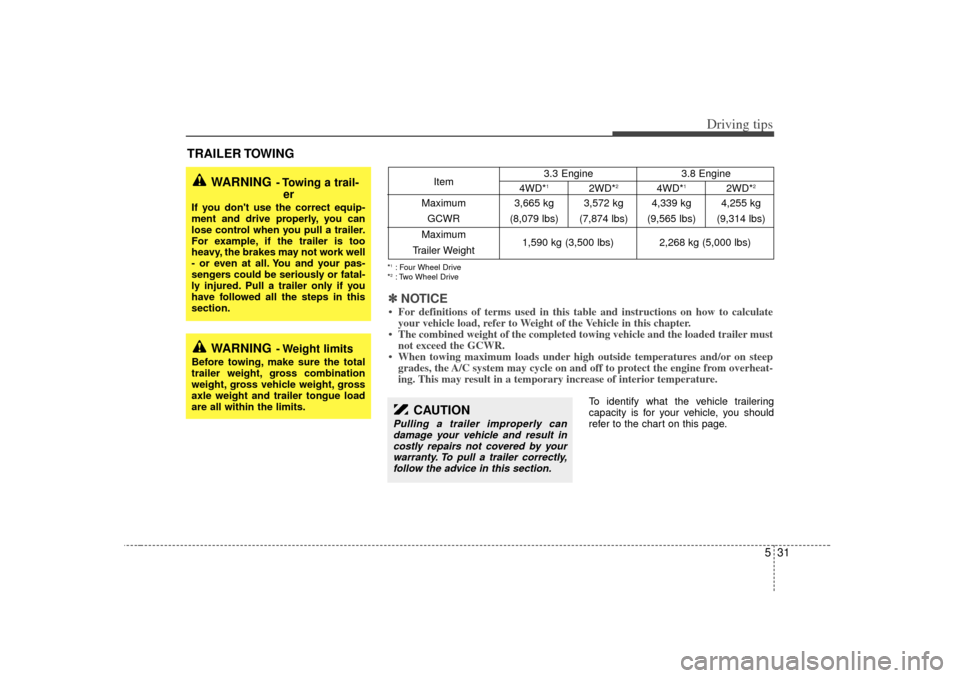
To identify what the vehicle trailering
capacity is for your vehicle, you should
refer to the chart on this page.
WARNING
- Towing a trail-er
If you don't use the correct equip-
ment and drive properly, you can
lose control when you pull a trailer.
For example, if the trailer is too
heavy, the brakes may not work well
- or even at all. You and your pas-
sengers could be seriously or fatal-
ly injured. Pull a trailer only if you
have followed all the steps in this
section.
WARNING
- Weight limits
Before towing, make sure the total
trailer weight, gross combination
weight, gross vehicle weight, gross
axle weight and trailer tongue load
are all within the limits.
Item 4WD*
1
2WD*
2
4WD*
1
2WD*
2
Maximum 3,665 kg 3,572 kg 4,339 kg 4,255 kg
GCWR (8,079 lbs) (7,874 lbs) (9,565 lbs) (9,314 lbs)
Maximum
Trailer Weight
3.3 Engine
1,590 kg (3,500 lbs)
*1: Four Wheel Drive
*2: Two Wheel Drive
2,268 kg (5,000 lbs) 3.8 Engine
✽ ✽
NOTICE• For definitions of terms used in this table and instructions on how to calcu\
late
your vehicle load, refer to Weight of the Vehicle in this chapter.
• The combined weight of the completed towing vehicle and the loaded trail\
er must not exceed the GCWR.
• When towing maximum loads under high outside temperatures and/or on steep grades, the A/C system may cycle on and off to protect the engine from overheat-
ing. This may result in a temporary increase of interior temperature.
CAUTION
Pulling a trailer improperly can
damage your vehicle and result in costly repairs not covered by yourwarranty. To pull a trailer correctly,follow the advice in this section.
Page 302 of 325
729
Maintenance
Wheel alignment and tire
balance The wheels on your vehicle were
aligned and balanced carefully at the
factory to give you the longest tire life
and best overall performance.
In most cases, you will not need to
have your wheels aligned again.
However, if you notice unusual tire
wear or your vehicle pulling one way
or the other, the alignment may need
to be reset.
If you notice your vehicle vibrating
when driving on a smooth road, your
wheels may need to be rebalanced.
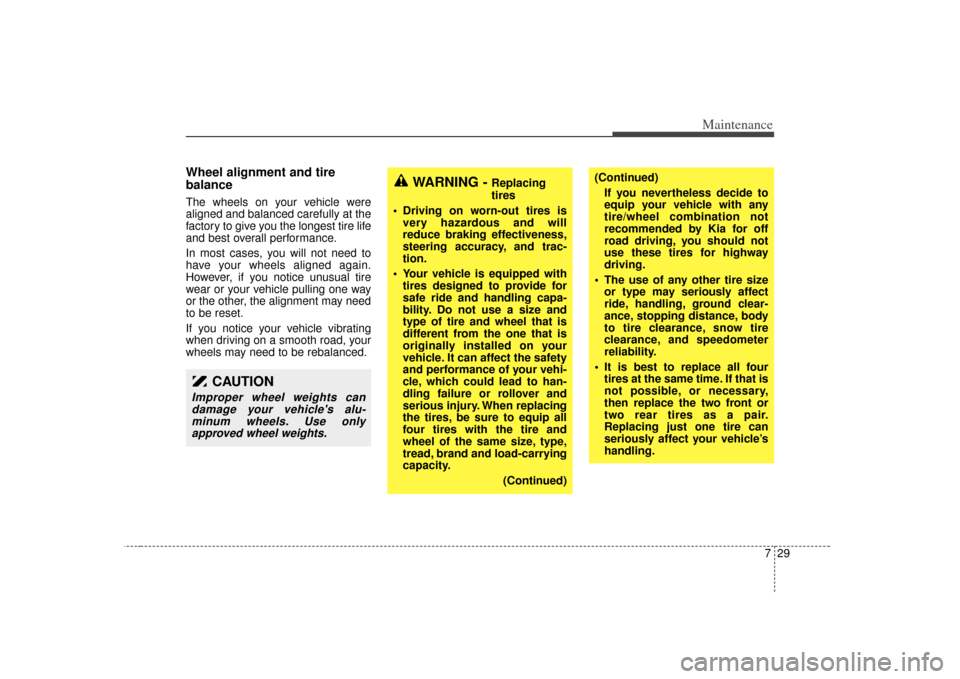
WARNING -
Replacing
tires
Driving on worn-out tires is very hazardous and will
reduce braking effectiveness,
steering accuracy, and trac-
tion.
Your vehicle is equipped with tires designed to provide for
safe ride and handling capa-
bility. Do not use a size and
type of tire and wheel that is
different from the one that is
originally installed on your
vehicle. It can affect the safety
and performance of your vehi-
cle, which could lead to han-
dling failure or rollover and
serious injury. When replacing
the tires, be sure to equip all
four tires with the tire and
wheel of the same size, type,
tread, brand and load-carrying
capacity.
(Continued)
(Continued)If you nevertheless decide to
equip your vehicle with any
tire/wheel combination not
recommended by Kia for off
road driving, you should not
use these tires for highway
driving.
The use of any other tire size or type may seriously affect
ride, handling, ground clear-
ance, stopping distance, body
to tire clearance, snow tire
clearance, and speedometer
reliability.
It is best to replace all four tires at the same time. If that is
not possible, or necessary,
then replace the two front or
two rear tires as a pair.
Replacing just one tire can
seriously affect your vehicle’s
handling.
CAUTION
Improper wheel weights candamage your vehicle's alu-minum wheels. Use onlyapproved wheel weights.
Page 305 of 325
Maintenance32
73. Checking tire life (TIN : Tire
Identification Number) Any tires that are over 6 years, based
on the manufacturing date, tire
strength and performance, decline
with age naturally (even unused
spare tires). Therefore, the tires
(including the spare tire) should be
replaced by new ones. You can find
the manufacturing date on the tire
sidewall (possibly on the inside of the
wheel), displaying the DOT Code.
The DOT Code is a series of num-
bers on a tire consisting of numbers
and English letters. The manufactur-
ing date is designated by the last four
digits (characters) of the DOT code.
DOT : XXXX XXXX OOOO
The front part of the DOT means a
plant code number, tire size and
tread pattern and the last four num-
bers indicate week and year manu-
factured.
For example:
DOT XXXX XXXX 1606 represents
that the tire was produced in the 16th
week of 2006.
4. Tire ply composition and mate-rialThe number of layers or plies of rub-
bercoated fabric in the tire. Tire man-
ufacturers also must indicate the
materials in the tire, which include
steel, nylon, polyester, and others.
The letter "R" means radial ply con-
struction; the letter "D" means diago-
nal or bias ply construction; and the
letter "B" means belted-bias ply con-
struction.5. Maximum permissible inflationpressureThis number is the greatest amount
of air pressure that should be put in
the tire. Do not exceed the maximum
permissible inflation pressure. Refer
to the Tire and Loading Information
label for recommended inflation
pressure.
WARNING -
Tire age
Tires degrade over time, even
when they are not being used.
Regardless of the remaining
tread, it is recommended that
tires generally be replaced after
six (6) years of normal service.
Heat caused by hot climates or
frequent high loading condi-
tions can accelerate the aging
process. Failure to follow this
warning can result in sudden
tire failure, which could lead to a
loss of control and an accident
involving serious injury or
death.
Page 310 of 325
737
Maintenance
Vehicle Maximum Load on the
Tire: Load on an individual tire due to
curb and accessory weight plus
maximum occupant and cargo
weight.
Vehicle Normal Load on the Tire:
That load on an individual tire that is
determined by distributing to each
axle its share of the curb weight,
accessory weight, and normal occu-
pant weight and driving by 2.
Vehicle Placard: A label permanent-
ly attached to a vehicle showing the
original equipment tire size and rec-
ommended inflation pressure.
All season tires Kia specifies all season tires on
some models to provide good per-
formance for use all year round,
including snowy and icy road condi-
tions. All season tires are identified
by ALL SEASON and/or M+S (Mud
and Snow) on the tire sidewall. Snow
tires have better snow traction than
all season tires and may be more
appropriate in some areas.Summer tires Kia specifies summer tires on some
models to provide superior perform-
ance on dry roads. Summer tire per-
formance is substantrally reduced in
snow and ice. Summer tires do not
have the tire traction rating M+S
(Mud and Snow) on the tire side wall.
if you plan to operate your vehicle in
snowy or icy conditions. Kia recom-
mends the use of snow tires or all
season tires on all four wheels.
Snow tiresIf you equip your car with snow tires,
they should be the same size and
have the same load capacity as the
original tires. Snow tires should be
installed on all four wheels; other-
wise, poor handling may result.
Snow tires should carry 28 kPa (4
psi) more air pressure than the pres-
sure recommended for the standard
tires on the tire label on the driver's
side of the center pillar, or up to the
maximum pressure shown on the tire
sidewall whichever is less.
Do not drive faster than 120 km/h (75
mph) when your car is equipped with
snow tires.
Page 323 of 325

Index29Air bags - advanced supplemental restraint system ··················\
··················\
··················\
··················\
3-47
Air cleaner ··················\
··················\
··················\
··············7-19
Antenna ··················\
··················\
··················\
··················\
·3-98
Audio remote control··················\
··················\
···············3-99
Audio system ··················\
··················\
··················\
········3-100
Auto fuel cutoff switch ··················\
··················\
············3-74
Automatic climate control system ··················\
············4-66
Automatic transmission ··················\
··················\
····4-5,7-16
Battery··················\
··················\
··················\
··················\
···7-22
Before driving··················\
··················\
··················\
···········5-5
Brake fluid ··················\
··················\
··················\
··············7-14
Brake system ··················\
··················\
··················\
··········4-20
Climate control air filter ··················\
··················\
·········7-20
Cruise control system ··················\
··················\
··············4-27
Defroster ··················\
··················\
··················\
·················4-57\
Door locks ··················\
··················\
··················\
·················3-7 Electrical circuit protection ··················\
··················\
······6-7
Electronic stability control ··················\
··················\
······4-30
Emergency starting··················\
··················\
··················\
··6-4
Emission control system ··················\
··················\
············5-3
Engine compartment ··················\
··················\
·········2-3,7-10
Engine cooling system ··················\
··················\
·············7-12
Engine oil ··················\
··················\
··················\
················7-11
Exterior care··················\
··················\
··················\
···········7-39
Four wheel drive (4WD)··················\
··················\
··········4-10
Fuel filler lid ··················\
··················\
··················\
···········3-71
Fuel requirements ··················\
··················\
··················\
····5-2
Gauges ··················\
··················\
··················\
··················\
···4-37
Hazard warning flasher ··················\
··················\
··········4-58
Homelink® wireless control system ··················\
·········3-78
Hood ··················\
··················\
··················\
··················\
······3-69
How to use this manual ··················\
··················\
·············1-2ABCD
EFGH