2007 KIA Sorento engine overheat
[x] Cancel search: engine overheatPage 239 of 325
531
Driving tips
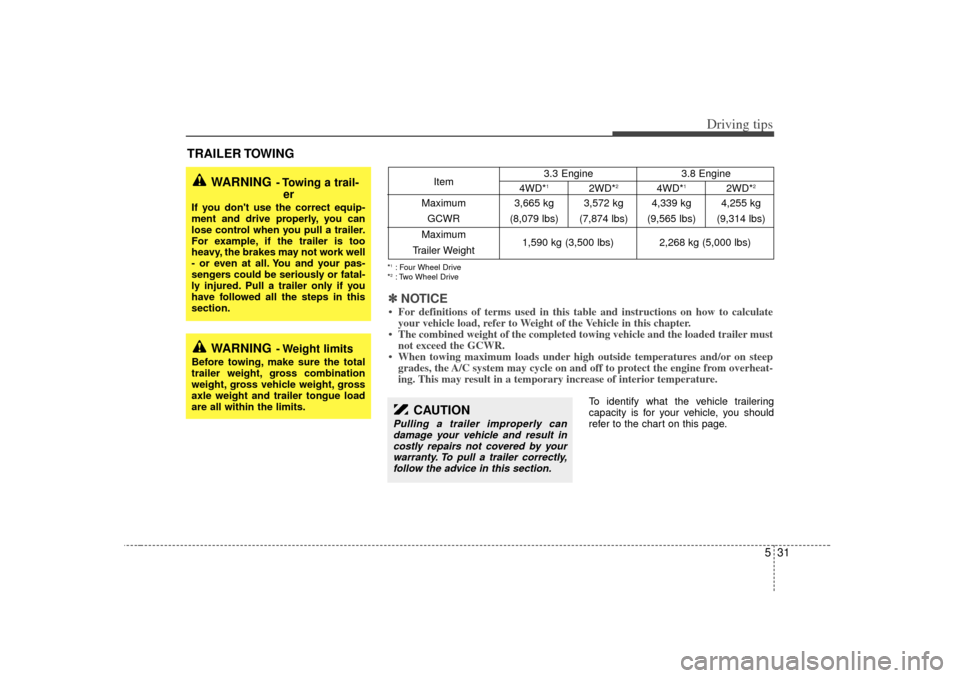
TRAILER TOWING
To identify what the vehicle trailering
capacity is for your vehicle, you should
refer to the chart on this page.
WARNING
- Towing a trail-er
If you don't use the correct equip-
ment and drive properly, you can
lose control when you pull a trailer.
For example, if the trailer is too
heavy, the brakes may not work well
- or even at all. You and your pas-
sengers could be seriously or fatal-
ly injured. Pull a trailer only if you
have followed all the steps in this
section.
WARNING
- Weight limits
Before towing, make sure the total
trailer weight, gross combination
weight, gross vehicle weight, gross
axle weight and trailer tongue load
are all within the limits.
Item 4WD*
1
2WD*
2
4WD*
1
2WD*
2
Maximum 3,665 kg 3,572 kg 4,339 kg 4,255 kg
GCWR (8,079 lbs) (7,874 lbs) (9,565 lbs) (9,314 lbs)
Maximum
Trailer Weight
3.3 Engine
1,590 kg (3,500 lbs)
*1: Four Wheel Drive
*2: Two Wheel Drive
2,268 kg (5,000 lbs) 3.8 Engine
✽ ✽
NOTICE• For definitions of terms used in this table and instructions on how to calcu\
late
your vehicle load, refer to Weight of the Vehicle in this chapter.
• The combined weight of the completed towing vehicle and the loaded trail\
er must not exceed the GCWR.
• When towing maximum loads under high outside temperatures and/or on steep grades, the A/C system may cycle on and off to protect the engine from overheat-
ing. This may result in a temporary increase of interior temperature.
CAUTION
Pulling a trailer improperly can
damage your vehicle and result in costly repairs not covered by yourwarranty. To pull a trailer correctly,follow the advice in this section.
Page 244 of 325

Driving tips36
5Do not connect a trailer lighting system
directly to your vehicle’ s lighting system.
Use only an approved trailer wiring har-
ness.
Your Authorized Kia Dealer can assist
you in installing the wiring harness.
Driving on grades Reduce speed and shift to a lower gear
before you start down a long or steep
downgrade. If you don’t shift down, you
might have to use your brakes so much
that they would get hot and no longer
operate efficiently.
On a long uphill grade, shift down and
reduce your speed to around 70 km/h (45
mph) to reduce the possibility of engine
and transmission overheating.
If your trailer weighs more than the max-
imum trailer weight without trailer brakes
and you have an automatic transmission,
you should drive in D (Drive) when tow-
ing a trailer.
Operating your vehicle in D (Drive) when
towing a trailer will minimize heat build up
and extend the life of your transmission.
If you have a manual transmission, drive
in fourth gear (or, as you need to, a lower
gear).
WARNING
Failure to use an approved trailer
wiring harness could result in dam-
age to the vehicle electrical system
and/or personal injury.
CAUTION
When towing a trailer on steep grades (in excess of 6%) payclose attention to the enginecoolant temperature gauge to ensure the engine does not over-heat. If the needle of the coolanttemperature gauge moves acrossthe dial towards “H” (HOT), pull over and stop as soon as it is safeto do so, and allow the engine toidle until it cools down. You mayproceed once the engine has cooled sufficiently.
You must decide driving speed depending on trailer weight anduphill grade to reduce the possi- bility of engine and transmissionoverheating.
Page 246 of 325

Driving tips38
5Maintenance when trailer towing Your vehicle will need service more often
when you regularly pull a trailer.
Important items to pay particular atten-
tion to include engine oil, automatic
transmission fluid, axle lubricant and
cooling system fluid. Brake condition is
another important item to frequently
check. Each item is covered in this man-
ual, and the Index will help you find them
quickly. If you’ re trailering, it ’s a good idea
to review these sections before you start
your trip.
Don’t forget to also maintain your trailer
and hitch. Follow the maintenance
schedule that accompanied your trailer
and check it periodically. Preferably, con-
duct the check at the start of each day’ s
driving. Most importantly, all hitch nuts
and bolts should be tight.
CAUTION
Due to higher load during trailer usage, overheating might occurin hot days or during uphill driv-ing. If the coolant gauge indicates over-heating, switch off the A/Cand stop the vehicle in a safe areato cool down the engine.
When towing check transmission fluid more frequently.
If your vehicle is not equipped with the air conditioner, youshould install a condenser fan to improve engine performancewhen towing a trailer.
Page 251 of 325

63
In case of an emergency
OVERHEATING If your temperature gauge indicates over-
heating, if you experience a loss of
power, or if you hear a loud knocking or
pinging noise, the engine has probably
overheated. Should any of these symp-
toms occur, use the following procedure:
1. Turn on the hazard warning flasher,then drive to the nearest safe location
and stop your vehicle; set the automat-
ic transmission in P (Park), or shift the
manual transmission to N (Neutral)
and apply the parking brake.
2. Make sure the air conditioner is off.
3. If coolant or steam is boiling out of the radiator, stop the engine and call an
Authorized Kia Dealer for assistance. If coolant is not boiling out, allow the
engine to idle and open the hood to
permit the engine to cool gradually.
If the temperature does not go down
with the engine idling, stop the engine
and allow sufficient time for it to cool.
4. The coolant level should then be checked. If the level in the reservoir is
low, look for leaks at the radiator hoses
and connections, heater hoses and
connections, radiator, and water
pump. If you find a major leak or anoth-
er problem that may have caused the
engine to overheat, do not operate the
engine until it has been corrected. Call
an Authorized Kia Dealer for assis-
tance. If you do not find a leak or other
problem, carefully add coolant to the
reservoir.
If the engine frequently overheats, havethe cooling system checked and repaired by an Authorized Kia Dealer.
WARNING
- Removing
radiator cap
Do not remove the radiator cap
when the engine and radiator are
hot. Scalding hot coolant and steam
may blow out under pressure. This
could cause serious injury.
Page 254 of 325

In case of an emergency66Jump starting procedure 1. Make sure the booster battery is 12-volt and that its negative terminal is
grounded.
2. If the booster battery is in another vehicle, do not allow the vehicles to
touch.
3. Turn off all unnecessary electrical loads.
4. Connect the jumper cables in the exact sequence shown in the previous illus-
tration. First connect one end of a
jumper cable to the positive terminal of
the discharged battery (
➀), then con-
nect the other end to the positive ter-
minal on the booster battery (
➁).
Proceed to connect one end of the
other jumper cable to the negative ter-
minal of the booster battery (
➂), then
the other end to a solid, stationary,
metallic point (for example, the engine
lifting bracket) away from the battery
(
➃). Do not connect it to or near any
part that moves when the engine is
cranked. Do not allow the jumper cables to con-
tact anything except the correct bat-
tery terminals or the correct ground.
Do not lean over the battery when
making connections.
5. Start the engine of the vehicle with the booster battery and let it run at 2,000
rpm, then start the engine of the vehi-
cle with the discharged battery.
If the cause of your battery discharging isnot apparent, you should have your vehi-cle checked by an Authorized Kia Dealer.
Push-starting Your manual transmission-equipped
vehicle should not be push-started
because it might damage the emission
control system.
Vehicles equipped with automatic trans-
mission cannot be push-started.
Follow the directions in this section for
jump-starting.
CAUTION
Never tow a vehicle to start it because the sudden surge forwardwhen the engine starts could causea collision with the tow vehicle.
CAUTION -
Battery cables
Do not connect the jumper cable from the negative terminal of thebooster battery to the negative ter- minal of the discharged battery.This can cause the discharged bat- tery to overheat and crack, releas-ing battery acid.
Page 324 of 325

93
Index
If you have a flat tire ··················\
··················\
···············6-19
Ignition switch ··················\
··················\
··················\
··········4-2
Immobilizer system ··················\
··················\
··················\
··3-5
Instrument cluster ··················\
··················\
··················\
·4-36
Instrument panel overview ··················\
··················\
·······2-2
Interior care··················\
··················\
··················\
············7-42
Interior features ··················\
··················\
··················\
·····3-86
Interior lights ··················\
··················\
··················\
·········3-82
Keys ··················\
··················\
··················\
··················\
·········3-2
Label information ··················\
··················\
··················\
··5-39
Lighting ··················\
··················\
··················\
··················\
·4-51
Limited slip differential··················\
··················\
···········4-19
Lubricant specifications ··················\
··················\
··········7-37
Lubricants and fluids ··················\
··················\
··············7-18
Luggage center box ··················\
··················\
··················\
3-96
Luggage net ··················\
··················\
··················\
············3-94
Maintenance schedule Owner maintenance ················7-7
Maintenance services ··················\
··················\
·················7-2
Manual climate control system··················\
·················4-59\
Mirrors ··················\
··················\
··················\
··················\
··3-74Multi-meter··················\
··················\
··················\
·············4-45
Overheating ··················\
··················\
··················\
··············6-3
Power steering ··················\
··················\
··················\
········7-15
Rear parking assist system·············\
··················\
···········4-33
Remote keyless entry ··················\
··················\
·················3-3
Road warning ··················\
··················\
··················\
···········6-2
Roof rack ··················\
··················\
··················\
················3-96
Safety belts··················\
··················\
··················\
··············3-25
Seat ··················\
··················\
··················\
··················\
········3-15
Special driving conditions ··················\
··················\
·········5-7
Specifications ··················\
··················\
··················\
············8-2
Starting the engine ··················\
··················\
··················\
···4-4
Steering wheel···············\
··················\
··················\
············4-25
Storage compartment ··················\
··················\
··············3-83
Suggestions for economical operation··················\
········5-6
Sunroof ··················\
··················\
··················\
··················\
··3-91KLMI
OPRS