2007 KIA Sorento Hazard
[x] Cancel search: HazardPage 250 of 325
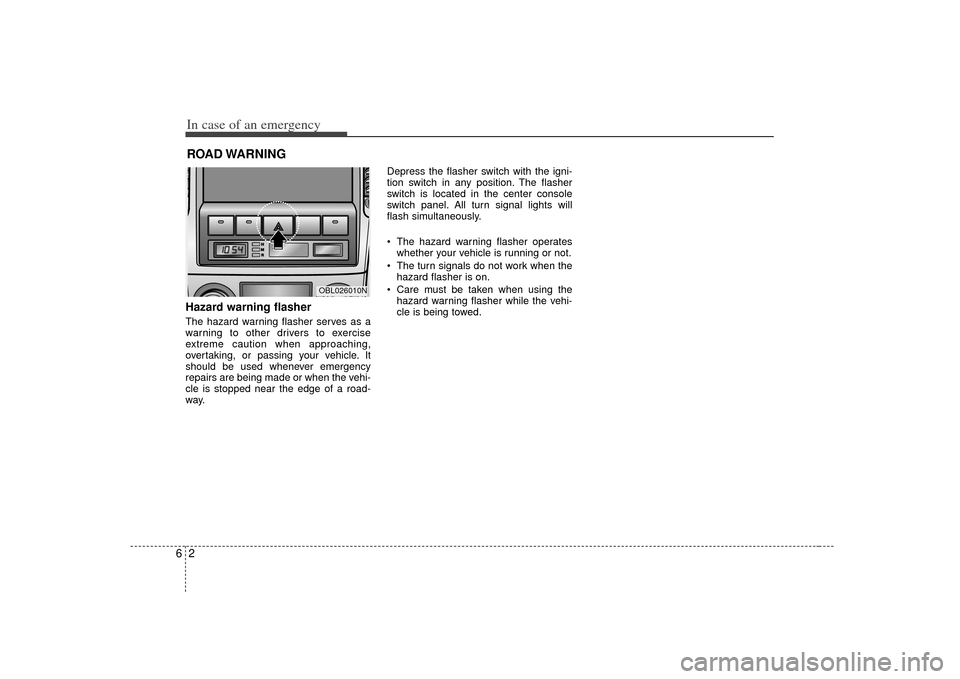
In case of an emergency26ROAD WARNING Hazard warning flasher The hazard warning flasher serves as a
warning to other drivers to exercise
extreme caution when approaching,
overtaking, or passing your vehicle. It
should be used whenever emergency
repairs are being made or when the vehi-
cle is stopped near the edge of a road-
way.Depress the flasher switch with the igni-
tion switch in any position. The flasher
switch is located in the center console
switch panel. All turn signal lights will
flash simultaneously.
• The hazard warning flasher operates
whether your vehicle is running or not.
The turn signals do not work when the hazard flasher is on.
Care must be taken when using the hazard warning flasher while the vehi-
cle is being towed.
OBL026010N
Page 251 of 325

63
In case of an emergency
OVERHEATING If your temperature gauge indicates over-
heating, if you experience a loss of
power, or if you hear a loud knocking or
pinging noise, the engine has probably
overheated. Should any of these symp-
toms occur, use the following procedure:
1. Turn on the hazard warning flasher,then drive to the nearest safe location
and stop your vehicle; set the automat-
ic transmission in P (Park), or shift the
manual transmission to N (Neutral)
and apply the parking brake.
2. Make sure the air conditioner is off.
3. If coolant or steam is boiling out of the radiator, stop the engine and call an
Authorized Kia Dealer for assistance. If coolant is not boiling out, allow the
engine to idle and open the hood to
permit the engine to cool gradually.
If the temperature does not go down
with the engine idling, stop the engine
and allow sufficient time for it to cool.
4. The coolant level should then be checked. If the level in the reservoir is
low, look for leaks at the radiator hoses
and connections, heater hoses and
connections, radiator, and water
pump. If you find a major leak or anoth-
er problem that may have caused the
engine to overheat, do not operate the
engine until it has been corrected. Call
an Authorized Kia Dealer for assis-
tance. If you do not find a leak or other
problem, carefully add coolant to the
reservoir.
If the engine frequently overheats, havethe cooling system checked and repaired by an Authorized Kia Dealer.
WARNING
- Removing
radiator cap
Do not remove the radiator cap
when the engine and radiator are
hot. Scalding hot coolant and steam
may blow out under pressure. This
could cause serious injury.
Page 259 of 325

611
In case of an emergency
Driver side panel
Description Fuse rating Protected component
W/SHD*15A Rear window defroster
TPMS* 10A Tire pressure monitoring system
WIPER(FRT) 20A Front wiper
DRL/OBD-II* 15A Daytime running light
HAZARD 15A Hazard warning light
WIPER(RR) 10A Rear wiper
S/ROOF* 20A Sunroof
O/S MIRROR 10A Outside rearview mirror
RELAY COIL 10A Ignition coil
START 10A Start motor
S/WARMER 20A Seat warmer
ACC 15A Accessory
STOP LAMP 20A Stop light
TCCS 20A TCS, ESC, Immobilizer
ROOM LAMP 10A Room lamp
CIGAR(FRT) 15A Cigar lighter
O/S MIRROR DEF 20A Outside rearview mirror heater
ENGINE 10A Engine control unit
METER 10A Multi-meter
ABS IG 10A ABS
A/BAG 10A Airbag
TURN LAMP 10A Turn signal light
POWER SEAT 30A Power seat
DOOR LOCK 20A Central door lock
SPARE 20A Spare fuse*: if equipped
Page 270 of 325
In case of an emergency22
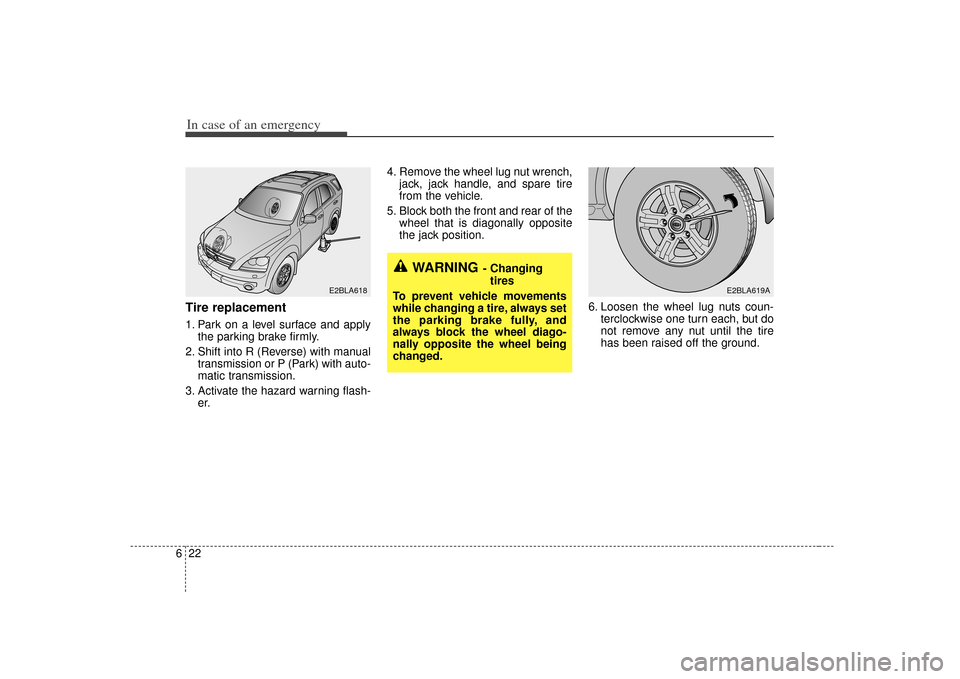
6Tire replacement 1. Park on a level surface and apply
the parking brake firmly.
2. Shift into R (Reverse) with manual transmission or P (Park) with auto-
matic transmission.
3. Activate the hazard warning flash- er. 4. Remove the wheel lug nut wrench,
jack, jack handle, and spare tire
from the vehicle.
5. Block both the front and rear of the wheel that is diagonally opposite
the jack position.
6. Loosen the wheel lug nuts coun-terclockwise one turn each, but do
not remove any nut until the tire
has been raised off the ground.
E2BLA618
E2BLA619A
WARNING
- Changing
tires
To prevent vehicle movements
while changing a tire, always set
the parking brake fully, and
always block the wheel diago-
nally opposite the wheel being
changed.
Page 281 of 325

Maintenance87At least monthly: Check coolant level in the coolantrecovery reservoir.
Check the operation of all exterior lights, including the stoplights, turn sig-
nals and hazard warning flashers.
Check the inflation pressures of all tires including the spare.
At least twice a year (i.e., every Spring and Fall) : Check radiator, heater and air condi- tioning hoses for leaks or damage.
Check windshield washer spray and wiper operation. Clean wiper blades
with clean cloth dampened with wash-
er fluid.
Check headlight alignment.
Check muffler, exhaust pipes, shields and clamps.
Check the lap/shoulder belts for wear and function.
Check for worn tires and loose wheel lug nuts.
At least once a year : Clean body and door drain holes.
Lubricate door hinges and checks, andhood hinges.
Lubricate door and hood locks and latches.
Lubricate door rubber weatherstrips.
Check the air conditioning system before the warm weather season.
Check the power steering fluid level.
Inspect and lubricate automatic trans- mission linkage and controls.
Clean battery and terminals.
Check the brake fluid level.
Page 299 of 325
Maintenance26
7
WARNING
- Tire Inflation
Overinflation or underinflation
can reduce tire life, adversely
affect vehicle handling, and lead
to sudden tire failure. This could
result in loss of vehicle control
and potential injury.
CAUTION
- Tire pressure
Always observe the following: Check tire pressure when the tires are cold. (After vehiclehas been parked for at leastthree hours or hasn't beendriven more than 1.6 km (onemile) since startup.)
Check the pressure of your spare tire each time you checkthe pressure of other tires.
Never overload your vehicle. Be careful not to overload avehicle luggage rack if yourvehicle is equipped with one.
Worn, old tires can cause acci- dents. If your tread is badlyworn, or if your tires havebeen damaged, replace them.
CAUTION
Underinflation also results in excessive wear, poor handlingand reduced fuel economy.Wheel deformation also ispossible. Keep your tire pres-sures at the proper levels. If atire frequently needs refilling,have it checked by anAuthorized Kia Dealer.
Overinflation produces a harsh ride, excessive wear atthe center of the tire tread, anda greater possibility of dam-age from road hazards.
CAUTION
Warm tires normally exceed recommended cold tire pres-sures by 28 to 41 kPa (4 to 6psi). Do not release air fromwarm tires to adjust the pres-sure or the tires will be under-inflated.
Be sure to reinstall the tire inflation valve caps. Withoutthe valve cap, dirt or moisturecould get into the valve coreand cause air leakage. If thecap have been lost, install newone as soon as possible.
Page 302 of 325
729
Maintenance
Wheel alignment and tire
balance The wheels on your vehicle were
aligned and balanced carefully at the
factory to give you the longest tire life
and best overall performance.
In most cases, you will not need to
have your wheels aligned again.
However, if you notice unusual tire
wear or your vehicle pulling one way
or the other, the alignment may need
to be reset.
If you notice your vehicle vibrating
when driving on a smooth road, your
wheels may need to be rebalanced.
WARNING -
Replacing
tires
Driving on worn-out tires is very hazardous and will
reduce braking effectiveness,
steering accuracy, and trac-
tion.
Your vehicle is equipped with tires designed to provide for
safe ride and handling capa-
bility. Do not use a size and
type of tire and wheel that is
different from the one that is
originally installed on your
vehicle. It can affect the safety
and performance of your vehi-
cle, which could lead to han-
dling failure or rollover and
serious injury. When replacing
the tires, be sure to equip all
four tires with the tire and
wheel of the same size, type,
tread, brand and load-carrying
capacity.
(Continued)
(Continued)If you nevertheless decide to
equip your vehicle with any
tire/wheel combination not
recommended by Kia for off
road driving, you should not
use these tires for highway
driving.
The use of any other tire size or type may seriously affect
ride, handling, ground clear-
ance, stopping distance, body
to tire clearance, snow tire
clearance, and speedometer
reliability.
It is best to replace all four tires at the same time. If that is
not possible, or necessary,
then replace the two front or
two rear tires as a pair.
Replacing just one tire can
seriously affect your vehicle’s
handling.
CAUTION
Improper wheel weights candamage your vehicle's alu-minum wheels. Use onlyapproved wheel weights.
Page 323 of 325

Index29Air bags - advanced supplemental restraint system ··················\
··················\
··················\
··················\
3-47
Air cleaner ··················\
··················\
··················\
··············7-19
Antenna ··················\
··················\
··················\
··················\
·3-98
Audio remote control··················\
··················\
···············3-99
Audio system ··················\
··················\
··················\
········3-100
Auto fuel cutoff switch ··················\
··················\
············3-74
Automatic climate control system ··················\
············4-66
Automatic transmission ··················\
··················\
····4-5,7-16
Battery··················\
··················\
··················\
··················\
···7-22
Before driving··················\
··················\
··················\
···········5-5
Brake fluid ··················\
··················\
··················\
··············7-14
Brake system ··················\
··················\
··················\
··········4-20
Climate control air filter ··················\
··················\
·········7-20
Cruise control system ··················\
··················\
··············4-27
Defroster ··················\
··················\
··················\
·················4-57\
Door locks ··················\
··················\
··················\
·················3-7 Electrical circuit protection ··················\
··················\
······6-7
Electronic stability control ··················\
··················\
······4-30
Emergency starting··················\
··················\
··················\
··6-4
Emission control system ··················\
··················\
············5-3
Engine compartment ··················\
··················\
·········2-3,7-10
Engine cooling system ··················\
··················\
·············7-12
Engine oil ··················\
··················\
··················\
················7-11
Exterior care··················\
··················\
··················\
···········7-39
Four wheel drive (4WD)··················\
··················\
··········4-10
Fuel filler lid ··················\
··················\
··················\
···········3-71
Fuel requirements ··················\
··················\
··················\
····5-2
Gauges ··················\
··················\
··················\
··················\
···4-37
Hazard warning flasher ··················\
··················\
··········4-58
Homelink® wireless control system ··················\
·········3-78
Hood ··················\
··················\
··················\
··················\
······3-69
How to use this manual ··················\
··················\
·············1-2ABCD
EFGH