2007 KIA Sorento Hand brake
[x] Cancel search: Hand brakePage 226 of 325
Driving tips18
5Driving uphillOnce you decide you can safely drive up
the hill, you need to take some special
steps.
Use a low gear and get a firm grip on
the steering wheel.
Get a smooth start up the hill and try to maintain your speed. Don’t use more
power than you need, because you
don’t want your wheels to start spin-
ning or sliding.
Try to drive straight up the hill, if at all possible. If the path twists and turns,
you may have to find another route. Slow down as you approach the top of
the hill.
Attach a flag to the vehicle to make you more visible to approaching traffic on
trails or hills.
Sound the horn as you approach the top of the hill to let opposing traffic
know you’re there.
Use your headlights even during the day. They make you more visible to
other drivers.
Stalling while driving uphill
What should I do if my vehicle stalls, or isabout to stall, and I can’t make it up thehill?If your vehicle stalls, or is about to stall
while driving uphill, there are some
things you should do, and there are some
things you must not do. First, here’s what
you should do:
Push the brake pedal to stop the vehi- cle and keep it from rolling backwards.
Also, apply the parking brake.
If your engine is still running, shift the transmission into reverse, release the
parking brake, and slowly back down
the hill in reverse.
If your engine has stopped running, you’ll need to restart it. With the brake
pedal depressed and the parking
brake still applied, shift a manual trans-
mission to N (Neutral), or an automatic
transmission to P (Park) and restart
the engine. Then, shift to reverse,
release the parking brake, and slowly
back down the hill in reverse.
As you are backing down the hill, put your left hand on the steering wheel at
the 12 o’clock position. This way, you’ll
be able to tell if your wheels are
straight or turned to the left or right as
you back down.
WARNING -
Driving across
hills
Turning or driving across steep
hills can be dangerous. You could
lose traction, slide sideways, or just
reach an area too steep to traverse.
In any case, it could cause you to
roll over. You could be seriously or
fatally injured. When driving up
hills, always try to go as straight up
as possible.
WARNING
- Driving overhills
Driving to the top (crest) of a hill at
full speed can cause an accident
and result in serious or fatal injury.
There could be a drop-off, embank-
ment, cliff, another vehicle or peo-
ple sitting on the ground. As you
near the top of a hill, slow down and
stay alert.
Page 238 of 325
Driving tips30
5GCWR (Gross Combined
Weight Rating)This is the maximum allowable
weight of the vehicle and the loaded
trailer - including all cargo and pas-
sengers - that the vehicle can handle
without risking damage. (Important :
The towing vehicle's braking system
is rated for operation at GVWR, not
GCWR. Separate functional brakes
should be used for safe control of
towed vehicles and for trailers weigh-
ing an 750kg (1,653 lbs).) The GCW
must never exceed the GCWR.
Maximum Trailer WeightThis is the highest possible weight of
a fully loaded trailer the vehicle can
tow. It assumes a vehicle with only
mandatory options, no cargo, and a
driver. The weight of other optional
equipment, passengers and cargo in
your vehicle will reduce the maxi-
mum trailer weight your vehicle can
tow.
Calculating the load your vehi-
cle can tow1. Use the appropriate maximum
GCWR chart (in the Weight of the
Trailer section in this chapter) for
your type of drive system and
transmission.
2. Weigh your vehicle.
3. Subtract the weight of your vehicle from the maximum GCWR in the
chart. This is the maximum trailer
weight your vehicle can tow. It
must be below the maximum trail-
er weight shown in the chart. Note
that the maximum trailer weight
your vehicle can tow depends on
the total weight of any cargo, pas-
sengers and available equipment
in the vehicle.
Page 242 of 325

Driving tips34
5Safety chains You should always attach chains
between your vehicle and your trailer.
Cross the safety chains under the tongue
of the trailer so that the tongue will not
drop to the road if it becomes separated
from the hitch.
Instructions about safety chains may be
provided by the hitch manufacturer or by
the trailer manufacturer. Follow the man-
ufacturer’ s recommendation for attaching
safety chains. Always leave just enough
slack so you can turn with your trailer.
And, never allow safety chains to drag on
the ground.
Trailer brakes If your trailer weighs more than the max-
imum trailer weight without trailer brakes
loaded, then it needs its own brakes and
they must be adequate. Be sure to read
and follow the instructions for the trailer
brakes so you’ll be able to install, adjust
and maintain them properly.
Don’t tap into your vehicle's brake sys-
tem.
Driving with a trailer Towing a trailer requires a certain
amount of experience. Before setting out
for the open road, you must get to know
your trailer. Acquaint yourself with the
feel of handling and braking with the
added weight of the trailer. And always
keep in mind that the vehicle you are
driving is now a good deal longer and not
nearly so responsive as your vehicle is
by itself.
Before you start, check the trailer hitch
and platform, safety chains, electrical
connector(s), lights, tires and mirror
adjustment. If the trailer has electric
brakes, start your vehicle and trailer mov-
ing and then apply the trailer brake con-
troller by hand to be sure the brakes are
working. This lets you check your electri-
cal connection at the same time.
During your trip, check occasionally to be
sure that the load is secure, and that the
lights and any trailer brakes are still work-
ing.
WARNING -
Trailer brakes
Do not use a trailer with its own
brakes unless you are absolutely
certain that you have properly set
up the brake system. This is not a
task for amateurs. Use an experi-
enced, competent trailer shop for
this work.
Page 270 of 325
In case of an emergency22
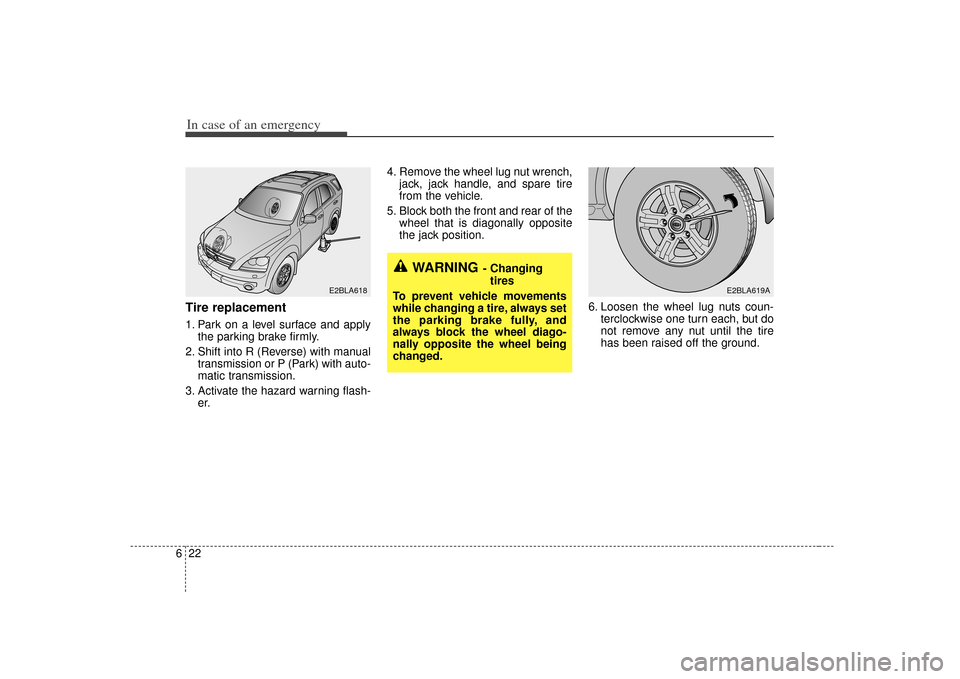
6Tire replacement 1. Park on a level surface and apply
the parking brake firmly.
2. Shift into R (Reverse) with manual transmission or P (Park) with auto-
matic transmission.
3. Activate the hazard warning flash- er. 4. Remove the wheel lug nut wrench,
jack, jack handle, and spare tire
from the vehicle.
5. Block both the front and rear of the wheel that is diagonally opposite
the jack position.
6. Loosen the wheel lug nuts coun-terclockwise one turn each, but do
not remove any nut until the tire
has been raised off the ground.
E2BLA618
E2BLA619A
WARNING
- Changing
tires
To prevent vehicle movements
while changing a tire, always set
the parking brake fully, and
always block the wheel diago-
nally opposite the wheel being
changed.
Page 287 of 325
Maintenance14
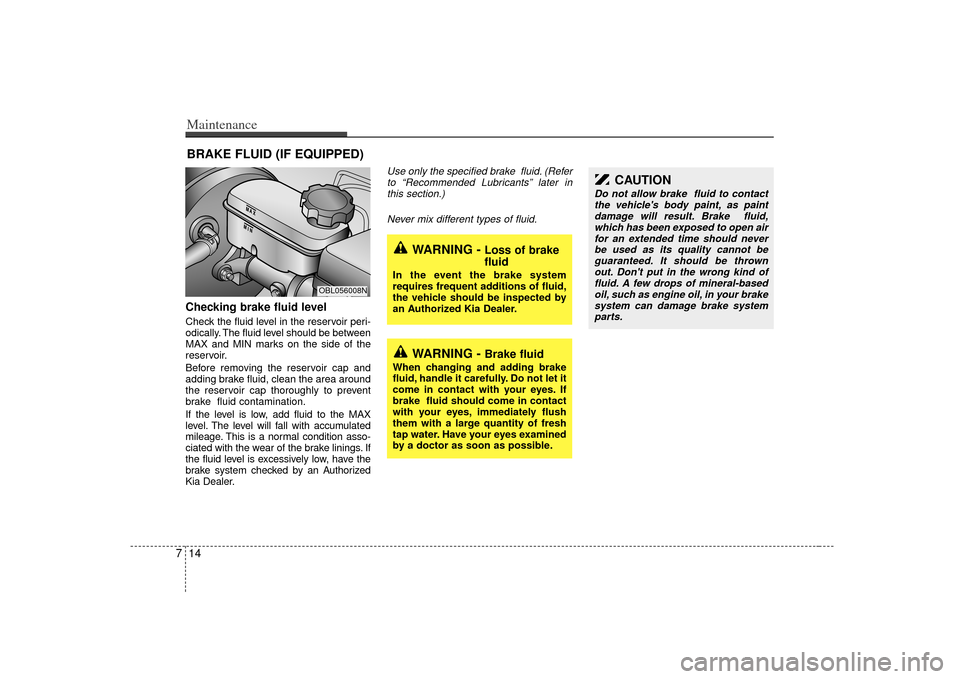
7BRAKE FLUID (IF EQUIPPED)Checking brake fluid level Check the fluid level in the reservoir peri-
odically. The fluid level should be between
MAX and MIN marks on the side of the
reservoir.
Before removing the reservoir cap and
adding brake fluid, clean the area around
the reservoir cap thoroughly to prevent
brake fluid contamination.
If the level is low, add fluid to the MAX
level. The level will fall with accumulated
mileage. This is a normal condition asso-
ciated with the wear of the brake linings. If
the fluid level is excessively low, have the
brake system checked by an Authorized
Kia Dealer.
Use only the specified brake fluid. (Refer
to “Recommended Lubricants” later in this section.)
Never mix different types of fluid.
WARNING -
Brake fluid
When changing and adding brake
fluid, handle it carefully. Do not let it
come in contact with your eyes. If
brake fluid should come in contact
with your eyes, immediately flush
them with a large quantity of fresh
tap water. Have your eyes examined
by a doctor as soon as possible.
WARNING -
Loss of brake
fluid
In the event the brake system
requires frequent additions of fluid,
the vehicle should be inspected by
an Authorized Kia Dealer.
OBL056008N
CAUTION
Do not allow brake fluid to contactthe vehicle's body paint, as paint damage will result. Brake fluid,which has been exposed to open air for an extended time should neverbe used as its quality cannot beguaranteed. It should be thrown out. Don't put in the wrong kind offluid. A few drops of mineral-based oil, such as engine oil, in your brakesystem can damage brake system parts.
Page 301 of 325
Maintenance28
7
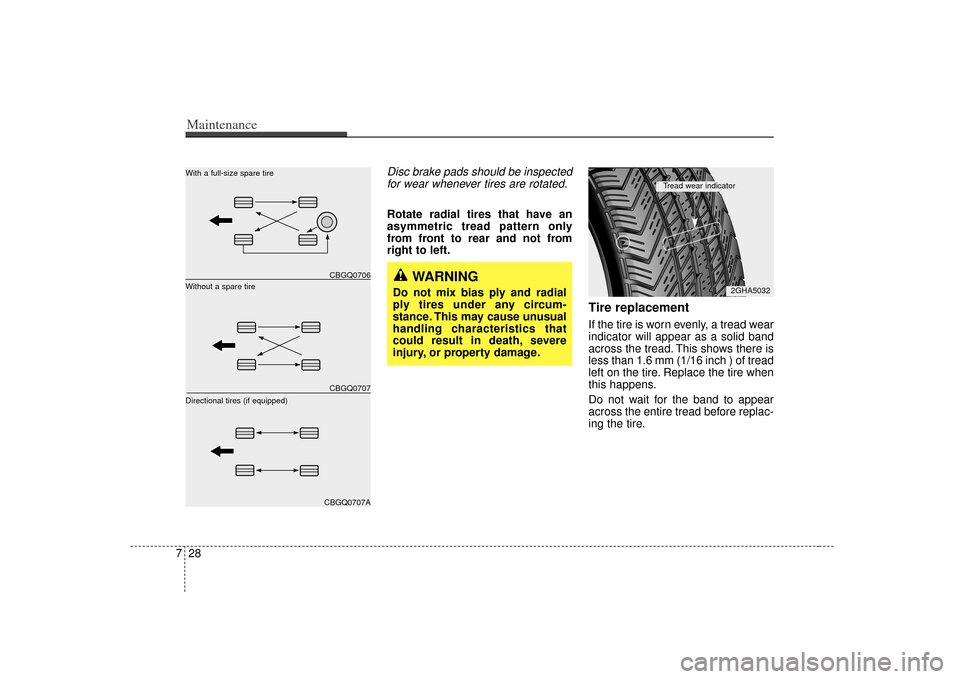
Disc brake pads should be inspected
for wear whenever tires are rotated.Rotate radial tires that have an
asymmetric tread pattern only
from front to rear and not from
right to left.
Tire replacementIf the tire is worn evenly, a tread wear
indicator will appear as a solid band
across the tread. This shows there is
less than 1.6 mm (1/16 inch ) of tread
left on the tire. Replace the tire when
this happens.
Do not wait for the band to appear
across the entire tread before replac-
ing the tire.
WARNING
Do not mix bias ply and radial
ply tires under any circum-
stance. This may cause unusual
handling characteristics that
could result in death, severe
injury, or property damage.
CBGQ0706CBGQ0707CBGQ0707A
Without a spare tire With a full-size spare tire
Directional tires (if equipped)
Tread wear indicator
2GHA5032