Page 174 of 325

Driving your vehicle44
4Low washer fluid level
warning indicator
(If equipped) This warning light indicates the washer
fluid reservoir is near empty. Refill the
washer fluid as soon as possible.4WD system warning
(if equipped) When the key is turned to the “ON” posi-
tion, the 4WD indicator light will come on
and then go off in a few seconds.
The 4WD indicator light will illuminate
when the transfer shift knob is set to 4HI
position (Part time 4WD only).
4WD LOW indicator light
(if equipped) When the key is turned to the “ON” posi-
tion, the 4WD LOW indicator will come
on and then go off in a few seconds. The
4WD LOW indicator light comes on when
the transfer shift knob is set to 4WD LOW
position.
Part-time 4WD : 4LO position
Full-time 4WD : Low position
Safety belt warning chime If the driver's safety belt is not fastened
when the ignition key is turned ON or if it
is unfastened after the key is ON, the
safety belt warning chime will sound for
approximately 6 seconds. At this time, if
the safety belt is fastened, the chime will
stop at once.Door ajar warning chime
(if equipped)If a door is opened while driving the vehi-
cle more than 3 mph (5 km/h), the warn-
ing chime will sound.Key reminder warning chime
(if equipped)If the driver’s door is opened while the
ignition key is left in the ignition switch,
the key reminder warning chime will
sound. This is to prevent you from locking
your keys in the vehicle.
CAUTION
If the 4WD indicator light ( )
blinks (full-time 4WD) or 4WD indi-cator light ( ) and 4WD LOW indi- cator light
()
illuminate at the
same time (part time 4WD), this indicates that there is a malfunctionin the 4WD system. If this occurs,have your vehicle checked by an Authorized Kia Dealer as soon aspossible.
4WD
LOW
4WD
LOW
Page 239 of 325
531
Driving tips
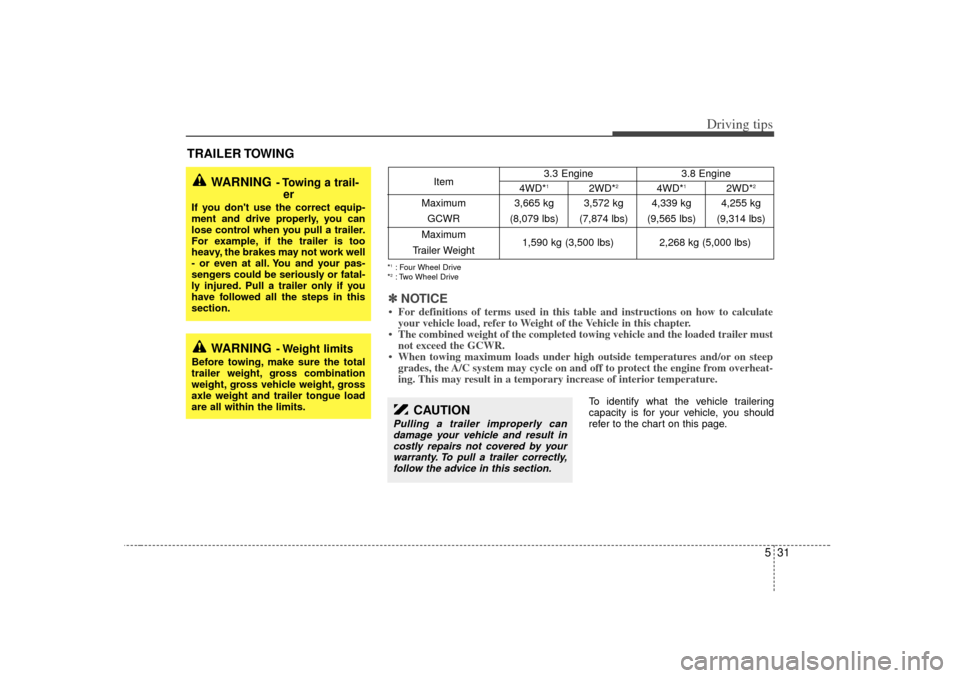
TRAILER TOWING
To identify what the vehicle trailering
capacity is for your vehicle, you should
refer to the chart on this page.
WARNING
- Towing a trail-er
If you don't use the correct equip-
ment and drive properly, you can
lose control when you pull a trailer.
For example, if the trailer is too
heavy, the brakes may not work well
- or even at all. You and your pas-
sengers could be seriously or fatal-
ly injured. Pull a trailer only if you
have followed all the steps in this
section.
WARNING
- Weight limits
Before towing, make sure the total
trailer weight, gross combination
weight, gross vehicle weight, gross
axle weight and trailer tongue load
are all within the limits.
Item 4WD*
1
2WD*
2
4WD*
1
2WD*
2
Maximum 3,665 kg 3,572 kg 4,339 kg 4,255 kg
GCWR (8,079 lbs) (7,874 lbs) (9,565 lbs) (9,314 lbs)
Maximum
Trailer Weight
3.3 Engine
1,590 kg (3,500 lbs)
*1: Four Wheel Drive
*2: Two Wheel Drive
2,268 kg (5,000 lbs) 3.8 Engine
✽ ✽
NOTICE• For definitions of terms used in this table and instructions on how to calcu\
late
your vehicle load, refer to Weight of the Vehicle in this chapter.
• The combined weight of the completed towing vehicle and the loaded trail\
er must not exceed the GCWR.
• When towing maximum loads under high outside temperatures and/or on steep grades, the A/C system may cycle on and off to protect the engine from overheat-
ing. This may result in a temporary increase of interior temperature.
CAUTION
Pulling a trailer improperly can
damage your vehicle and result in costly repairs not covered by yourwarranty. To pull a trailer correctly,follow the advice in this section.
Page 262 of 325
In case of an emergency14
6TOWINGIf emergency towing is necessary, we
recommend having it done by an author-
ized Kia dealer or a commercial tow-truck
service. Proper lifting and towing proce-
dures are necessary to prevent damage
to the vehicle. The use of wheel dollies or
flatbed is recommended.For trailer towing guidelines information,
refer to section 5 “Driving Tips”.
On 4WD vehicles, your vehicle must
be towed with a wheel lift and dollies
or flatbed equipment with all the
wheels off the ground. On 2WD vehicles, it is acceptable to tow
the vehicle with the front wheels on the
ground (without dollies) and the rear
wheels off the ground.
When being towed by a commercial tow
truck and wheel dollies are not used, the
rear of the vehicle should always be lift-
ed, not the front.
E4BLA609A
E4BLA609B
E4BLA630
Page 311 of 325
Maintenance38
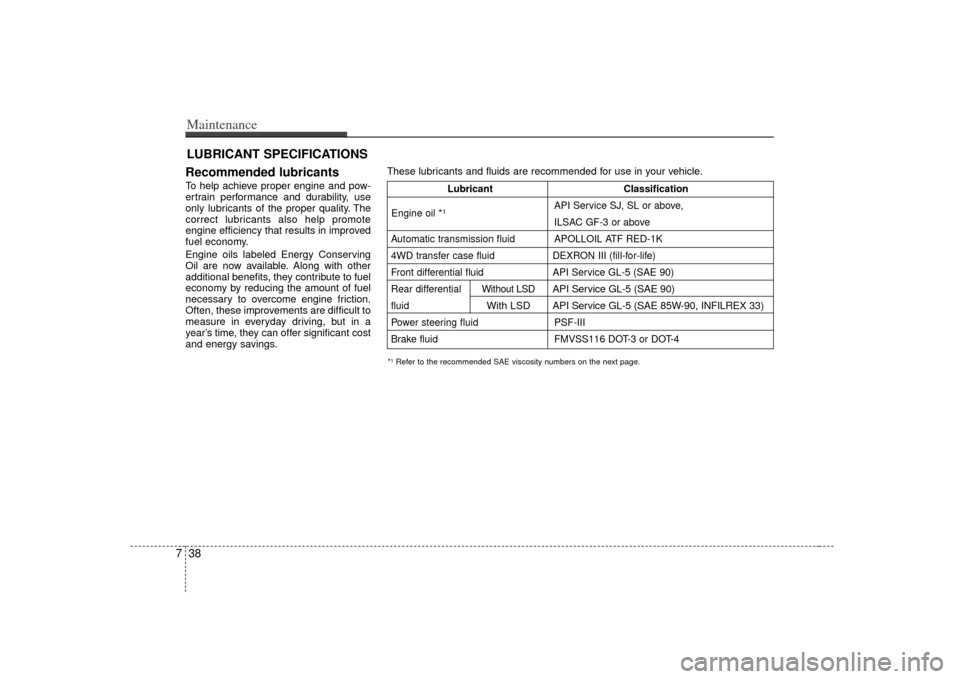
7LUBRICANT SPECIFICATIONS
Recommended lubricants To help achieve proper engine and pow-
ertrain performance and durability, use
only lubricants of the proper quality. The
correct lubricants also help promote
engine efficiency that results in improved
fuel economy.
Engine oils labeled Energy Conserving
Oil are now available. Along with other
additional benefits, they contribute to fuel
economy by reducing the amount of fuel
necessary to overcome engine friction.
Often, these improvements are difficult to
measure in everyday driving, but in a
year’s time, they can offer significant cost
and energy savings.
*¹ Refer to the recommended SAE viscosity numbers on the next page.These lubricants and fluids are recommended for use in your vehicle.
Lubricant Classification
API Service SJ, SL or above,
ILSAC GF-3 or above
Automatic transmission fluid APOLLOIL ATF RED-1K
4WD transfer case fluid DEXRON III (fill-for-life)
Front differential fluid API Service GL-5 (SAE 90)
Rear differential Without LSD
API Service GL-5 (SAE 90)
fluid
With LSDAPI Service GL-5 (SAE 85W-90, INFILREX 33)
Power steering fluid PSF-III
Brake fluid FMVSS116 DOT-3 or DOT-4Engine oil
*¹
Page 323 of 325

Index29Air bags - advanced supplemental restraint system ··················\
··················\
··················\
··················\
3-47
Air cleaner ··················\
··················\
··················\
··············7-19
Antenna ··················\
··················\
··················\
··················\
·3-98
Audio remote control··················\
··················\
···············3-99
Audio system ··················\
··················\
··················\
········3-100
Auto fuel cutoff switch ··················\
··················\
············3-74
Automatic climate control system ··················\
············4-66
Automatic transmission ··················\
··················\
····4-5,7-16
Battery··················\
··················\
··················\
··················\
···7-22
Before driving··················\
··················\
··················\
···········5-5
Brake fluid ··················\
··················\
··················\
··············7-14
Brake system ··················\
··················\
··················\
··········4-20
Climate control air filter ··················\
··················\
·········7-20
Cruise control system ··················\
··················\
··············4-27
Defroster ··················\
··················\
··················\
·················4-57\
Door locks ··················\
··················\
··················\
·················3-7 Electrical circuit protection ··················\
··················\
······6-7
Electronic stability control ··················\
··················\
······4-30
Emergency starting··················\
··················\
··················\
··6-4
Emission control system ··················\
··················\
············5-3
Engine compartment ··················\
··················\
·········2-3,7-10
Engine cooling system ··················\
··················\
·············7-12
Engine oil ··················\
··················\
··················\
················7-11
Exterior care··················\
··················\
··················\
···········7-39
Four wheel drive (4WD)··················\
··················\
··········4-10
Fuel filler lid ··················\
··················\
··················\
···········3-71
Fuel requirements ··················\
··················\
··················\
····5-2
Gauges ··················\
··················\
··················\
··················\
···4-37
Hazard warning flasher ··················\
··················\
··········4-58
Homelink® wireless control system ··················\
·········3-78
Hood ··················\
··················\
··················\
··················\
······3-69
How to use this manual ··················\
··················\
·············1-2ABCD
EFGH