Page 21 of 329
311
1 23456789
Knowing your vehicle
1. Open the rear door.
2. Push the child safety lock locatedon the rear edge of the door to the
“lock” position. When the child
safety lock is in the “lock ( )”position, rear door will not openwhen the inner door handle is
pulled inside the vehicle.
3. Close the rear door.
4. To open the rear door, pull the out- side door handle.
Even though the doors may be
unlocked, the rear door will not open
by pulling the inner door handle ( 1)
until rear door child safety lock is
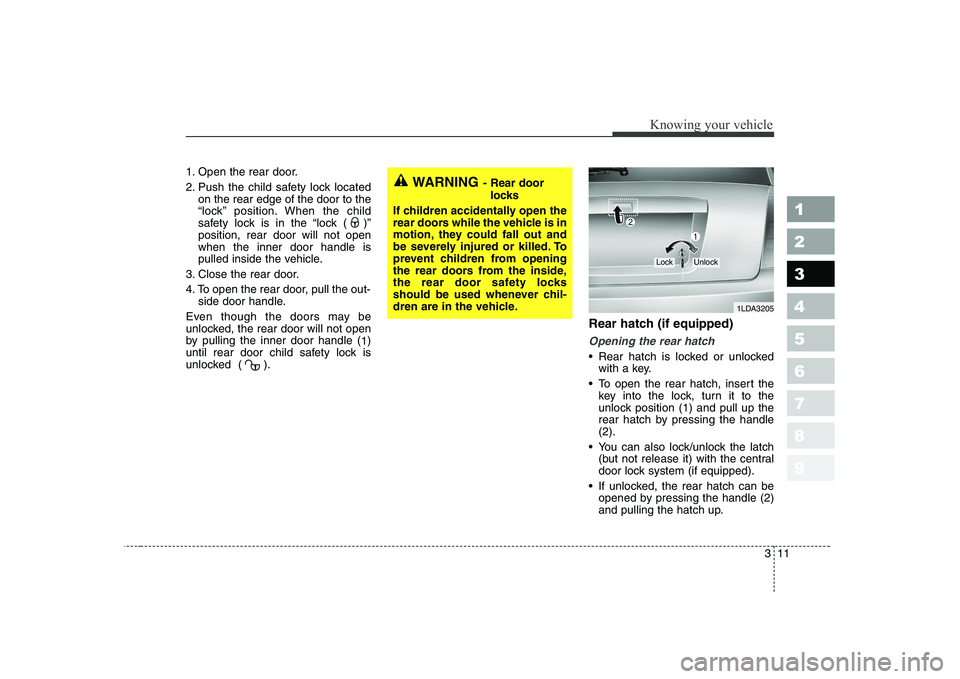
unlocked ( ). Rear hatch (if equipped)
Opening the rear hatch
Rear hatch is locked or unlocked
with a key.
To open the rear hatch, insert the key into the lock, turn it to the
unlock position (1) and pull up the
rear hatch by pressing the handle(2).
You can also lock/unlock the latch (but not release it) with the central
door lock system (if equipped).
If unlocked, the rear hatch can be opened by pressing the handle (2)
and pulling the hatch up.
WARNING - Rear door
locks
If children accidentally open the
rear doors while the vehicle is in
motion, they could fall out and
be severely injured or killed. To
prevent children from opening
the rear doors from the inside,
the rear door safety locks
should be used whenever chil-
dren are in the vehicle.
1LDA3205
LockUnlock
Page 45 of 329
335
1 23456789
Knowing your vehicle
WARNING- Belt use
Safety belts must be used cor-
rectly to work properly in an
accident. Each seating position
in your vehicle has a specific
safety belt assembly that
includes a buckle and tongue
designed to be used together.
For greatest effectiveness, fol-
low these guidelines in using
safety belts:
Use the shoulder portion of the safety belt on the outside
shoulder only. Never wear the
shoulder portion under thearm.
Never swing the safety belt around your neck to fit over
the inside shoulder.
Never wear the shoulder por- tion of the safety belt across
the neck or face.
(Continued)(Continued)
Wear the lap portion as low aspossible. Be sure that the lap
belt fits snugly around the
hips. Never wear lap belt or a
lap portion of a lap/shoulder
belt over your waist; it should
always go over the stronger
area of your hips.
Never use a single safety belt for more than one person.
The front seatbacks should always remain in a comfort-
able, upright position when
the vehicle is moving.WARNING - Safety belt
care
A damaged belt may not give you the protection you need in an accident.
Inspect your safety belts peri- odically for excessive wear or
damage. Pull out each belt
fully and look for fraying, cuts,
burns or other damage. Pull
the safety belt out and let it
retract a number of times.Make sure that the lap/shoul-
der belts return smoothly and
easily into the retractor.
Check the latches to make sure they latch and release
without interference or delay.
Never close the doors on any part of the lap or shoulderbelt.
Any belt not in good condition or in good working order
should be promptly replaced.
Page 277 of 329
Maintenance
12
7
1 23456789
At least monthly:
Check coolant level in the engine
coolant reservoir.
Check the operation of all exterior lights, including the stoplights, turn
signals and hazard warning flash-
ers.
Check the inflation pressures of all tires including the spare.
At least twice a year
(i.e., every Spring and Fall) :
Check radiator, heater and air con- ditioning hoses for leaks or da-
mage.
Check windshield washer spray and wiper operation. Clean wiper
blades with clean cloth dampened
with washer fluid.
Check headlight alignment.
Check muffler, exhaust pipes, shields and clamps.
Check the lap/shoulder belts for wear and function.
Check for worn tires and loose wheel lug nuts.
At least once a year :
Clean body and door drain holes.
Lubricate door hinges and checks,and hood hinges.
Lubricate door and hood locks and latches.
Lubricate door rubber weather- strips.
Check the air conditioning system.
Check the power steering fluid level.
Inspect and lubricate automatic transaxle linkage and controls.
Clean battery and terminals.
Check the brake fluid level.
Page 291 of 329
Maintenance
26
7
1 23456789
LUBRICANTS AND FLUIDS
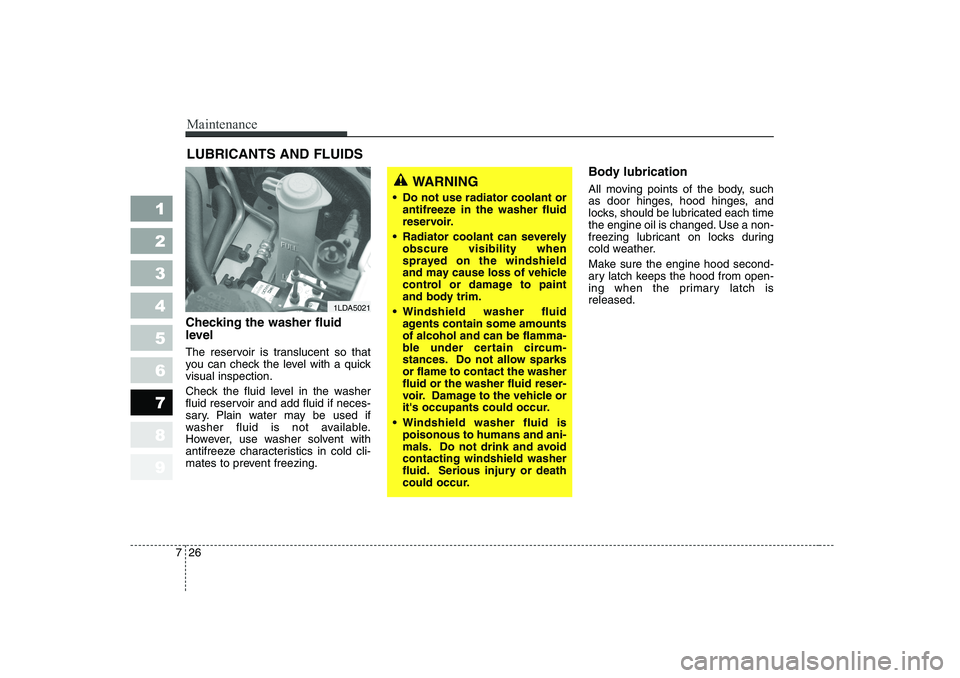
Checking the washer fluid
level
The reservoir is translucent so that
you can check the level with a quickvisual inspection.
Check the fluid level in the washer
fluid reservoir and add fluid if neces-
sary. Plain water may be used if
washer fluid is not available.
However, use washer solvent with
antifreeze characteristics in cold cli-
mates to prevent freezing. Body lubrication
All moving points of the body, such
as door hinges, hood hinges, and
locks, should be lubricated each time
the engine oil is changed. Use a non-
freezing lubricant on locks during
cold weather.
Make sure the engine hood second-
ary latch keeps the hood from open-
ing when the primary latch isreleased.
1LDA5021
WARNING
Do not use radiator coolant or antifreeze in the washer fluid
reservoir.
Radiator coolant can severely obscure visibility when
sprayed on the windshield
and may cause loss of vehicle
control or damage to paint
and body trim.
Windshield washer fluid agents contain some amountsof alcohol and can be flamma-
ble under certain circum-
stances. Do not allow sparksor flame to contact the washerfluid or the washer fluid reser-
voir. Damage to the vehicle or
it's occupants could occur.
Windshield washer fluid is poisonous to humans and ani-
mals. Do not drink and avoidcontacting windshield washer
fluid. Serious injury or death
could occur.