Page 74 of 467
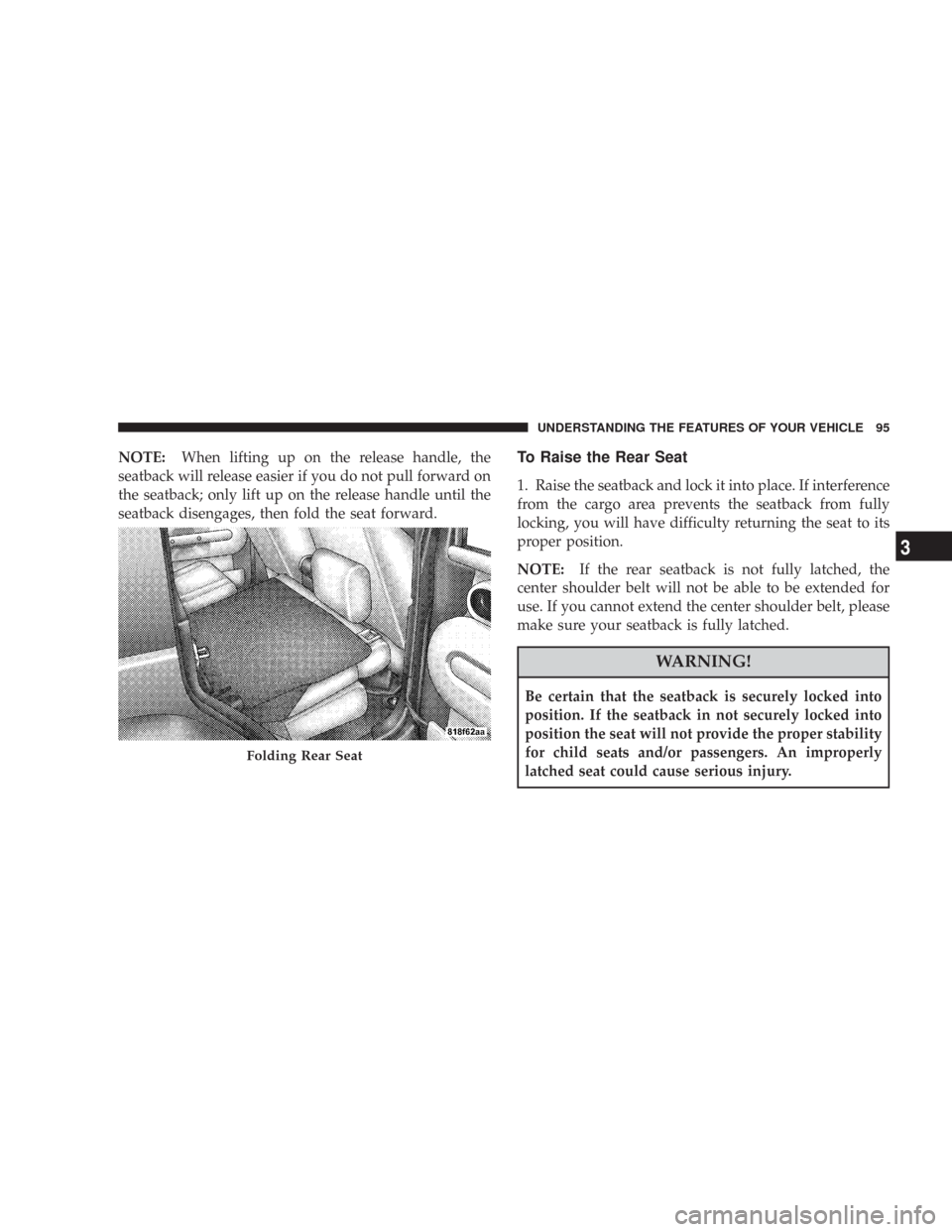
Many, but not all restraint systems will be equipped with
separate straps on each side, with each having a hook or
connector for attachment to the lower anchorage and a
means of adjusting the tension in the strap. Forward-
facing toddler restraints and some rear-facing infant
restraints will also be equipped with a tether strap, ahook for attachment to the tether strap anchorage and a
means of adjusting the tension of the strap.
You will first loosen the adjusters on the lower straps and
on the tether strap so that you can more easily attach the
hooks or connectors to the vehicle anchorages. Next
attach the lower hooks or connectors over the top of the
anchorage bars, pushing aside the seat cover material.
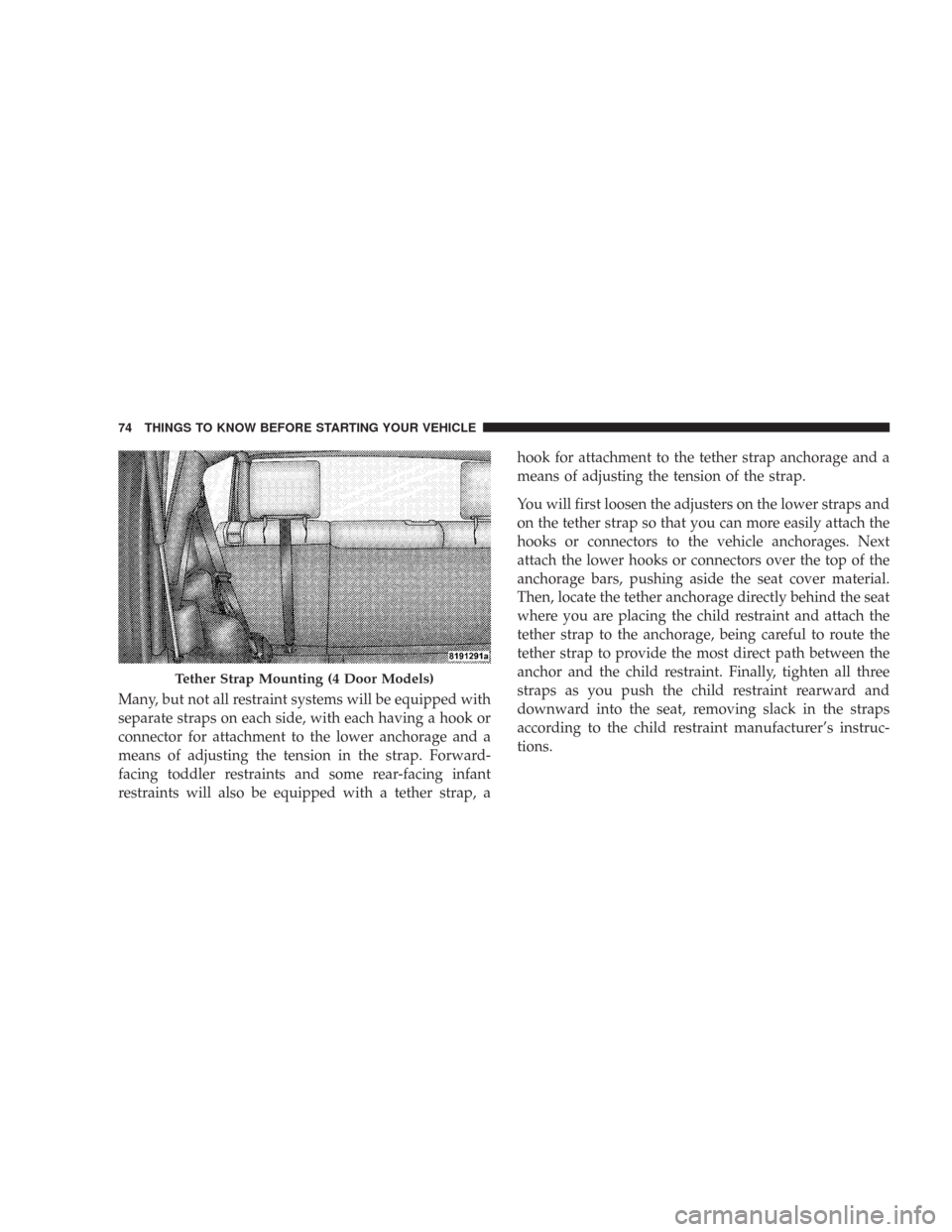
Then, locate the tether anchorage directly behind the seat
where you are placing the child restraint and attach the
tether strap to the anchorage, being careful to route the
tether strap to provide the most direct path between the
anchor and the child restraint. Finally, tighten all three
straps as you push the child restraint rearward and
downward into the seat, removing slack in the straps
according to the child restraint manufacturer’s instruc-
tions.
Tether Strap Mounting (4 Door Models)
74 THINGS TO KNOW BEFORE STARTING YOUR VEHICLE
Page 75 of 467

WARNING!
Improper installation of a child restraint to the
LATCH anchorages can lead to failure of an infant or
child restraint. The child could be badly injured or
killed. Follow the manufacturer’s directions exactly
when installing an infant or child restraint.
Installing Child Restraints Using the Vehicle Seat
Belt
The passenger seat belts are equipped with automatic
locking retractors, which are designed to keep the lap
portion tight around the child restraint so that it is not
necessary to use a locking clip. If the seat belt has a
cinching latch plate, pulling up on the shoulder portion
of the lap/shoulder belt will tighten the belt. Any seat
belt system will loosen with time, so check the belt
occasionally and pull it tight if necessary.If the seat belt has a automatic locking retractor, it will
have a distinctive label. Pull the belt from the retractor
until there is enough to allow you to pass through the
child restraint and slide the latch plate into the buckle.
Then, pull the belt until it is all extracted from the
retractor. Allow the belt to return to the retractor, pulling
on the excess webbing to tighten the lap portion about
the child restraint. Refer to “Automatic Locking Mode”
earlier in this section.
In the rear seat, you may have trouble tightening the
lap/shoulder belt on the child restraint because the
buckle or latch plate is too close to the belt path opening
on the restraint. Disconnect the latch plate from the
buckle and twist the short buckle-end belt several times
to shorten it. Insert the latch plate into the buckle with the
release button facing out.
If the belt still can’t be tightened, or if by pulling and
pushing on the restraint loosens the belt, you may need
THINGS TO KNOW BEFORE STARTING YOUR VEHICLE 75
2
Page 76 of 467
to do something more. Disconnect the latch plate from
the buckle, turn the buckle around, and insert the latch
plate into the buckle again. If you still can’t make the
child restraint secure, try a different seating position.
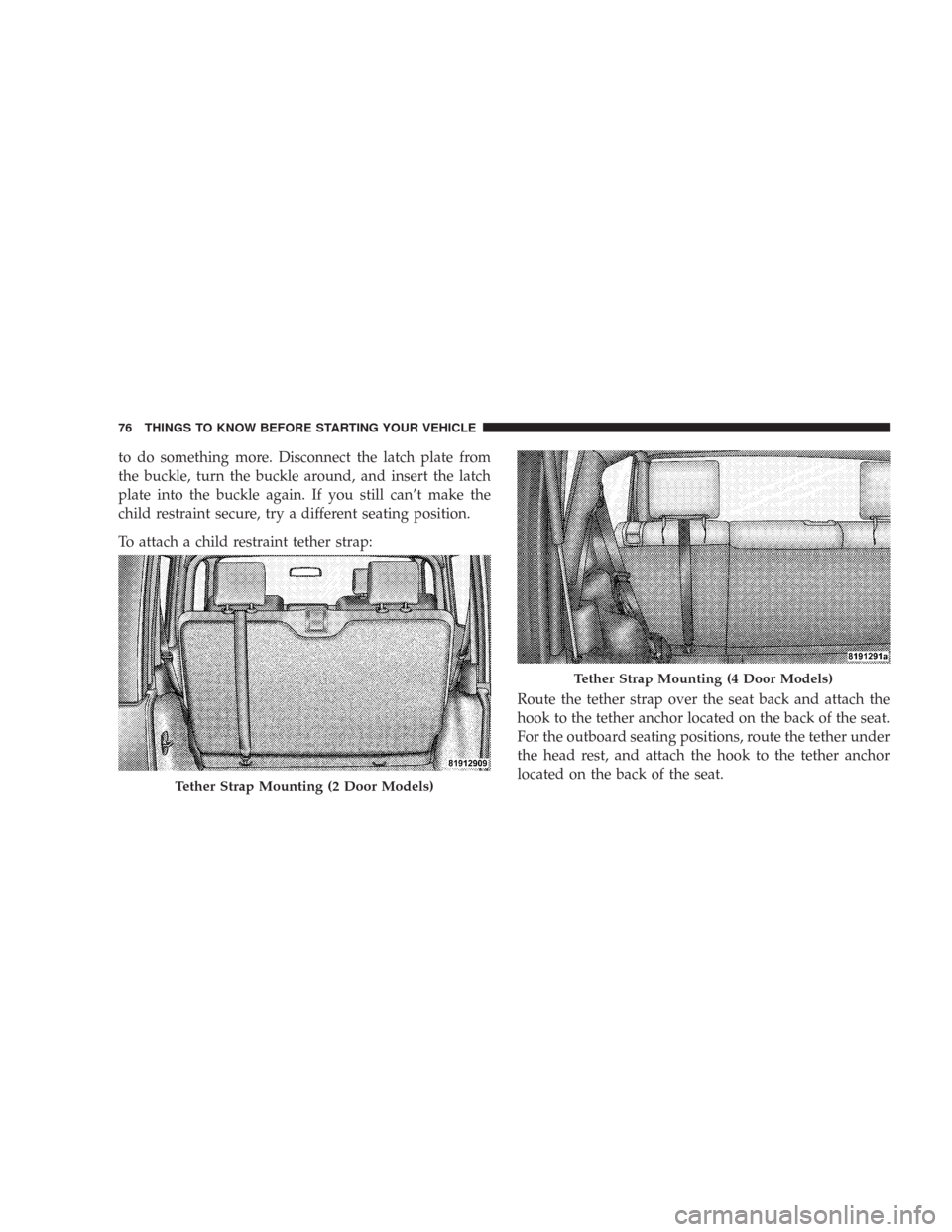
To attach a child restraint tether strap:
Route the tether strap over the seat back and attach the
hook to the tether anchor located on the back of the seat.
For the outboard seating positions, route the tether under
the head rest, and attach the hook to the tether anchor
located on the back of the seat.
Tether Strap Mounting (2 Door Models)
Tether Strap Mounting (4 Door Models)
76 THINGS TO KNOW BEFORE STARTING YOUR VEHICLE
Page 77 of 467
WARNING!
An incorrectly anchored tether strap could lead to
increased head motion and possible injury to the
child. Use only the anchor positions directly behind
the child seat to secure a child restraint top tether
strap.
Transporting Pets
Airbags deploying in the front seat could harm your pet.
An unrestrained pet will be thrown about and possibly
injured, or injure a passenger during panic braking or in
a collision.
Pets should be restrained in the rear seat in pet harnesses
or pet carriers that are secured by seat belts.
ENGINE BREAK-IN RECOMMENDATIONS
A long break-in period is not required for the engine in
your new vehicle.
Drive moderately during the first 300 miles (500 km).
After the initial 60 miles (100 km), speeds up to 50 or 55
mph (80 or 90 km/h) are desirable.
While cruising, brief full-throttle acceleration, within the
limits of local traffic laws, contributes to a good break-in.
Wide open throttle acceleration in low gear can be
detrimental and should be avoided.
The engine oil installed in the engine at the factory is a
high quality energy conserving type lubricant. Oil
changes should be consistent with anticipated climate
conditions under which vehicle operations will occur.
The recommended viscosity and quality grades are
shown in Section 7 of this manual. NON-DETERGENT
OR STRAIGHT MINERAL OILS MUST NEVER BE
USED.
THINGS TO KNOW BEFORE STARTING YOUR VEHICLE 77
2
Page 95 of 467
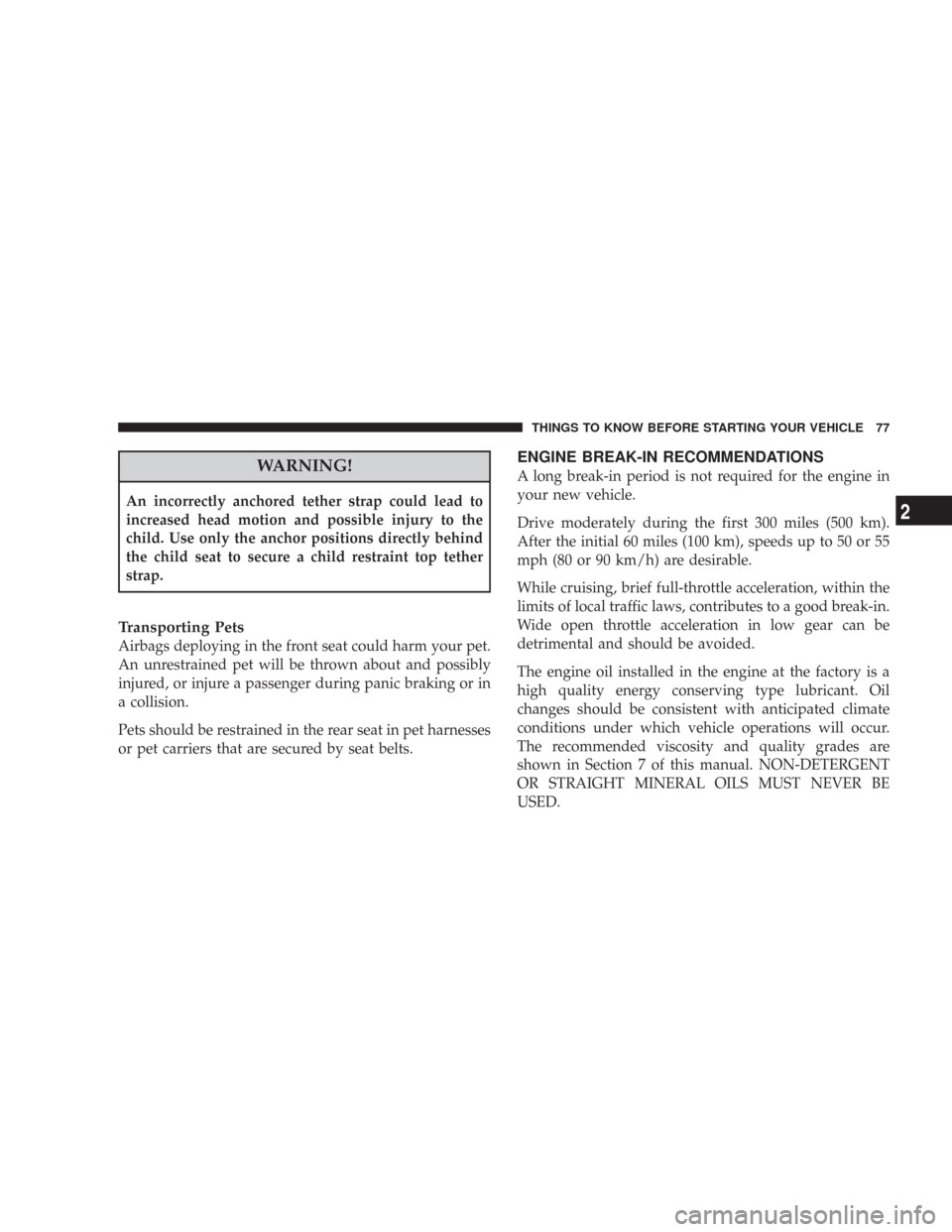
NOTE:When lifting up on the release handle, the
seatback will release easier if you do not pull forward on
the seatback; only lift up on the release handle until the
seatback disengages, then fold the seat forward.To Raise the Rear Seat
1. Raise the seatback and lock it into place. If interference
from the cargo area prevents the seatback from fully
locking, you will have difficulty returning the seat to its
proper position.
NOTE:If the rear seatback is not fully latched, the
center shoulder belt will not be able to be extended for
use. If you cannot extend the center shoulder belt, please
make sure your seatback is fully latched.
WARNING!
Be certain that the seatback is securely locked into
position. If the seatback in not securely locked into
position the seat will not provide the proper stability
for child seats and/or passengers. An improperly
latched seat could cause serious injury.
Folding Rear Seat
UNDERSTANDING THE FEATURES OF YOUR VEHICLE 95
3
Page 265 of 467

STARTING PROCEDURES
Before starting your vehicle, adjust your seat, adjust both
inside and outside mirrors, and fasten your seat belts.
WARNING!
Never leave children alone in a vehicle. Leaving
children in a vehicle unattended is dangerous for a
number of reasons. A child or others could be seri-
ously or fatally injured. Do not leave the keys in the
ignition. A child could operate power windows,
other controls, or move the vehicle.
Manual Transmission
Apply the parking brake, place the gearshift control lever
in N (Neutral) and depress the clutch pedal before
starting vehicle. This vehicle is equipped with a clutch
interlocking ignition system. It will not start unless the
clutch pedal is pressed to the floor.4WD Models Only
In 4L mode, this vehicle will start regardless of whether
or not the clutch pedal is pressed to the floor. This feature
enhances off-road performance by allowing the vehicle to
start when in 4L without having to depress the clutch
pedal. The “4WD Indicator Light” will illuminate when
the transfer case has been shifted into this mode.
Automatic Transmission
Start the engine with the selector lever in the N (Neutral)
or P (Park) position. Apply the brake before shifting to
any driving range.
Normal Starting
Normal starting of either a cold or a warm engine is
obtained without pumping or depressing the accelerator
pedal. Turn the key to the START position and release
when the engine starts. If the engine fails to start within
10 seconds, turn the key to the OFF position, wait 5
seconds, then repeat the normal starting procedure.
STARTING AND OPERATING 265
5
Page 452 of 467

Check Engine Light
(Malfunction Indicator Light).............208,366
Child Restraint....................64,65,71,75
Child Restraint Tether Anchors.............70,71
Child Seat.............................. 69
Climate Control......................... 252
Clock...........................219,235,246
Compact Disc (CD) Maintenance............. 251
Compass.............................. 211
Compass Calibration..................... 213
Console............................... 118
Console, Floor.......................... 118
Contract, Service........................ 442
Converter, Catalytic...................... 373
Cooling System......................... 380
Adding Coolant (Antifreeze).............. 382
Coolant Capacity...................... 412
Coolant Level......................... 384
Disposal of Used Coolant................ 383Drain, Flush, and Refill.................. 381
Inspection........................... 380
Points to Remember.................... 384
Pressure Cap......................... 383
Selection of Coolant (Antifreeze).........381,412
Temperature Gauge..................... 205
Corrosion Protection..................... 393
Crankcase Emission Control System.......... 375
Cruise Light........................... 205
Cup Holder............................ 117
Customer Assistance..................... 440
Data Recorder, Event...................... 62
Daytime Running Lights................... 101
Dealer Service.......................... 368
Defroster, Rear Window................... 195
Defroster, Windshield...............253,255,256
Delay (Intermittent) Wipers................. 101
Diagnostic System, Onboard................ 365
452 INDEX
Page 461 of 467

Radio, Navigation....................... 245
Radio Operation........................ 252
Radio, Satellite.......................246,247
Rear Axle (Differential).................... 392
Rear Swing Gate......................... 34
Rear Window Defroster................... 195
Rear Window Features.................... 193
Rear Wiper/Washer...................... 193
Rearview Mirrors........................ 85
Recorder, Event Data...................... 62
Recreational Towing...................... 346
Shifting into Transfer Case Neutral (N)....... 346
Shifting out of Transfer Case Neutral (N)..... 347
Reformulated Gasoline.................... 322
Refrigerant............................ 377
Release, Hood........................... 96
Reminder, Lights On..................... 100
Reminder, Seat Belt....................... 45Remote Control
Door Locks........................... 20
Remote Keyless Entry (RKE)................. 20
Replacement Bulbs....................... 408
Replacement Parts....................... 368
Replacement Tires....................... 314
Reporting Safety Defects................... 443
Restraint, Head.......................... 90
Restraints, Child.......................64,69
Restraints, Occupant...................... 36
Rotation, Tires.......................... 316
Safety Checks Inside Vehicle................. 79
Safety Checks Outside Vehicle............... 80
Safety Defects, Reporting.................. 443
Safety Information, Tire................... 300
Safety Tips............................. 78
Satellite Radio.......................246,247
INDEX 461
10